Chongqing Industrial Rooftop PV Retrofit — Pultruded FRP H-Rail Mounting on Colored Steel-Tile Roofs
Chongqing, China · 2024
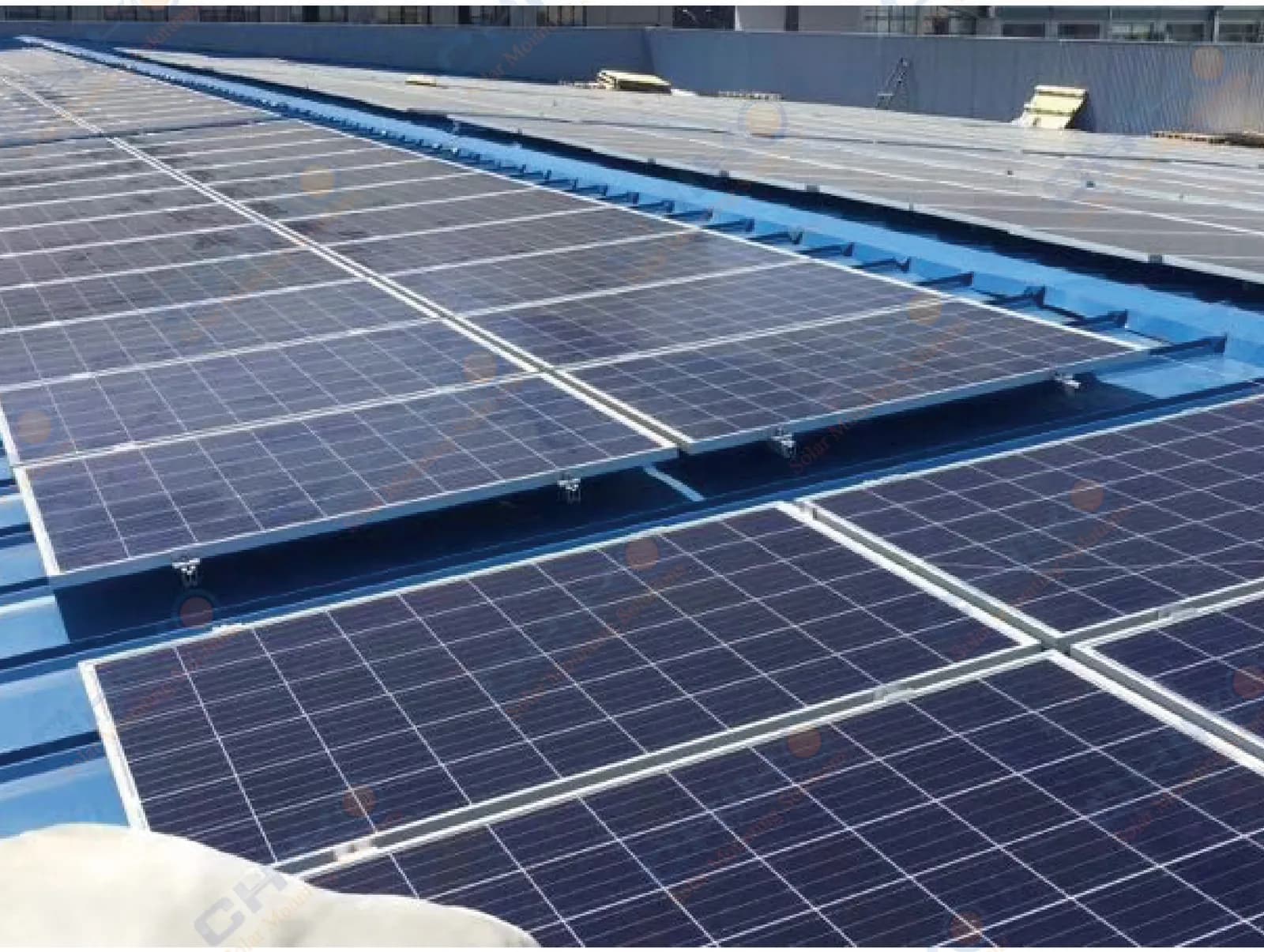
FRP rooftop solar mounting project overview
This energy case study documents an F1 Composite project in Chongqing, China, delivered in 2024. The supplied scope used Custom Pultrusions, Standard Profiles to address the stated project constraints, with the challenge, engineered solution, measured delivery outcomes, and related product paths recorded below.
Project challenge — FRP rooftop solar mounting
An industrial-park owner in Chongqing committed in 2024 to retrofit rooftop photovoltaic arrays onto a group of existing factory buildings, with the dual aim of reducing campus carbon emissions and generating revenue from unused roof area. Two project-specific constraints made conventional galvanized-steel and aluminum PV-rail systems a poor fit. The first is structural reserve. The factory buildings were originally designed for a generic-industrial roof live load of about 0.5 kN/m² — the prevailing Chinese pre-2012 industrial-roof reserve — with no provision for the added permanent dead load of a PV array. A modern monocrystalline module installation with conventional galvanized-steel rail adds in the order of 15 – 20 kg/m² of permanent load once panels, rail, clamps, and ballast are included. That is a meaningful fraction of the original roof's live-load reserve, and the structural-review consultant flagged it as the binding constraint on retrofit feasibility. The owner needed a rail system materially lighter than galvanized steel, ideally lighter than aluminum too, to keep roof loading inside the as-designed reserve without commissioning a structural-reinforcement scope that would have eliminated the project's payback case. The second constraint is the rooftop environment. Chongqing is a humid sub-tropical city — annual humidity above 80 %, frequent dew condensation (Chongqing is locally known as the Fog City), and ambient acid-rain exposure from the Yangtze River basin's industrial corridor. On a colored steel-tile industrial roof, the daytime surface temperature can exceed 70 °C in summer and drop near freezing in winter, with hundreds of daily thermal cycles across the rail-roof interface. Galvanized steel rail in that environment is subject to accelerated zinc loss and requires a coating-renewal cycle on a 5 – 8 year schedule — uneconomic across a PV asset designed for 25-year operation, and operationally awkward because every coating renewal demands taking the panel rows off the rail. Aluminum rail solves the corrosion side but pits at the anodized surface in the acid-rain humidity profile and forms a galvanic couple with the stainless-steel clamp fasteners and the copper grounding wire.
F1 Composite solution — FRP rooftop solar mounting
F1 Composite supplied pultruded glass-fiber-reinforced polymer (GFRP) H-section composite rail from FengDu's Yancheng facility for the Chongqing rooftop PV retrofit, paired with a matched accessory kit covering mid-clamps, end-clamps, splice plates, and Jiaochi-type roof clamps that engage the standing seams of the existing colored steel-tile roof without penetrating the roof membrane. The pultruded H-rail addresses both project constraints through one material decision. On the structural-reserve side, the GFRP composite rail has a density of about 1.9 g/cm³ against carbon steel at 7.85 g/cm³ and aluminum 6063 at 2.70 g/cm³. In a typical rooftop PV layout the rail line-mass drops from 4 – 6 kg per linear meter for galvanized steel C-section, or 1.5 – 2.5 kg/m for aluminum extrusion, to roughly 1.0 – 1.5 kg/m for the pultruded GFRP H-rail — roughly three-quarters off the rail's contribution to roof dead load compared to galvanized steel. Across a typical 1 MW rooftop array spanning around 2,000 linear meters of rail, that translates to roughly 7 – 10 tonnes of dead load removed against a steel-rail baseline. The roof's as-designed live-load reserve is preserved, the structural-reinforcement scope is taken off the project critical path, and the PV addition becomes structurally feasible without re-engineering the building. On the rooftop weather-exposure side, GFRP pultruded rail does not anodize, does not pit, does not require a zinc-renewal cycle, and does not form a galvanic couple with the stainless-steel clamp fasteners or the copper grounding wire that runs alongside the array. The accessory kit was finalized across two production batches to match the project's installation sequence, with a published clamp-and-bolt schedule (M6 × 12 for rail splices, M8 × 25 for mid- and end-clamps and T-bolts, M8 × 30 for Jiaochi roof clamps) that matched the installer's standard rooftop kit. Profiles were factory-cut to length at the F1 Yancheng line and palletized in rail-direction sequence for direct ground-level rooftop hoisting.
Results and impact — FRP rooftop solar mounting
The Chongqing factory rooftop retrofit completed its PV-array commissioning inside the as-designed roof live-load reserve, without a structural-reinforcement scope and without taking the original factory roof off operation. The pultruded GFRP H-rail delivered the two performance contributions the project specification had originally been split across two competing rail materials: weight reduction first, and rooftop weather durability second. On the weight-reduction side, the GFRP rail line-mass at roughly 1.0 – 1.5 kg/m against the galvanized-steel baseline of 4 – 6 kg/m removed roughly 75 % of the rail's contribution to the array's permanent dead load — the structural reserve calculation closed comfortably inside code. On the rooftop weather side, the GFRP rail eliminates the recoating cycle that would otherwise have required taking the array panels off the rail every 5 – 8 years for zinc renewal under galvanized steel, and eliminates the pitting/galvanic-couple maintenance burden that an aluminum-rail specification would have inherited under the local humidity and acid-rain profile. For F1 Composite, the project validates the pultruded GFRP rail system in the rooftop-PV retrofit segment where structural reserve and weather durability are jointly binding constraints. The rooftop-retrofit segment is one of the largest single addressable PV growth markets in China through 2030 — and the structural-reserve constraint that limited rooftop PV uptake under steel-rail assumptions is a constraint the GFRP rail materially relaxes.
Have a similar project to Chongqing Industrial Rooftop PV Retrofit?
Open the FRP Engineering Advisor with this case study loaded as context. Ask about specs, profile families, resin selection, or how to build your own RFQ.
Pre-filled question: “I'm looking at the F1 Composite case study "Chongqing Industrial Rooftop PV Retrofit — Pultruded FRP H-Rail Mounting on Colored Steel-Tile Roofs" in Chongqing, China (/case-studies/solar-farm-mounting). What materials, profile families, resin systems, and standards drove this project — and what would I need to provide for a similar RFQ?”
Interested in a similar solution?
Send the dimensions, quantity, service environment, and destination. Engineering responds within one business day.