The fiberglass pultrusion process, step by step
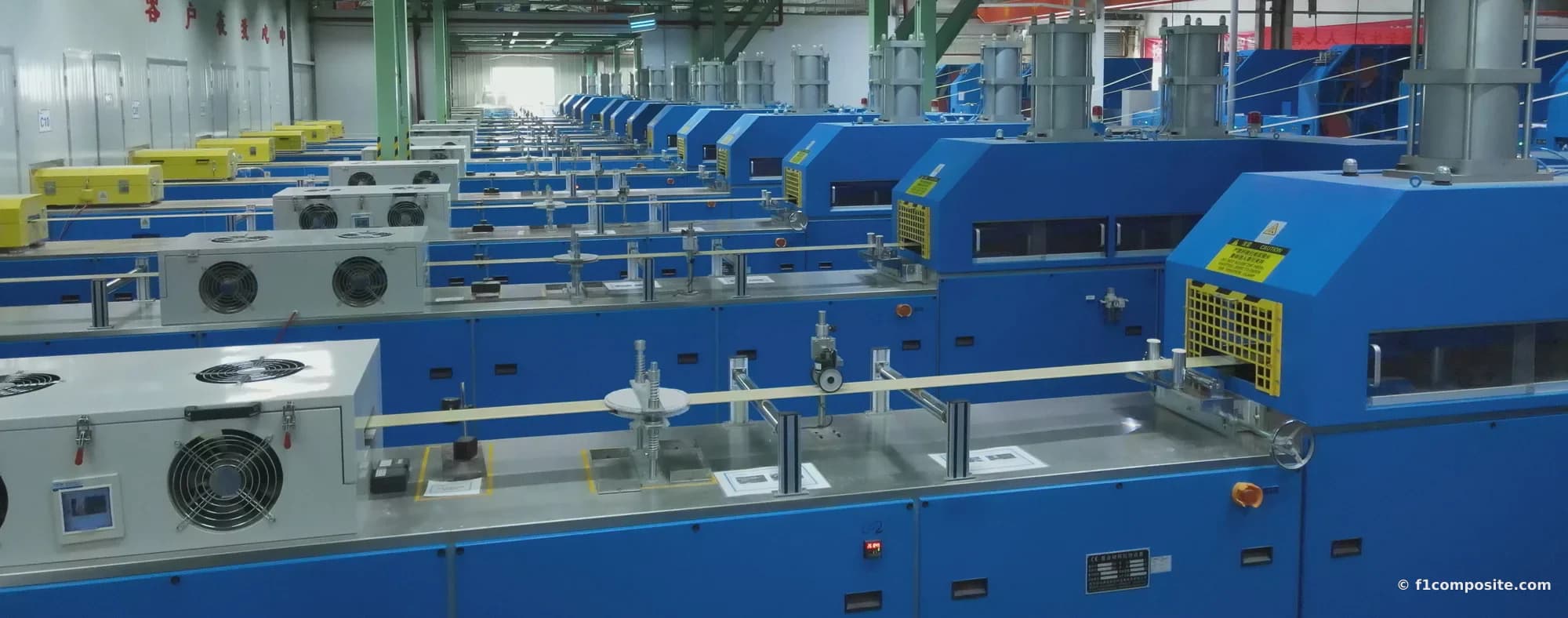
Pultrusion is a continuous process: glass or carbon fiber rovings and mats are pulled through a resin bath or injection chamber, then through a steel die heated to about 120–180 °C, where the resin cures into a profile of constant cross-section. A puller draws the cured profile at 0.3–1.5 m/min, and a flying saw cuts it to length without stopping the line. Fiber makes up 60–70% of the profile by volume, which gives pultruded sections high strength along their length.
The six stages of pultrusion
Conceptual injection pultrusion line with simplified proportions. Heating, pressure and line speed depend on the material and profile. Select a numbered station to read about that stage below.
Stage 1
Fiber creel
50–300+ spools of continuous fiber roving organized on a steel rack
- Fibers
- E-glass, ECR-glass, carbon, aramid
- Reinforcements
- Roving, CFM, multi-axial fabrics
- Tension
- Spring/pneumatic tensioners
How it worksShow less
The creel rack holds 50 to over 300 spools of continuous fiber roving configured to deliver the precise number and type required by the profile design. For complex shapes, the creel also supplies continuous filament mat (CFM) or stitched multi-axial fabrics for off-axis strength.
Proper creel tension management is critical. Each roving must pay out at consistent tension to prevent dry spots (under-tensioned) or fiber breakage (over-tensioned). Modern systems use spring-loaded or pneumatic tensioners to maintain even pay-off as spool diameters decrease.
Stage 2
Guide plate
Precision cards with ceramic-lined eyelets arrange fibers into the correct spatial configuration
- Function
- Spatial arrangement + pre-tensioning
- Material
- Ceramic-lined eyelets/slotted channels
- Routing
- More rovings to flanges, fewer to web
How it worksShow less
Fiber rovings and fabric reinforcements pass through precision-machined guide plates that arrange the fibers into the spatial configuration required by the die cross-section and pre-tension the fiber bundle to prevent tangling.
For profiles with multiple wall thicknesses (such as an I-beam with thick flanges and a thinner web) the guide plate routes more rovings to flange zones and fewer to the web, ensuring uniform fiber volume fraction throughout the cross-section.
Stage 3
Resin impregnation
Fibers are fully wetted with thermoset resin via injection or open-bath
- Method
- Injection (standard) or open-bath
- Injection pressure
- 3–8 bar
- Ratio control
- ±1% of target (injection)
How it worksShow less
Every fiber filament must be completely wetted by the resin system: any dry fibers create internal voids that reduce mechanical strength and durability. In injection systems, resin is injected under controlled pressure (3–8 bar) into a sealed chamber at the die entrance. This achieves near-zero emissions, minimal waste, and ±1% resin-to-fiber ratio control.
Open-bath systems submerge fibers in a resin trough: simpler and lower cost, but with higher styrene emissions and ±3–5% ratio control. Injection pultrusion is our standard process.
Stage 4
Heated die
Chrome-plated steel die at 120–180 °C cures the resin and forms the profile shape
- Die length
- 600–1200 mm
- Temperature
- 120–180 °C typical, 3-zone control
- Accuracy
- ±2 °C across all zones
How it worksShow less
The resin-impregnated fiber bundle enters a precision-machined, chrome-plated steel die whose internal cavity defines the profile cross-section. The die has three independently controlled temperature zones: entry (100–130 °C to initiate cure), center (140–170 °C to complete cure), and exit (150–180 °C for controlled shrinkage release).
The exothermic peak temperature inside the profile must be carefully managed. If it runs too high, the resin develops internal stresses that cause surface crazing. Our dies incorporate thermocouple ports at multiple depths for real-time core temperature monitoring.
Stage 5
Pull mechanism
Reciprocating clamp or caterpillar puller draws the cured profile at 0.3–1.5 m/min
- Pull speed
- 0.3–1.5 m/min (typical)
- Max pull force
- Up to 100 kN
- Control
- Servo-driven, ±0.5% accuracy
How it worksShow less
Two types of puller are used: reciprocating clamp pullers (hydraulic, for large profiles requiring up to 100 kN pull force) and caterpillar belt pullers (smoother, vibration-free, preferred for thin-walled profiles).
Pull speed determines the residence time inside the heated die and controls the degree of cure. Thick-walled profiles run at 0.3 m/min (longer heat penetration time), while small shapes reach 1.5 m/min. Our servo-driven pullers maintain ±0.5% speed accuracy.
Stage 6
Cut-off
Flying saw cuts continuous profile to length without stopping the line
- Blade
- Diamond/carbide-tipped, wet cutting
- Accuracy
- ±0.5 mm
- Post-cut
- Label, inspect, measure, package
How it worksShow less
A flying cut-off saw travels with the profile during the cutting stroke to maintain continuous production. Diamond-tipped blades cut through the abrasive composite; wet cutting with coolant suppresses dust and extends blade life.
After cutting, profiles are labeled, inspected for visual defects per ASTM D4385, measured for dimensional compliance, and staged for packaging or secondary fabrication (drilling, routing, bonding, painting).
Injection vs open bath
| Parameter | Injection (our standard) | Open bath |
|---|---|---|
| VOC emissions | Near zero | High |
| Resin ratio control | ±1% | ±3–5% |
| Resin waste | Minimal | 5–10% |
| Surface finish | Excellent | Good |
| Capital cost | Higher | Lower |
| Resin compatibility | Polyester, VE, epoxy, PU | Polyester, VE |
| Changeover time | 30–60 min | 15–30 min |
| Operator exposure | Minimal | Significant |
Production line specifications
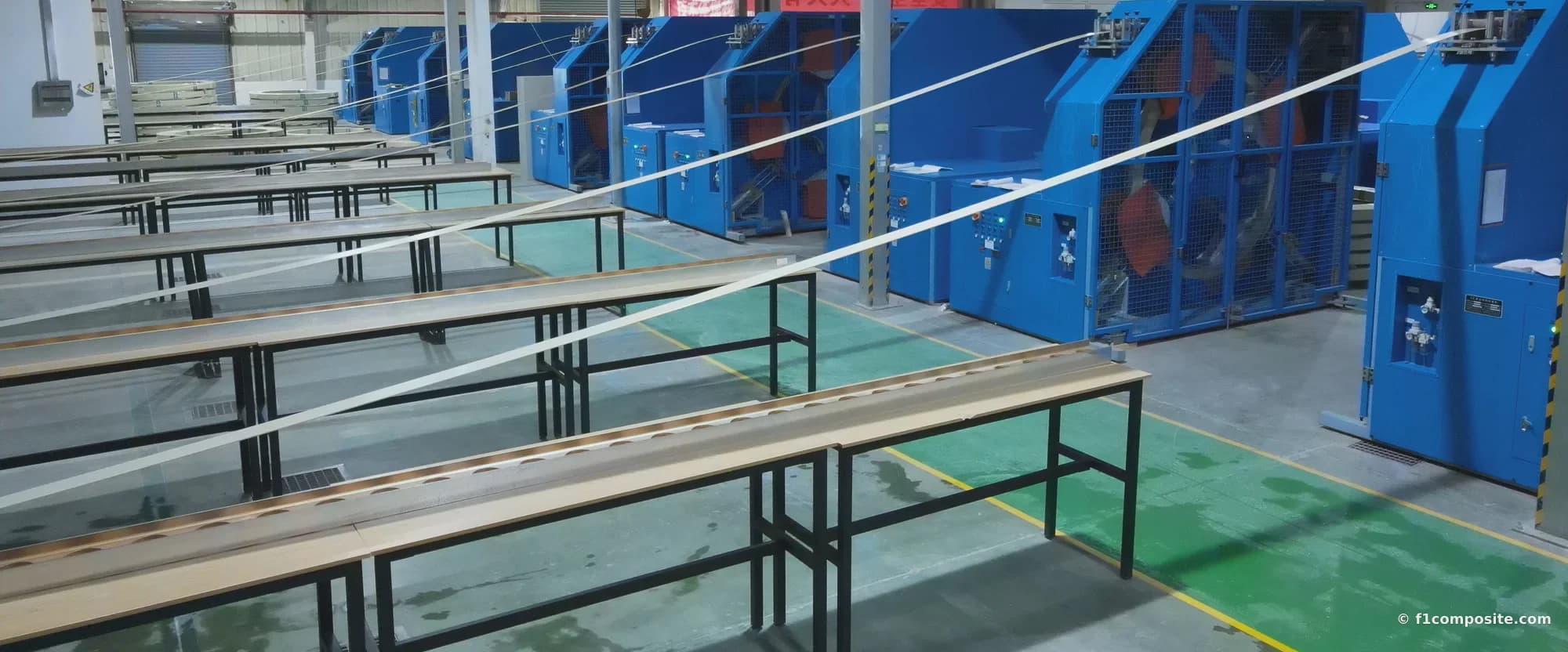
Line speed range
0.2–2.0 m/min
Servo-controlled, ±0.5% accuracy
Die heating range
100–200 °C
Three independent zones, ±2 °C
Maximum pull force
Up to 100 kN
Hydraulic clamp puller
Profile envelope
500 × 100 mm
Width × depth bounding rectangle
Minimum wall
1.5 mm
With CFM reinforcement
Fiber volume range
55–72%
Depends on geometry and resin
Injection pressure
3–8 bar
Closed-loop pressure regulation
Cut-off accuracy
±0.5 mm
Flying saw with automatic tracking
How the process parameters are controlledShow less
Every production run is governed by a validated recipe specifying exact values for pull speed, die zone temperatures, injection pressure, and resin mix ratios. Recipes are stored digitally and version-controlled; any parameter change triggers a formal engineering change order (ECO) with re-validation testing.
Real-time statistical process control (SPC) monitors key parameters at one-second intervals against control limits. If any parameter drifts outside its control band, the system generates an immediate alert and can automatically pause the puller for critical deviations.
Frequently asked questions
What is pultrusion?
Pultrusion is a continuous manufacturing process for producing fiber-reinforced polymer (FRP) composite profiles with a constant cross-section. The term combines 'pull' and 'extrusion': reinforcing fibers are pulled through a resin bath and then through a heated steel die where the resin cures, forming a rigid structural profile.
How does the pultrusion process work step by step?
The pultrusion process follows six sequential stages: (1) fiber creel, where fibers are dispensed from the roving rack; (2) guide plate, which arranges the fibers in position; (3) resin impregnation, by injection or an open bath; (4) heated die, where the resin cures at 120–180 °C; (5) pull mechanism, which draws the cured profile at 0.3–1.5 m/min; (6) cut-off, where a flying saw cuts it to length.
What is the difference between injection and open-bath pultrusion?
In open-bath pultrusion, fibers pass through an open resin trough. In injection pultrusion, resin is injected into a sealed chamber under 3–8 bar pressure. Injection offers near-zero VOC emissions, ±1% resin ratio control, less waste, and better surface finish. Open-bath is simpler and lower in capital cost.
What types of fibers and resins are used?
Fibers: E-glass (most common), ECR-glass (chemical resistance), carbon (stiffness), aramid (impact). Resins: isophthalic polyester (general structural), vinyl ester (chemical/corrosion resistance), epoxy (highest properties, carbon fiber), polyurethane (high toughness, fast cure).
What are the advantages of pultrusion over hand lay-up or filament winding?
Pultrusion is the most cost-effective method for constant-cross-section profiles: continuous, highly automated, 60–70% fiber volume fraction (vs 30–45% for hand lay-up). Hand lay-up suits complex one-off shapes. Filament winding suits hollow rotational parts (pipes, tanks) but cannot produce open shapes like I-beams or channels.
Ready to discuss your pultrusion requirements?
Send the dimensions, quantity, service conditions and destination. We reply within one business day.