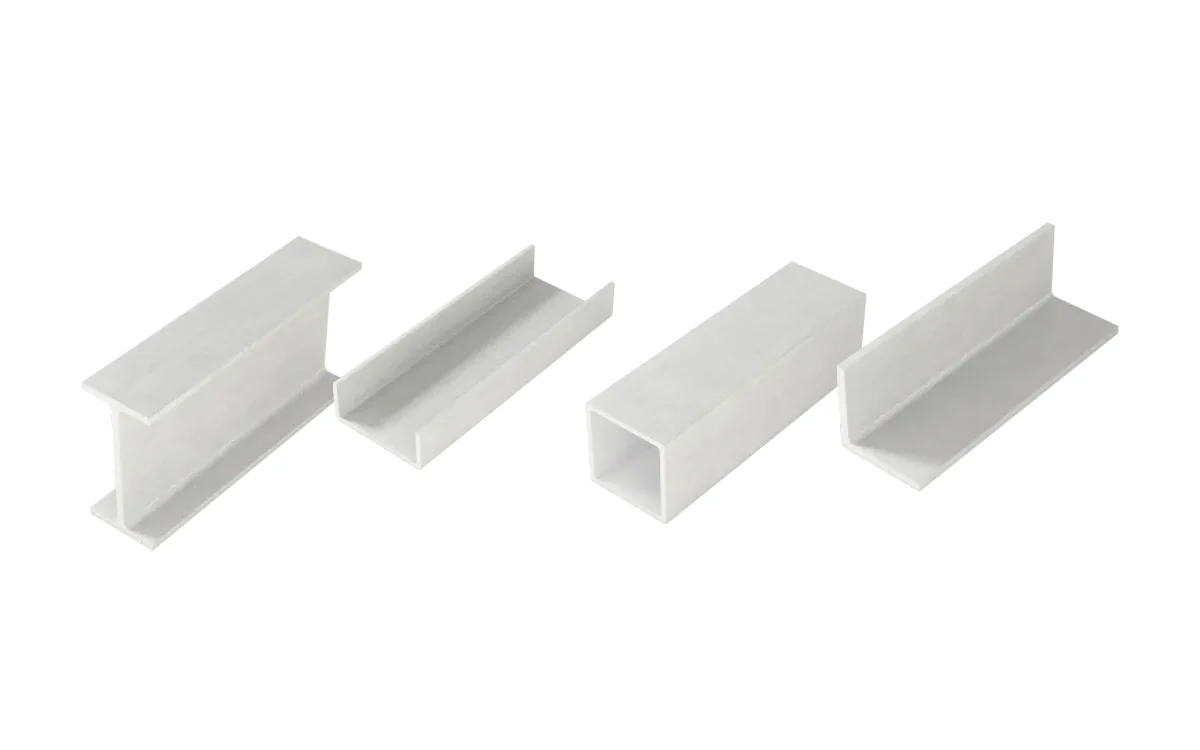
 Choose a standard structural shapeCompare 114 cataloged I-beams, channels, angles, tubes, rods, and flat bars with dimensions, weights, and section data.Browse standard FRP profiles
 FRP Guide
What is FRP? Definition, materials, properties, and uses
FRP means fiber reinforced polymer or plastic. Glass-reinforced FRP is called GFRP or GRP; carbon-reinforced FRP is CFRP. Compare the terminology, composition, properties, applications and design limits before selecting a material.
Last updated
Browse FRP ProfilesRequest Engineering ReviewWhatsApp
Already have dimensions or a drawing? Send the section, quantity, environment, and destination.
What is glass fiber reinforced plastic?
FRP definition: FRP (fiber-reinforced polymer or fiber-reinforced plastic) is a composite material made from reinforcing fibers—most commonly glass—embedded in a polymer resin. The fibers provide strength and stiffness, while the resin binds and protects them. Glass-fiber FRP is also known as GFRP, GRP, or fiberglass-reinforced plastic.
FRP (fiber reinforced polymer) is a structural composite material that combines two constituents: a thermoset polymer resin matrix (polyester, vinyl ester, polyurethane, phenolic, or epoxy) and a high-performance fiber reinforcement (typically E-glass, also called fiberglass). The fibers carry the mechanical load; the resin transfers the load between fibers and protects them from the environment.
The resulting fiberglass reinforced polymer is lighter than aluminum, stronger per kilogram than steel, immune to rust, electrically non-conductive, and thermally insulating. FRP composites are used wherever corrosion, weight, electromagnetic transparency, or thermal efficiency is critical — from chemical plant platforms and offshore grating to FRP windows and doors for passive-house buildings and pedestrian bridges.
When the FRP is produced by the pultrusion process, it is called pultruded FRP. The full F1 Composite pultruded product range is documented on the pultruded FRP profiles hub.
Turn FRP research into a specification
The right next page depends on whether the geometry is standard, custom, or already defined for quotation. Choose the shortest path to the dimensions, engineering input, or commercial response you need.
- Choose a standard structural shapeCompare 114 cataloged I-beams, channels, angles, tubes, rods, and flat bars with dimensions, weights, and section data.Browse standard FRP profiles
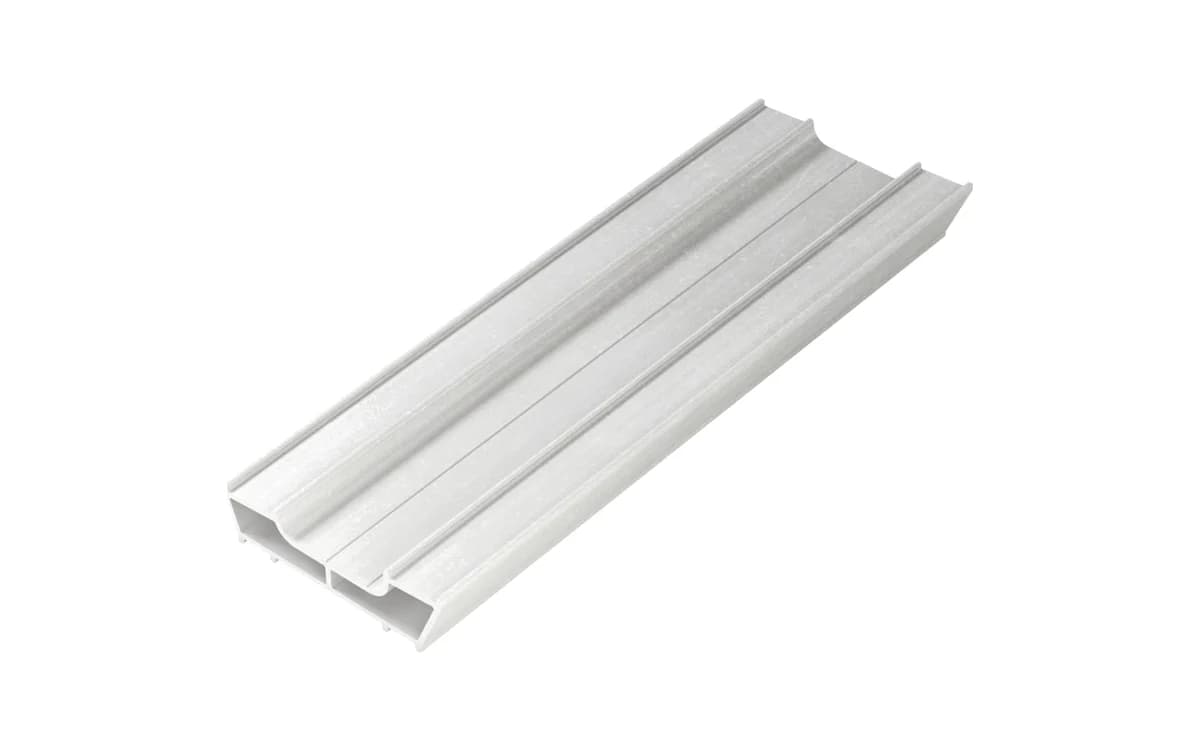 Develop a custom pultrusionTake a project-specific cross-section from geometry and resin selection through tooling, sample approval, and repeat production.Explore custom pultrusion
 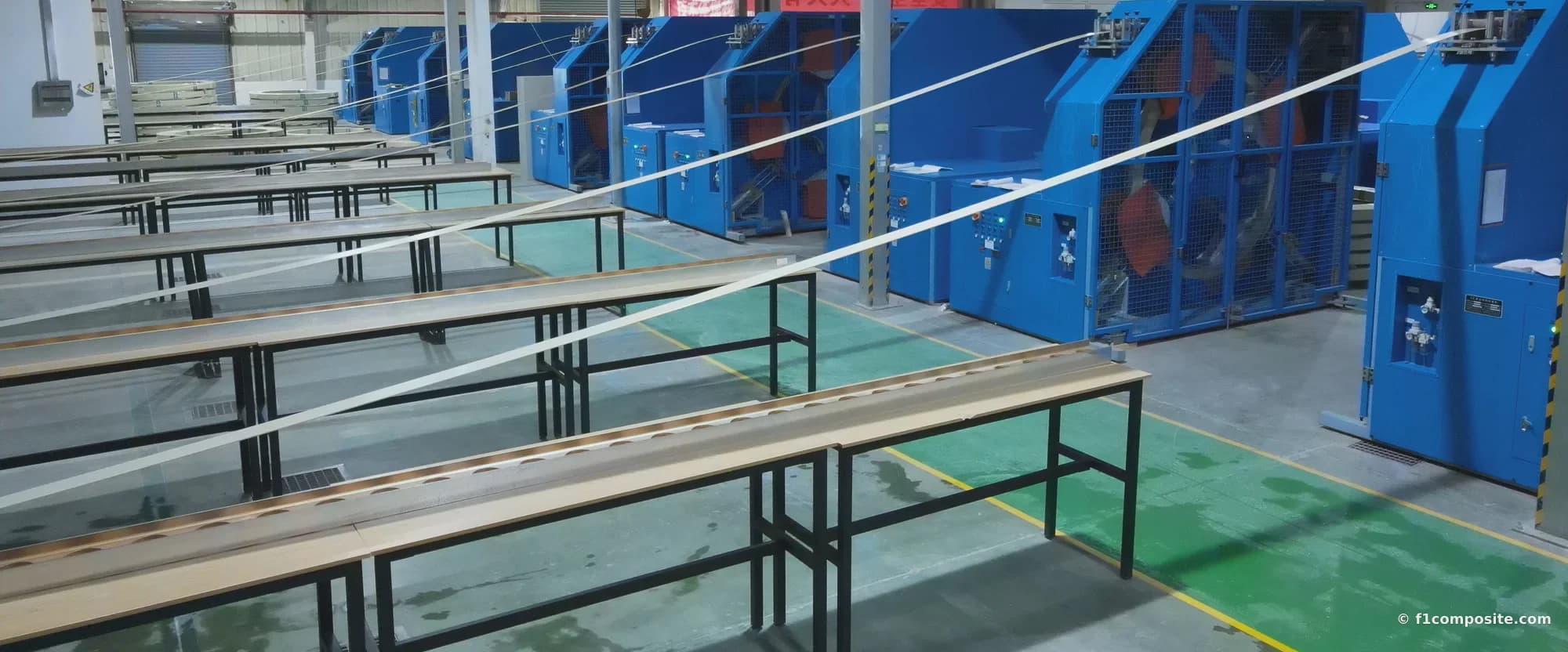 Production photoPrice a defined requirementSend the section, quantity, service environment, and destination for an engineering review and a scoped export quotation.Request a project quote
FRP vs fiberglass: what is the difference?
FRP is the material family; fiberglass describes glass fibers or a glass-reinforced product. Glass fibers combined with a polymer resin make GFRP, also called GRP. Carbon-fiber reinforced polymer is FRP too, but it is not fiberglass. In a supplier catalog, a fiberglass tube commonly means a finished glass-and-resin composite tube.
FRP
Fiber-reinforced polymer (or plastic). The reinforcement and resin must still be specified.
GFRP / GRP
The glass-reinforced part of the FRP family. These names do not set a strength, resin or fire rating.
Fiberglass
May refer to glass fiber itself or a finished composite. Read the product description to identify which.
Buying a fiberglass product?
Match the shape, resin, reinforcement, dimensions and service conditions. A structural tube, solid sheet and pressure pipe need different specifications even when all are described as FRP.
GRP vs FRP: terminology and regional buying language
Same material family, different labels: glass fiber reinforced plastic is the glass-reinforced subset of FRP. GFRP and GRP identify the same glass-and-resin composite, while fiberglass can mean either the reinforcement itself or the finished product. “Polymer” is the more precise matrix term; “plastic” remains common in specifications and search.
United States
Supplier catalogs often lead with fiberglass structural shapes or FRP. In material specifications, GFRP makes the glass reinforcement explicit.
United Kingdom & European suppliers
GRP profiles, GRP grating and glass fibre are common English-language terms. GRP sections and fiberglass structural shapes can describe the same glass-reinforced product family.
Australia & India
FRP and GRP appear together in supplier catalogs. Moulded and molded are spelling variants; neither changes the panel construction or its load rating.
These are naming patterns, not separate material grades. For a like-for-like quote, match reinforcement, resin, dimensions, load case and test requirements. Browse our FRP and GRP profiles, pultruded GRP grating or moulded GRP grating for product-specific data.
Examples of supplier terminology: Strongwell (US), Fibrolux (Europe), Terra Firma (Australia) and Satyam (India).
The terminology around fiber composites is regional and often overlapping. In engineering practice:
- FRP
- Fiber Reinforced Polymer. An umbrella term used internationally. Can use glass, carbon, aramid, or basalt fibers.
- GRP / GFRP
- Glass Reinforced Plastic / Glass Fiber Reinforced Polymer (or Plastic). Both identify glass reinforcement; neither describes carbon-fiber FRP. GRP is common in UK and European supplier literature, while Australian and Indian suppliers also use FRP and GRP together.
- Glass fiber reinforced plastic
- the full form of GFRP in specifications that use “plastic” for the cured resin matrix. It is also written fiberglass reinforced plastic.
- Fiberglass
- Informal North American term. Refers either to the raw E-glass fiber or to the finished glass-FRP composite.
- Composites
- Umbrella term for any material combining two or more constituents. In structural use, usually means continuous-fiber FRP.
- Advanced composites
- Composites with engineered fiber architectures and controlled fiber fractions (≥ 50% by weight). Pultruded FRP profiles qualify.
- Pultruded composites / pultruded profiles
- FRP composites manufactured by the pultrusion process: the focus of F1 Composite.
What is inside a pultruded FRP profile?
Reinforcement (60–70% by weight)
- E-glass roving — unidirectional fiber bundles carrying axial load. The dominant reinforcement by mass.
- Continuous strand mat (CSM) — randomly oriented glass mat that adds transverse strength and through-thickness integrity.
- Woven roving / biaxial fabric — used in custom profiles requiring balanced in-plane stiffness.
- Surfacing veil — polyester or C-glass veil that gives a resin-rich, UV-stable outer surface. Typically 0.2–0.4 mm thick.
- ECR-glass / carbon / basalt / aramid — optional reinforcements for enhanced corrosion resistance, high modulus, or specialty requirements.
Polymer matrix (30–40% by weight)
- Isophthalic polyester — general structural use. Best cost / performance balance.
- Vinyl ester — superior chemical, chloride, and hydrolysis resistance. Preferred for marine and chemical environments.
- Polyurethane (PU) — 3–5× the flexural toughness of polyester; fast cure; used in rail interiors and EV battery trays.
- Phenolic — low smoke and toxicity in fire; used where rail (EN 45545-2) or building fire classes govern, with a report for the specified formulation.
- Epoxy — highest mechanical properties; specified when tensile or fatigue requirements approach steel equivalents.
- Additives — UV stabilizers, flame retardants, pigments, release agents, and catalysts (MEKP for polyester; BPO for vinyl ester).
How is FRP made? Six processes at a glance
Glass fiber and resin can be formed by several processes. Pultrusion produces constant-section profiles; molded grating and other shaped parts use different routes. These simplified loops illustrate material flow and tool motion, with each batch process resetting for a new part.
- Our process · 370 lines
Pultrusion
Continuous fibers pulled through a resin bath or injection box and a heated die, making constant cross-sections at industrial throughput. It is the process behind every F1 profile, from I-beams to PHI-certified window frames.
See the process step by step Filament winding
Continuous fibers wound helically around a rotating mandrel: the route to pipes, tanks and pressure vessels.
How it compares vs pultrusionCompression molding (SMC/BMC)
Pre-compounded sheet or bulk charge pressed in a heated matched die, for high-volume parts like enclosures and covers.
Hand lay-up
Fabric laid into an open mold and wetted out by hand roller: low tooling cost, for one-off and large parts.
Vacuum infusion
A dry fabric stack under a vacuum bag, with resin drawn through by vacuum, for boat hulls, blades and large panels.
RTM (resin transfer molding)
Resin injected into a closed matched mold under pressure: two finished faces, for mid-volume structural parts.
How pultruded FRP is made
Pultrusion is a continuous, automated process that produces constant-cross-section FRP profiles. Invented in the 1950s and standardized in the 1970s, it is now the dominant manufacturing route for structural FRP shapes worldwide.
Step 1
Creel
Thousands of E-glass roving packages are fed from a creel frame, aligned in the longitudinal direction.
Step 2
Resin impregnation
Fibers are pulled through an open resin bath or closed injection chamber, fully wetted with liquid thermoset resin.
Step 3
Pre-former
Impregnated fibers pass through guide plates that compact the material into the required cross-section geometry.
Step 4
Heated die
The compacted fiber/resin bundle enters a heated steel die (typically 120–180 °C) where the resin cures.
Step 5
Pullers
Reciprocating or caterpillar pullers draw the cured profile at 0.3–1.5 m/min, providing the continuous 'pulling' action that names the process.
Step 6
Cut-off
A synchronized flying saw cuts profiles to length — typically 6 m or 12 m for shipping — and they are stacked for inspection.
Custom die lead time
Creating a new custom profile typically takes 6–10 weeks total:
- Cross-section design & approval1–2 weeks
- Steel die manufacturing3–6 weeks
- Trial run & sample approval1 week
- First production batch1–2 weeks
Mechanical and physical properties of pultruded FRP
Typical values for E-glass / isophthalic-polyester pultruded structural profiles at 23 °C. Properties are directional — the table below gives longitudinal (L) values unless noted. Vinyl ester and polyurethane systems provide 10–25% higher strength.
| Property | Value | Test standard |
|---|---|---|
| Density | 1.8–2.1 g/cm³ | — |
| Tensile strength (L) | 240–400 MPa | ASTM D638 |
| Tensile modulus (L) | 17–28 GPa | ASTM D638 |
| Flexural strength (L) | 200–350 MPa | ASTM D790 |
| Flexural modulus (L) | 12–20 GPa | ASTM D790 |
| Compressive strength (L) | 200–300 MPa | ASTM D695 |
| Interlaminar shear strength | 20–30 MPa | ASTM D2344 |
| Barcol hardness | 40–55 | ASTM D2583 |
| Coefficient of thermal expansion (L) | 8 × 10⁻⁶ / °C | ASTM E831 |
| Thermal conductivity | 0.3 W/m·K | ASTM C177 |
| Dielectric strength | 10–14 kV/mm | ASTM D149 |
| Water absorption (24 h) | < 0.6% | ASTM D570 |
| Glass fiber content by weight | 60–70% | ASTM D2584 (burn-off) |
| Dimensional tolerance | ±0.25 mm typical | EN 13706 / ASTM D3917 |
Why engineers specify FRP over steel and aluminum
75% lighter than steel
Density 1.8–2.1 g/cm³ vs 7.85 g/cm³ for steel. Enables manual handling, smaller cranes, and lower freight cost.
Does not rust
No rust, galvanic corrosion or chloride pitting. The resin is matched to the chemicals in marine, chemical and de-icing-salt service.
Electrically non-conductive
Dielectric strength 10–14 kV/mm. Used for electrical substations, rail insulators, and RF-transparent structures.
Thermally insulating
Conductivity 0.3 W/m·K — about 1/170 of steel and 1/530 of aluminum. Enables passive-house-grade window systems.
Less corrosion maintenance
No painting or galvanizing for corrosion protection, which is where FRP gains its lifecycle-cost advantage. Outdoor surfaces rely on a veil and UV-stable resin, and are inspected like any structure.
Easy fabrication
Cut with carbide blade, drill with diamond bit, connect with stainless bolts or adhesive. No hot work permits, no welding.
When FRP is not the right choice
FRP is not a universal substitute for steel. Engineering considerations that frequently disqualify or complicate a pultruded FRP specification:
- Low elastic modulus. FRP stiffness is ~1/10 of steel. For long-span primary beams, deflection often governs. Hybrid FRP–concrete or FRP–steel designs can be the right answer for spans beyond 10–12 m.
- Creep under sustained load.Polyester-matrix FRP creeps under long-term high stress; design allowables typically apply a 0.25–0.35 reduction factor for permanent loads.
- No welding. Thermoset FRP cannot be welded, heated, or bent after manufacture. All connections are bolted or adhesive bonded.
- Temperature limits. Isophthalic polyester has a heat deflection temperature (HDT) of 90–100 °C. Vinyl ester 105–120 °C. Phenolic 140–160 °C. For higher service temperatures, specialty resins or alternative materials are needed.
- Upfront cost. Per meter, FRP is 50–100% more expensive than carbon steel. Lifecycle economics favor FRP in corrosive environments, but marginal-environment projects may not justify the premium.
- UV degradation of resin-starved surfaces. Always specify a surfacing veil and a pigmented or UV-stabilized resin for outdoor service, and ask for weathering data for the resin system you are buying.
FRP composites: key standards and certification
| Standard | Scope |
|---|---|
| ISO 9001:2015 | Quality management system standard. Ask any supplier for the certificate holder, number and scope; F1's certificate is available on request. |
| EN 13706-1/2/3 | European pultruded profile standard. Defines structural grades E17 and E23, test methods, and classification. |
| ASTM D3917 | Standard specification for dimensional tolerance of thermosetting glass-reinforced plastic pultruded shapes. |
| ASTM D638 / D790 / D695 / D2344 | Test methods for tensile, flexural, compressive, and interlaminar shear properties. |
| ASCE/SEI 74-23 | Pre-Standard for LRFD Design of Pultruded FRP Structures (United States). |
| EUROCOMP Design Code | Structural design of polymer composites (Europe). |
| ASTM E84 / BS 476 | Fire: surface burning characteristics and fire tests on building materials. |
| EN 45545-2 | Fire: fire protection on railway rolling stock. |
| AS 4586 | Slip resistance classification for pedestrian surface materials (gratings). |
| PHI (Passive House Institute) | Thermal performance certification for fenestration systems. |
| DNV / Lloyd's Register | Marine certification for offshore structural FRP. |
Where advanced FRP composites are specified
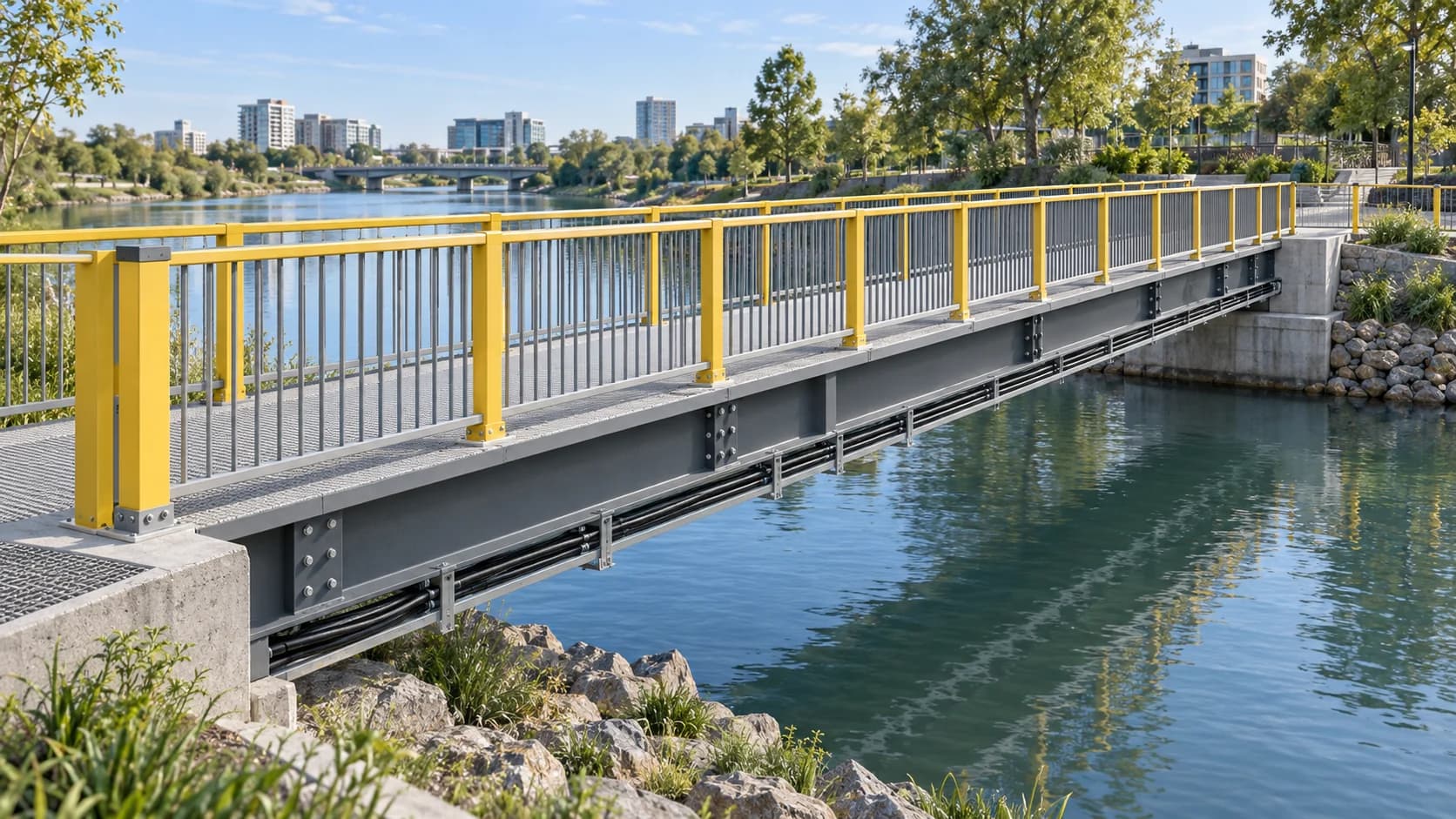 Infrastructure and transportPedestrian bridges and deck panels, rail platform canopies, cable trays and pipe supports in utility corridors, and highway noise barriers.Explore the applications
 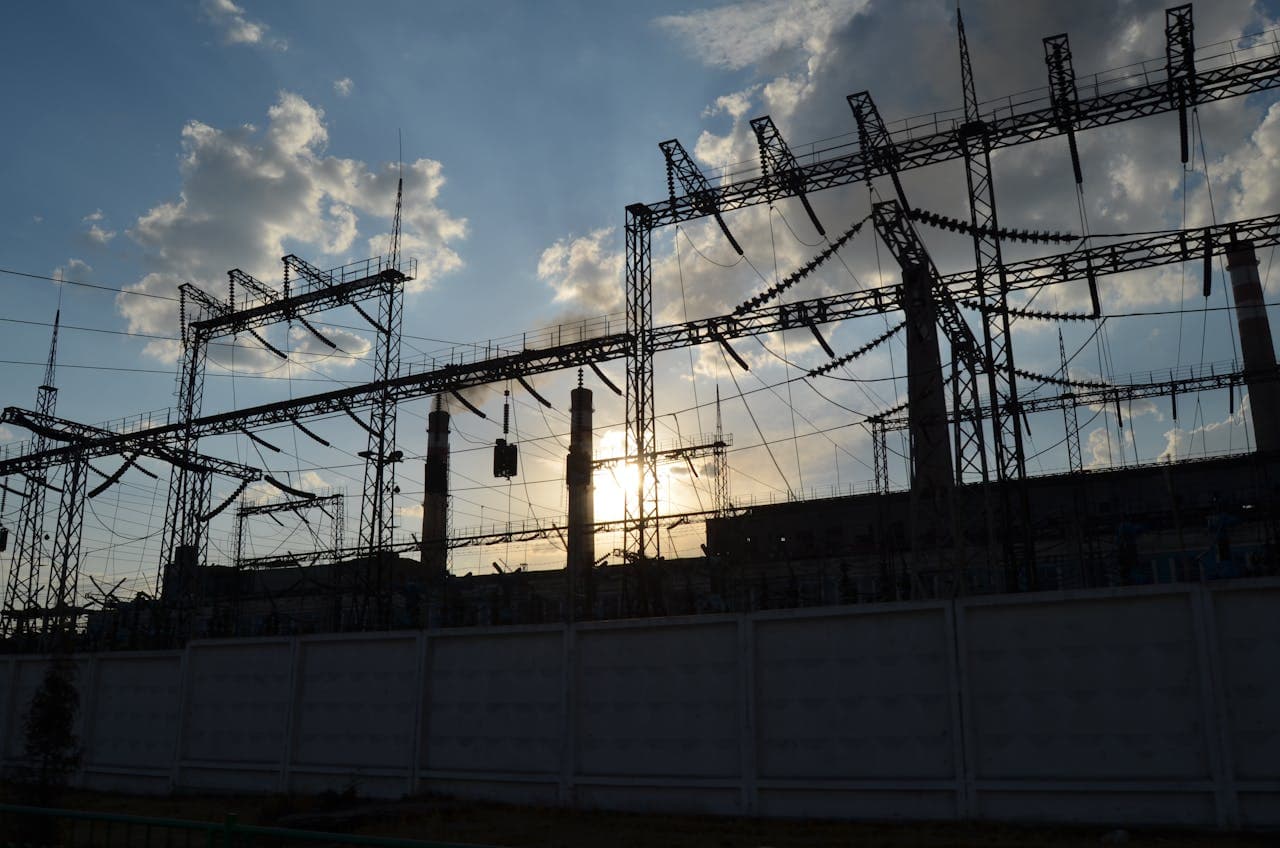 Illustrative photoEnergy and utilitiesOverhead distribution crossarms and substation equipment, solar mounting frames, wind-turbine secondary structures, and oil and gas access platforms.Explore the applications
 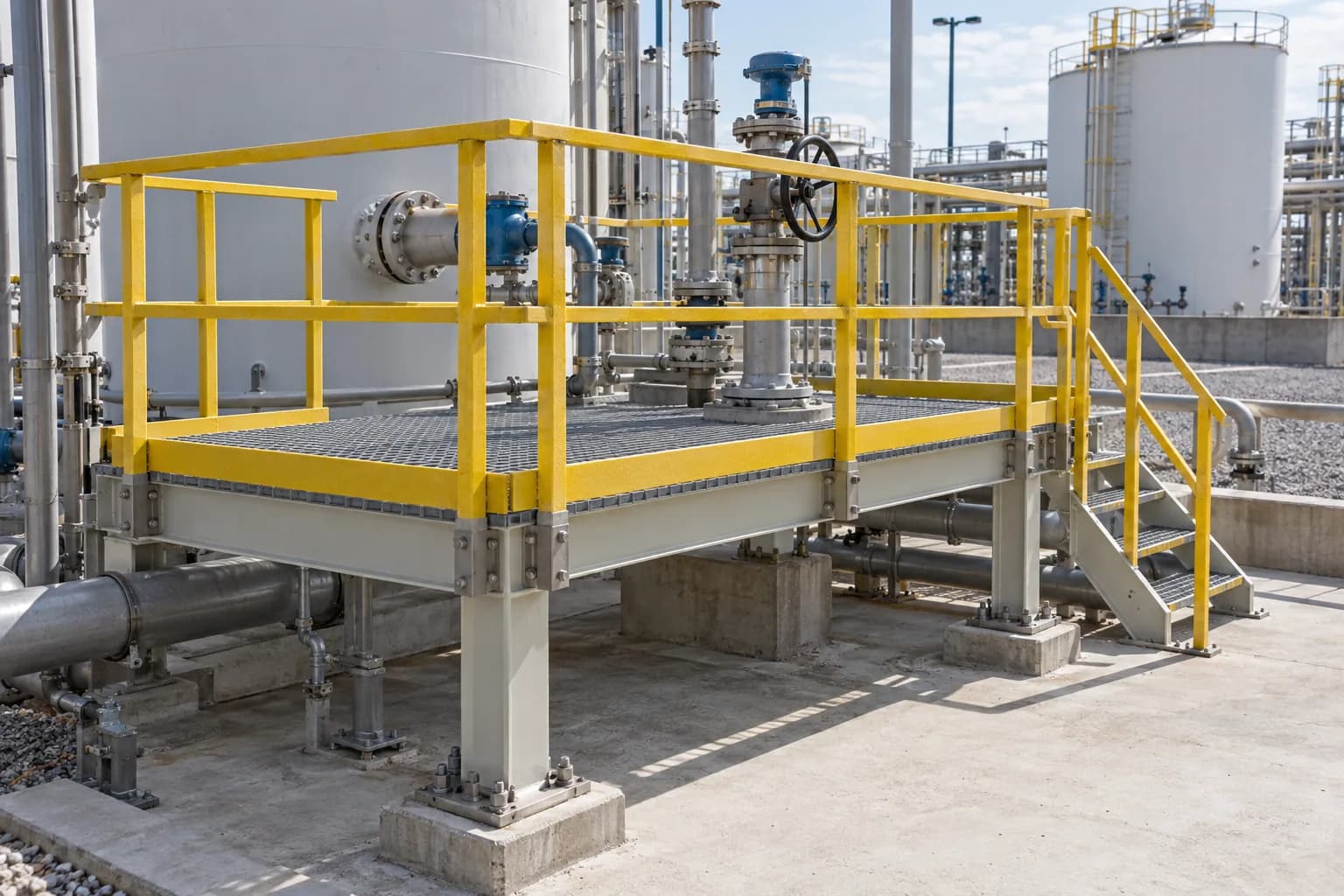 Chemical and marineChemical plant walkways and handrails, cooling tower structures, wastewater and desalination gratings, and offshore platforms and floating docks.Explore the applications
 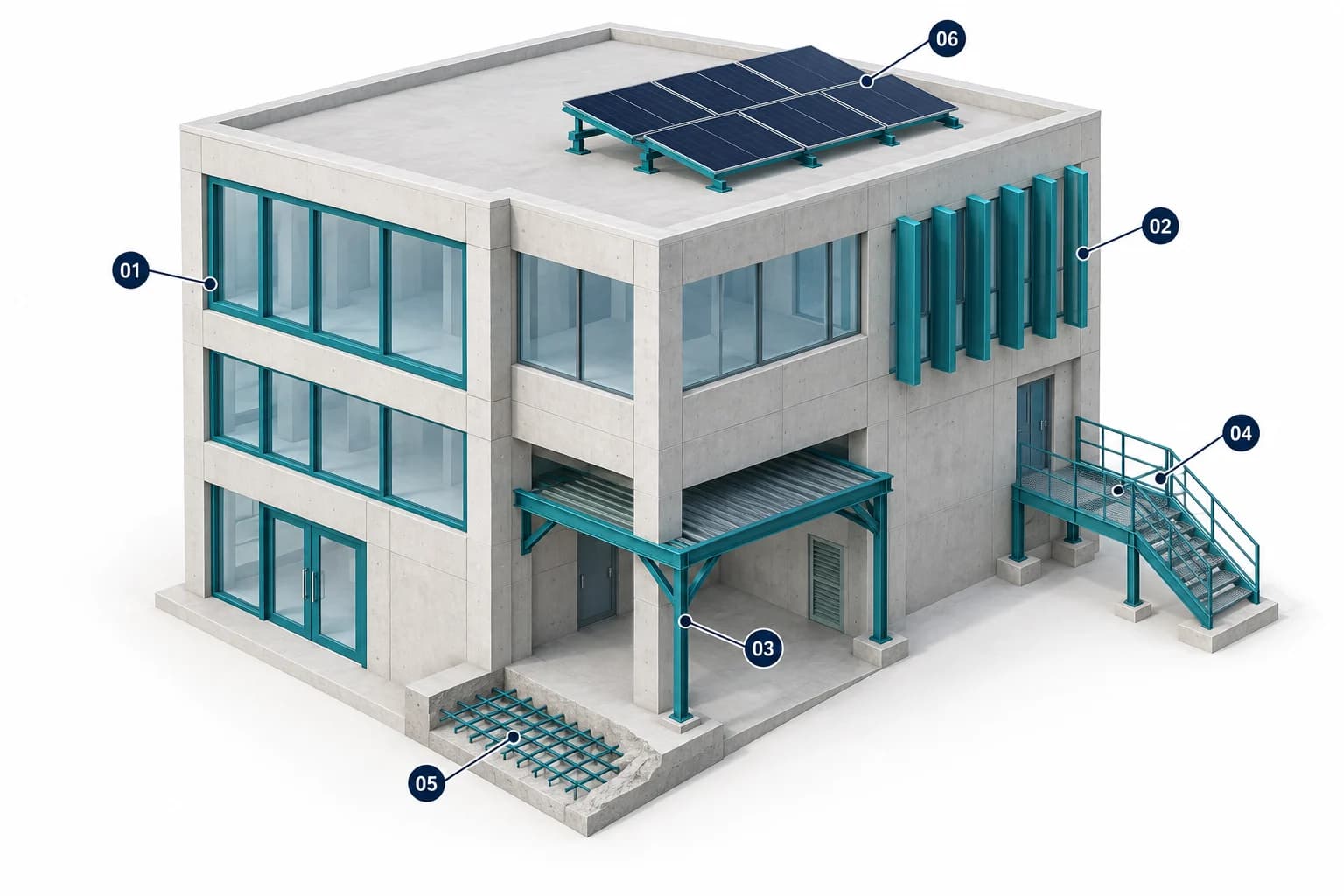 Building and constructionWindow profiles for passive-house and low-energy buildings, facade supports and curtain-wall mullions, rooftop platforms, and rebar for concrete in corrosive service.Explore the applications
For a deeper overview by industry, see the industries section. For live case studies including before/after weight, cost, and delivered lead-time data, see our case studies.
Frequently asked questions
What is glass fiber reinforced plastic (GFRP)?
Glass fiber reinforced plastic (GFRP) is a composite made by combining glass fibers with a polymer resin. It is the glass-reinforced subset of FRP and is also called glass fiber reinforced polymer, fiberglass reinforced plastic, GRP, or simply fiberglass. Pultruded GFRP profiles use continuous fibers aligned through a constant cross-section.
Is FRP the same as fiberglass?
Fiberglass can mean glass fibers or a finished glass-reinforced composite. FRP is the broader family of fiber-reinforced polymers and can use glass, carbon or other fibers. Glass-reinforced FRP is called GFRP or GRP. For a structural fiberglass tube or sheet, compare the resin, reinforcement, dimensions and supporting data rather than assuming the names define a material grade.
Are FRP composites considered advanced composites?
Yes. Pultruded FRP profiles are classified as advanced composites because they use engineered fiber architectures (unidirectional roving, continuous strand mat, woven fabric) and controlled fiber-volume fractions of 60–70%. Advanced composites are distinguished from short-fiber or filled plastics by their tailored directional properties and structural-grade mechanical performance.
Is FRP stronger than steel?
Pultruded FRP has tensile strength of 240–400 MPa, comparable to A36 structural steel (400 MPa), but at about one quarter of the weight. Per kilogram, FRP is significantly stronger than steel. However, the elastic modulus of FRP (17–28 GPa) is roughly 1/10 that of steel (200 GPa), so stiffness and deflection usually govern design rather than strength.
Does FRP rust or corrode?
No. FRP does not rust, pit, or suffer galvanic corrosion. The polymer matrix is inert to most acids, bases, salts, and chlorinated environments. Vinyl ester resin is specified for aggressive chemical or marine environments, and field reports on vinyl ester FRP in saltwater splash zones show little property loss after 30 years or more of service.
Is FRP flammable?
The standard isophthalic polyester laminate is combustible and is not fire-retardant. Fire-retardant polyester and vinyl ester formulations reach ASTM E84 Class A (flame-spread index 25 or less) with the right additive package, and phenolic resin gives inherently low flame spread, smoke and toxicity, which is why it is specified for rail interiors (EN 45545-2), tunnels and offshore platforms. A fire class belongs to the tested formulation, thickness and installation, so ask for the test report of the formulation quoted rather than relying on a resin name; UL 94, ASTM E84 and EN 13501-1 results are not interchangeable.
How long do FRP composites last?
Pultruded FRP structures can be designed for 50–100 years when the resin, UV protection, connections and inspection plan are right, and they need no painting or galvanizing. Installations in chemical plants, bridges and marine sites have been in service for 30 years or more.
Can FRP be recycled?
Thermoset FRP cannot be melted and re-formed like metals. Current end-of-life options include mechanical grinding to filler for cement or concrete (widely commercial), co-processing in cement kilns (energy recovery plus calcium oxide input), and emerging solvolysis/pyrolysis fiber-recovery routes. Non-hazardous landfill is permitted — FRP contains no heavy metals or toxic leachates.
Talk to our FRP engineers about your project
Send the dimensions, quantity, service conditions and destination. We reply within one business day.