Skip to content
Industry· Industrial & chemical

FRP for Chemical & Industrial Facilities

Fiber-reinforced polymer (FRP) profiles, grating and access systems for processing plants and manufacturing sites where steel corrodes. The resin is chosen for the chemicals on site, with fire-retardant grades where the plant requires them.

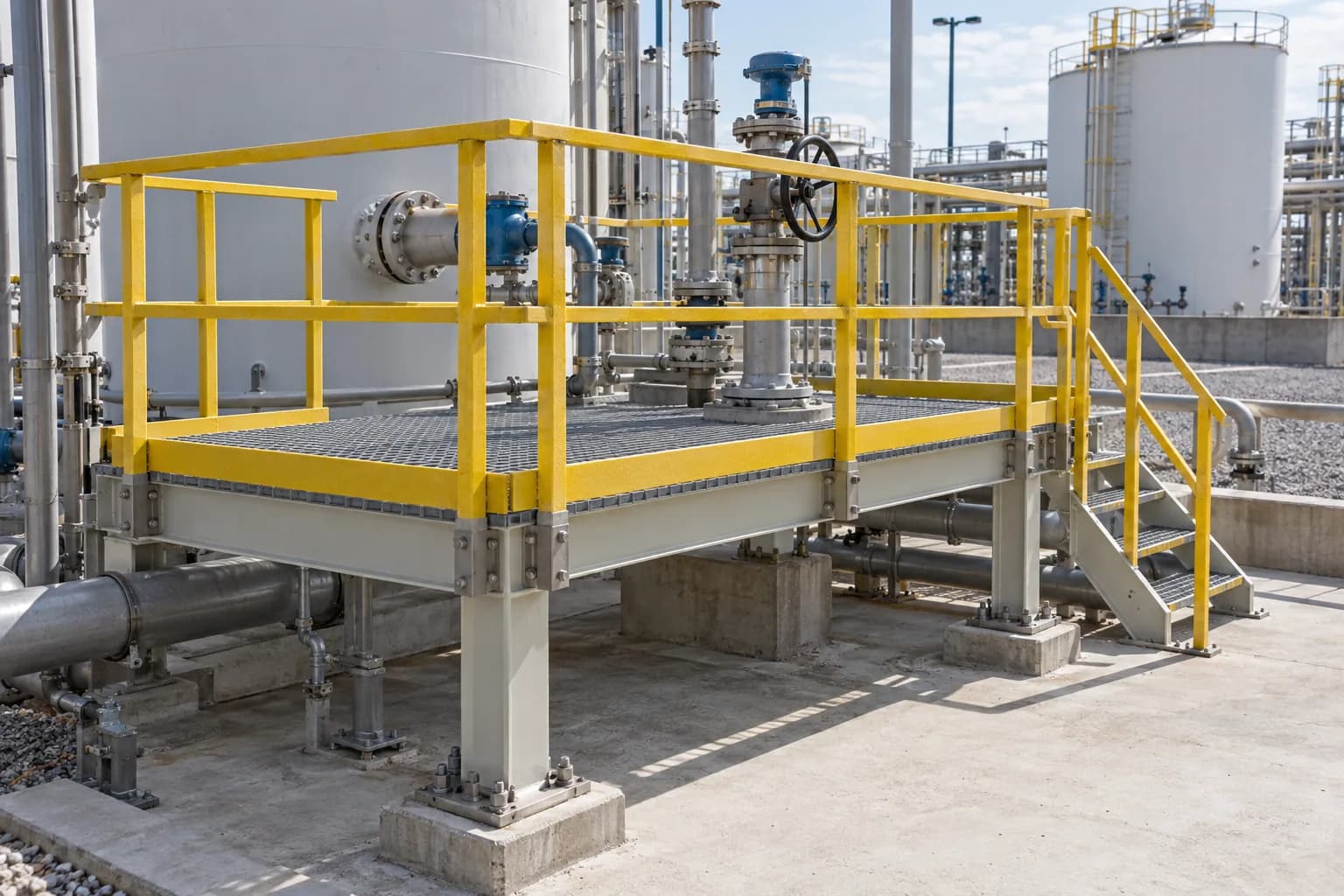
FIG. 1 Industrial & chemical
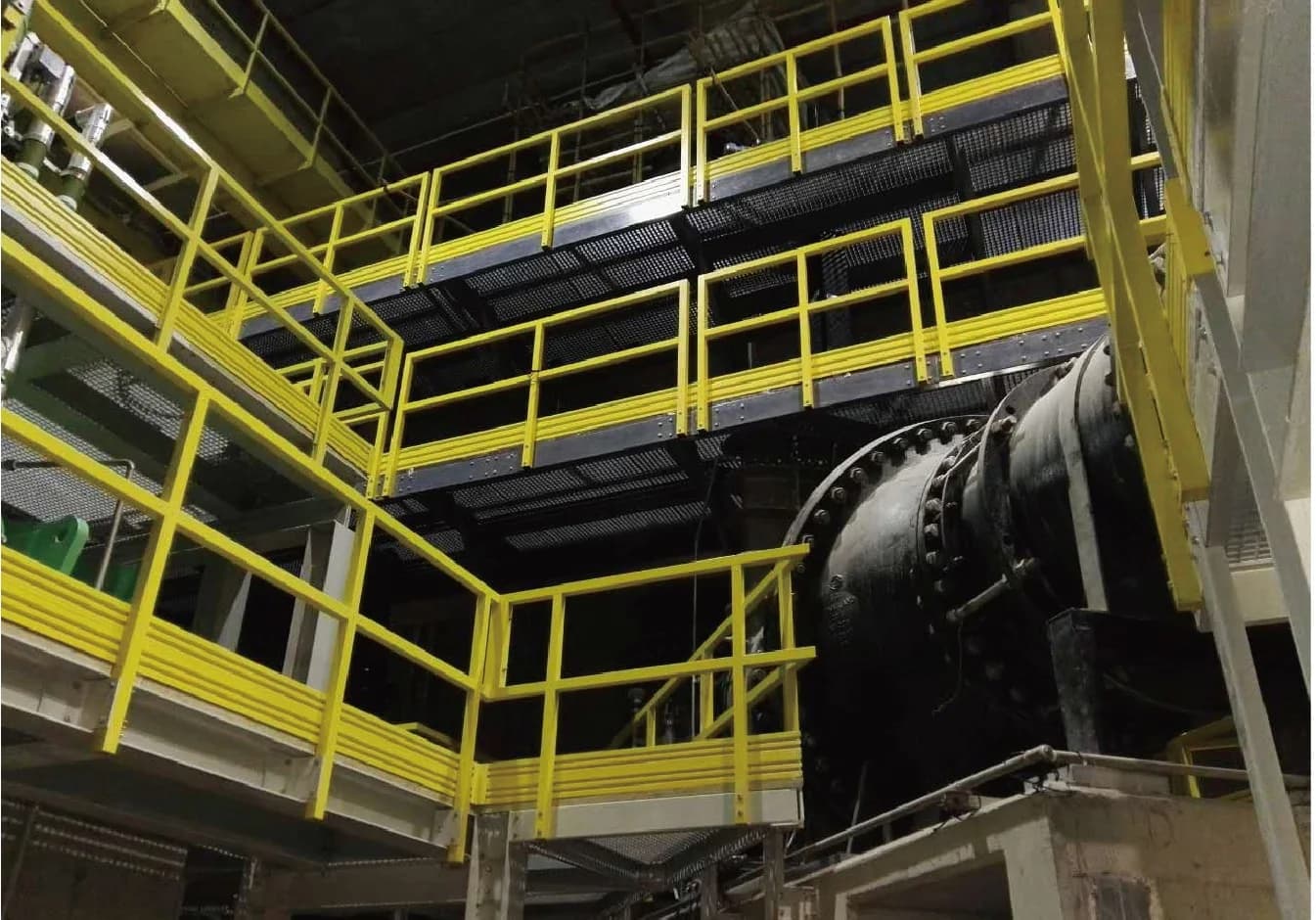
Chemical tank access platform with FRP grating, rails and structural supports
Grating, rails and structural supports at a tank access platform. Final members and connections require project design.

Where FRP is used, area by area

Corrosion, wash-down and access needs differ across a plant. Resin compatibility is confirmed per chemical, and safety requirements apply to the complete assembly.
AreaConditionsTypical FRP partsWhat to check
Chemical processingAcids, alkalis and solvents corrode steel and attack its coatingsPlatforms, grating, handrails, ladders and equipment framesEach chemical with its concentration and temperature; vinyl ester is the usual starting resin
Access around equipmentSteel access routes need recoating, and changes need hot-work permitsMolded or pultruded grating, stair treads, handrail systems, fixed laddersLoads, spans and openings, and guard and ladder requirements such as OSHA 1910.29 for the complete assembly
Wash-down areasConstant moisture and cleaning agents in food, beverage and pharmaceutical plantsGrating, stair treads, covers and framesCleaning agents and temperatures; any food-contact or hygiene requirement is confirmed for the specific resin and surface
Cooling towersHumidity, chlorides, biocides and wet-dry cyclingBeams, tubes, angles, louvers and grating supportsWater chemistry, temperature, loads and any fire requirement
Cable routes and instrument areasMetal supports corrode and need groundingChannels, angles and brackets for cable supports; instrument standsCable weight, support spacing and fire-retardant resin where required

Where FRP components do a specific job 4 applications

F1 supplies pultruded profiles and coordinated access components. What a lighter, corrosion-resistant material is worth depends on the real operating route, the chemicals present and the full assembly, including its grating supports, connections and inspection plan.

01 · Tank-access platforms

Chemical dosing and tank-access platforms

A tank-side platform may be used for valve operation every shift, sampling at a fixed point and occasional replacement of an agitator or instrument.

The walking route, clearances and escape path need to work around the actual vessels and pipework. Splash, vapor, rain and washdown can reach different parts of the assembly at different frequencies.

Pultruded I-beams or channels can form the support frame; molded or pultruded grating provides the walking surface; stair treads, guardrails and toe boards complete the access route. The guardrail posts transfer their loads into the platform frame, while base plates and anchors transfer all reactions into the existing structure. A replacement for steel therefore needs a new member and connection check, even when the footprint is unchanged.

Start resin selection with a list of chemicals, concentrations, temperatures and exposure modes, including cleaning agents. Define where cuts, drilled holes and metal fasteners will be exposed. Supply can be limited to profiles and panels or expanded to a cut, drilled and labeled component package against approved drawings.

Components to evaluate

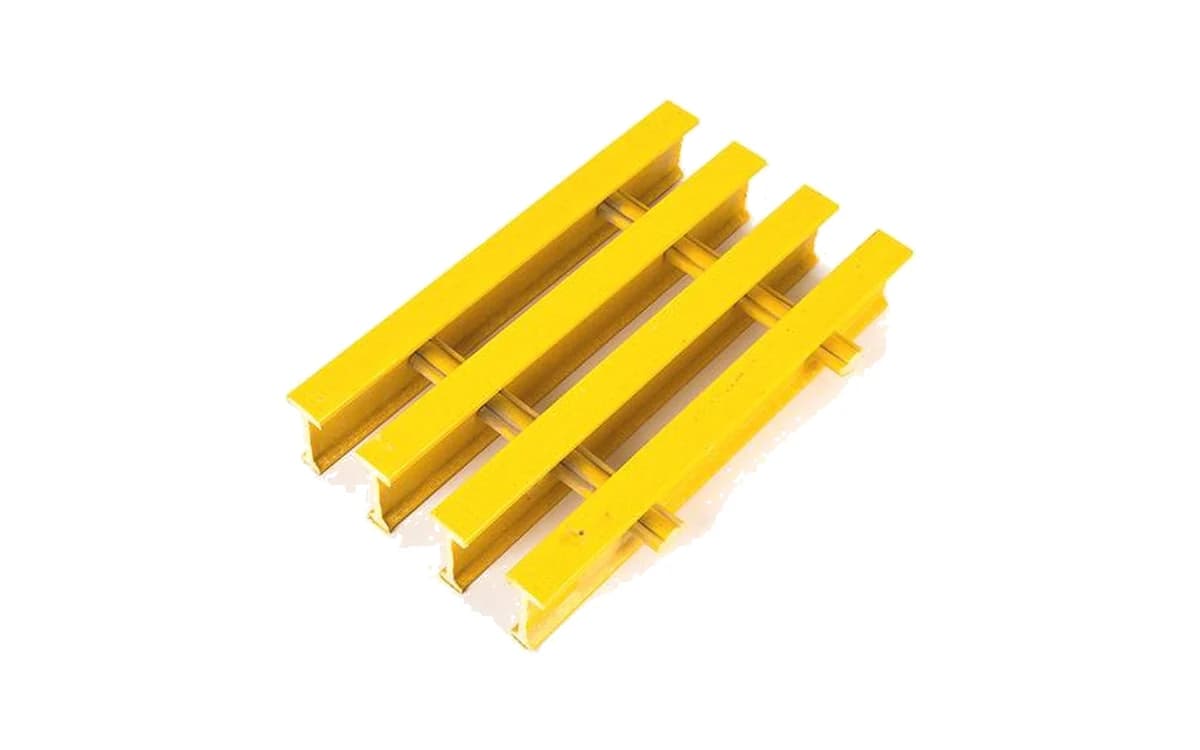
  • I-beams and channels
  • Grating and stair treads
  • Handrails, toe boards and fittings

Confirm before selection

  • Operating and maintenance loads, clear spans and deflection
  • Guardrail layout, anchor substrate and local connection loads
  • Chemical splash, washdown and fire requirements
02 · Plating & pickling lines

Plating and pickling-line walkways

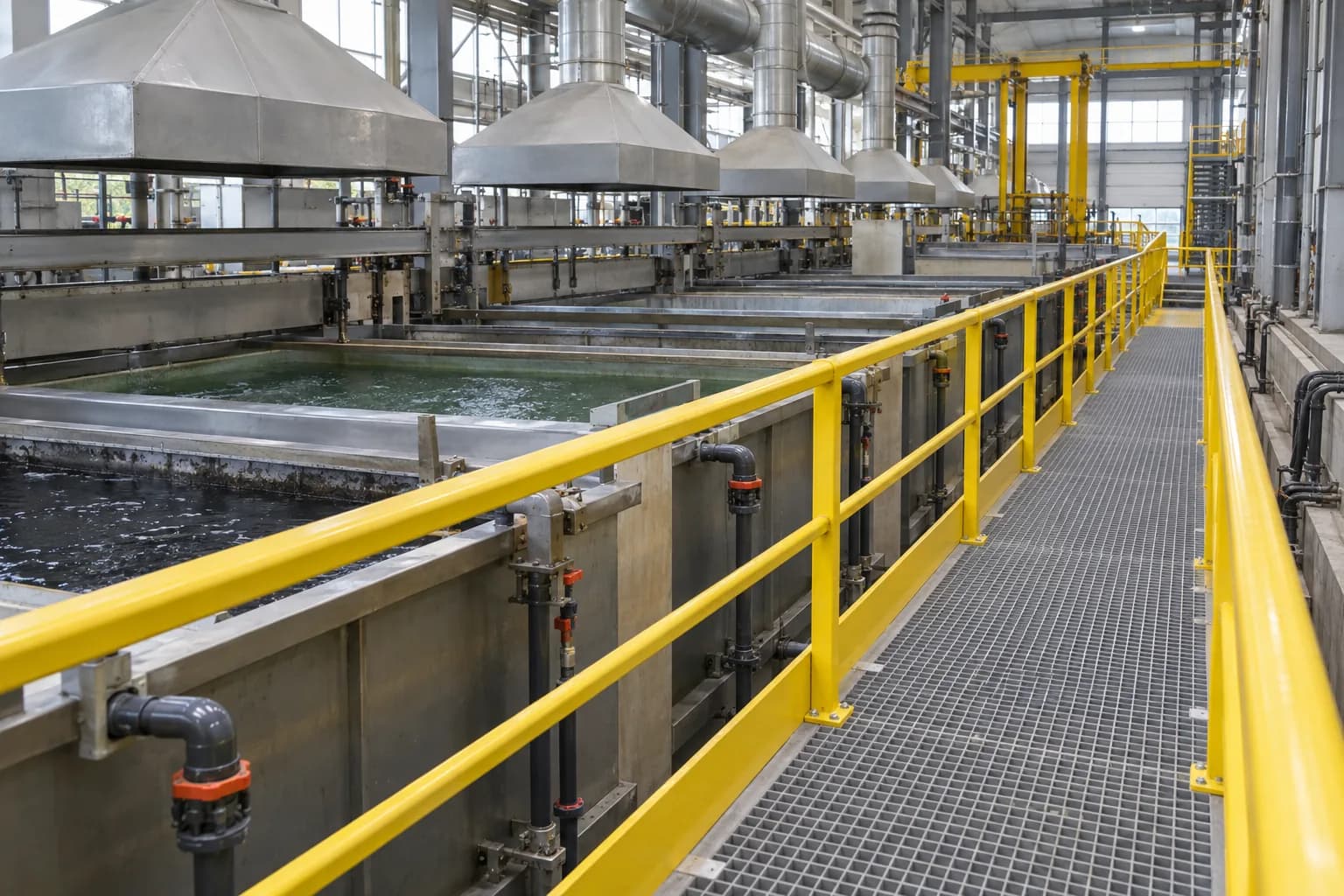
An operator beside a plating or pickling line needs access to bath controls, hoists and inspection points without stepping around open channels or loose covers.

Mist above the baths, drips from transferred parts and periodic cleaning create a different exposure from a dry production aisle. Set out the walkway width, removable sections, drainage path and barriers around every opening before selecting a panel.

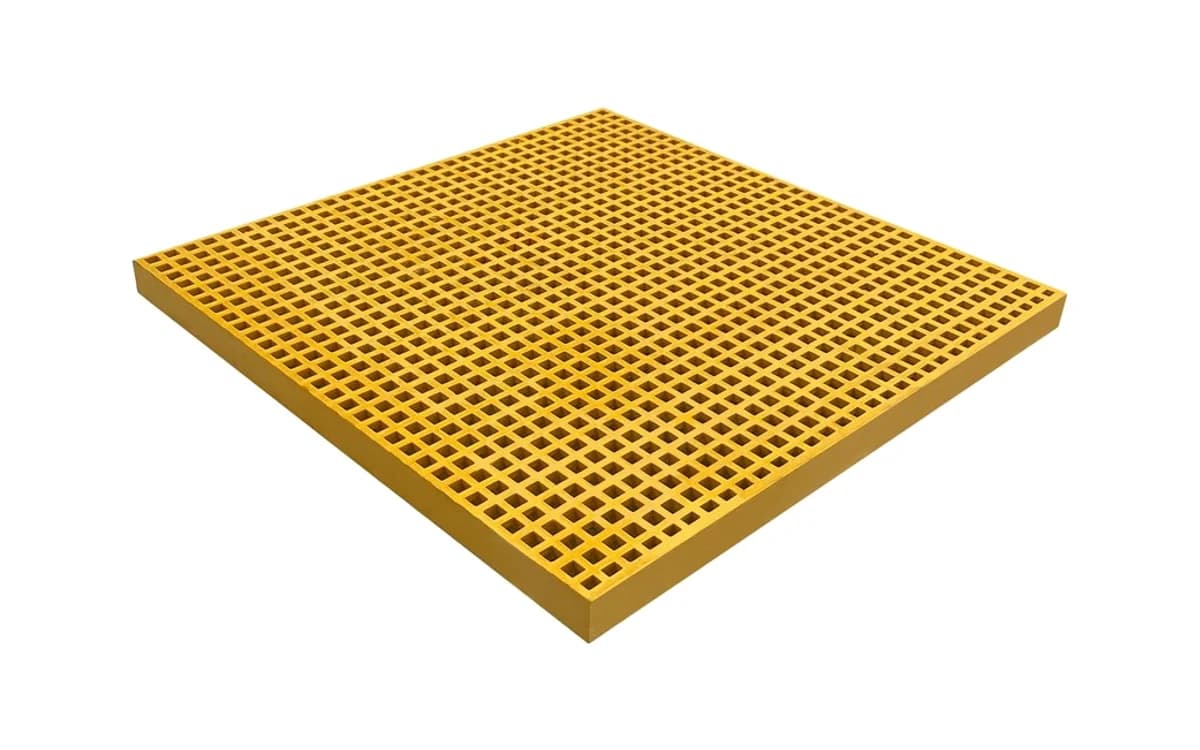
Molded grating is often a useful starting point for irregular layouts with several cutouts or support in two directions. Pultruded grating suits layouts organized around a defined bearing-bar direction and a checked span. In either case, the chosen mesh or bar opening, surface texture, edge supports, hold-down clips and the load from tools or carts belong on the panel schedule.

Chemical compatibility is specific to the actual bath and cleaning chemistry. A resin family name alone cannot establish suitability for concentrated acids, oxidizers or elevated temperatures. Review the proposed laminate and any exposed cut edges with the material supplier before releasing the layout.

FIG. 2 Plating & pickling lines
Plating line walkway with FRP grating panels alongside process baths and a guarded access route

Components to evaluate

  • Molded or pultruded grating
  • Stair treads and edge framing
  • Guardrails and removable-panel hardware

Confirm before selection

  • Bath chemistry, mist, spills and washdown temperature
  • Cutout positions, support bearing and grating orientation
  • Slip surface, drainage, clips and safe removal sequence

03 · Cooling towers

Cooling-tower framing and wet-zone access

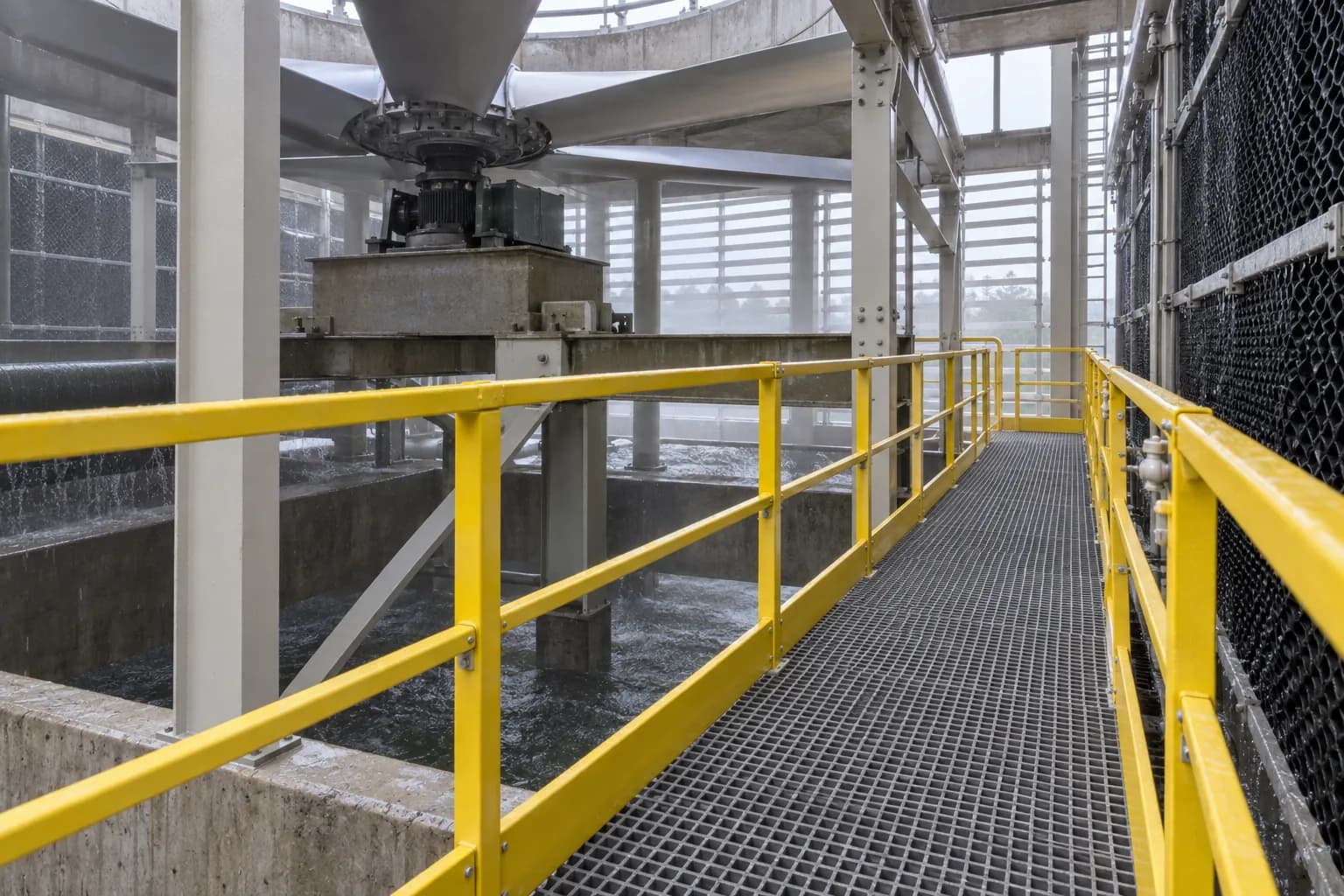
Inside a cooling tower, the frame and access route see saturated air, water-treatment chemicals and repeated wet-dry cycles.

Fan-deck maintenance, louver access and inspection around the fill require members that work as a connected structure. Pultruded beams, channels, square tubes and angles can form framing, bracing and edge supports; grating and rails complete the service route.

The design must account for the tower's maximum expected water temperature, sustained loads, member buckling, service deflection and the stiffness of bolted joints. Water chemistry and the biocide program affect resin selection. CTI STD-137 addresses pultruded structural products for cooling towers, including material and quality requirements; its use still requires the offered product and project design to be checked.

For refurbishment, provide the existing tower drawings, support positions and the replacement sequence. A lighter component may simplify handling, but the existing anchors, remaining structure and temporary support during change-out still need engineering review.

FIG. 3 Cooling towers
Cooling tower wet zone with FRP grating walkway, beams, bracing and guardrails

Components to evaluate

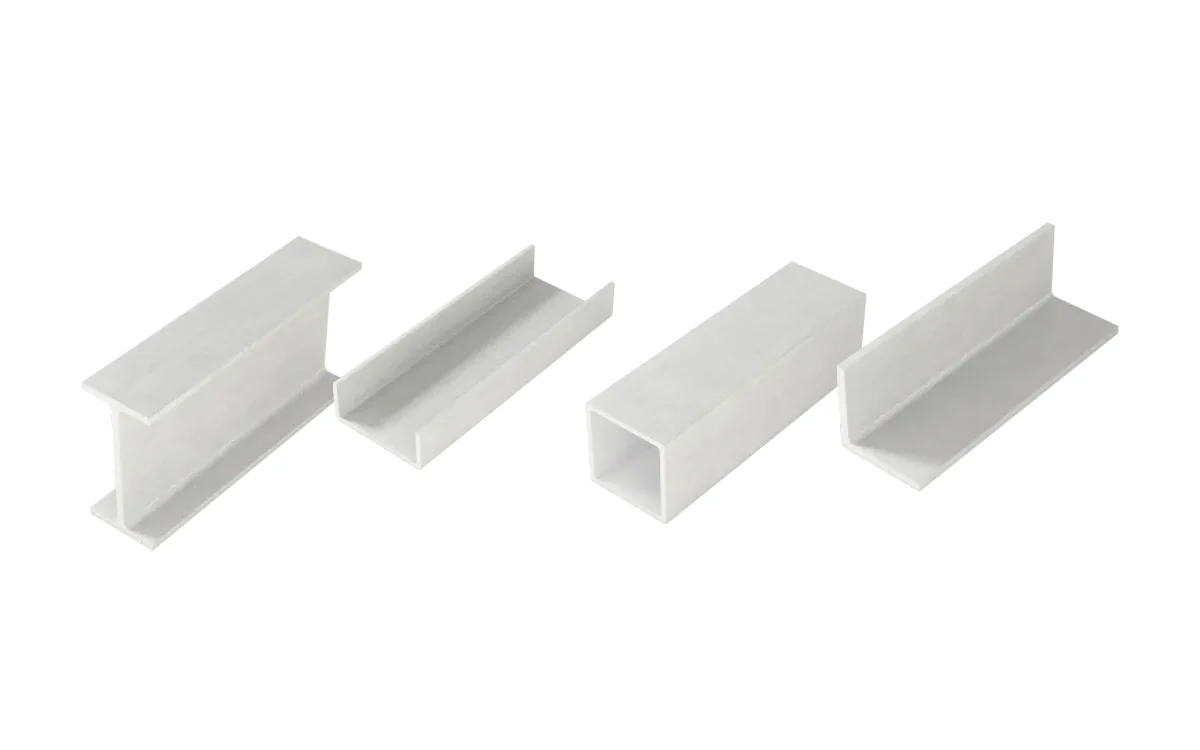
  • I-beams, channels and square tubes
  • Angles, grating and louvers
  • Guardrails and connection plates

Confirm before selection

  • Water chemistry, biocides and maximum temperature
  • Long-duration loads, buckling and service deflection
  • Connections, cut-edge treatment and replacement staging

04 · Cable routes

Cable routes through corrosive process areas

Electrical and control cables often pass above chemical dosing skids, washdown aisles or outdoor pipe corridors.

The support schedule needs more than a route length: cable mass, future fill, support spacing, fittings, turns and the location of each splice all affect deflection and connection demand.

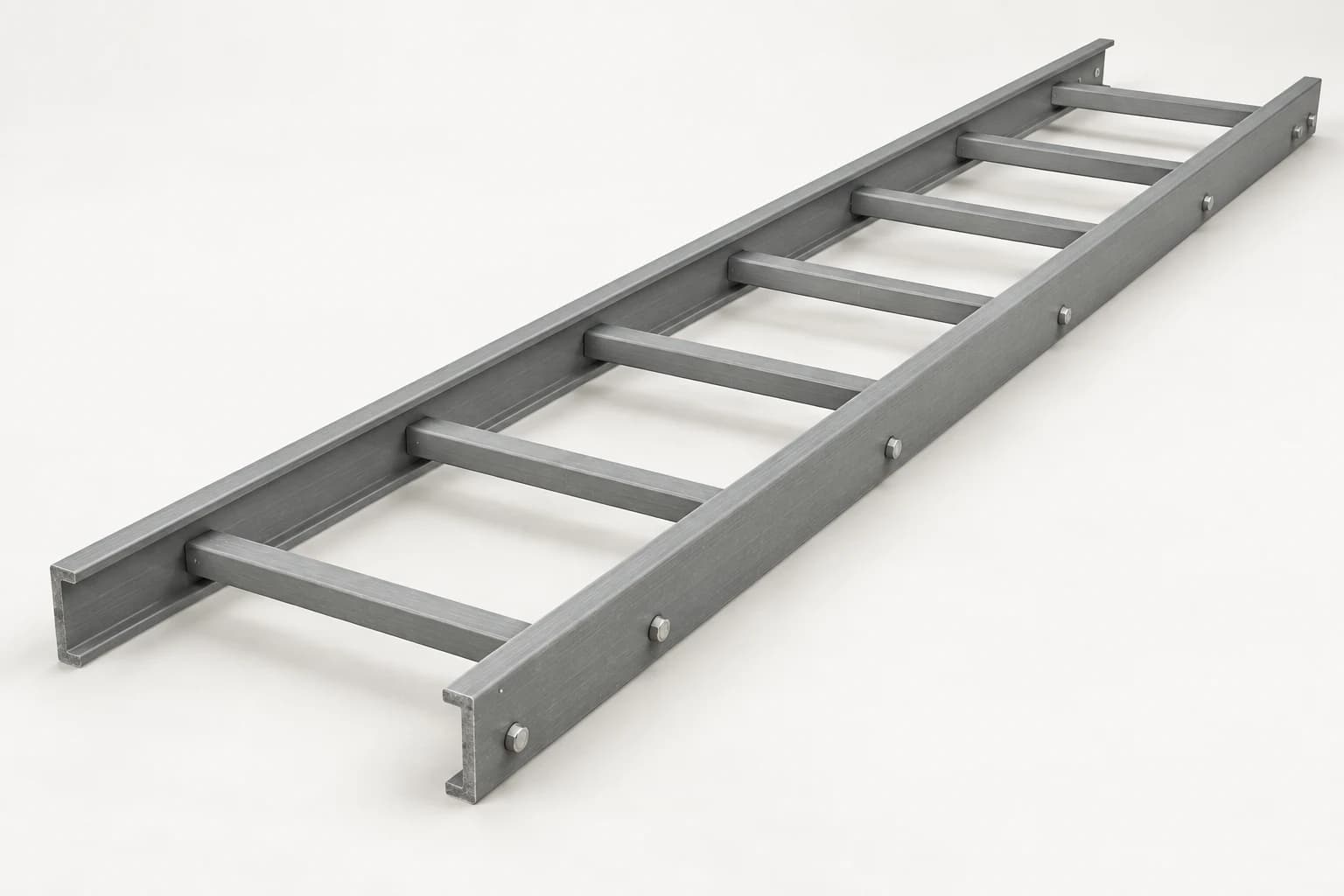
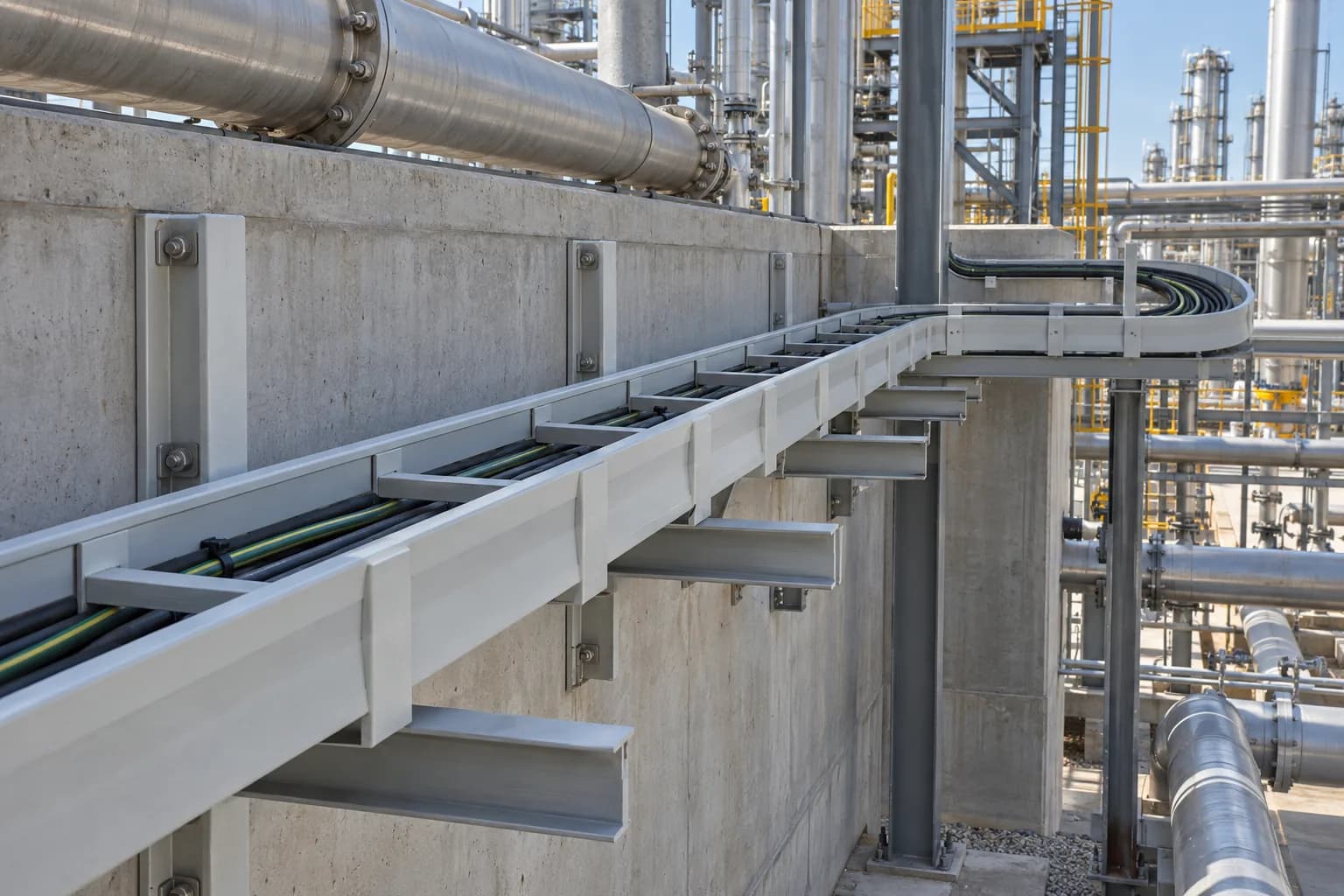
Pultruded channels and angles can form wall brackets and secondary supports; square tubes can serve as posts in a free-standing frame. A cable ladder or tray is a complete system with side rails, rungs or base, splices and fittings. Confirm whether the inquiry is for component profiles, fabricated supports or a qualified complete tray system before citing IEC 61537 or another system standard.

FRP members are nonmetallic, but they do not settle the electrical design. Cable bonding, metallic fasteners, static control, fire and smoke requirements, and any hazardous-area rules remain with the project engineer. State these requirements separately from the chemical exposure specification.

FIG. 4 Cable routes
FRP cable ladder on wall brackets in a chemical processing corridor

Components to evaluate

  • Channels and angles for brackets
  • Square tubes for support posts
  • Agreed tray, ladder and fitting package

Confirm before selection

  • Cable load, future fill, route geometry and support spacing
  • Bracket anchors, splices and concentrated maintenance loads
  • Electrical, fire and hazardous-area requirements

Match the component to the load path

Profiles, grating and access assemblies have different reinforcement layouts and design checks. Select a product family only after locating its supports, loads, openings and connections.
Component functionStart withWhat decides the specification
Walkway with cutoutsMolded gratingMesh opening, local supports, clips and removable panels
Span-led walking surfacePultruded gratingBearing direction, clear span, loads and deflection
Platform or tower frameI-beams, channels, tubes and anglesMember stability, connections, temperature and anchors
Platform edge protectionHandrail systemsGuardrail loads, toe boards, post spacing and substrate
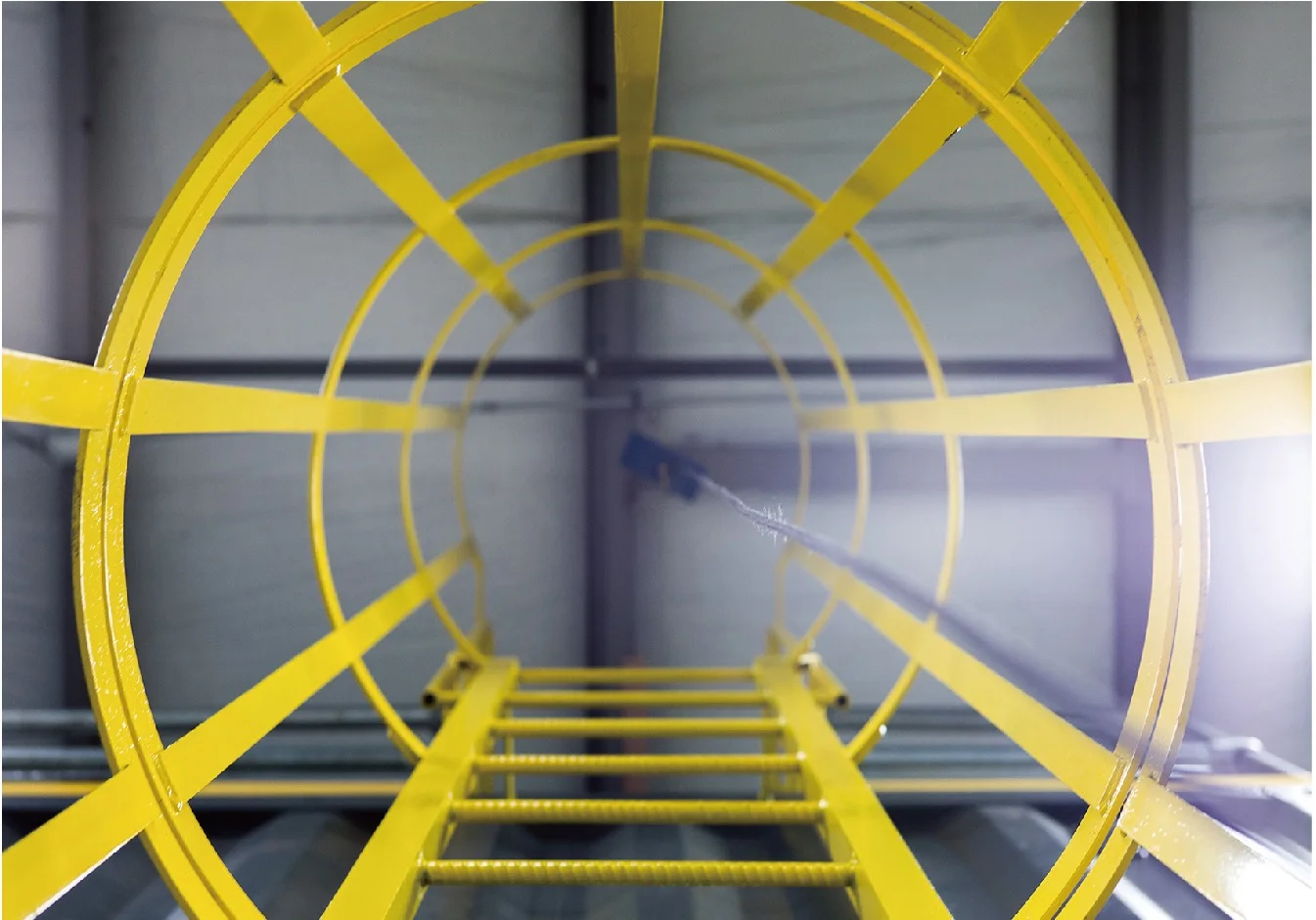
Vertical and stepped accessFixed laddersLadder layout, landing transition and anchorage
Stair accessStair treadsTread span, nosing, slip surface and fixings
Cable route supportsChannels, angles and custom sectionsCable load, support spacing, fittings and system scope
  • Chemical exposure

    Review the complete resin, reinforcement and surface package against concentration, temperature and contact mode. Cut edges and connection hardware are part of the exposure.

  • Structural performance

    Check member and panel deflection, local loads, buckling, bearing and anchor reactions. An identical steel and FRP section size does not imply identical performance.

  • Plant safety

    Set fire, smoke, electrical, static, slip and fall-protection criteria for the location. Confirm the offered assembly and its evidence against those requirements.

Extend the same method to adjacent equipment

  • Pump rooms and scrubber access

    A maintenance route to pump seals, filter covers, scrubber nozzles or dampers may need removable grating, room for lifting a component and a guarded edge beside equipment. Check localized tool and equipment loads, clear headroom, panel removal sequence, support reactions and the cleaning or condensate chemistry. A grating panel should not obstruct drainage or access to a shut-off point.

    Plan an access platform
  • Wet production and washdown zones

    In beverage, food or other wet production buildings, FRP can be evaluated for non-product-contact mezzanines, service stairs and utility corridors exposed to repeated cleaning. Record the washdown temperature, detergents and sanitizers, drainage, slip-surface needs and cleanable joint details. Direct food contact or cleanroom use requires separate finished-product evidence and site approval.

    Review stair treads and covers

For basin edges, treatment tanks and dosing rooms, continue to the water and wastewater industry guide.

Standards and references

These sources define design questions; none of them is a certification claim for a particular F1 product. Use the edition and jurisdiction specified by the project. The engineer of record confirms the governing code, the complete load path and acceptance of the installed system.

Documents

  • CatalogPDF · 991 KB

    Pultruded FRP Pipe — Mining & Oilfield Catalog (Edition 2026.06)

    Issued by
    F1 Composite
    For
    Pultruded FRP pipe

    3-page product catalog for F1 Composite serial-production pultruded FRP pipe in two qualified families. Series 01 — Oilfield Surface Gathering: DN50–DN300, 0.7–3.5 MPa, −40 °C to +140 °C continuous (short-term peak +160 °C), vinyl-ester / epoxy / polyurethane matrices with 0.5–2.5 mm resin-rich liner (novolac VE for sour H₂S / CO₂ service), ≥25-year life, qualified to API 15LR, ISO 14692, NORSOK M-622, ASTM D2992, SY/T 6266. Series 02 — Mine Methane Drainage: DN25–DN300, 0.6–1.6 MPa, surface resistance ≤3×10⁸ Ω, LOI ≥28%, UL 94 V-0, ≥50-year design life, qualified to MT 558.2, GB 16413, MT 113, ISO 4589-2, ASTM E84 Class I. Edition 2026.06, Rev v1.3.

  • Data sheetPDF · 3 MB

    FRP Profile Design Manual — DOC-PF-2026-EN Rev. B

    Issued by
    F1 Composite
    For
    Structural shapes

    Revision B (October 2026), generated from the website's catalog, laminate and design-basis data: EN 13706 E23 laminate values beside the grade minimums, section properties of all 114 catalog sizes, allowable uniform loads to the published LRFD screening basis, application guides, durability stated by resin formulation, fabrication and inspection. A preliminary-sizing reference, not a project approval or batch certificate; it supersedes the withdrawn Rev. A.

  • CertificatePDF · 142 KB

    EPD & Carbon Footprint — Pultruded GFRP Composite Profiles

    Issued by
    CABR
    For
    Standard profiles

    Environmental Product Declaration and product carbon footprint analysis for F1 Composite pultruded GFRP composite profile products, with 1 m² functional unit. Calculation reference CABR-CFC-01(02)-2025(20030)1, cradle-to-gate 33,934.34 g CO₂e/m², distribution 254.59 g, cradle-to-grave 36,099.32 g. Standards: GB/T 24025-2009 (ISO 14025-aligned Type III EPD), GB/T 32161-2015, ISO 14067, PAS 2050. Issued by China Academy of Building Research Co., Ltd. (CABR) Certification Center on April 30, 2025.

  • CADOn request

    Standard Profiles — CAD Library

    Issued by
    F1 Composite
    For
    Standard profiles

    2D and 3D CAD models for all standard I-beam, channel, angle, and tube profiles.

  • CatalogOn request

    Product Catalog 2024

    Issued by
    F1 Composite
    For
    All products

    Complete catalog of standard pultruded FRP profiles with dimensions, properties, and ordering information.

  • CertificateOn request

    ISO 9001:2015 Certificate

    For
    All products

    Request the current quality-management certificate holder, validity and scope for your proposed supply.

  • CertificateOn request

    CE Declaration of Performance

    For
    All products

    Request product-specific performance and applicable conformity documentation; confirm the intended use and assessment route.

All downloads and CADTest reports and their scope

Questions buyers ask

Which chemicals can FRP profiles resist?

It depends on the complete laminate and the chemical, concentration, temperature, exposure time and cleaning cycle. Vinyl ester is the usual starting point for acids, alkalis, chlorine chemicals and wastewater; isophthalic polyester suits milder exposure. Send the process-chemical list with the inquiry so the resin and surface construction can be reviewed for the actual service; a generic vinyl-ester rating does not cover every formulation or mixture.

When should a plant use molded rather than pultruded grating?

Molded panels are a useful starting point for layouts with frequent openings or support in two directions. Pultruded panels have a defined bearing-bar direction and suit span-led layouts. Both need a panel-specific load and deflection check, suitable edge support, hold-downs, surface and openings.

Can an FRP beam replace a steel beam of the same size?

Not directly. FRP can be sized for the same loads, usually as a deeper section, because its modulus is about a tenth of steel's. Compare the complete assembly against its load cases, deflection limit, buckling, connection bearing and exposure, using the span tables and the profile calculator, then confirm with the project calculation. Retrofitted anchors and the remaining structure also need review.

Is every FRP profile fire rated or suitable for a hazardous area?

No. Specify the flame, smoke, structural fire, static-control and hazardous-area requirements for the installed component or assembly, then request reports for the offered laminate and test configuration. A resin label or small-sample rating alone does not establish project acceptance.

Do FRP ladders and handrails meet OSHA requirements?

Compliance belongs to the complete assembly: rails, posts, fittings, anchors and the supporting structure. OSHA 1910.29 sets the requirements for guardrails and fixed ladders in general industry, and the design and installation are checked against it for the project.

Can these products be used in food or pharmaceutical production areas?

FRP may be evaluated for non-product-contact access and service areas exposed to frequent washdown. Direct food contact, cleanroom use and validated hygiene performance require separate review of the finished product, surface, joints, cleaning chemicals and the site's acceptance criteria. Do not infer those approvals from a resin ingredient.

Quote FRP for industrial & chemical

Send a marked-up layout and a short exposure schedule; for a replacement, add the existing member and anchor drawings. We reply within one business day; a formal quotation follows once the specification and delivery are reviewed.

Process environment
Each chemical with its concentration, the cleaning agents, operating and cleaning temperatures, and splash, mist, immersion or washdown.
Geometry and loads
Plan, elevations, openings and access route; spans, support spacing, load cases, deflection limits and grating direction.
Interfaces and rules
Anchors and base material; the guardrail, stair, ladder and egress basis; fire, smoke, electrical and hygiene requirements.
Supply and evidence
Profiles, panels or a fabricated package; drawings, tests, samples and inspection records; quantity, destination and installation window.
Get a quoteWhatsApp