Molded grating
Alternating rovings → resin wet-out → thermal cure → one-piece mesh
Multi-directional loads, chemical exposure, frequent cutouts and short-to-medium spans.
Corrosion-proof, lightweight fiberglass gratings and structural deck panels — molded and pultruded FRP grating, solid-top cover plates, and closed-top deck planks for pedestrian bridges, vehicular decks, and industrial platforms.
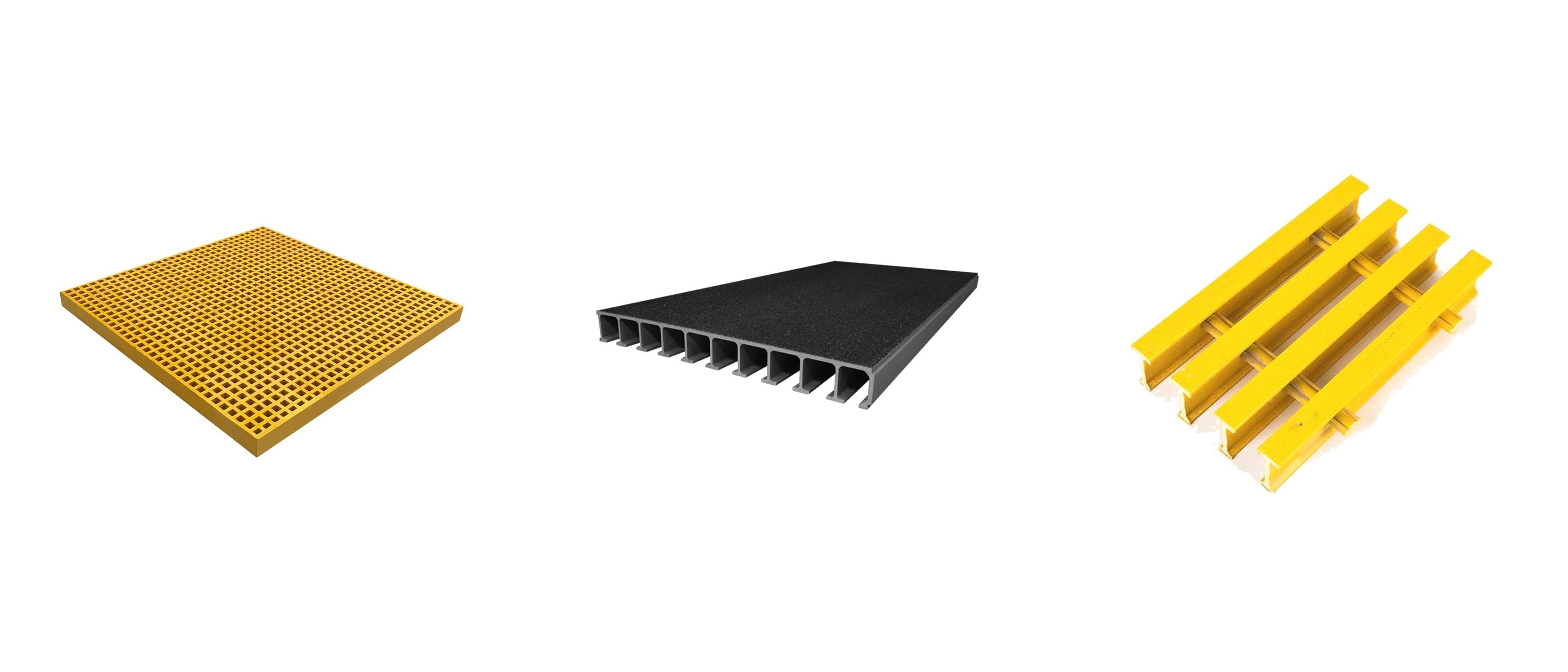
FRP (fiber-reinforced polymer) gratings and structural deck panels, also known as GRP (glass-reinforced polymer) gratings and FRP decking, deliver the structural performance of steel at a fraction of the weight and with zero corrosion risk. At F1 Composite, we manufacture molded and pultruded grating systems, solid-top cover plates, and pultruded structural deck panels — a complete platform and decking solution for industrial plants, offshore platforms, marine vessels, wastewater treatment facilities, pedestrian bridges, and FRP bridge deck replacement projects.
The economic case for FRP gratings extends far beyond the initial material cost. Steel gratings in corrosive environments typically require replacement every 8 to 12 years, with annual maintenance costs for inspection, cleaning, and re-coating that can exceed the original purchase price within the first five years. Our FRP gratings deliver a documented service life exceeding 30 years in the harshest chemical and marine environments with zero maintenance, reducing the total cost of ownership by 40 to 60% compared to galvanized or stainless steel alternatives. The 65-75% weight reduction also translates directly into lower structural support costs, reduced transport expenses, and faster installation with smaller crews and lighter lifting equipment.
We ship grating panels worldwide on DDP and CIF terms. For projects in the Gulf region, see our dedicated FRP grating supply program for Saudi Arabia — Riyadh, Jeddah, and Dammam covering by-city supply notes for the KSA market and project documentation aligned with Aramco SAEP / SAES requirements.
Molded FRP gratings are manufactured by laying continuous glass fiber roving in alternating directions within a mold and infusing with resin under controlled temperature and pressure. This bi-directional fiber architecture gives molded gratings near-equal strength in both the longitudinal and transverse directions, making them the preferred choice for applications where loads may be applied from any direction or where panels must be cut to fit irregular openings without significant loss of structural integrity. We produce molded gratings in isophthalic polyester and vinyl ester resin systems, with the vinyl ester option specified for chemical processing, wastewater treatment, and offshore marine environments where aggressive chemical exposure is expected.
| Mesh sizes | 38 x 38 mm, 40 x 40 mm, 50 x 50 mm; 19 x 19 mm heel-proof mini mesh |
| Panel thickness | 13, 15, 25, 30, 38, 40, 50 mm |
| Standard panel sizes | 1220 x 3660, 1220 x 2440, 921 x 3050, 1524 x 4000 mm |
| Resin systems | Isophthalic polyester, vinyl ester |
| Fire rating | ASTM E84 Class 1 (flame spread index ≤25) |
Pultruded FRP gratings consist of pultruded I-bars or T-bars mechanically interlocked with cross-rods to form a rigid open-mesh panel. The unidirectional fiber architecture of the pultruded bearing bars provides superior strength and stiffness in the load-bearing direction compared to molded gratings of the same thickness, making pultruded gratings the optimal choice for long-span applications where deflection limits govern the design. Our pultruded gratings are assembled with precision-machined interlocking connections that eliminate the need for adhesive bonding, ensuring consistent panel flatness and simplifying field replacement of individual bars if impact damage occurs. We offer pultruded gratings with bearing bar depths from 25 mm to 65 mm, covering span requirements from 600 mm to over 2,400 mm depending on load class.
| Bearing bar depth | 25 mm, 32 mm, 38 mm, 50 mm, 64 mm, 76 mm |
| Bearing bar centers | 25.4 - 61 mm center-to-center |
| Cross-bar centers | 152.4 mm (6 in) |
| Maximum panel size | 1524 x 6100 mm |
| Open area | 12% - 83% depending on series |
FRP cover plates, also known as solid-top gratings, combine a molded or pultruded grating base with a bonded solid FRP top surface. The solid top provides a continuous walking surface that prevents small objects, tools, and liquids from falling through the grating openings, making cover plates the required specification for platforms above occupied areas, food processing facilities, and pharmaceutical clean rooms. We manufacture cover plates with a gritted anti-slip surface that exceeds the BS 7976-2 pendulum test requirement for slip resistance in wet conditions. The solid top surface also provides a smooth substrate for directional marking, safety striping, and corporate branding using embedded pigments or applied coatings.
| Base thickness | 25 mm, 38 mm |
| Top plate thickness | 3 mm, 5 mm |
| Total thickness | 28 mm, 43 mm |
| Surface finish | Fine grit, coarse grit, smooth |
| Standard colors | Grey (RAL 7035), Safety yellow (RAL 1023) |
FRP structural deck panels are pultruded, closed-top composite planks engineered as a continuous walking or driving surface. Unlike open-mesh gratings, deck panels provide a fully sealed top face that carries point loads without requiring a separate cover plate — making them the preferred specification for pedestrian bridge decks, observation platforms, elevated walkways, and FRP bridge deck replacement projects. Each plank incorporates internal webs that give the panel superior flexural stiffness relative to its depth, enabling longer clear spans than conventional molded grating. Deck panels are supplied with integrally pigmented UV-stable surfaces and a gritted anti-slip top, with interlocking tongue-and-groove joints that distribute wheel loads across adjacent planks and eliminate trip hazards. Typical applications include pedestrian bridges (5–12 m spans), vehicular access decks rated for light and medium vehicles, offshore helideck surrounds, solar farm walkways, and stadium platform decks where a clean architectural appearance is required alongside corrosion immunity.
| Panel depth | 40 mm, 50 mm, 75 mm, 100 mm |
| Panel width | 305 mm, 500 mm, 610 mm |
| Maximum span | Up to 3.6 m (100 mm panel, pedestrian load) |
| Joint system | Tongue-and-groove interlock, bonded and/or bolted |
| Load classes | AASHTO H-5 / H-10 / H-20 available for vehicular |
| Resin systems | Isophthalic polyester, vinyl ester, polyurethane |
The tables below list the most frequently ordered production configurations from our grating program — nominal metric data taken from series-production tooling, not made-to-order estimates. Further mesh sizes, depths, panel formats, and resin systems are available; request the certified datasheet for design values.
| Mesh (mm) | Depth (mm) | Bar Width Top/Bottom (mm) | Open Area | Weight (kg/m²) | Standard Panel Sizes (mm) |
|---|---|---|---|---|---|
| 38.1 x 38.1 | 25 | 6.5 / 5.0 | 68% | 12.3 | 1524 x 4000, 1220 x 3660, 1220 x 2440, 921 x 3050 |
| 38.1 x 38.1 | 30 | 6.5 / 5.0 | 68% | 14.6 | 1524 x 4000, 1220 x 3660, 1220 x 2440, 921 x 3050 |
| 38.1 x 38.1 | 38 | 7.0 / 5.0 | 68% | 19.5 | 1524 x 4000, 1220 x 3660, 1220 x 2440, 921 x 3050 |
| 40 x 40 | 40 | 7.0 / 5.0 | 67% | 19.2 | 1007 x 3007, 1007 x 4007 |
| 50.8 x 50.8 | 25 | 7.5 / 6.0 | 78% | 11.8 | 1220 x 3660, 1220 x 2440 |
| 50.8 x 50.8 | 40 | 7.0 / 5.0 | 78% | 17.8 | 1220 x 3660, 1220 x 2440, 921 x 3050 |
| 19.05 x 19.05 mini | 30 | 6.5 / 5.0 | 30% | 18.5 | 1524 x 4000, 1220 x 3660, 1220 x 2440, 921 x 3050 |
Mini-mesh (19.05 x 19.05 mm) meets heel-proof opening requirements for public walkways. Additional depths from 13 mm to 65 mm and covered (solid-top) variants are produced on the same tooling.
| Type | Series | Depth (mm) | Bar Centers (mm) | Open Area | Weight (kg/m²) |
|---|---|---|---|---|---|
| T-2510ADA | Pedestrian T-bar | 25 | 50.8 | 25% | 13.6 |
| T-3810 | Pedestrian T-bar | 25 | 61.0 | 38% | 10.2 |
| T-2515ADA | Pedestrian T-bar | 38 | 50.8 | 25% | 16.7 |
| I-4010ADA | Industrial I-bar | 25 | 25.4 | 40% | 17.1 |
| I-5015 | Industrial I-bar | 38 | 30.5 | 50% | 19.1 |
| I-6015 | Industrial I-bar | 38 | 37.1 | 60% | 16.1 |
| HI-4720 | High-load I-bar | 50 | 30.2 | 47% | 54.5 |
| SI-8315 | Standard I-bar (cooling tower) | 38 | 47.6 | 83% | 12.0 |
All types: cross-bar centers 152.4 mm (6 in), maximum panel size 1524 x 6100 mm, 60-65% glass content. Types marked ADA provide openings of 13 mm or less in one direction, compliant with the Americans with Disabilities Act walking-surface rule. High-load (HI) series is rated for forklift and vehicular traffic — span tables per AASHTO wheel loads available on request.
Alternating rovings → resin wet-out → thermal cure → one-piece mesh
Multi-directional loads, chemical exposure, frequent cutouts and short-to-medium spans.
Pultruded bearing bars → cut and drill → cross-rods → bonded panel
Long clear spans, stiffness-led design, high open area and directional loads.
| Decision | Molded | Pultruded |
|---|---|---|
| Fiber architecture | Bi-directional | Bearing-direction dominant |
| Typical glass content | 30–35% | 60–65% |
| Best structural fit | Short/medium spans | Long clear spans |
| Field cutouts | Flexible in either direction | Preserve bearing-bar direction |
| Chemical exposure | Highest resin-rich protection | High, with veil protection |
| Typical choice | Wet process areas | Elevated walkways and bridges |
We engineer gratings to satisfy the following standard load classes. Custom load ratings and span tables are available on request for project-specific requirements.
| Load Class | Uniform Load | Typical Application |
|---|---|---|
| Light pedestrian | 5 kN/m² | Walkways, inspection platforms |
| Heavy pedestrian | 7.5 kN/m² | Public access areas, stairways |
| Light vehicular | 15 kN/m² | Maintenance vehicle access, cart traffic |
| Heavy industrial | 25 kN/m² | Forklift traffic, equipment platforms |
| Concentrated point load | 4.5 kN (on 25x25 mm) | All grating types, worst-case design check |
All anti-slip values measured using the BS 7976-2 pendulum test method in wet conditions. Higher values indicate greater slip resistance.
PTV: ≥36 (low slip potential)
The concave meniscus top surface of standard molded and pultruded gratings provides baseline slip resistance suitable for dry indoor environments and light industrial applications. No additional surface treatment is applied.
PTV: ≥55 (moderate-high slip resistance)
A layer of fine silica grit (0.5 - 1.0 mm) is bonded to the top surface of the grating bars during manufacture, providing enhanced slip resistance for outdoor platforms, wet areas, and moderately oily environments. Fine grit is our most commonly specified anti-slip surface.
PTV: ≥70 (high slip resistance)
Coarse silica or aluminum oxide grit (1.0 - 2.5 mm) provides maximum slip resistance for the most demanding environments, including offshore platforms, vessel decks, oil and gas processing facilities, and any application where the grating surface is routinely exposed to water, oil, or chemical spillage.
Choose molded grating when loads arrive from both directions, the layout needs many field cutouts, or maximum chemical resistance is the priority: its woven, resin-rich construction (30-35% glass by weight) gives near-equal two-way strength and the best corrosion performance. Choose pultruded grating when the design is span-driven: its unidirectional bearing bars (60-65% glass) carry significantly longer clear spans with fewer supports, and dedicated series cover ADA pedestrian surfaces, 73-83% open cooling-tower decks, and forklift-rated high-load platforms. Both families are produced to ASTM E84 Class 1 flame spread (FSI ≤25).
The dedicated pedestrian series are. ADA/ABA surface rules require walking-surface openings of 13 mm (1/2 in) or less in the dominant direction of travel; our T-2510 and T-2515 pedestrian T-bar gratings (12.7 mm slot at 50.8 mm bar centers) and the I-4010 industrial I-bar (≈10 mm slot at 25.4 mm centers) meet that limit and are marked ADA in the specification table on this page. Open-mesh industrial and cooling-tower series (38-83% open area) prioritize drainage and airflow instead and are not intended for ADA-governed pedestrian routes — specify by series, not by material family.
FRP gratings are open-mesh panels formed by bi-directional glass fiber (molded) or by interlocking pultruded bearing bars (pultruded). They provide high drainage, light transmission, and reduced wind load, but small objects can fall through the mesh. FRP deck panels (also called structural deck planks) are closed-top pultruded planks with internal webs and an integrally sealed top surface — they carry concentrated loads without requiring a cover plate, span longer than gratings of equivalent depth, and are the preferred specification for pedestrian bridge decks, vehicular access platforms, and FRP bridge deck replacement projects.
In North American construction specifications, fiberglass reinforced gratings are specified under CSI MasterFormat Section 06 74 13 (Fiberglass Reinforced Gratings), within Division 06 — distinct from metal gratings, which sit in Division 05 (05 53 00). Specifying under 06 74 13 keeps the corrosion-resistance, load-deflection, and fire-rating requirements in a section written for composites rather than forcing FRP into a steel-grating spec. F1 supports 06 74 13 submittals with load tables, ASTM E84 flame-spread data, and batch material test reports.
F1 Composite pultruded FRP deck panels span up to 3.6 m under pedestrian load with a 100 mm panel depth. Shorter spans of 1.2–2.4 m are typical for panels rated to AASHTO H-10 or H-20 vehicular load. For longer pedestrian bridge decks, multiple panels are spliced with tongue-and-groove joints and supported on intermediate FRP or steel cross-beams. Full span/load/deflection tables are available on request for project-specific design.
FRP gratings weigh approximately 25-35% of an equivalent steel grating, which dramatically reduces structural support requirements, transport costs, and installation labor. A standard 38 mm molded FRP grating weighs approximately 19.5 kg/m² compared to 55-65 kg/m² for a comparable hot-dip galvanized steel grating. In terms of load capacity, FRP gratings are designed to the same load class specifications as steel, though the lower elastic modulus of FRP means that deflection often governs the design, particularly at longer spans.
FRP gratings are the preferred specification for offshore platforms, vessels, and coastal infrastructure precisely because they are immune to the corrosion mechanisms that destroy steel gratings in marine environments: salt spray, immersion, wet-dry cycling, and galvanic corrosion from contact with dissimilar metals. Vinyl ester resin gratings provide the highest resistance to hydrolysis and chemical attack in marine applications. We supply gratings to major offshore operators and shipyards worldwide, with product certifications from DNV, Lloyd’s, and ABS.
Yes. Both molded and pultruded FRP gratings can be cut on site using standard carbide-tipped circular saws or reciprocating saws. Molded gratings are particularly easy to cut to irregular shapes because the bi-directional fiber architecture maintains structural integrity regardless of the cut direction. Pultruded gratings should ideally be cut so that bearing bars span the load direction, and we recommend that significant cut-outs be planned during the panel layout stage rather than executed in the field. Dust extraction and particulate respiratory protection are recommended during cutting.
Our standard isophthalic polyester gratings achieve ASTM E84 Class 1 fire rating with a flame spread index of 25 or less. For applications requiring enhanced fire performance such as offshore platforms, tunnels, and transit infrastructure, we offer gratings in fire-retardant resin formulations that achieve flame spread indices below 10 and generate significantly lower smoke density and toxic gas emission. We can provide gratings tested to IMO Resolution MSC.307(88) for marine applications and EN 13501-1 Euroclass ratings for European building projects.
Our FRP Engineering Advisor answers spec, sizing, and chemical-compatibility questions instantly — and routes complex ones to the right human.
Pre-filled question: “I need FRP gratings/deck for [marine/chemical/industrial] application. Span [mm], live load [kN/m²], required slip resistance [R10/R11/R13], chemical exposure [list]. Molded or pultruded — which fits, and what's the panel size / weight?”
Our engineering team is ready to help you find the right FRP solution. Get in touch for technical consultation or a detailed quotation.