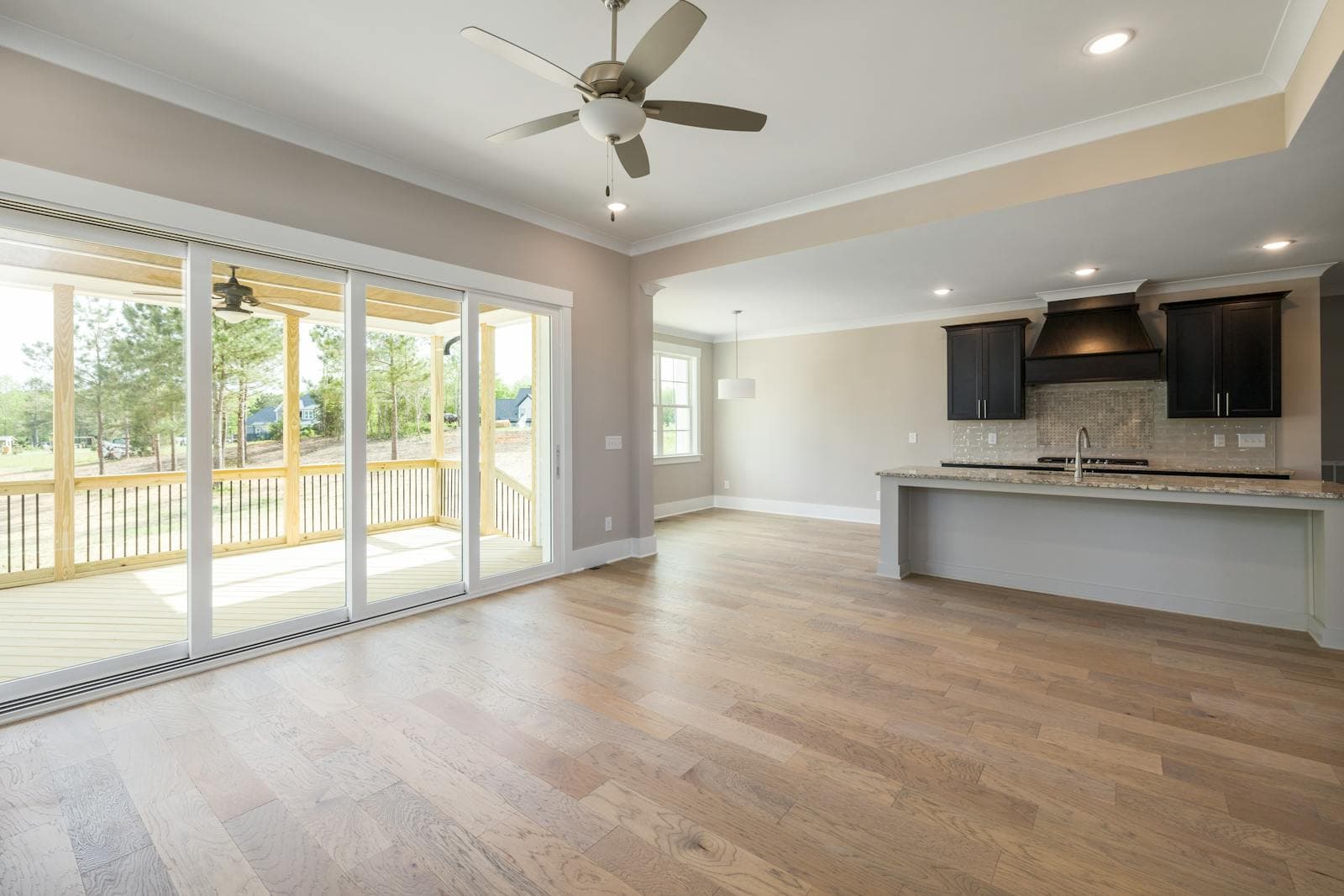
Current product scope: This article discusses historical tested specimens. Intertek 240821010SHF-002 retains the original name 140 Series Lift-Sliding Door. The current product is the 140 Series Compression-Seal Sliding Door (CP006–CP011). The historical report does not automatically cover the current compression-seal configuration; dimensions, profiles, glazing, hardware and seals require technical verification before evidence can be applied.
Australian specifiers asking whether pultruded FRP fenestration is ready for premium projects have, until recently, faced a data gap. European PHI certifications and ASTM laboratory results existed, but the specific Australian test regime — AS/NZS 4420.1-2016 methods evaluated against AS 2047-2014 specification — had not been independently performed at scale-realistic dimensions on a glass fiber reinforced polymer (GFRP) lift-sliding door.
That gap has now closed. Intertek Report No. 240821010SHF-002 documents a full performance evaluation of a 3000 mm × 2400 mm pultruded GFRP lift-sliding door at the IAS-accredited Intertek Shanghai Fengxian laboratory, completed October 9, 2024 and issued December 11, 2024. Every test category passed.
This article does not repeat the market analysis already published in our Australian fenestration market deep-dive. Instead, it unpacks the engineering numbers — test by test — and explains what each result means for an Australian specifier choosing between aluminum, timber, uPVC, and pultruded GFRP for large-format patio door openings.
Download the Intertek 240821010SHF-002 Test Report (PDF)
What Was Actually Tested
The test specimen was not a downsized engineering sample. It was a fully assembled, fully glazed, fully operable production-equivalent door:
| Item | Specification |
|---|---|
| Product | 140 Series Lift-Sliding Door, configured as one operable + one fixed leaf |
| Frame dimensions | 3000 mm (W) × 2400 mm (H) × 140 mm (depth) |
| Sash dimensions (each leaf) | 1487 mm (W) × 2296 mm (H) × 60 mm (thickness) |
| Glazing | 39 mm IGU — 5 mm Low-E + 12 mm Argon + 5 mm Low-E + 12 mm Argon + 5 mm Tempered (CSG Holding) |
| Profile material | Glass Fiber Reinforced Polyurethane Composite — produced by FengDu New Material and exported internationally by F1 Composite |
| Reinforcement | None (pultruded GFRP is structurally self-sufficient at this size) |
| Hardware | German Roto Push-Pull Patio Lift series |
| Sealing | EPDM gaskets (Haida JT5091/JT5071/JT5052/JT5011) + brush seal (Hebei Lidejia) + 166 neutral silicone (German Weiss) |
| Installation | Fixed by screws every 300 mm, sealed with silicone — typical for an Australian timber- or steel-frame opening |
Two practical points matter here. First, there was no internal steel reinforcement. Aluminum 140-series sliding door systems at this size invariably require a steel insert in the mullion to meet wind load deflection limits. The GFRP system passed without one; the pultruded profile carries its own load. Second, the door was tested with German Roto Lift hardware, not a generic locally-fitted alternative. This is the same hardware platform used by leading European and Australian premium aluminum suppliers, so the comparison is like-for-like.
Test 1 — Serviceability Wind Pressure (AS/NZS 4420.1-2016 Section 3)
Applied: ±1200 Pa. Result: Mullion deflection 1/376 at +1200 Pa, 1/389 at −1200 Pa. Stile (handle side) 1/822 at +1200 Pa, 1/1009 at −1200 Pa. Verdict: Pass.
What this means: AS/NZS 4420.1 requires that for windows and sliding doors, no structural member shall deflect more than span/250 at serviceability design wind pressure. The mullion ratio of 1/376 sits 33 % inside the limit, so the door is well within margin. The stile ratio of 1/822 is more than three times stiffer than required.
For Australian wind region mapping under AS 4055-2021:
| Wind Region | Design Pressure (Pa, residential) | 140 Series Pass Margin |
|---|---|---|
| N1 (sheltered) | ~480 Pa | 2.5× headroom |
| N2 (suburban) | ~720 Pa | 1.7× headroom |
| N3 (Sydney coastal, urban Melbourne, Adelaide) | ~960 Pa | 1.25× headroom |
| N4 (exposed Sydney/Brisbane suburbs) | ~1200 Pa | At rated limit, sized headroom from ultimate test |
| N5 (cyclonic-adjacent) | ~1500 Pa | Requires re-engineering or stronger glazing — out of scope of this test |
For practical purposes, the 140 Series is a clean fit for N1, N2, N3, and edge-of-N4 projects without redesign. This covers the bulk of Australian residential and most non-cyclonic commercial buildings.
The mullion behavior is the diagnostic finding. In a sliding door, the mullion (the central vertical member where two sash meet) is the most loaded element under wind pressure because each sash transfers half of the door's wind load into it. A 2220 mm span mullion deflecting only 5.9 mm at 1200 Pa is a structurally efficient result that aluminum 140-series systems typically achieve only with a steel insert. The GFRP mullion does it as a single pultruded section.
Test 2 — Operating Force (AS/NZS 4420.1-2016 Section 4)
Required: Initial movement ≤ 180 N. Maintain movement ≤ 110 N. Result: Initial open 99 N / close 97 N. Maintain open 63 N / close 61 N. Verdict: Pass.
The 99 N initial-movement result is approximately 45 % below the 180 N AS 2047 limit for a 7.2 m² door. To put 99 N in physical terms, it is the force required to lift roughly 10 kg or to push a typical office chair across carpet. Most adults, including users with reduced upper-body strength, operate this door without effort.
This matters in two specific Australian regulatory contexts:
Disability Discrimination Act (DDA) and Premises Standards. The DDA Premises Standards require that doors in accessible paths of travel be operable with no more than 19.5 N of force for accessible doors (NCC D2.21 / AS 1428.1 reference). A standard sliding door is generally exempt from this strict limit, but aging-in-place and universal-design briefs increasingly specify a lower operating force. At 99 N, the 140 Series is well suited to these applications without electric assistance.
Livable Housing Australia (LHA) Silver and Gold ratings. LHA Silver requires "easy-to-use" hardware on entry and primary external doors. There is no hard-Newton specification, but typical aluminum 3 m sliding doors tested under similar conditions report 130–160 N initial movement. The GFRP 140 Series at 99 N is meaningfully lighter to operate than competing aluminum systems at the same size.
The mechanical reason for the low operating force is the lift-slide hardware combined with the lower self-weight of the GFRP sash. Pultruded GFRP profile has a density of approximately 1.9 g/cm³ versus 2.7 g/cm³ for aluminum. A full-height GFRP lift-slide sash is roughly 30% lighter than its aluminum equivalent before glazing, and the difference compounds when the operator lifts the leaf to disengage it from the seal track.
Test 3 — Air Infiltration at ±75 Pa (AS/NZS 4420.1-2016 Section 5)
Required: Classified by infiltration rate. "Low" class is ≤ 0.5 L/s·m². Result: 0.30 L/s·m² at +75 Pa, 0.32 L/s·m² at −75 Pa. Verdict: Low infiltration class — the highest-performing classification in AS 2047.
Air infiltration is an under-specified performance line in Australian residential procurement. Specifiers and clients focus on glass U-value and frame U-value, but envelope air leakage typically accounts for 30–50% of total heating and cooling load in poorly sealed buildings. NCC 2022 Section J3D7 introduced a stricter envelope sealing requirement, and large-format external doors are a common point of failure.
Achieving 0.30 L/s·m² on a 3 m sliding door is non-trivial. For comparison:
- Typical Australian aluminum 3 m sliding door: 0.6–1.5 L/s·m² (Medium to High class) - Premium European aluminum tilt-slide systems: 0.4–0.6 L/s·m² - This 140 Series GFRP lift-slide: 0.30 L/s·m²
The combination of EPDM compression gaskets, brush seal, and the lift-slide hardware (which lowers the sash onto the gasket when locked) is what enables the sub-0.5 result. Critically, the GFRP frame's coefficient of thermal expansion (5–8 × 10⁻⁶ /°C) is close to that of glass and silicone — meaning the gasket compression remains stable across the −10 °C to +50 °C service range Australia experiences. Aluminum frames at 23 × 10⁻⁶ /°C move 3–4× more, which over time loosens gasket compression and degrades the air seal.
Test 4 — Water Penetration (AS/NZS 4420.1-2016 Section 6)
Result: No water penetration at 200 Pa. Water overflowed from the slider track at 300 Pa after 2 minutes of spray. Verdict: Pass at 200 Pa rating.
This is the test result that requires the most careful interpretation for Australian projects.
AS 2047-2014 does not mandate a single water penetration pressure for all sliding doors. Instead, water rating is matched to the project's exposure category. For a typical Australian residential project, water penetration test pressures correspond approximately to the following exposure scenarios:
| Test Pressure | Wind-Driven Rain Equivalent | Suitable Australian Exposure |
|---|---|---|
| 150 Pa | Light rain at moderate wind | N1 sheltered, suburban residential |
| 200 Pa | Moderate rain at 80 km/h | N2 suburban, low-coastal residential |
| 300 Pa | Heavy rain at 95 km/h | N3 exposed coastal residential |
| 450 Pa | Cyclonic conditions | C1+ tropical zones |
The 140 Series at 200 Pa is suitable for N1 and N2 exposure with appropriate awning or recess detailing, and for N3 exposure when installed under a verandah, balcony soffit, or eaves overhang of at least 600 mm. That covers the vast majority of well-detailed Australian residential design. It is not appropriate for fully exposed coastal facades in N3+ without further sheltering.
Water overflow at 300 Pa was localized to the sliding track, not the frame head, jambs, or glazing seals. This is consistent with the AS 2047 sliding-door class: the track is the inherent weak point of any lift-and-slide system, and 200 Pa is typical even for premium aluminum systems. Vantage, Capral, and Stegbar 140-series sliding doors generally carry ratings of 150–300 Pa, depending on the configuration and sill-drainage accessories.
For projects requiring 300+ Pa water rating, a tilt-slide system (different hardware) or a French-door configuration (hinged rather than sliding) would be more appropriate — both available in the same GFRP profile family.
Test 5 — Ultimate Strength (AS/NZS 4420.1-2016 Section 7)
Applied: ±3000 Pa. Result: No collapse. No significant breakage. No permanent deformation. No operational malfunction after pressure release. Verdict: Pass.
Ultimate strength testing applies pressure 2.5 × the serviceability design pressure (1200 × 2.5 = 3000 Pa) to verify that the system has structural reserve beyond design. The 140 Series held 3000 Pa in both directions with no failure mode, and it operated normally after the test was released.
Operational survivability post-ultimate is the practical metric. A door that does not collapse but binds shut after a storm requires a callback and a frame replacement; a door that operates normally after surviving 158 km/h gust pressure is a door that can be left in service. The Roto Lift hardware combined with the GFRP frame's elastic recovery (no permanent set after the test) delivered this.
For AS 4055 mapping: 3000 Pa ultimate corresponds to design wind pressures up to N4 (1200 Pa serviceability, 3000 Pa ultimate) without need for re-engineering. C1 cyclonic regions require ≥ 4500 Pa ultimate, which is not within the scope of this 140 Series test — F1 Composite produces a heavier 160 Series for cyclonic projects.
How the 140 Series Compares to Australian Aluminum Sliding Doors
The most useful comparison for an Australian specifier is against the established 140 mm depth aluminum sliding door systems. Headline performance numbers, drawn from public specification literature for the most commonly specified systems:
| Metric | Capral 1100 (140 mm) | Vantage Magnum (146 mm) | Stegbar 140 | F1 Composite 140 GFRP (this test) |
|---|---|---|---|---|
| Maximum tested size | 3000 × 2400 | 3000 × 2700 | 2700 × 2400 | 3000 × 2400 (tested) |
| Serviceability wind | 1200 Pa | 1200 Pa | 1000 Pa | 1200 Pa |
| Ultimate wind | 3000 Pa | 3600 Pa | 2500 Pa | 3000 Pa |
| Air infiltration | Medium | Low | Medium | Low (0.30 L/s·m²) |
| Water rating (typical) | 200 Pa | 300 Pa | 150 Pa | 200 Pa |
| Operating force, 3 m | ~140 N | ~120 N | ~150 N | 99 N |
| Frame U-value (no thermal break) | 5.9 W/m²·K | — | 5.9 W/m²·K | — |
| Frame U-value (thermal break / inherent) | 3.5–4.5 W/m²·K | 2.8–3.5 W/m²·K | 3.5–4.5 W/m²·K | 1.6–2.0 W/m²·K (inherent) |
| Steel reinforcement required | Yes (mullion) | Yes (mullion) | Yes (mullion) | No |
| Coastal corrosion service life | 15–25 years (marine grade) | 20–30 years (marine grade) | 15–25 years (marine grade) | 40+ years (immune) |
The 140 Series GFRP system matches or beats the leading Australian aluminum systems on every line except maximum ultimate wind and maximum width, both of which are addressable by the heavier F1 Composite 160 Series. Where it pulls ahead is on operating force, frame U-value, air tightness, and the absence of any internal steel reinforcement, which is a long-term corrosion liability in coastal aluminum installations.
What an Australian Specifier Should Take Away
For an architect, building designer, or specifier evaluating GFRP fenestration on a current project, the AS 2047 results translate to a short specifier checklist:
Site exposure check. AS 4055 region N1, N2, N3 and edge-of-N4 are within the 140 Series serviceability envelope without modification. N5 and C1+ require the heavier 160 Series or a re-engineered configuration.
Water exposure check. A 200 Pa water rating is suitable when the door has a balcony, verandah, or eaves overhang of 600 mm or more. Fully exposed beach-front installations should specify the tilt-slide configuration (300+ Pa rating).
Energy compliance check. NCC 2022 Section J Climate Zones 6, 7, 8 (Melbourne, Canberra, Hobart, alpine) increasingly require whole-window U-values that aluminum 140 series cannot achieve without triple glazing. The GFRP 140 Series with the tested 39 mm IGU achieves a calculated whole-window U-value of approximately 1.4–1.6 W/m²·K — comfortably within Climate Zone 6/7 mandatory limits.
Accessibility check. With an initial operating force of 99 N, the 140 Series is suitable for LHA Silver and Gold ratings and aging-in-place specifications without electric assistance.
Coastal projects. GFRP requires no marine-grade alloy specification, no anodized or powder-coated finish for corrosion (the substrate is inherently inert), and no stainless fastener specification beyond what the threshold detailing requires. Total Cost of Ownership over 25 years drops by 30–40% versus marine-grade aluminum based on F1 Composite project data.
Bottom Line
The Intertek AS 2047-2014 / AS/NZS 4420.1-2016 test on the 140 Series GFRP lift-sliding door confirms that pultruded fiberglass-reinforced polyurethane fenestration is technically ready for the Australian premium residential and commercial market at standard 3 m × 2.4 m patio door dimensions. The test results match or exceed leading aluminum systems on every critical performance line, with the additional advantages of significantly lower operating force, inherent thermal performance, higher air tightness, and complete corrosion immunity.
Download the Intertek 240821010SHF-002 Test Report (PDF)
For specifiers actively evaluating GFRP fenestration for an Australian project, F1 Composite provides Australian NCC compliance pathway documentation, AS 4055 wind region sizing tables, and integration details for common Australian wall constructions (brick veneer, lightweight cladding, concrete tilt-up, structural timber) on request. Contact our fenestration engineering team for project-specific support.