Walk into any high-end architectural showroom in Sydney, Melbourne, Vancouver, Munich, or Dubai. Look at the prestige residential window mock-ups on display. Then run your fingertips across the frames.
The aluminum frames are smooth, dense, and uniform — a finish that feels engineered. The high-performance fiberglass frames next to them are not quite the same. They have a faint surface texture that is easier to feel than to see: a nearly imperceptible micro-grain that reveals the pultruded profile's underlying fiber architecture under directional light or a darker pigment. It is not a defect. It is the visible trace of the surface mat that gives the profile its cross-directional strength.
For specifiers, that texture has quietly kept fiberglass fenestration from displacing aluminum on projects where finish quality drives material selection. The thermal-performance argument was won years ago. The corrosion argument was won decades ago. The structural argument is settled. Until recently, the remaining question was whether a fiberglass window could blend into the building envelope as seamlessly as a powder-coated aluminum window.
This article walks through why that signature exists, how the industry has historically dealt with it, and the pultrusion architecture innovation — transverse reinforcement embedded beneath a resin-rich surface zone — that finally removes it.
The Glass-Fiber Telegraph Problem
In a conventional pultruded fiberglass profile, the fiber architecture from the inside out is approximately:
| Layer (inside → outside) | Function | Typical Material |
|---|---|---|
| Core roving | Axial tensile strength | E-glass unidirectional roving (60–70% by weight) |
| Continuous strand mat (CSM) | Cross-direction strength | Chopped E-glass mat, 300–600 g/m² |
| Surface mat / surfacing veil | Surface protection, UV barrier | Polyester veil, 30–50 g/m² |
| Resin matrix | Binder, surface gloss | Polyester, vinyl ester, polyurethane |
Cross-direction strength is non-negotiable in a fenestration profile. A window frame is loaded across multiple axes simultaneously — wind pressure pushes outward against the long span, hardware loads pull at corners, glazing weight bears down on the bottom rail, and operating force concentrates at lock points. Without cross-direction reinforcement (CSM, woven fabrics, or stitched multi-axials), a profile that runs only longitudinal roving will splinter at lock cut-outs and fail at corner welds.
The dilemma is that the cheapest, fastest, and most universally adopted way to deliver cross-direction strength — continuous strand mat placed near the surface — telegraphs its texture through any thin coating applied on top. CSM is by definition a randomly oriented mat of chopped fibers. After cure, the surface above it is not perfectly flat at the micro scale; the resin shrinks slightly during cure, and the fibers directly beneath the surface "print" their pattern into the cured top coat. The effect is most visible on dark colors, satin/matte finishes, and any direction-of-light condition that grazes the surface.
A 60–80 micron architectural powder coat cannot fully bridge this micro-topography. The profile may look smooth from a normal viewing distance, but specifiers, architects, and discerning end-users notice it under raking light or close inspection.
This is the unspoken reason fiberglass fenestration has not been the default choice for many premium projects.
How the Industry Has Historically Responded
Two approaches have emerged in the established fiberglass fenestration category, and each has tradeoffs.
Response 1: Embrace the texture as an aesthetic signature. Established North American fiberglass window brands — for example, the Pella Impervia line, a category benchmark for more than two decades — position the subtle surface texture as part of an "engineered durability" aesthetic. They support it with a curated palette of approximately ten color options optimized for the substrate. This coherent product strategy serves a clear customer segment well. However, it does not satisfy specifications that require an unrestricted RAL palette, different interior and exterior colors, custom architectural pigments, or finishes that must blend visually with an adjacent powder-coated aluminum curtain wall on the same building.
Response 2: Add a surface cap film or in-line co-extrusion layer. Some manufacturers laminate a smooth thermoplastic capstock onto the pultruded profile during or after manufacture. This delivers a smoother starting surface but introduces three new problems: long-term adhesion of the cap to the substrate (capstock systems can delaminate after 15–25 years of UV and thermal cycling), additional cost ($/linear meter), and a coating system that is now a different chemistry from the substrate — meaning powder coating onto the cap requires its own qualification protocol. Capstock-based systems exist but have not become the category standard.
Neither response solves the underlying engineering problem: how do you keep cross-direction strength while removing the surface signature it creates?
A Third Approach: Transverse-Reinforced Architecture
The pultrusion architecture used in F1 Composite fenestration profiles takes a different path. Rather than placing the cross-direction reinforcement at the surface (where it has the easiest fiber wet-out and the lowest manufacturing cost), it places the cross-direction reinforcement deeper in the profile cross-section and protects it with a deliberate resin-rich surface zone above and a finely-knit synthetic surfacing veil at the outermost layer.
The resulting layer stack looks like this:
| Layer (inside → outside) | Function | Material in F1 Composite Architecture |
|---|---|---|
| Inner core | Longitudinal tensile strength | E-glass unidirectional roving |
| Stitched multi-axial fabric | Cross-direction (transverse) strength | Stitched ±45° / 90° E-glass non-crimp fabric, embedded mid-cross-section |
| Resin-rich transition zone | Decouples internal fiber topography from surface | Polyurethane resin, 200–400 µm depth |
| Synthetic surfacing veil | Surface uniformity, UV barrier, paint adhesion | Fine non-woven synthetic veil, < 20 µm fiber diameter |
| Cured finish surface | Coating substrate | Polyurethane resin matrix |
Three engineering choices make this work.
Choice 1: Transverse strength is delivered by a stitched multi-axial fabric, not a chopped strand mat. Stitched non-crimp fabrics with ±45° and 90° fiber orientations deliver cross-direction tensile and shear properties superior to CSM at the same fiber weight, with a fraction of the surface texture printing risk because the fibers are aligned and bound rather than randomly placed. The cost is higher per kilogram of reinforcement, but the structural efficiency is also higher — less material is needed to hit the same cross-direction performance target.
Choice 2: The transverse fabric is buried mid-section, not surface-adjacent. Because the fabric is structurally most effective when it spans the section, not when it sits at the skin, placing it deeper in the profile actually improves both surface quality AND structural efficiency. The resin-rich transition zone above it is 200–400 µm thick — enough to fully decouple the surface topography from the underlying fiber pattern.
Choice 3: The matrix is polyurethane, not polyester or vinyl ester. Polyurethane resin pultrusion has lower cure shrinkage and superior wet-out of fine surfacing veils than polyester systems. The result is a substrate that comes off the pultrusion line with mirror-finish surface quality, ready for direct architectural powder coating without a fill-and-sand pre-treatment step.
This is what we mean by transverse-reinforced architecture: cross-direction strength delivered structurally by an internal stitched fabric, not aesthetically compromised by a surface mat.
What Changes Visually
The output of this architecture is a coated fenestration profile that is genuinely indistinguishable from architectural-grade powder-coated aluminum across every meaningful inspection dimension:
| Inspection | F1 Composite Pultruded GFRP Profile | Architectural Powder-Coated Aluminum |
|---|---|---|
| Direct viewing distance (300 mm) | Uniform, no fiber signature visible | Uniform |
| Raking light, 15° | Uniform, no telegraph | Uniform |
| Tactile micro-roughness (Ra, µm) | 0.4–0.8 µm | 0.4–1.0 µm |
| Gloss uniformity (60° per ISO 2813) | ±2 GU across 6 m | ±2 GU across 6 m |
| Dark-color acceptability (RAL 9005, 7016) | No visible defect | No visible defect |
| Dual-tone (different RAL inside vs outside) | Supported on 70 mm + profiles | Supported |
| Custom RAL or NCS color | Yes (no minimum order beyond standard powder lot) | Yes |
| Coating thickness (µm) | 60–100 µm | 60–100 µm |
| Cross-hatch adhesion (ISO 2409) | Class 0 (no flaking) | Class 0 |
In side-by-side architectural mockups, neither the architect nor the building owner can distinguish the powder-coated F1 Composite GFRP frame from the powder-coated aluminum frame in the same RAL color. The thermal performance underneath is, of course, dramatically different — frame U-value 1.6–2.0 W/m²·K for GFRP versus 3.5–4.5 W/m²·K for thermally broken aluminum — but the visual experience is identical.
What This Unlocks for Specifiers
Removing the surface-finish constraint expands the range of projects suitable for fiberglass fenestration.
Passive house and ultra-low-energy buildings. Architects working on Passivhaus-certified projects in Australia, Canada, the Pacific Northwest, and Northern Europe routinely require U_w ≤ 0.80 W/m²·K. Aluminum cannot reach this even with thermal breaks. PHI-certified GFRP fenestration can — F1 Composite's 90 Series holds PHI Component ID 2491wi03 at U_w 0.78. With architectural-grade powder coating in any RAL, these projects no longer face an aesthetic compromise to achieve their energy target.
Class A commercial and hospitality. Hotel facades, premium office buildings, and luxury retail interiors specify finishes that meet architectural coating standards, typically AAMA 2605. Until recently, the uncertainty around specifying a fiberglass window under AAMA 2605 involved substrate finish quality, not coating chemistry. On transversely reinforced GFRP profiles, AAMA 2605 powder coatings are applied, qualified, and finished using the same process and standards as coatings on aluminum.
Coastal premium residential. Beach-front Australian, Mediterranean, and Pacific Coast US projects specify aluminum because it can take a coating, despite knowing that aluminum in salt air will eventually fail. GFRP solves the corrosion problem at the substrate level — and now solves the finish problem too. The coating is no longer the only argument for aluminum.
Architectural curtain-wall integration. When a building combines fenestration with adjacent powder-coated aluminum curtain wall, mullions, or cladding, the visual continuity matters. Mismatched textures or gloss between window frame and adjacent metalwork is immediately visible and is one of the most common reasons specifiers default to aluminum throughout the assembly. Transverse-reinforced GFRP fenestration finished to the same powder coat specification visually merges with the surrounding metalwork — extending the use of high-performance frame material across the entire architectural system rather than just isolated openings.
Two-tone and custom-color specifications. Designers increasingly specify a dark exterior color (RAL 9005 black, 7016 anthracite, or 7022 umbra gray) paired with a warm interior tone (wood-look oak, cream, or RAL 1015 light ivory). This is straightforward on aluminum and on F1 Composite's transversely reinforced architecture. It is harder to achieve cleanly on conventional fiberglass profiles, where the surface texture limits finish choices, particularly with dark or matte colors that make fiber print-through more visible.
A Note on Coating Process
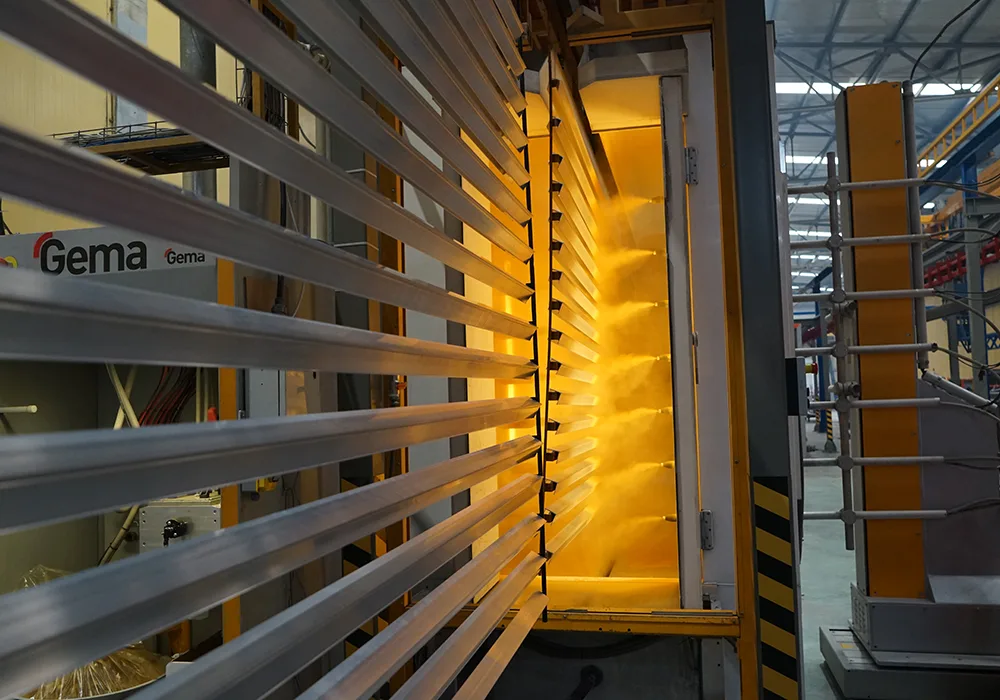
The powder coating process applied to F1 Composite fenestration profiles is the same process applied to architectural aluminum extrusions: surface preparation (degrease, light abrasion, ultrasonic clean), conversion-coat or adhesion primer where required, electrostatic powder application in a downdraft booth, and oven cure at 180–200 °C for 15–20 minutes. The full process and standards alignment are documented in our companion article on powder-coated FRP window profiles for architectural finishes. What this article adds is the substrate-side innovation that makes the coating process produce architectural-grade results rather than near-architectural-grade results.
Bottom Line
For thirty years, pultruded fenestration treated cross-direction strength and surface-finish quality as a tradeoff. Brands that prioritized structural efficiency accepted a visible surface texture; brands that prioritized finish quality added capstock films or reduced the cross-direction reinforcement. That tradeoff was real until the reinforcement was repositioned, both structurally and chemically, within the profile so that it no longer affected the coated surface.
That repositioning is what F1 Composite calls transverse-reinforced architecture. It is not a coating innovation. It is a substrate architecture innovation that lets the coating do its job. The result is a pultruded GFRP fenestration profile that hits the structural targets (EN 13706, AS 2047, AAMA/WDMA classifications), hits the thermal targets (whole-window U_w 1.4–1.6 W/m²·K with the right glazing), and now hits the architectural finish targets (AAMA 2604/2605, Qualicoat Class 1/2, full RAL palette, dual-tone capable).
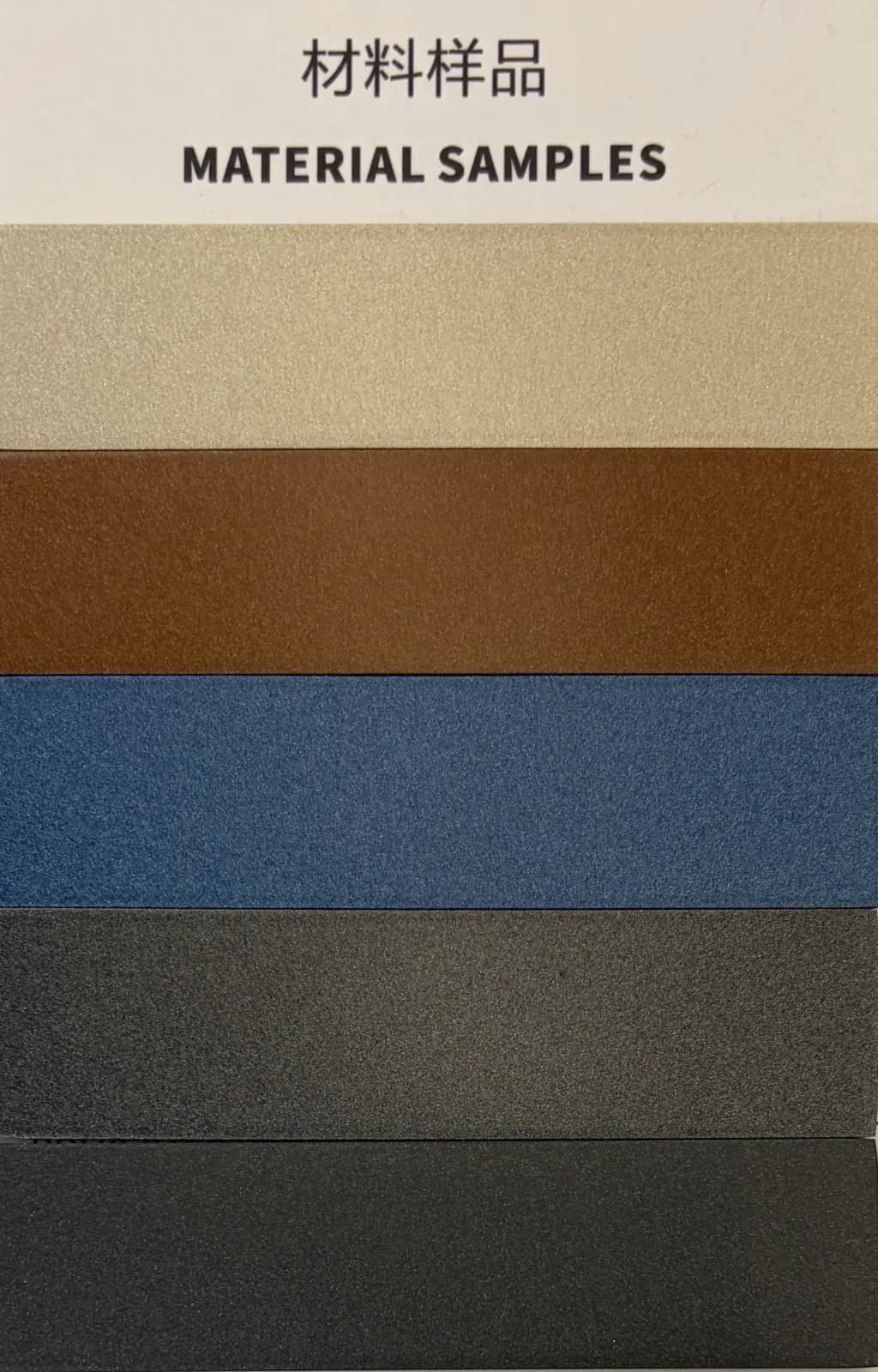
For specifiers seeking a fiberglass option that does not require an aesthetic compromise, that option is now available. F1 Composite supplies its 65, 70, 80, and 90 Series fenestration profiles with transversely reinforced architecture and factory-applied powder coatings that meet AAMA 2604, AAMA 2605, or Qualicoat Class 1 or Class 2 standards. Finish samples are available in any RAL or NCS color; project-specific matching to existing curtain-wall finishes is available on request.