Sourcing pultruded FRP profiles directly from a Chinese manufacturer can reduce delivered cost by 30–50% compared with buying from a regional distributor in North America, the UK, or Europe. The catch is that buyers realize those savings only when the procurement process is structured correctly. Buyers who treat FRP like a commodity steel section (issuing an RFQ, accepting the lowest bid, and hoping for the best) often receive profiles that fail incoming inspection, miss the project schedule, or cost more after delivery than a domestic source would have.
This guide walks through the procurement process F1 Composite has refined across 30+ countries of direct-from-factory export. The framework applies whether you buy from us or from a peer Chinese pultrusion factory.
Why source from China in 2026
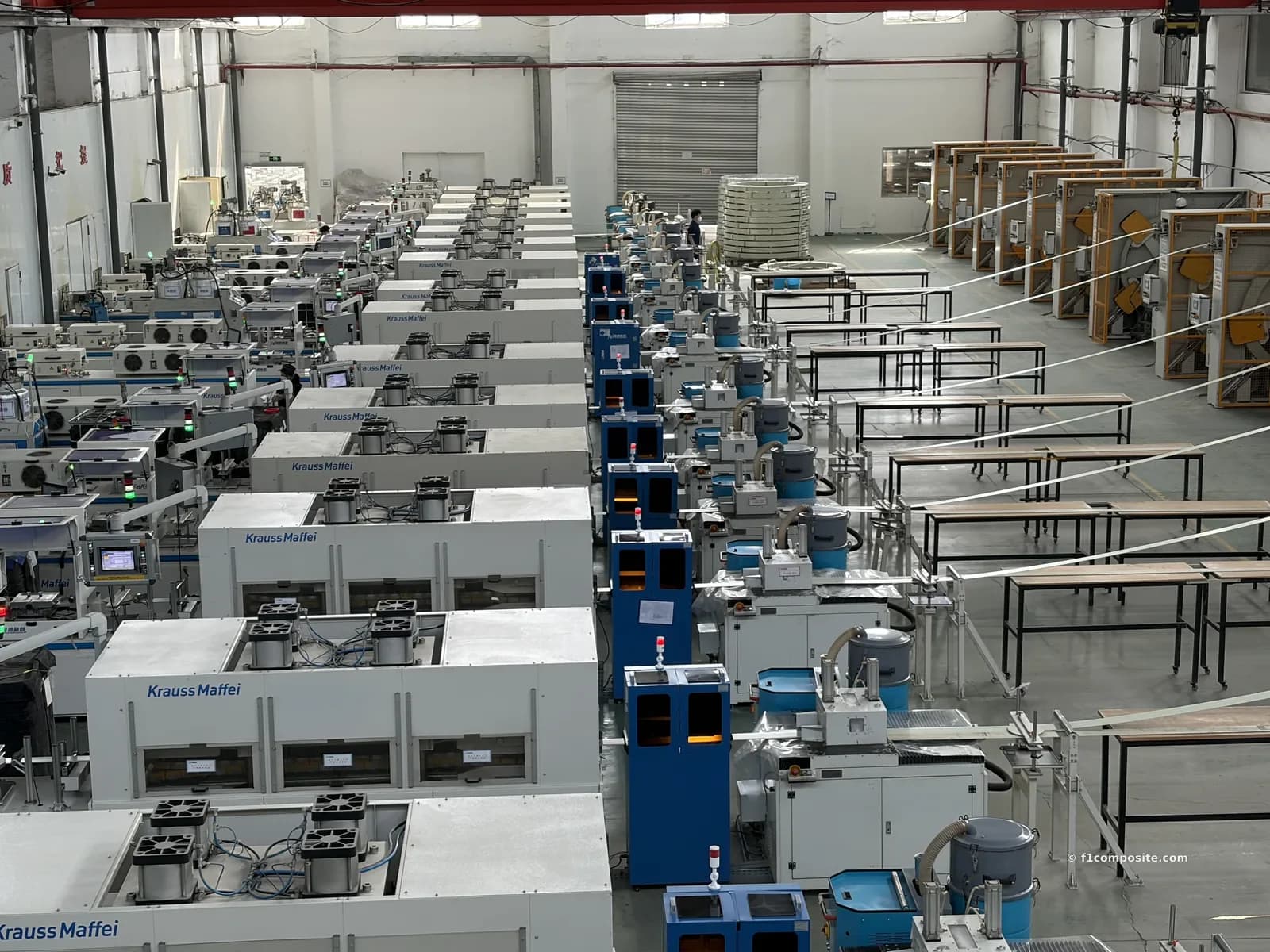
The FRP pultrusion industry now has three roughly comparable centers of capacity: North America (Strongwell, Creative Pultrusions, Liberty Pultrusions, Fibergrate), Europe (Fiberline, Exel Composites, Topglass), and China, where a handful of large factories (including the FengDu network F1 Composite exports from, with 5 production sites and 370 pultrusion lines) sit alongside a long tail of regional players.
The structural quality benchmark for all three regions is the same: EN 13706 E17/E23 grades and ASTM D3917 dimensional tolerance. Factories that hold ISO 9001 and produce to these standards in China deliver mechanical properties indistinguishable from US or European peers in third-party laboratory testing.
Where China sources differ is on three commercial axes:
1. Factory-direct pricing. Buying direct removes the distributor margin. Compare landed cost line by line, because freight, duty and inspection add part of the difference back. 2. Custom tooling. Large Chinese plants run their own tooling shops. At F1 a new die takes 4–8 weeks, and the first delivery follows 6–10 weeks after drawing approval. 3. Capacity for large orders. FengDu's production network, which F1 exports from, runs about 150,000 t a year across 5 bases. Stocking-distributor inventory in the US or EU rarely supports a single-project order above 30 tonnes without long lead times.
The trade-offs are sea freight time (25–40 days to most ports), Incoterms complexity, and the overhead of qualifying a factory you cannot visit easily.
Step 1: Qualify the factory before requesting a quote
The single biggest procurement mistake is treating an FRP RFQ like a steel RFQ, sending it to ten suppliers and comparing line-item prices. FRP varies meaningfully between factories on fiber architecture, resin chemistry, and surface finish. A 30% price difference between two Chinese suppliers on the same nominal profile usually reflects a real difference in product, not just margin.
Before you send any RFQ, qualify the factory on four points:
(a) Manufacturing standards. Ask for the certificate scope of EN 13706 (E17 and/or E23 grade, which profile families are covered) and ISO 9001:2015. A factory that lists "EN 13706" without a grade or scope is a flag. Established Chinese pultrusion factories will show the actual certificate scope on request. F1 Composite sends each certificate with its holder, number and scope.
(b) Mechanical test capability. Ask whether the factory operates an in-house mechanical test lab and whether they will issue a Mill Test Certificate (MTC) per batch. Tested values should be referenced against ASTM D638 (tensile), ASTM D790 (flexural), ASTM D695 (compressive), and ASTM D2344 (interlaminar shear). A factory without an in-house lab can still qualify, but you will need third-party testing on the first article, which adds 2–3 weeks.
(c) Existing export markets. Ask which countries the factory actively exports to. A factory exporting to the US, Germany, the Netherlands, Australia, or Saudi Arabia has been through customs documentation, port-of-entry inspection, and project-level QC at scale. A factory whose export experience is concentrated in a single low-regulation market is higher risk.
(d) Custom tooling capability. If your project needs anything beyond stock standard profiles, the factory must operate its own tooling shop. Outsourced tooling adds 3–4 weeks and, more importantly, removes the manufacturer's ability to debug a die that is producing dimension-out profiles in the first run.
A 20-minute video call with the factory technical contact answering these four questions filters out 60–70% of the suppliers a first-time buyer might consider.
Step 2: The RFQ checklist that gets a complete quote
A vague RFQ ("please quote pultruded FRP profile, 100×100, vinyl ester, 5000m") generates a vague quote. The factory will assume the cheapest possible interpretation of every undefined parameter, which means your apples-to-apples comparison across suppliers is impossible.
Send this seven-line RFQ instead:
| Field | Example |
|---|---|
| Profile | I-beam, 200×100×10 mm; or custom drawing attached |
| Quantity | 5,000 linear meters |
| Resin system | Isophthalic polyester / vinyl ester / polyurethane / phenolic |
| Standard | EN 13706 E23 / ASTM D3917 / both |
| Surface finish | Standard veil / synthetic veil + UV / powder-coat ready |
| Application & environment | e.g. coastal walkway, salt-spray, 25-year design life |
| Delivery terms | FOB Shanghai / CIF Rotterdam / DAP project site, target arrival date |
With these seven lines in the RFQ, an established factory can quote without a round of questions. F1 Composite replies to every RFQ within one business day. Factories that take 5–10 days to respond to a complete RFQ are operationally weak; this usually predicts schedule slips on the actual production order too.
Step 3: Understand MOQ, lead time, and tooling economics
Standard catalog profiles (I-beam, channel, angle, flat bar, square tube and round tube in common sizes) run on existing dies, so there is no tooling charge and small orders are possible. At F1 Composite they ship in 2–4 weeks, and the minimum quantity is confirmed for the section and resin. Pricing is unit-based, with mild volume breaks at 1,000 m / 5,000 m / 20,000 m.
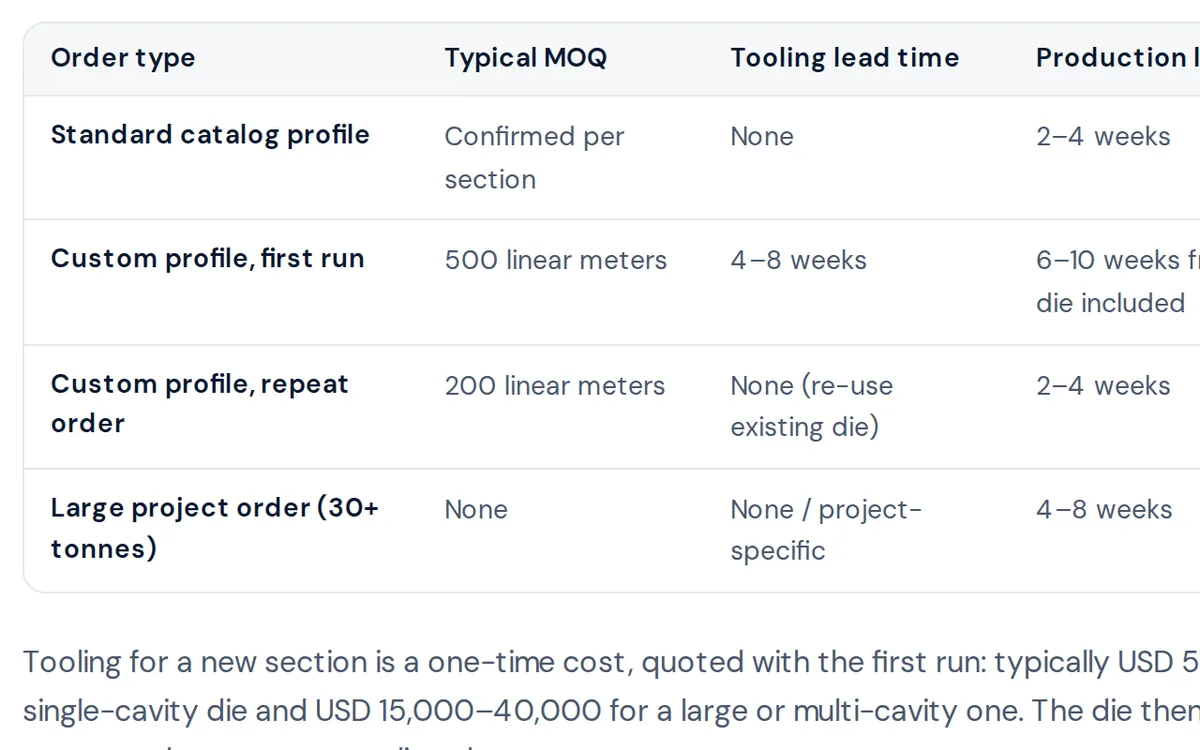
Custom profiles (any cross-section that is not in the standard catalog) require dedicated tooling and have an MOQ for the first run:
| Order type | Typical MOQ | Tooling lead time | Production lead time |
|---|---|---|---|
| Standard catalog profile | Confirmed per section | None | 2–4 weeks |
| Custom profile, first run | 500 linear meters | 4–8 weeks | 6–10 weeks from drawing approval, die included |
| Custom profile, repeat order | 200 linear meters | None (re-use existing die) | 2–4 weeks |
| Large project order (30+ tonnes) | None | None / project-specific | 4–8 weeks |
Tooling for a new section is a one-time cost, quoted with the first run: typically USD 5,000–8,000 for a small single-cavity die and USD 15,000–40,000 for a large or multi-cavity one. The die then stays at the plant, so repeat orders carry no tooling charge.
The single biggest scheduling mistake is not allowing for tooling lead time on the first run. Plan 6–10 weeks from drawing approval to first delivery (4–8 weeks of it for the die) plus 25–40 days of sea freight: about 10–16 weeks from PO to project site for a custom profile shipped CIF to Europe. Catalog profiles cut this to about 6–10 weeks.
Step 4: Incoterms and freight costs under FOB, CIF and DAP
Most Chinese FRP factories quote in three Incoterms:
FOB Shanghai / Ningbo / Shenzhen. The factory delivers the goods to the export port and clears Chinese customs. The buyer arranges sea freight, destination port handling, import duty, and inland delivery. FOB is the lowest factory-quoted price but the highest buyer overhead. Use FOB only if you have an established freight forwarder.
CIF [destination port]. The factory arranges and pays for sea freight and basic insurance to the destination port. The buyer handles customs at destination and inland delivery. This is the most common mid-market Incoterms: the factory's freight pricing is competitive because they ship containers daily.
DAP [project site]. The factory arranges everything to the project site, including destination customs, inland trucking, and unloading. DAP is roughly 8–15% above CIF but eliminates buyer-side logistics overhead. Best for project-based buyers with no in-house import logistics.
A 40' high-cube container holds approximately 18–22 tonnes of pultruded FRP profiles depending on cross-section density. Ocean freight from Shanghai to Rotterdam runs $1,200–2,500 per 40HC in 2026 (down sharply from 2021–2022 peaks). Ocean freight to LA/Long Beach runs $1,800–3,500 per 40HC. Insurance is typically 0.3–0.5% of cargo value.
Container loading: pultruded FRP profiles are usually packed in wooden crates or steel-banded bundles, with ends protected against impact damage. Bundle weight is held at 100–150 kg per bundle for forklift handling. Long profiles (over 12 m) require open-top containers or specialized flat-rack equipment, which adds cost: keep cut lengths at 6 m or 12 m where possible.
Step 5: Quality verification at receipt
When the container arrives, three checks catch 95% of quality issues before they affect the project:
1. Mill Test Certificate matches the order. Cross-reference batch numbers on the certificate against batch numbers stamped on the profiles. Tested mechanical values should meet or exceed EN 13706 E17 or E23 thresholds (whichever was specified). 2. Dimensional spot-check on 3-5 random pieces per cross-section. ASTM D3917 tolerance is ±0.25 mm on width and depth, ±0.5% on length. A digital caliper and a 5-meter tape measure are sufficient. 3. Surface inspection for veil coverage. No exposed glass fibers, no resin starvation patches, no surface cracks. A veil-deficient surface will weather poorly even if the structural performance is fine.
If issues are found, photograph and send to the factory within 48 hours. Established Chinese factories (F1 Composite included) replace defective material at factory cost. Documenting the issue at receipt rather than after installation is what activates the warranty.
Five common procurement mistakes
Mistake 1: Spec'ing only by dimensions, not by mechanical class. Two profiles with the same 200×100×10 dimensions can have 30% different stiffness depending on fiber architecture. Always specify EN 13706 E17 or E23, or specify minimum tested mechanical values.
Mistake 2: Mixing resin systems on a single project. Polyester and vinyl ester profiles cannot be bonded with the same adhesives; their thermal expansion coefficients differ slightly. Pick one resin system for a project and document it on the BOM.
Mistake 3: Ignoring UV protection. "Pultruded FRP is UV-resistant" is true at the resin level but not at the surface. Outdoor profiles need a synthetic veil plus a UV-stabilized resin or protective coating. Include this requirement in the RFQ.
Mistake 4: Underestimating lead time on first runs. Custom tooling, production and sea freight take about 10–16 weeks. Buyers planning around 8 weeks routinely miss project schedules.
Mistake 5: Not asking for a sample before the production order. Reputable Chinese factories ship 0.5–2 m sample pieces free or at nominal cost via DHL/FedEx air. A 5–7 day air sample is the cheapest way to verify surface quality and dimensions before committing to a 30-tonne order.
Bottom line
Sourcing pultruded FRP profiles directly from a qualified Chinese manufacturer is, in 2026, a standard procurement pattern across construction, infrastructure, energy, and marine projects worldwide. The savings versus regional distributors are real and the quality gap is largely closed at the top tier of Chinese factories. The buyer-side process is not standardized, and that is where most of the avoidable risk sits.
Before the RFQ, the fiberglass pultruded profile price estimator gives a planning price per meter for a standard section. If you need a starting point for your RFQ, send it through our contact form; F1 Composite replies within one business day. For application-driven sourcing, the AI Sourcing Assistant turns a free-form project description into a specification recommendation, certification guidance, and a clear path to a quote.