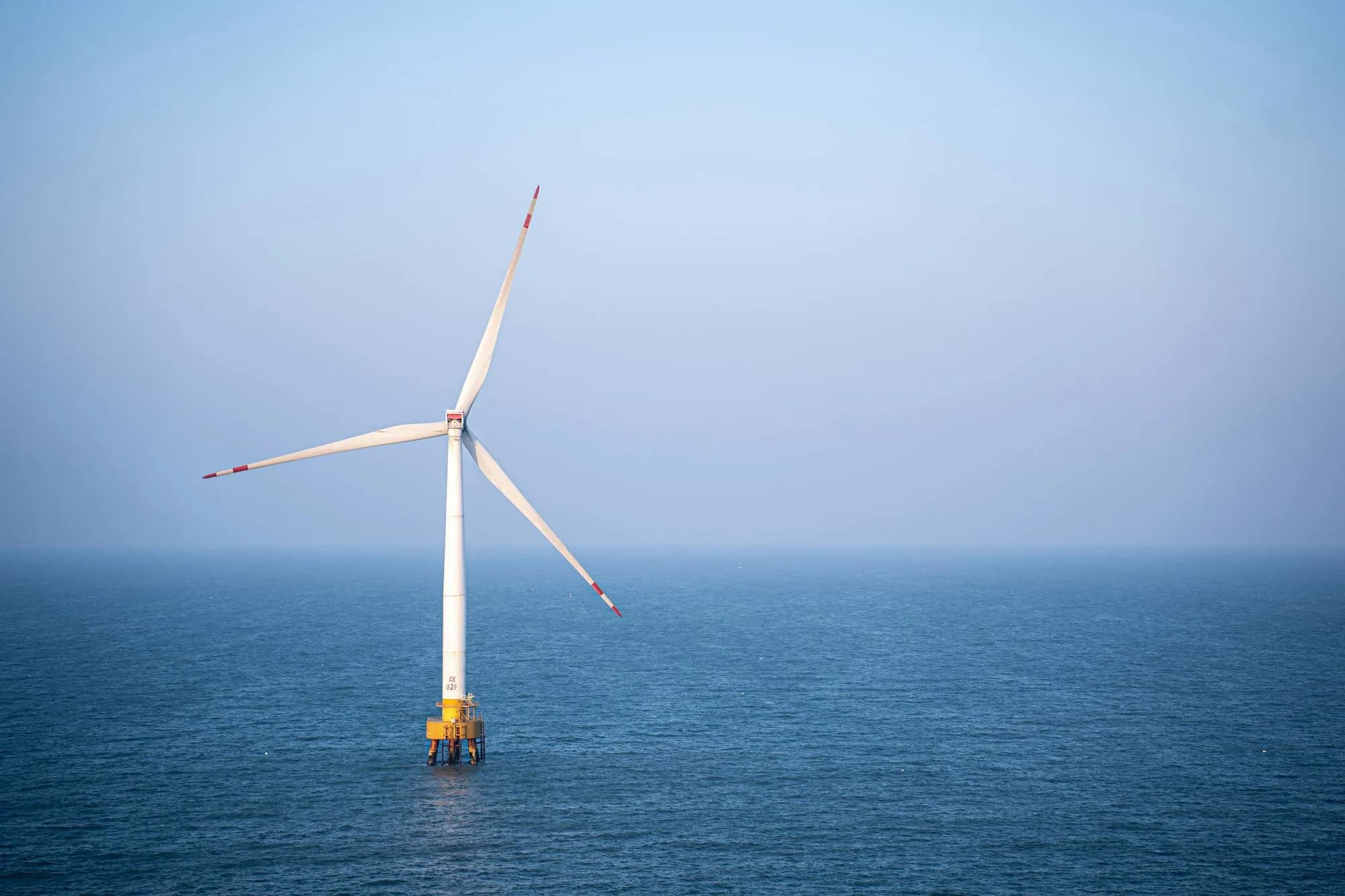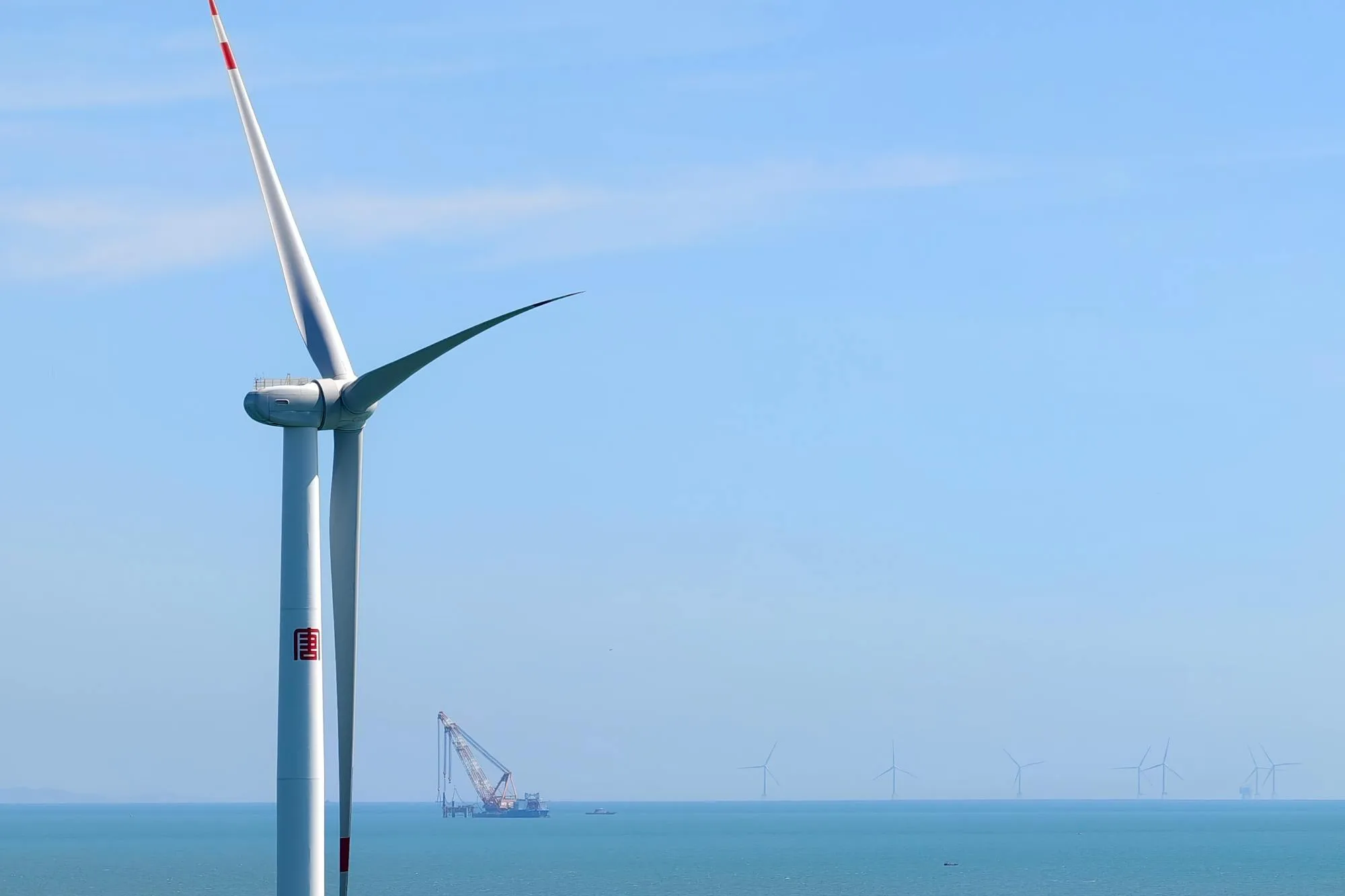
Carbon-fiber pultruded laminates take over from glass once wind blades pass roughly 80 meters in length. At that scale the spar cap has to carry more bending moment than a glass laminate can deliver at acceptable thickness, and the mass saving of carbon combined with its higher modulus outweighs the higher per-kilogram price. WE-C100 is F1 Composite's unidirectional carbon / epoxy grade in this family, built for the spar caps of long blades. The article below walks through the full static mechanical data and explains how blade designers should read the characteristic value Rk that DNVGL-ST-0376 requires as the design input.
What WE-C100 is
WE-C100 is a continuous pultruded unidirectional laminate using 48K industrial-grade carbon roving in a wind-grade epoxy matrix. The "100" denotes the grade family target tensile modulus class; the production panel is pulled to spar-cap geometry directly off the line. Independent third-party laboratory testing puts the laminate's physical properties at fiber mass content (Wf) around 70.4 % per ISO 14127, fiber volume content (Vf) around 62.3 %, laminate density of 1.58 g/cm³ per ISO 1183-1, and glass transition temperature (Tg) of about 116 °C measured as the DSC half-step per ISO 11357-2.
For reference, WE-C100's density at 1.58 g/cm³ is around 27 % lower than the WE-G80 GFRP at 2.17 g/cm³, while its 0° tensile modulus more than triples (147 GPa versus 45 GPa). Both numbers feed the trade-off that justifies the carbon premium in long blades.
The full static data
WE-C100 has been characterized across the complete static range a blade design body needs. All testing was conducted at 23 °C / 50 % RH after at least 24 h of conditioning, on production-grade panels, in a DNV·GL-accredited laboratory. Average values and DNVGL-ST-0376 characteristic values from the test panel:
| Property | Standard | Avg | Rk (DNVGL-ST-0376) |
|---|---|---|---|
| 0° Tensile strength | ISO 527-5:2021 | 1920 MPa | 1690 MPa |
| 0° Tensile modulus | ISO 527-5:2021 | 147 GPa | 142 GPa |
| 0° Tensile strain at break | ISO 527-5:2021 | 1.23 % | 1.14 % |
| 90° Tensile strength | ISO 527-5:2021 | 63.8 MPa | 58.5 MPa |
| 90° Tensile modulus | ISO 527-5:2021 | 8.42 GPa | 7.85 GPa |
| 0° Compressive strength | ISO 14126 | 1480 MPa | 1350 MPa |
| 0° Compressive modulus | ISO 14126 | 135 GPa | 128 GPa |
| 90° Compressive strength | ISO 14126 | 164 MPa | 162 MPa |
| V-notched rail shear (90°) | ASTM D7078 | 73.0 MPa | 70.9 MPa |
| In-plane shear modulus G12 | ASTM D7078 | 5.16 GPa | 4.88 GPa |
| Interlaminar shear strength | ISO 14130 | 70.2 MPa | 66.4 MPa |
| 0° Flexural strength | ISO 14125 | 1760 MPa | 1550 MPa |
| 0° Flexural modulus | ISO 14125 | 139 GPa | 135 GPa |
What Rk is and why it matters
Rk is not the average. It is a one-sided 95 % survival, 95 % confidence statistical tolerance bound calculated per the DNVGL-ST-0376 (Rotor Blades for Wind Turbines, Edition December 2015) method. The calculation accounts for two sources of uncertainty at once: the panel-to-panel scatter measured across the test specimens (typically captured as coefficient of variation, CoV) and the finite sample size of the test program (captured as a k-factor that shrinks toward unity as n increases).
The form is Rk = X̄ · (1 − kn · CoV), where X̄ is the panel mean, CoV is the coefficient of variation of the n tests, and kn is the one-sided tolerance factor from DNVGL-ST-0376 Section 5 for the chosen survival and confidence levels. For WE-C100, the gap from average to Rk is about 12 % on 0° tensile strength (1920 to 1690 MPa), 9 % on 0° compressive strength (1480 to 1350 MPa), 12 % on 0° flexural strength (1760 to 1550 MPa), 5 % on interlaminar shear strength (70.2 to 66.4 MPa), and only 1 % on 90° compressive strength (164 to 162 MPa).
The narrowest gap, on 90° compression, says the laminate scatter in that test was exceptionally tight, so the statistical penalty almost disappears. The wider gaps on 0° tension and 0° flexure reflect a modest CoV of around 4 to 5 % that any real production laminate carries.
How designers apply Rk
The first and most important point is to build the laminate model on Rk, not the average. Averages are useful for engineering judgment and grade-to-grade comparison; they are not allowed as design inputs in any wind-blade certification scheme, and a blade certified on averages will not survive a notified-body review.
The second is that environmental and partial safety factors apply on top of Rk. DNVGL-ST-0376 specifies separate γ factors for matrix-dominated and fiber-dominated failure modes (γMb) and for compressive failure (γMc), then layers environmental knock-downs for humidity, temperature, and UV. The Rk column is the starting point for design stress, not the design stress itself.
The third is to read 90° compression as the cleanest process quality test on the laminate. Pultruded UD laminates are strongly orthotropic; 0° properties are dominated by the fiber, while 90° properties are matrix- and interface-controlled. A high and tight 90° compression result (164 MPa with Rk = 162 MPa, CoV around 0.5 %) tells you the pultrusion process is consolidating the matrix without micro-voids or interface defects.
When to step back to GFRP
The carbon premium only earns its keep when the blade is long enough that the mass saving of carbon, multiplied across the full spar-cap stack, beats the cost differential. For most blades up to about 80 m, the high glass-content WE-G80 GFRP grade is the right answer both structurally and economically. Its fatigue data is covered in the companion article on GFRP pultruded spar caps.
The complete static data for WE-C100 (all 15 mechanical properties with their Rk values) plus the WE-G80 fatigue table is published as a single 4-page PDF: Wind Energy Pultruded Laminate Data Sheet. For project-specific qualification or custom blade layups, contact F1 Composite engineering through the contact form.