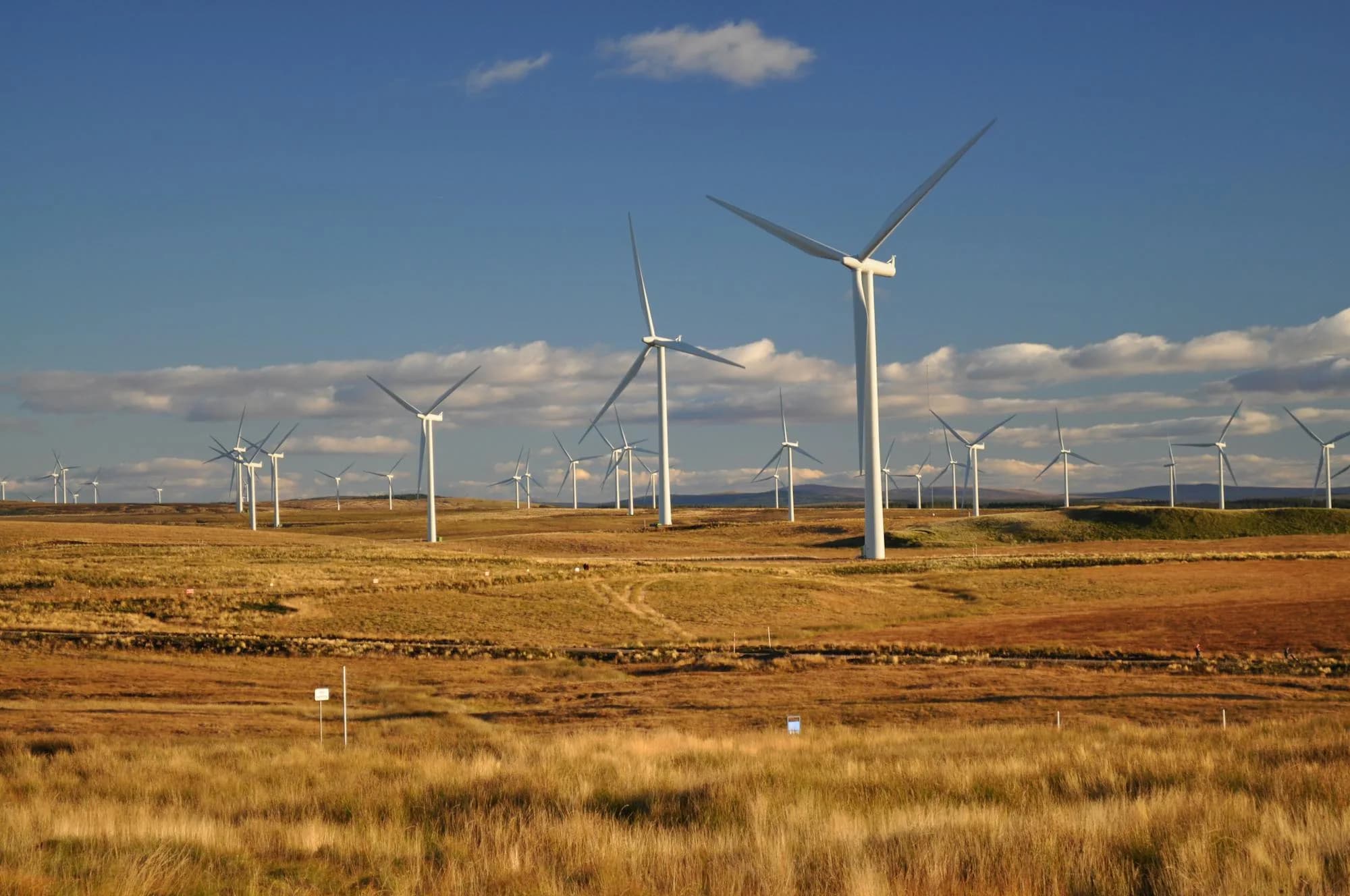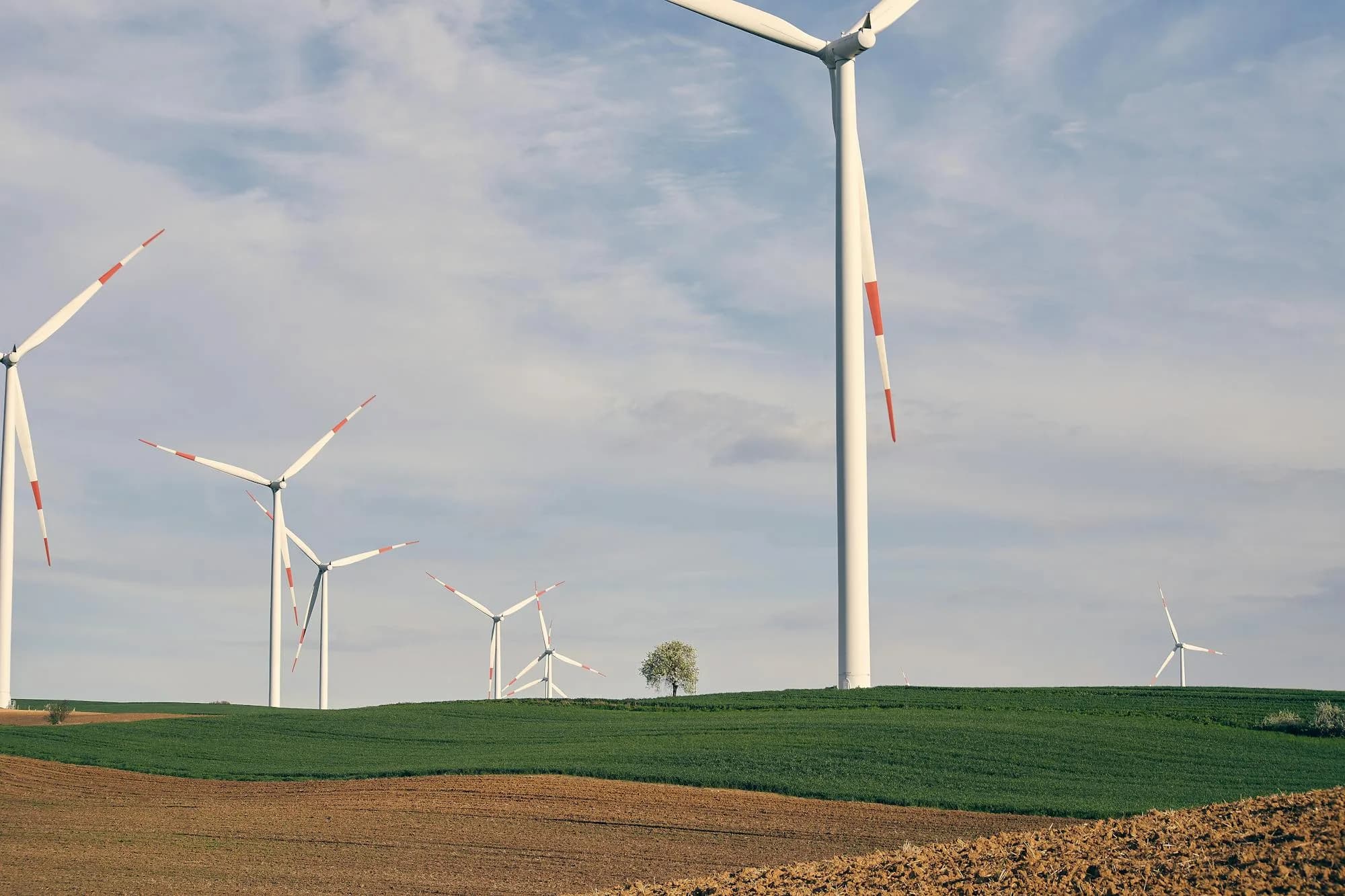
Glass-fiber pultruded laminates still carry the spar caps of most medium-length wind blades in commercial production today. WE-G80 is F1 Composite's high glass-content version of this family, a unidirectional pultruded laminate built for blades where stiffness-to-cost dominates the design rather than absolute mass. The article below works through the tension-tension fatigue endurance that certification bodies require over a 10⁷-cycle design life.
Why GFRP still wins on most blades
A wind blade has to survive enormous numbers of fatigue cycles. Over a 25-year life a typical 70-meter rotor sees on the order of 10⁹ load cycles at varying amplitude, most of them well below static failure stress but accumulating damage all the same. What the spar cap actually needs is fatigue endurance per dollar of installed laminate, not raw static strength. For blades up to roughly 80 meters, high glass-content pultruded GFRP wins this calculation. CFRP only pays back its premium once the blade is long enough that the mass penalty of glass exceeds the cost of carbon.
What WE-G80 is
WE-G80 is a continuous pultruded laminate using boron-free E-glass roving in a bisphenol-A epoxy matrix. The cure schedule is tuned for high-speed pultrusion at production scale, and the panel is pulled to spar-cap geometry directly off the line. Independent third-party testing puts the laminate's physical properties at the high end of what continuous pultrusion can hold: fiber mass content (Wf) of about 85.3 % per ISO 1172, fiber volume content (Vf) around 72.5 %, and laminate density of 2.17 g/cm³ per ISO 1183-1.
That fiber volume fraction is roughly ten percentage points above commodity GFRP pultrusion, and it is the structural reason WE-G80 reaches the stiffness numbers it does. Every additional percentage point of fiber volume buys longitudinal modulus almost linearly.
ISO 13003 fatigue and the design line
For a wind-blade GFRP laminate, tension-tension fatigue per ISO 13003 is the defining test. It runs at load ratio R = σmin / σmax = 0.1 (always in tension, never compressive), sine wave at 5 Hz, 23 °C / 50 % RH, on waisted dog-bone specimens cut from the production panel. Specimens are loaded at varied stress amplitudes from roughly 10³ to 10⁷ cycles, and the S-N relationship is fitted as σa = A · N^(−1/m), with two regression statistics: the slope exponent m and the stress-amplitude intercept A at N = 1.
For WE-G80 the laboratory returns slope exponent m = 8.51, intercept A = 957 MPa, coefficient of correlation −0.993, and goodness of fit 0.985. The slope of 8.51 sits at the upper edge of what wind-grade pultruded GFRP returns in the international literature. A generic E-glass / polyester pultruded laminate typically slopes around 8.0 to 8.3; structural steel under tension-tension fatigue slopes around 3 to 5, and a lower slope means faster fatigue degradation.
For certification, the 50 % survival fit is not the design input. Certification bodies require a one-sided 95 % survival, 95 % confidence design line that captures both the inherent scatter of the laminate and the finite sample size of the test panel. WE-G80's P95 / 95 % S-N curve is σa = 861 · N^(−0.1175). Read at the canonical wind-blade design lives:
| Cycles N | P95 σa (MPa) | P95 σmax (MPa) |
|---|---|---|
| 10⁶ | 169.8 | 377.2 |
| 10⁷ | 129.5 | 287.8 |
| 10⁸ | 98.8 | 219.6 |
At 10⁷ cycles, the design life used in most wind-blade certification, the P95 curve predicts σa around 130 MPa with a corresponding maximum stress of 288 MPa. That value goes into the layup calculation before environmental partial safety factors are applied on top.
Using the curve in practice
Engineers approaching WE-G80 for the first time usually take three working notes from these numbers. The first is to drive the layup from the P95 line. The 50 % fit is for engineering reference and material comparisons; certification bodies will not accept it as a design input.
The second is that environmental and geometric partial factors apply on top of the P95 stress. The S-N curve was measured dry, room-temperature, and axial. Real spar-cap stress is humid, warm, multi-axial, and ply-misalignment-sensitive. DNVGL-ST-0376 (Rotor Blades for Wind Turbines, Edition December 2015) specifies the γMb and γMc factors for matrix-dominated and fiber-dominated failure modes; GL 2010 has equivalent factors under slightly different names.
The third is to read the slope exponent m as a process quality indicator, not only as a regression output. A panel that returns m below about 7.5 usually has a fiber / matrix interface problem (often sizing-related). WE-G80 at m = 8.51 says the pultrusion process is consolidating the laminate cleanly.
When to step up to CFRP
GFRP keeps the lead in spar caps up to about 80 m blade length. Past that, the laminate thickness needed to carry the moment grows faster than the blade-shell geometry can accommodate, and the mass penalty of glass becomes the binding constraint. WE-C100, the carbon / epoxy grade in the same family, takes over from there. The static characteristic values for WE-C100, with the full data per ISO 527-5, 14125, 14126, 14130 and ASTM D7078 plus characteristic values per DNVGL-ST-0376, are covered in the companion article on CFRP pultruded spar caps.
The complete fatigue table for WE-G80 (P50 and P95 columns across 10³ to 10⁸ cycles) plus the static data for WE-C100 are published as a single 4-page PDF: Wind Energy Pultruded Laminate Data Sheet. For project-specific qualification or custom blade layups, contact F1 Composite engineering through the contact form.