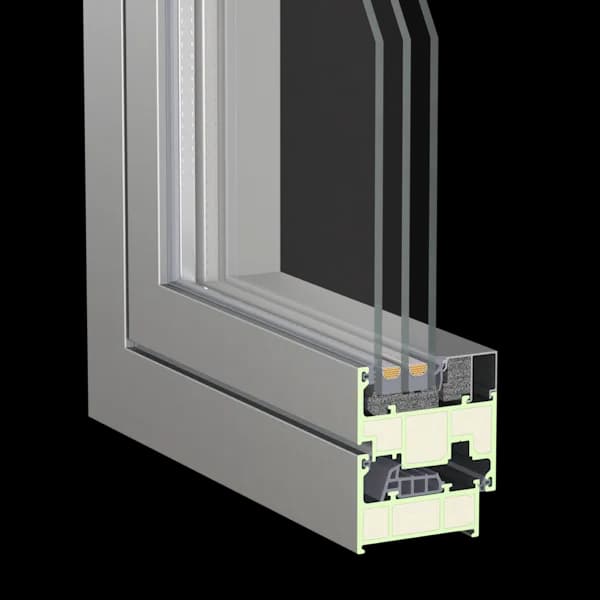
Aluminum window frames dominate the global fenestration market. But their fundamental weakness, thermal conductivity of roughly 160 watts per meter-kelvin, creates thermal bridges that undermine building envelope performance. Pultruded FRP window frames, with thermal conductivity around 0.3 watts per meter-kelvin, remove that problem at the material level.
The Physics of Thermal Bridging
A thermal bridge is a pathway through the building envelope where heat transfers more readily than through the surrounding insulated assembly. In a wall with high insulation value, an aluminum frame can act as a short circuit that drags down the total system performance. Even with thermal break strips, aluminum frames still carry conductive sections on both sides of the assembly.
FRP Frame Performance
Pultruded FRP window frames typically achieve frame U-values in the 0.8 to 1.2 watt per square meter-kelvin range without requiring separate thermal break inserts. When combined with high-performance glazing units, FRP systems can support whole-window performance targets needed for low-energy and passive-standard buildings.
Dimensional Stability
Pultruded FRP profiles have a coefficient of thermal expansion close to glass. That compatibility matters more than many specifiers initially assume. When the frame and glazing expand and contract at similar rates, seals stay under less cyclic stress and long-term airtightness is easier to maintain. Compared with PVC and aluminum, FRP is often the most balanced option when the project needs both thermal performance and structural rigidity.
Structural Strength
FRP window frames offer tensile strength exceeding 240 megapascals and strong stiffness-to-weight performance. This allows larger spans and slimmer visible sight lines than PVC while keeping the envelope much more thermally efficient than aluminum. For commercial facades, that means less compromise between aesthetics, structural need, and energy code targets.
Why More Specifiers Are Looking at FRP
High-performance building standards have shifted the discussion from simple frame strength to full-envelope performance. In that context, FRP solves several problems at once: lower thermal bridging, reduced condensation risk, good dimensional stability, and corrosion immunity in coastal or industrial climates.
F1 Composite develops pultruded FRP fenestration profiles for casement, tilt-and-turn, sliding, and fixed systems. The material case is straightforward: if the project wants aluminum-like structural performance without aluminum's thermal penalty, FRP deserves a serious specification review.