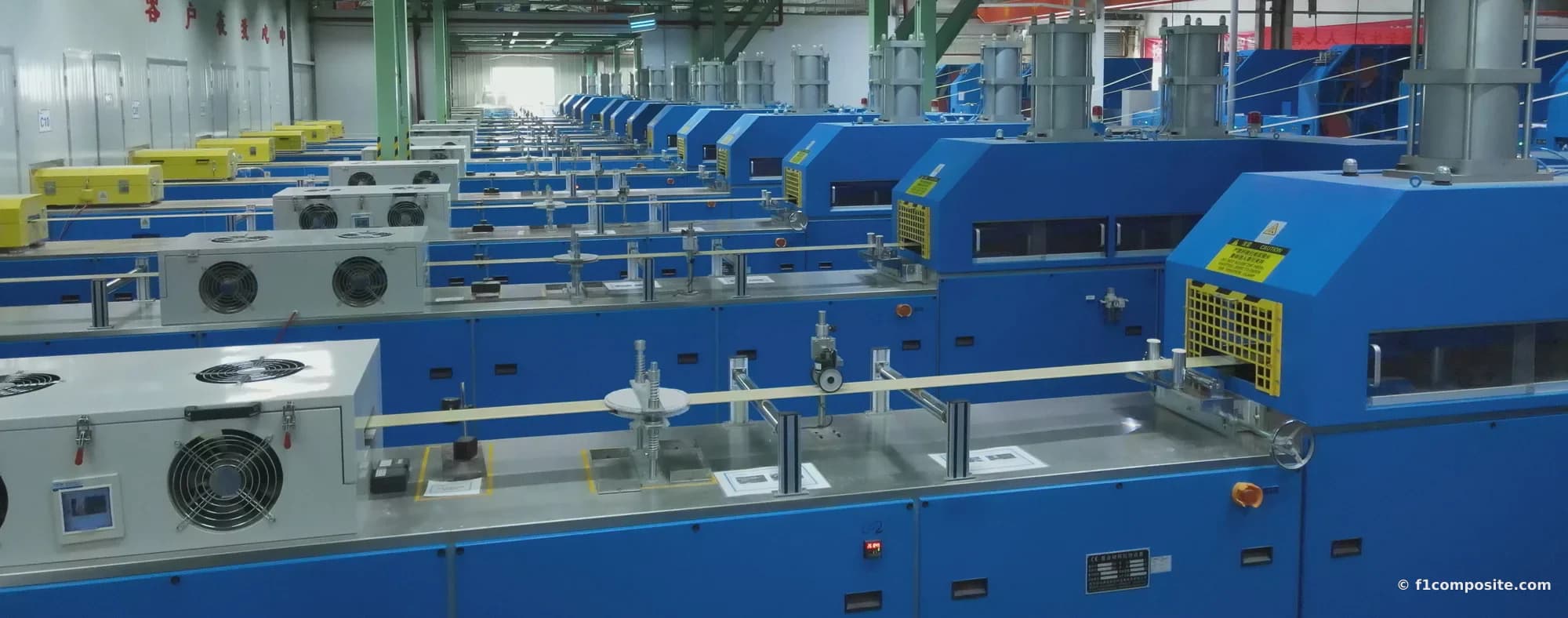
Pricing for pultruded FRP profiles is harder to benchmark than steel or aluminum because the major distributors do not publish list prices and the per-meter cost varies significantly with resin system, fiber architecture, and surface finish. This reference collects 2026 direct-from-factory FOB China benchmarks for the most common profile families, updated against active F1 Composite quotes and observed market pricing.
The profile prices below come from the engine behind the price estimator: FOB China (Shanghai or Ningbo) in USD, E-glass and general-purpose polyester at 70% glass, standard gray, no options, for a 1,000 m order, price basis 30 June 2026. Each range is the estimator's ±15% band, and the weights are the published catalog values. Vinyl ester, polyurethane or phenolic resin, fire-retardant and UV packages and a surface veil each add a premium; run the estimator with the options the application needs.
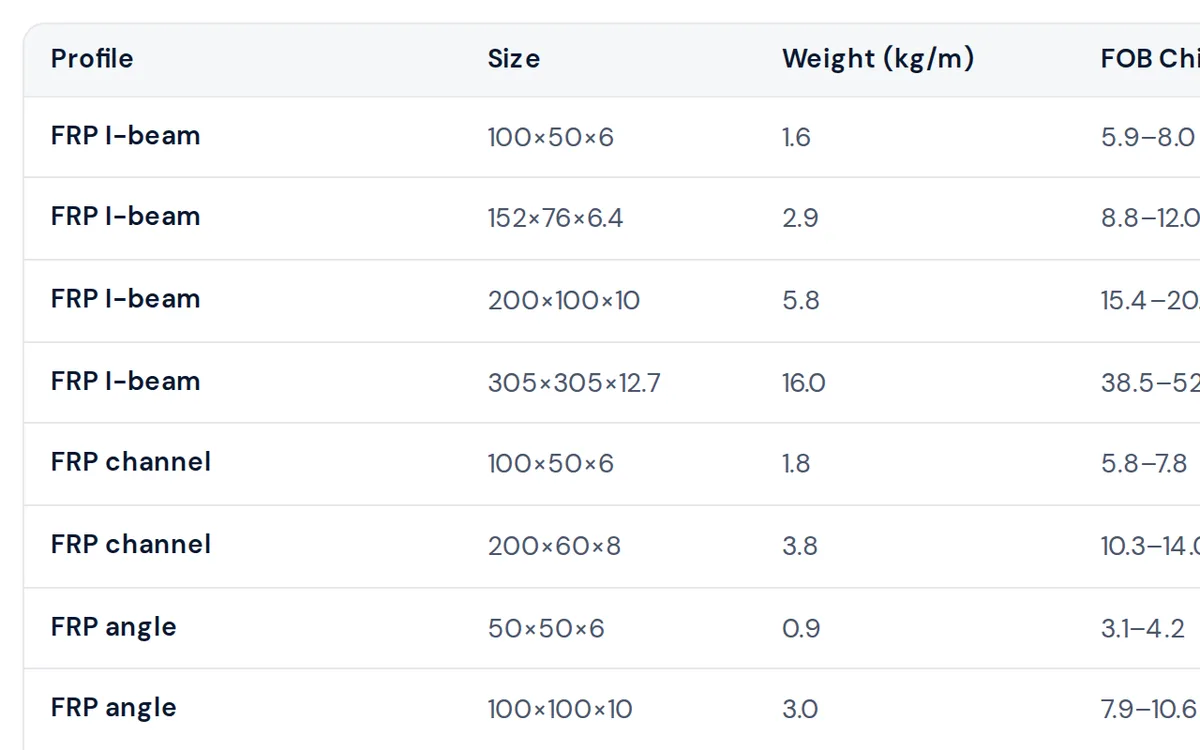
Standard profile pricing (FOB China, 2026)
| Profile | Size | Weight (kg/m) | FOB China price ($/m) |
|---|---|---|---|
| FRP I-beam | 100×50×6 | 1.6 | 5.9–8.0 |
| FRP I-beam | 152×76×6.4 | 2.9 | 8.8–12.0 |
| FRP I-beam | 200×100×10 | 5.8 | 15.4–20.8 |
| FRP I-beam | 305×305×12.7 | 16.0 | 38.5–52.1 |
| FRP channel | 100×50×6 | 1.8 | 5.8–7.8 |
| FRP channel | 200×60×8 | 3.8 | 10.3–14.0 |
| FRP angle | 50×50×6 | 0.9 | 3.1–4.2 |
| FRP angle | 100×100×10 | 3.0 | 7.9–10.6 |
| FRP square tube | 50×50×5 | 1.4 | 4.4–6.0 |
| FRP square tube | 100×100×6 | 3.5 | 9.2–12.4 |
| FRP rectangular tube | 120×60×5 | 2.6 | 7.3–9.9 |
| FRP round tube | OD 50, wall 4 | 0.9 | 3.0–4.0 |
Quantity moves the price in steps. Against the 1,000 m figures above, an order under 1,000 m costs about 5% more, 5,000 m about 3% less and 20,000 m or more about 7% less. Below the family minimum (100 m for round and square tubes and angles, 150 m for rectangular tubes, 200 m for channels and I-beams) a small-batch premium applies.
A regional distributor prices from local stock with delivery included, so compare delivered cost (FOB China, sea freight, import duty and inland transport) with the distributor's quote line by line.
Grating and deck panel pricing
| Product | Description | FOB China price |
|---|---|---|
| FRP molded grating | 38 × 38 mm mesh, 38 mm thick, polyester | $35–50 / m² |
| FRP molded grating | 38 × 38 mm mesh, 50 mm thick, vinyl ester | $55–75 / m² |
| FRP pultruded grating | I-bar 25 mm pitch | $65–90 / m² |
| FRP deck panel | 600 mm × 25 mm, polyurethane core | $45–65 / m² |
Grating pricing is per square meter of grating panel, including standard end banding and lifting cuts. Custom panel cuts add $2–5 / m².
Fenestration profile pricing
| Series | Frame depth | Application | FOB China price |
|---|---|---|---|
| 65 Series | 65 mm | Residential casement, U_w 1.4–1.6 | $8–12 / m |
| 70 Series | 70 mm | Commercial casement, dual-glazed | $10–14 / m |
| 80 Series | 80 mm | High-perf residential, U_w 1.0–1.2 | $14–20 / m |
| 90 Series | 90 mm | Passivhaus-certified, U_w 0.78 | $22–32 / m |
| 140 Series | 140 mm | Compression-seal sliding door; configuration review required | Request a configuration-specific quote |
Fenestration profile pricing assumes raw profile only (no glazing, hardware, or assembly). PHI-certified 90 Series runs at the upper end of its range; non-PHI 90 Series equivalents are 15–20% below.
Custom pultrusion tooling cost
Tooling cost depends on the size and complexity of the cross-section and on the number of cavities:
| Die type | Tooling cost | Tooling lead time |
|---|---|---|
| Single-cavity die, small open profile | USD 5,000–8,000 | 4–8 weeks |
| Large or multi-cavity die | USD 15,000–40,000 | 4–8 weeks |
A new profile reaches first delivery 6–10 weeks after drawing approval, die included.
Tooling is a one-time cost on the first run of a new section. The die then stays at the plant for the life of the product, so repeat orders carry no tooling charge, and on a high-volume program the tooling share of the per-meter price becomes negligible within the first production run.
Lead time benchmarks
| Order type | Tooling | Production | Sea freight | Total to EU/US |
|---|---|---|---|---|
| Standard catalog profile | — | 2–4 weeks | 25–40 days | 6–10 weeks |
| Custom profile, first run | 4–8 weeks | about 2 weeks after the die | 25–40 days | 10–16 weeks |
| Custom profile, repeat | — | 2–4 weeks | 25–40 days | 6–10 weeks |
| Large stocking order (30+ tonnes) | — | 4–8 weeks | 25–40 days | 8–14 weeks |
| PHI-certified 90 Series fenestration | — | 6–12 weeks | 25–40 days | 10–18 weeks |
Air freight (DHL/FedEx) cuts transit to 5–7 days but costs 8–15× sea freight per kilogram, only economic for samples or schedule-critical small orders under 200 kg.
Container freight benchmarks (40' high-cube, 2026)
| Origin | Destination | $ per 40HC |
|---|---|---|
| Shanghai / Ningbo | Rotterdam / Hamburg | 1,200 – 2,500 |
| Shanghai / Ningbo | Felixstowe / London Gateway | 1,400 – 2,700 |
| Shanghai / Ningbo | Los Angeles / Long Beach | 1,800 – 3,500 |
| Shanghai / Ningbo | New York / Savannah | 2,500 – 4,500 |
| Shanghai / Ningbo | Jebel Ali (UAE) | 900 – 1,800 |
| Shanghai / Ningbo | Sydney / Melbourne | 1,500 – 2,800 |
| Shanghai / Ningbo | Santos (Brazil) | 2,800 – 4,800 |
A 40HC packs 18–22 tonnes of pultruded FRP profiles depending on cross-section density. Per-tonne sea freight to Rotterdam runs $55–140; per-tonne to LA runs $80–195. On a 200×100×10 I-beam at 5.8 kg/m in a full container, freight to Rotterdam adds about $0.30–0.80 per meter.
Insurance: 0.3–0.5% of cargo value, typically included in CIF terms.
Incoterms cost deltas
Quoted as a percentage above the FOB China price for the same physical shipment:
| Incoterms | Delta vs FOB China | What it includes |
|---|---|---|
| FOB Shanghai | baseline | Goods to export port, Chinese customs cleared |
| CFR / CIF [destination port] | +6 to +12% | Adds sea freight (and insurance for CIF) |
| DAP [project site] | +14 to +22% | Adds destination customs, inland trucking |
| DDP [project site] | +18 to +30% | Adds destination import duty |
DDP is the most expensive Incoterm because the factory takes on import-side tax and customs risk, which factories price conservatively. Most experienced buyers run CIF or DAP unless they have no in-house customs capability.
Putting the benchmarks to work
For a typical project of 5 tonnes of 200×100×10 FRP I-beam (≈ 860 m) in polyester resin to EN 13706 E23, shipped CIF Rotterdam, the 2026 benchmark math is:
- Profile: 860 m × $19/m (the estimator's central figure for an order under 1,000 m) = $16,340 - Container freight (1 × 40HC): $1,800 average - Insurance (0.4% of cargo value): $65 - Total CIF Rotterdam: ≈ $18,200, or about $21.20/m before import duty and inland delivery
Add import duty, customs clearance and inland delivery for the landed figure, then set it against a delivered quote for the same section and standard from a regional supplier.
Caveats
These benchmarks shift quarter-to-quarter on three drivers: glass fiber raw material cost (currently stable), resin cost (polyester/vinyl ester moved -3% in Q1 2026 versus Q4 2025), and container freight (volatile; check the Drewry World Container Index for current spot rates).
For a planning figure on a specific section, use the fiberglass pultruded profile price estimator, which works in USD per meter and per kilogram. For a project-specific quote based on current pricing, contact F1 Composite through the contact form; we reply within one business day. You can also describe the application in the AI Sourcing Assistant to receive a specification recommendation and a clear path to pricing in one response.