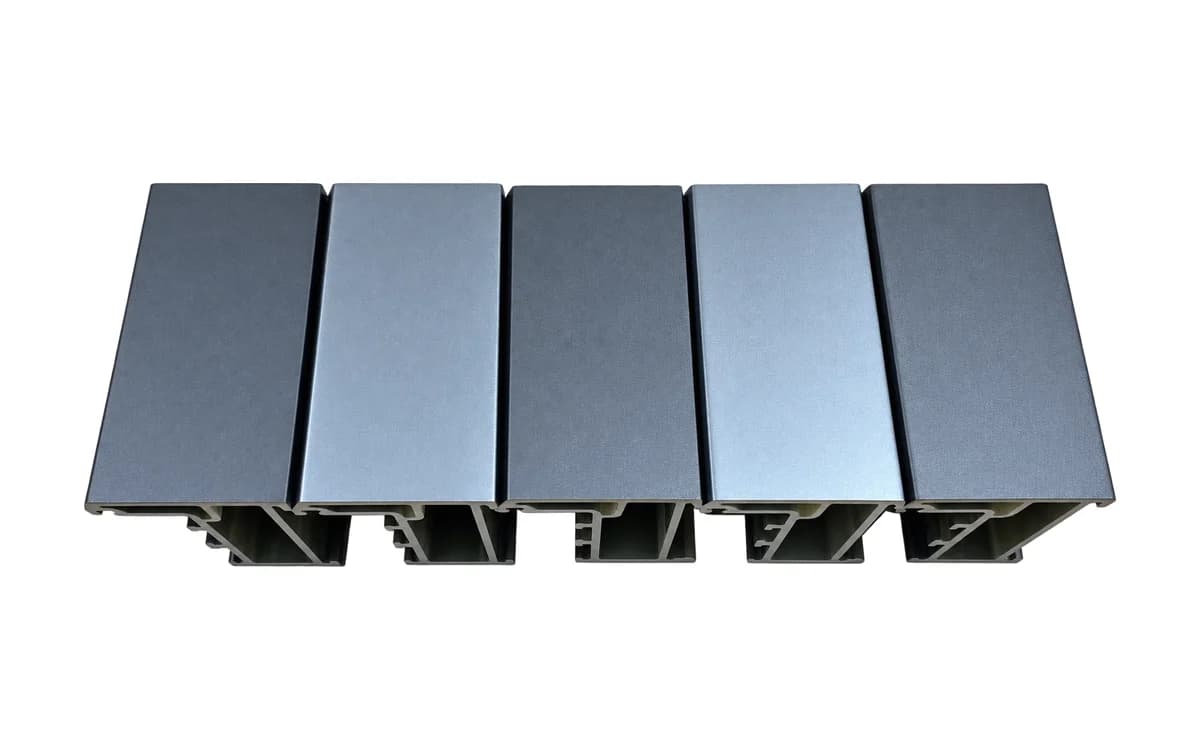
 Window and door profilesFrame, sash and mullion sections with agreed accessories, for local fabrication.Explore profile systems
 Material Comparison
FRP vs PVC window frames
Thermal performance, structural capacity, UV stability, dimensional stability, and fire safety compared. When PVC is genuinely the right choice, and when only pultruded FRP meets the requirement.
PVC wins on first cost; FRP on stiffness, heat and color range
uPVC remains the lowest first-cost window frame material and is the right specification for budget-sensitive residential retrofit and small windows in mild climates. Three technical limits cap its performance: the frame needs internal steel reinforcement above about 1.2 m span, dark colors can warp on sun-exposed elevations, and UV embrittlement can shorten service life to around 30 years. Pultruded FRP removes all three constraints (it needs no reinforcement, takes dark colors and does not embrittle in UV) and reaches passive house thermal performance.
This page compares FRP and PVC on the properties that drive specification. The verdict is context-dependent: for small casements in mild climates PVC is genuinely competitive; for windows that are large, dark-colored, south-facing or expected to outlast a typical PVC design life, FRP is the stronger choice.
Side-by-side: FRP vs uPVC window frames
FRP values are typical of pultruded E-glass/polyester window profiles at 65 to 90 mm frame depths. PVC values reflect premium triple-chamber uPVC systems typical of leading European manufacturers, steel-reinforced where required by span. Bold marks the properties where FRP materially outperforms PVC.
| Property | Unit | Pultruded FRP | uPVC (triple-chamber) |
|---|---|---|---|
| Frame Uf (70 mm, no reinforcement) | W/m²·K | 0.95 – 1.2 | 1.3 – 1.7 |
| Frame Uf (with steel reinforcement) | W/m²·K | N/A: none needed | 1.5 – 2.1 (steel bridge) |
| Thermal conductivity | W/m·K | 0.3 – 0.5 | 0.17 |
| Tensile strength | MPa | 240 – 400 | 40 – 55 |
| Elastic modulus | GPa | 20 – 28 | 2.4 – 3.5 |
| Steel reinforcement | — | Not needed | Usually, above about 1.2 m span |
| Thermal expansion | 10⁻⁶/K | 8 – 10 (matches glass) | 60 – 80 (8× glass) |
| Softening temperature | °C | Above 150 (heat distortion, typical) | 60 – 70 (dark colors can warp) |
| UV stability | — | Stable with a UV-stabilized resin and coating | Yellowing, chalking, embrittlement |
| Reaction to fire (EN 13501-1) | — | Depends on the FR resin; report per formulation | Class B or C, depending on formulation |
| Smoke | — | Halogen-free FR options avoid HCl | Contains hydrogen chloride (HCl) |
| Dimensional stability | — | High (low expansion, high stiffness) | Sag above 2 m, thermal creep |
| Recyclability | — | Limited (thermoset) | Recyclable 5–7 times |
| Initial cost | — | Moderate to high | Lowest |
A decision framework by project type
Choose PVC when
- • First-cost is the dominant project driver
- • Windows are under 1.2 m span and white/light-beige
- • Climate is moderate (no extreme heat or cold)
- • 30-year design life is acceptable
- • Recyclability matters to the project LCA
- • Uw target is 1.0–1.4 W/m²·K (standard energy code)
Choose FRP when
- • Passive house certification (Uw ≤ 0.80)
- • Windows over 1.5 m span without visible reinforcement
- • Dark colors or south/west solar exposure
- • Hot climates (ambient above 40°C)
- • Long building design life
- • Fire safety with low smoke toxicity required
- • Coastal or high-UV climate, with a UV-stable resin and coating
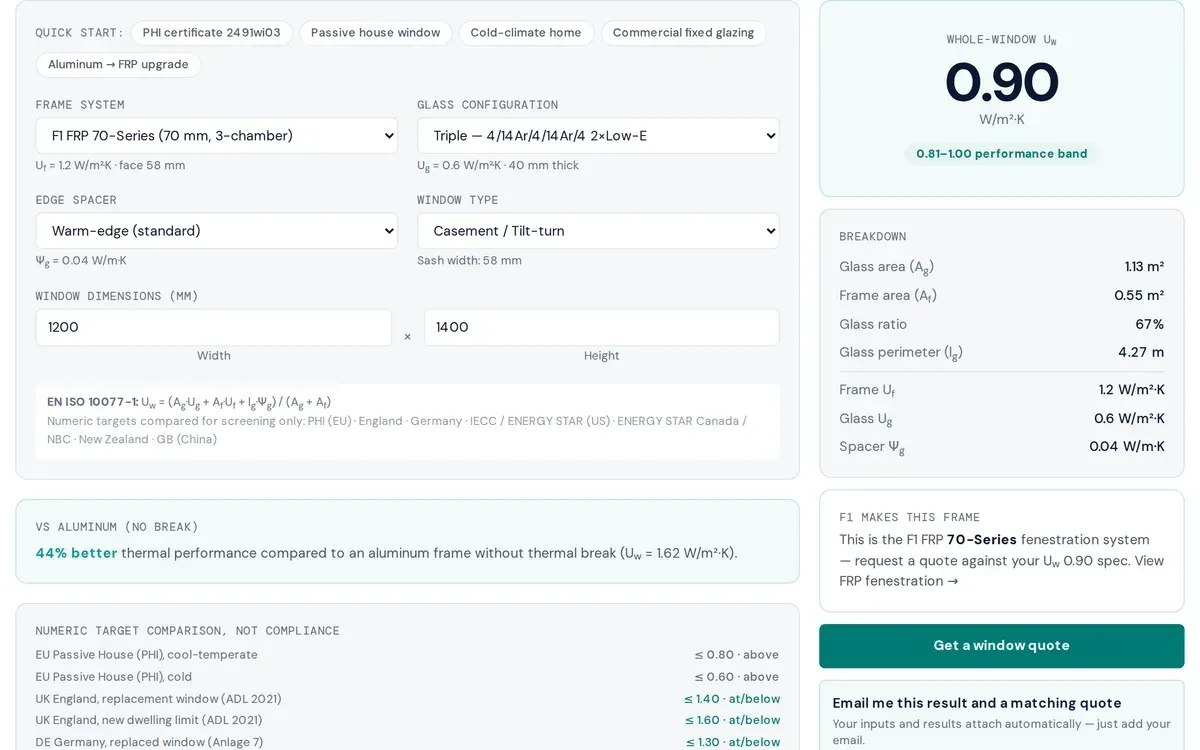
Compare Uw across FRP, PVC, and aluminum frames on your specific window size
Whole-window U-value depends on frame material, glazing configuration, spacer, and dimensions. Our U-value calculator implements EN ISO 10077-1 and lets you swap frame materials on the same window to see the Uw delta. For a typical 1230 × 1480 mm triple-glazed window, an FRP 90-series frame gives Uw ≈ 0.72 W/m²·K and a steel-reinforced PVC frame about 1.10 W/m²·K: about 35% less heat loss with the same glazing.
Frequently asked questions
Is FRP genuinely more thermally insulating than PVC?
At the material level, PVC has slightly lower thermal conductivity (0.17 W/m·K) than FRP (0.3–0.5 W/m·K). But window frame performance is driven by cross-section geometry and reinforcement. PVC frames above 1.2 m span must be reinforced with steel inserts to carry the glass load, and that steel creates a thermal bridge that raises the effective Uf to 1.5–2.1 W/m²·K. FRP is about eight to ten times stiffer and carries the same loads without reinforcement, so the finished frame Uf is typically 0.95–1.2 W/m²·K. For all but small windows, the FRP frame usually ends up with the lower Uf.
Why does PVC need steel reinforcement but FRP does not?
PVC elastic modulus is 2.4–3.5 GPa, about 1/10 that of pultruded FRP. Under glass dead load and wind load, unreinforced PVC sash or mullion profiles deflect well beyond code limits above roughly 1.2 m span. PVC system manufacturers insert U-shaped or rectangular galvanized steel reinforcement inside the hollow chamber to restore stiffness. That steel works structurally but creates a continuous cold bridge through the frame. FRP at 20–28 GPa modulus carries the same loads at the same section depth without reinforcement.
How does dark-color or south-facing performance compare?
PVC softens around 60–70°C. Dark PVC frames on south-facing elevations in hot climates can reach 70–85°C in direct sun, which can cause warping, sash binding and sealant failure, and some PVC systems restrict dark colors on sun-exposed elevations. Pultruded FRP is a thermoset with a heat distortion temperature typically above 150°C, well above the surface temperatures dark frames reach in sun, so dark colors can be used on any elevation. This matters for commercial facades, dark-bronze architecture and hot-climate markets.
What is the lifecycle difference between FRP and PVC windows?
Quality uPVC window frames in moderate climates often last 30–40 years before UV embrittlement, sealant degradation or dimensional creep forces replacement. Pultruded FRP frames do not embrittle under UV in the same way and keep their stiffness in heat, so they are expected to outlast uPVC; confirm the design life for your exposure with the system supplier. If the building's life calls for one PVC replacement cycle and no FRP one, include that in the life-cycle cost comparison.
Is PVC still the right choice for any project?
Yes: PVC remains the lowest first-cost option and the right choice for budget-driven residential retrofit, low-rise housing in mild climates, and projects where 30-year design life is acceptable. Modern triple-chamber uPVC can reach Uw below 1.0 W/m²·K with proper glazing. For those projects PVC's price advantage is real. FRP becomes the better choice when the project requires passive-house Uw ≤ 0.80, dark colors or south-facing elevations, spans above 2 m, fire performance without toxic HCl emission, or a longer design life than PVC is usually specified for.
How do FRP and PVC compare on fire safety?
Pultruded FRP with a fire-retardant resin can reach demanding EN 13501-1 classes; the class belongs to the tested formulation, so ask for its report. PVC reaches Class B or C depending on formulation, and its smoke contains hydrogen chloride (HCl), which is acutely toxic. Halogen-free FRP formulations avoid HCl, while halogenated fire retardants do not, so for schools, hospitals and high-rise housing name the smoke requirement in the specification.
FRP windows and doors from F1 Composite
Nine casement, tilt-and-turn and sliding series from 50 to 140 mm, with the 90 series PHI-certified as a component. Buy profiles to fabricate or finished units.
- Window and door profilesFrame, sash and mullion sections with agreed accessories, for local fabrication.Explore profile systems
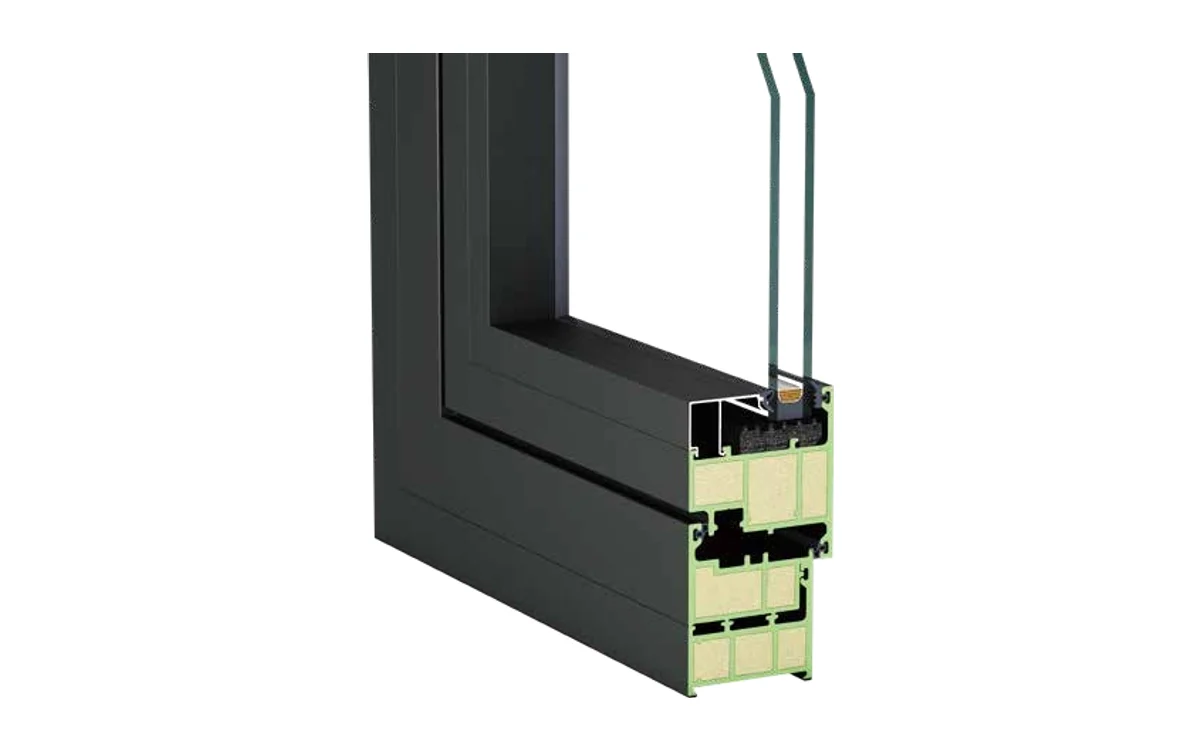 Finished windows and doorsUnits built to your window schedule, with the glass, hardware and delivery agreed.Explore finished units
Selecting window frames for a passive house, commercial, or premium residential project?
Send the dimensions, quantity, service conditions and destination. We reply within one business day.