Wanhua Yantai Zero-Carbon Community — Pultruded GFRP-PU Passive House Windows at Production Scale
Yantai, Shandong, China · 2022
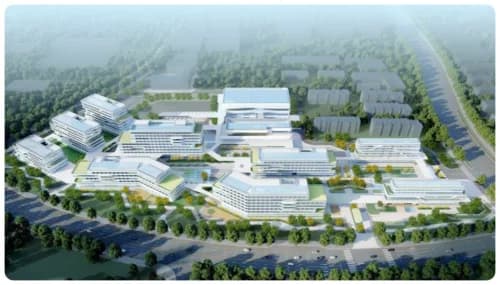
GFRP-PU passive house windows project overview
This construction case study documents an F1 Composite project in Yantai, Shandong, China, delivered in 2022. The supplied scope used Fenestration Systems to address the stated project constraints, with the challenge, engineered solution, measured delivery outcomes, and related product paths recorded below.
Project challenge — GFRP-PU passive house windows
Wanhua Chemical — the world's largest MDI (methylene diphenyl diisocyanate) producer and the upstream polyurethane resin supplier for the GFRP-PU pultrusion industry — committed in 2021 to build the first end-to-end zero-carbon employee residential community on its Yantai industrial campus in Shandong Province. The complex spans 112,815 m² of above-ground floor area inside the Yantai Economic and Technological Development Zone, comprising mid- and high-rise employee dormitories and supporting facilities. The specification required simultaneous compliance with two of China's tightest residential energy standards: the National Near-Zero Energy Building Design Standard and Shandong Province's Passive Ultra-Low Energy Residential Building standard. The performance targets were demanding: total primary energy consumption for heating, cooling, and lighting capped at 50 kWh per square meter per year; envelope thermal transmittance significantly tighter than national code; and Passivhaus-class airtightness verified by N50 blower-door testing. The window package was the binding constraint. Aluminum-thermal-break frames would have created continuous metallic conductive paths across the envelope and aged the polyamide thermal-break inserts under the project's full thermal-cycle range. PVC frames could not deliver the structural span needed across the tall double-skin facade openings on the stair towers. The specification called for whole-window U-values below 1.0 W/m²·K — a level conventional aluminum-with-thermal-break systems cannot reach without exotic glazing assemblies, and a level that prior production-scale Chinese residential projects had repeatedly missed. The project owner also imposed a supply-chain integrity constraint: as Wanhua is itself the polyurethane raw-material producer, the window-frame material had to fit the polyurethane composite story end-to-end, with traceable resin chemistry and embodied-carbon transparency from the same supplier ecosystem.
F1 Composite solution — GFRP-PU passive house windows
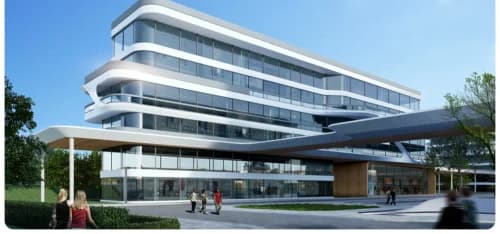
F1 Composite supplied pultruded glass-fiber-reinforced polyurethane (GFRP-PU) window-frame profiles from FengDu's Yancheng facility for the 13,657 m² employee-dormitory portion of the project. The profile package combined three F1 Composite fenestration series: 65-series inward-opening casement and tilt-and-turn for the smaller dormitory window openings, 90-series sliding for the larger balcony openings, and matching facade-frame sections at the stair-tower curtain-wall apertures. The pultruded frames were paired with a five-pane insulating glass unit — 5 mm single-silver Low-E plus 16 mm argon plus 5 mm single-silver Low-E plus 16 mm argon plus 5 mm Low-E — to achieve a verified whole-window U-value of 0.99 W/m²·K, comfortably inside the project's 1.0 W/m²·K specification. Critically, the GFRP-PU pultruded frame eliminates the metallic thermal break entirely. Where an aluminum-with-thermal-break frame must interrupt heat flow through polyamide thermal-break inserts that age, creep under cyclic loading, and ultimately delaminate at the metal-polymer interface, the GFRP-PU frame is a single continuous material with intrinsic thermal conductivity around 0.3 W/m·K — roughly five hundred times less conductive than aluminum across the frame depth, with no joint, no insert, and no aging interface. The pultruded-profile chemistry uses Wanhua polyurethane resin, closing the supply loop: the same Wanhua chemistry that produced the project's polyurethane sandwich wall insulation also supplied the resin matrix for the GFRP-PU window frames. Profiles were factory-finished in matched dark frame color with co-extruded EPDM gasket channels and reinforced corner joints, then delivered to site in modular palletized units for direct installation onto pre-set bracketry. Production scheduling tracked against eight months of overlapping site civil works to keep the fenestration installation on project critical path without lifting-equipment surges.
Results and impact — GFRP-PU passive house windows
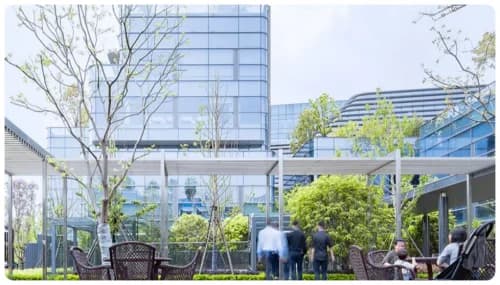
The Wanhua Zero-Carbon Community completed its 13,657 m² employee-dormitory envelope with the F1 Composite GFRP-PU fenestration system as the principal aperture component. Building-envelope verification at handover returned a comprehensive building energy-saving rate of 61.11 % against the national baseline (the near-zero-energy threshold in the underlying standard sits at 60 %); an envelope-only energy-saving rate of 47.56 %; a renewable-energy utilization rate of 51.81 %; and an airtightness measurement of N50 = 1.0 air changes per hour at 50 Pa — meeting Passivhaus airtightness inside a Chinese-code residential project. Total complex energy savings, when combined with the polyurethane wall insulation, ground-source heat pump array, rooftop photovoltaic system, and solar hot-water plant, are projected at more than 2,000 tonnes of CO₂ reduction per year across the 112,815 m² development. The project is referenced in the Wanhua Chemical 2022 sustainability portfolio as the company's first end-to-end zero-carbon community and stands as the largest single-site deployment of pultruded GFRP-PU fenestration in any Chinese residential project to date. For F1 Composite, the project validates the GFRP-PU pultruded fenestration system at production residential scale: 13,657 m² of envelope is a fundamentally different qualification surface than a research-station or prototype installation, and the verified 0.99 W/m²·K whole-window U-value combined with N50 = 1.0 airtightness now serves as the primary reference point for inquiries on near-zero-energy and passive-house residential developments across the temperate-cold and hot-summer-cold-winter climate zones.
Have a similar project to Wanhua Yantai Zero-Carbon Community?
Open the FRP Engineering Advisor with this case study loaded as context. Ask about specs, profile families, resin selection, or how to build your own RFQ.
Pre-filled question: “I'm looking at the F1 Composite case study "Wanhua Yantai Zero-Carbon Community — Pultruded GFRP-PU Passive House Windows at Production Scale" in Yantai, Shandong, China (/case-studies/fenestration-residential). What materials, profile families, resin systems, and standards drove this project — and what would I need to provide for a similar RFQ?”
Interested in a similar solution?
Send the dimensions, quantity, service environment, and destination. Engineering responds within one business day.