FRP solar panel frames, mounting rails and support profiles
One pultruded composite platform for the PV module perimeter, the supporting structure and the roof interface. Lightweight, corrosion resistant and electrically insulating profiles for rooftop retrofit, ground-mount, floating and coastal solar projects.
Composite profiles from module edge to mounting structure
Solar module frame profiles
Custom perimeter, corner-key and clamp-interface profiles for framed PV modules. Geometry is developed around the laminate, glass stack, sealant channel, drainage and module load test.
Composite PV support profiles
Square, C and H sections for fixed ground arrays, agrivoltaics, fishery-PV, floating arrays and coastal structures. Standard connectors remain mechanically fastened and field-serviceable.
Rooftop rails and hardware
Low-line-mass roof rails for BAPV, BIPV and distributed generation, with matched mid clamps, end clamps, splice plates, sliding nuts and roof interfaces.
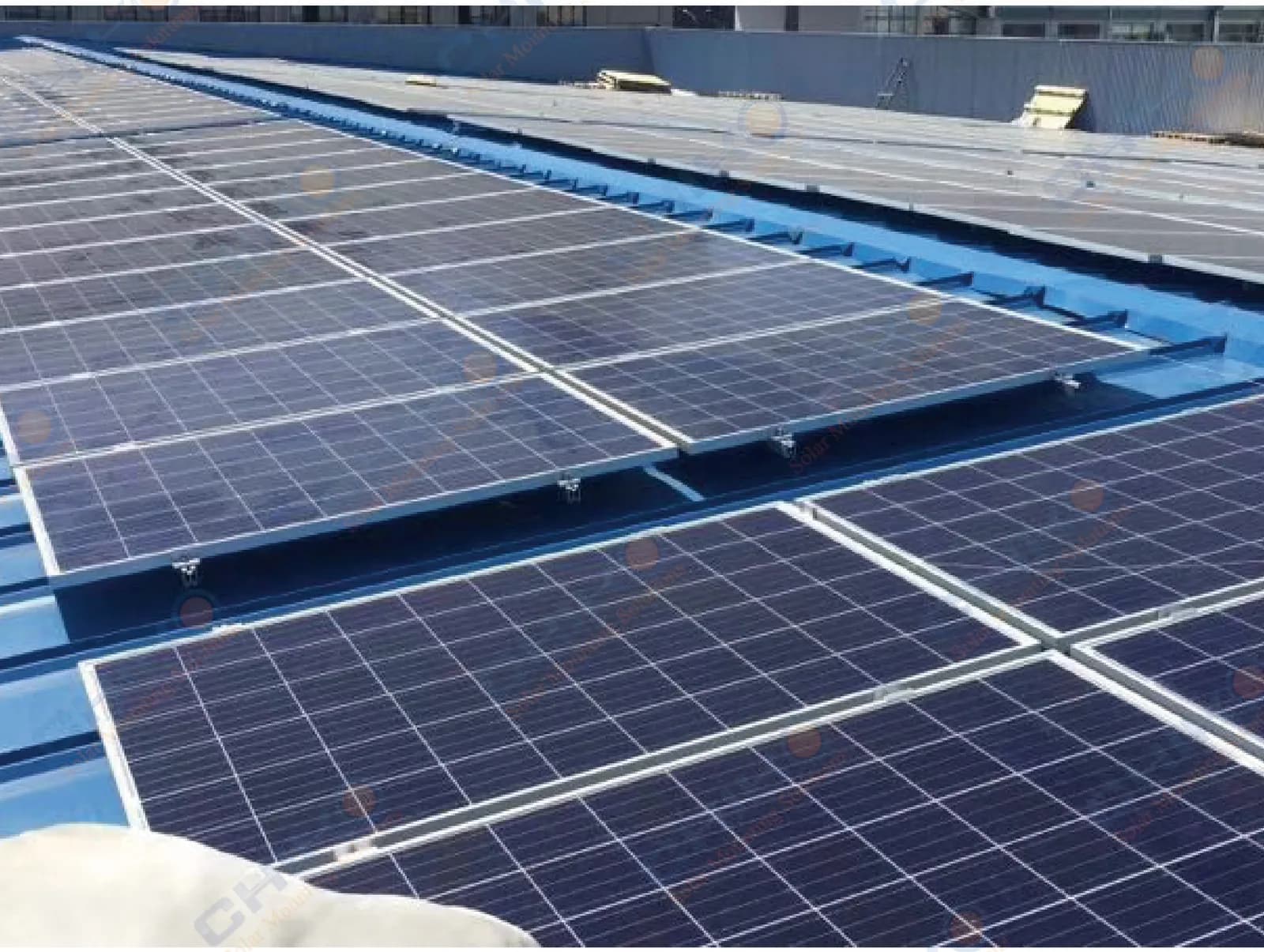
Rooftop retrofit system: pultruded H-rail with module clamps and roof-sheet interface.
Standard support and rail profiles
These starting sections cover light rooftop rails through primary ground-mount support. Final section selection is governed by span, module layout, wind uplift, snow, seismic load, connection capacity and the project deflection limit.
| Model | Overall size | Wall | Section area | Typical role |
|---|---|---|---|---|
| GTP-FCFG-3030-3 | 30 × 30 mm | 3.0 mm | 324 mm² | Light bracing / secondary support |
| GTP-FCFG-3060-3 | 30 × 60 mm | 3.0 mm | 504 mm² | Module bearer / light rail |
| GTP-FCFG-6060-3 | 60 × 60 mm | 3.0 mm | 684 mm² | Posts and support framing |
| GTP-FCFG-9090-5 | 90 × 90 mm | 5.0 mm | 1,713 mm² | Primary posts / heavy support |
| GTP-FCHB-8255-5 | 55 × 82 mm | 5.0 mm | 1,080 mm² | H-section mounting rail |
| GTP-FCCB-7550-4 | 50 × 75 mm | 4.0 mm | 782 mm² | C-section purlin / rail |
| GTP-FCCB-1005-4 | 50 × 100 mm | 4.0 mm | 896 mm² | Deep C-section purlin |
| GTP-FCHB-8080-5 | 80 × 80 mm | 5.0 mm | 1,374 mm² | H-section primary rail |
Model geometry and availability are confirmed at quotation. Custom solar-module frame and roof-interface profiles are produced from customer drawings or developed as a paid first-article program.
PU for thin-wall performance; polyester or vinyl ester for exposure-led design
Polyurethane (PU) pultrusion
- Density
- 2.0–2.2 g/cm³
- Axial tensile strength
- 1,000–1,200 MPa
- Axial tensile modulus
- 40–60 GPa
- Thermal conductivity
- 0.1–0.3 W/m·K
Unsaturated polyester (UP)
- Density
- 2.0–2.2 g/cm³
- Axial tensile strength
- 580–750 MPa
- Axial tensile modulus
- 30–40 GPa
- Thermal conductivity
- 0.2–0.4 W/m·K
Values are characteristic laminate ranges from the solar-profile program, not design allowables. Project calculations use batch-qualified properties with environmental, duration, temperature, buckling and safety factors applied.
Where composite PV profiles change the project equation
Rooftop retrofit
Lower rail dead load helps preserve the structural reserve of existing industrial roofs.
Coastal & offshore
No zinc loss, anodic pitting or galvanic couple along the main composite members.
Floating & fishery-PV
Low weight and resistance to humidity, salt spray and water-side corrosion.
Ground & agrivoltaic
Mechanically fastened posts, purlins and braces for corrosive soil and fertilizer exposure.
Engineering & applications
Proof & project detail
Frequently Asked Questions
Which photovoltaic products can F1 Composite supply?
The range covers three product families: custom pultruded profiles for solar-module perimeter frames; structural FRP profiles for ground-mount, floating, fishery-PV and agrivoltaic support frames; and lightweight rooftop rails supplied with mid clamps, end clamps, splice plates and roof-clamp interfaces. Profiles can be supplied as cut lineals or as a project-specific component kit.
Can FRP solar mounting rails be used on existing industrial roofs?
Yes. Rooftop retrofit is a strong fit where the original roof has limited dead-load reserve. A typical pultruded GFRP rail weighs about 1.0–1.5 kg/m, compared with roughly 4–6 kg/m for a galvanized-steel rail. Final suitability still requires a project-specific roof survey and structural check for wind uplift, snow, seismic load and connection pull-out.
How are panels and rails connected?
The standard assembly uses sliding nuts with M8×25 fasteners for module mid and end clamps, and M6×12 fasteners for rail splice plates. Standing-seam and trapezoidal-roof interfaces are selected for the roof sheet and can be configured as non-penetrating clamps where the roof geometry permits. Hardware schedules are confirmed with the module and roof drawings.
Which resin system should be specified for PV supports?
UV-stabilized unsaturated polyester is the cost-effective baseline for normal outdoor service. Polyurethane provides the higher characteristic strength and modulus range for thin-wall, stiffness-sensitive sections. Vinyl ester is recommended for offshore, floating, high-salinity, fertilizer and aggressive industrial exposure. The laminate, veil and coating package is selected from the site's exposure class and design life.
Do electrically insulating FRP rails eliminate every grounding requirement?
The FRP members do not create a conductive path and therefore do not need bonding as metallic rails do. The PV modules, inverter, cable system, metallic fasteners and lightning-protection system must still follow the electrical engineer's design and the applicable local code. Electrical isolation of the rail is a system advantage, not a waiver of project grounding and lightning-protection review.
Have a question about this product?
Our FRP Engineering Advisor answers spec, sizing, and chemical-compatibility questions instantly — and routes complex ones to the right human.
Pre-filled question: “I need FRP photovoltaic profiles for [module frame / rooftop rail / ground-mount / floating PV]. Module size and layout: [...]. Site: [...]. Wind/snow/seismic loads: [...]. Roof or foundation interface: [...]. Recommend a profile family, resin system, hardware concept, and RFQ inputs.”
Send the module, array and load drawings — get a solar-profile proposal.
Our engineering team is ready to help you find the right FRP solution. Get in touch for technical consultation or a detailed quotation.