Fiberglass I-Beam (FRP) Profiles
Wide-flange pultruded fiberglass I-beams from 76×38 mm to 305×305 mm. About 70–80% lighter than steel beams at the same depth, fully corrosion-free, EN 13706 E23.
A pultruded FRP I-beam is a constant-section fiberglass wide-flange beam made by pulling E-glass roving and mat through a resin bath and heated die. It carries bending load like a steel I-beam but weighs ~70–80% less, never corrodes, and does not conduct electricity — so deflection, not strength or rust, governs how you size it.
Key facts
Reviewed by Yifan Liu, Application Engineer · Last updated 2026-06-30
- Depth range
- 76 – 305 mm
- Mass
- 1.2 – 16 kg/m
- vs steel (same depth)
- ~68–83% lighter
- Grade
- EN 13706 E23
- Resins
- Polyester · vinyl ester · PU · phenolic
- Fire
- ASTM E84 Class A
- Tolerance
- ASTM D3917 · ±0.25 mm
- Lead time
- Stock 2–4 wk · custom 4–8 wk
Structural I-beams engineered for performance
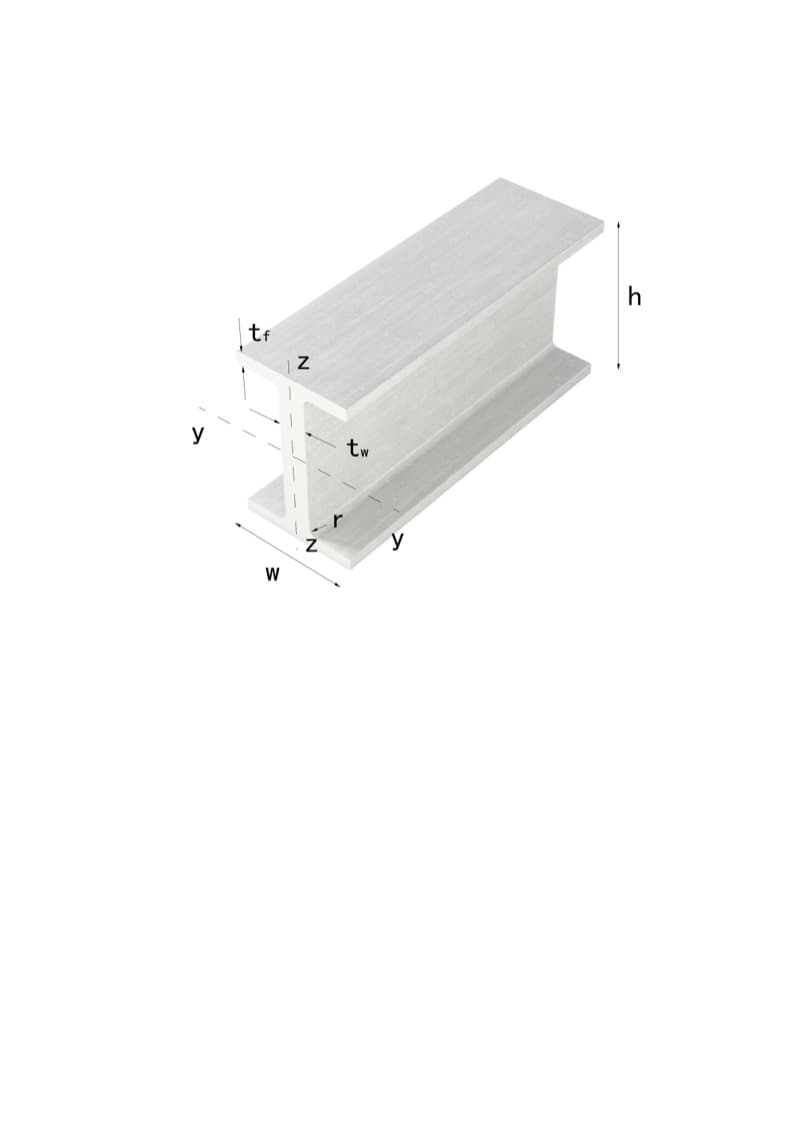
F1 Composite pultruded FRP I-beams replicate standard steel wide-flange geometry while delivering ~70–80% weight reduction. Unidirectional E-glass roving in the flanges provides flexural stiffness; continuous strand mat in the web carries shear; a surfacing veil gives a resin-rich, UV- and corrosion-resistant outer layer. Available in polyester, vinyl ester, polyurethane, and phenolic resin systems.
Deflection first, then strength
Sizing an FRP I-beam follows a different order than steel. Because the modulus is roughly a tenth of steel, the section that satisfies the deflection limit almost always satisfies bending and shear with margin. Work the four checks below in order — or run them instantly in the calculator, pre-loaded for an I-beam.
Deflection governs, not strength
FRP modulus is 17–28 GPa — roughly 1/10 of steel. A section sized for steel-equivalent strength deflects about 10× more, so check the L/240 or L/360 serviceability limit first. If deflection passes, bending and shear usually pass with large margin.
Shear deflection is real
In-plane shear modulus G_LT is only ~3 GPa, so shear deformation adds 15–25% on top of bending deflection on short spans. Use the Timoshenko-corrected deflection (the calculator applies it automatically); pure Δ = 5wL⁴/384EI under-predicts.
Check local buckling of the flange
Thin-walled FRP flanges can buckle before reaching calculated bending capacity. Keep the outstanding-flange slenderness b/t ≤ ~18 for E-glass pultruded, and run the full check per ASCE/SEI 74-23 Ch.3 or CEN/TS 19101 §6 for compression-governed members.
Detail connections for the transverse direction
Pultruded FRP is strongly orthotropic — transverse strength is ~1/4 of longitudinal. Bolted joints need edge distance ≥ 4× bolt diameter, spacing ≥ 4d, oversized washers, and snug-tight (never crushed) A4-316 stainless fasteners.
Standard I-beam sizes — and what they replace in steel
All dimensions in millimeters; mass in kg/m. The steel column is the standard section at the same nominal depth, for a direct weight comparison. Custom sizes available via custom pultrusion.
| Model (H×B×t) | H (mm) | B (mm) | FRP (kg/m) | Steel (same depth) | Steel (kg/m) | Weight saving |
|---|---|---|---|---|---|---|
| I 76×38×6.4 | 76 | 38 | 1.2 | IPE 80 | 6.0 | 80% |
| I 100×50×6 | 100 | 50 | 1.6 | IPE 100 | 8.1 | 80% |
| I 120×60×6 | 120 | 60 | 2 | IPE 120 | 10.4 | 81% |
| I 152×76×6.4 | 152 | 76 | 2.9 | UB 152×89 | 16.0 | 82% |
| I 160×80×8 | 160 | 80 | 3.6 | IPE 160 | 15.8 | 77% |
| I 200×100×10 | 200 | 100 | 5.8 | IPE 200 | 22.4 | 74% |
| I 240×120×12 | 240 | 120 | 8.4 | IPE 240 | 30.7 | 73% |
| I 300×150×15 | 300 | 150 | 13.5 | IPE 300 | 42.2 | 68% |
| I 305×305×12.7 | 305 | 305 | 16 | UC 305×305 | 96.9 | 83% |
Compared at the same nominal depth. Because FRP modulus is ~1/10 of steel, a deflection-equal FRP section is typically one or two depths larger than the steel it replaces — installed weight still drops ~70%. Steel masses are standard IPE / UC / UB sections (reference only, not supplied by F1 Composite).
Section properties (A, Ix, Sx)
Verified section properties — area, second moment of area, section modulus, radius of gyration — for the exact section you order are on the stamped production datasheet, and you can compute them live, with your wall thicknesses, in the FRP profile calculator. We deliberately do not publish back-calculated section properties on this page: pultruded I-beam wall geometry varies by size, so design-critical Ix/Sx must come from the datasheet for the profile you specify.
E23 characteristic properties (longitudinal)
F1 Composite standard I-beams are produced to EN 13706 grade E23 — a minimum full-section flexural modulus of 23 GPa. Each property is paired with the test method that produces it.
| Property | E23 value | Test method |
|---|---|---|
| Tensile modulus E_L (longitudinal) | ≥ 23 GPa | EN ISO 527-4 |
| Full-section flexural modulus | ≥ 23 GPa | EN ISO 14125 |
| Tensile strength (longitudinal) | 240 MPa | EN ISO 527-4 |
| Flexural strength | 240 MPa | EN ISO 14125 |
| In-plane shear strength | 30 MPa | EN ISO 14130 |
| Transverse tensile modulus E_T | ~ 7 GPa | EN ISO 527-4 |
| Density | 1.9 g/cm³ | EN ISO 1183 |
| Glass content (by weight) | 65–70% | ISO 1172 |
| Surface flame spread | Class A · FSI ≤ 25 | ASTM E84 |
Modulus rows are the EN 13706 grade definition; strength, density, glass content, and flame spread are F1 characteristic values per the cited method. Transverse strength is ~1/4 of longitudinal — design connections accordingly.
When an FRP I-beam wins — and when steel still makes sense
Specify FRP when
- Coastal, chemical, wastewater, or de-icing-salt exposure where steel needs recoating cycles.
- Electrical non-conductivity or non-magnetic behaviour is required (substations, rail, MRI rooms).
- Manual handling matters — crews lift FRP sections without cranes or hot-work permits.
- A 25–50+ year maintenance-free design life changes the lifecycle cost in FRP’s favour.
Stay with steel when
- Dry, inland, non-corrosive service with a short asset horizon (< 15 years).
- Long spans where deflection forces an impractically deep FRP section.
- Continuous service temperature above ~60 °C (approaching the resin’s glass transition).
- The certifying authority does not yet accept FRP for the element.
Full cost and lifecycle comparison: FRP vs steel, aluminum & timber.
The same I-beam, across EU / US / China specs
Specifiers in different regions cite different standard numbers for the same property. This maps the equivalents F1 Composite I-beams are tested and documented against.
| Topic | Europe | North America | China |
|---|---|---|---|
| Structural design code | CEN/TS 19101 | ASCE/SEI 74-23 (LRFD) | GB 50608 / CECS 692 |
| Profile grade / tolerance | EN 13706 E17 / E23 | ASTM D3917 | GB/T 31539 |
| Tensile test | EN ISO 527-4 | ASTM D638 | GB/T 1447 |
| Flexural test | EN ISO 14125 | ASTM D790 | GB/T 1449 |
| Fire — surface flame spread | EN 13501-1 | ASTM E84 | GB 8624 |
Related FRP profiles
Applications & case studies
Frequently Asked Questions
How much lighter are FRP I-beams compared to steel?
At the same nominal depth, a pultruded FRP I-beam weighs about 68–83% less than the steel section. An FRP I 200×100×10 is 5.8 kg/m versus 22.4 kg/m for a steel IPE 200 — a 74% reduction in lifting weight and dead load. Note that, because FRP modulus is ~1/10 of steel, a deflection-equal FRP member is usually one or two depths larger than the steel it replaces; installed weight still drops roughly 70%.
Where do I get the section properties (Ix, Sx) for design?
Verified section properties for the exact section you order are on the stamped production datasheet, and you can compute them live — with your wall thicknesses — in the FRP profile calculator. We deliberately do not publish back-calculated Ix/Sx on this page: pultruded I-beam wall geometry varies by size, so design-critical section properties must come from the datasheet for the ordered profile.
Can FRP I-beams be used as primary structural members?
Yes — for walkways, pedestrian bridges, platforms, cooling towers, and building frames. Because the elastic modulus is ~1/10 of steel, deflection usually governs the design rather than strength. F1 Composite supplies full E23 mechanical data, span/load calculation support, and connection detailing.
What resin systems are available for I-beams?
Isophthalic polyester for general structural use, vinyl ester for aggressive chemical, chlorine, or marine service, polyurethane for high toughness and fast cure, and phenolic for fire-critical or rail (EN 45545-2) applications. Resin choice drives chemical resistance and fire performance, not stiffness.
Which standards do F1 Composite I-beams meet?
Profiles are produced to EN 13706 grade E23 (≥23 GPa full-section flexural modulus) and ASTM D3917 (±0.25 mm tolerance), with ISO 9001:2015 quality management and ASTM E84 Class A flame spread. Design references: ASCE/SEI 74-23 (US LRFD), CEN/TS 19101 (EU), GB 50608 / CECS 692 (China).
What is the lead time and minimum order for FRP I-beams?
Standard sizes ship in 2–4 weeks; a custom section with new tooling is 4–8 weeks. Stock profiles have no minimum; custom runs are typically from 500 linear meters. Standard packaging is 6 m or 12 m lengths, cut to size on request.
Need engineering data or a quotation for I-beam profiles?
Our engineering team is ready to help you find the right FRP solution. Get in touch for technical consultation or a detailed quotation.