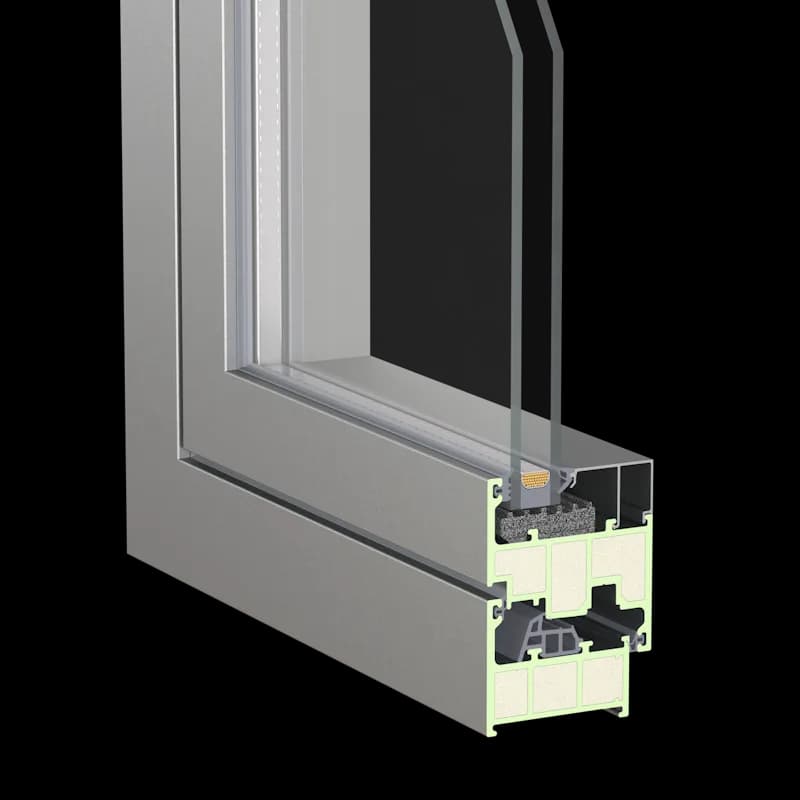
Every fabricator considering fiberglass lineals runs the same mental audit: I have saws, welders, corner cleaners, a hardware station, and a glazing line tuned for uPVC (or a machining center tuned for aluminum). How much of that survives the switch?
More than you expect. Here is the station-by-station reality, written for the production manager rather than the brochure reader.
Cutting: new blades, new dust extraction, same saws
Pultruded fiberglass machines rather than melts: the opposite of uPVC's forgiving, chip-welding behavior. Your existing double-miter saws carry over; the blades do not. Specify carbide-tipped blades with a triple-chip grind (or diamond blades for high volume), moderate feed pressure, and let the blade do the work: forcing the feed frays the cut edge and heats the resin.
The genuine change is dust management. Fiberglass cutting produces fine glass-and-resin dust, not uPVC swarf: local exhaust ventilation at the saw, sealed dust collection, and standard respiratory PPE at the cutting station are non-negotiable. This is the one workplace change to plan properly rather than improvise. It is routine in every composites shop, but it is new to a vinyl shop.
Machining: drilling and routing behave better than you fear
Lock cases, drainage slots, and hardware preps rout and drill cleanly with carbide tooling at conventional speeds. Two practical notes: support the exit side of through-holes to prevent breakout (fiberglass is laminar), and expect tooling wear faster than on uPVC. Glass is abrasive. CNC machining centers used for aluminum transfer almost directly; only the tooling and feeds change.
Corner joining: the one real process change
This is the station that actually changes. uPVC corners are fusion welded: melted and joined into a monolith, then corner-cleaned. Thermoset fiberglass does not melt, so corners are joined mechanically: corner keys or cleats seated in the profile chambers, structural adhesive at the miter, screwed or crimped depending on the system. Reinforced corner kits ship with the lineal set.
What this means on the line: the welders and corner cleaners go idle, replaced by a simpler assembly bench; joint cycle time is comparable once crews settle; and your QC point moves from weld-bead quality to joint squareness and adhesive coverage. One genuine advantage over welding: a mechanically joined corner can be checked, and in the worst case disassembled, rather than scrapped.
For aluminum fabricators the story is shorter: you already join mechanically. Fiberglass corners will feel familiar, minus the thermal-break alignment problem. There is no thermal break to align.
Hardware: an outright improvement
Multi-point locks, hinges, and friction stays screw directly into the pultruded wall: no steel reinforcement to find, no stripped threads in soft uPVC, no separate reinforcement-locating step. Pull-out retention in the glass-fiber wall is higher than in unreinforced uPVC, and higher again in polyurethane-matrix profiles, which is one reason PU runs on performance-tier lineals. Standard euro-groove hardware platforms fit; your hardware station carries over with revised screw specs.
Gasketing and glazing: mostly carry-over
If the lineal has co-pultruded gasket channels (ours do), gasket insertion is a push-fit step with no gluing and no drift between runs. Glazing is unchanged in kind: same IGU handling, same setting blocks, same toe-and-heel rules, with one pleasant difference. Fiberglass's thermal expansion is close to glass, so glazing pressure and seal compression stay where you set them across the seasons instead of fighting the frame.
Finish: decide who paints
Fiberglass lineals arrive either mill-finish for post-fabrication painting or pre-finished to AAMA 2604/2605 in RAL colors (the finish story is covered here). Most switching fabricators start with pre-finished lineals (it removes a whole line decision during transition) and revisit in-house finishing at volume.
The transition plan that actually works
No fabricator switches a line overnight, and none should. The pattern we see succeed: run a paid first article through your own stations (cutting, corners, hardware, glazing) as the qualification step; keep uPVC and fiberglass in mixed production on the same saws and glazing line while crews build corner-joint experience; and reserve the fiberglass line for the orders that justify it (passive-house tenders, large sashes, dark colors, coastal exposure) where the lineal's performance premium is priced in.
The honest summary: one station genuinely changes (corners), one improves (hardware), one needs investment (dust extraction), and the rest is blade specs and settling time. The line you own is closer to fiberglass-ready than the brochures, ours included, tend to admit. To plan a paid first article, start from the sections on our fiberglass window and door profiles page.