 Qinling Station, Antarctica: −60°C design low90-series GFRP-PU passive windows certified to PHI Component-ID 2491wi03 at the phB efficiency class for the cool-temperate climate zone, factory-assembled and leak-tested before a single-summer Antarctic installation window, against 45 m/s katabatic winds.Read the case study
 Material Technology
Polyurethane pultrusion windows (GFRP-PU)
Why polyurethane resin is displacing polyester in high-performance pultruded fiberglass window frames: higher cross-fiber strength, thinner walls, deep-cold toughness, and the certified passive-house results it delivers.
FIG. 1 90 series corner section
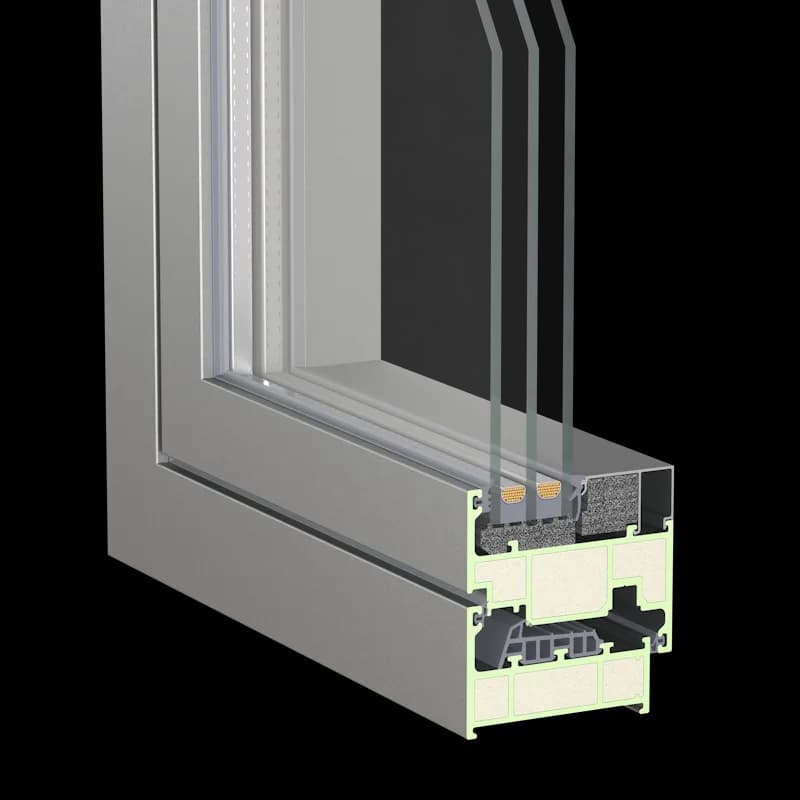
Same pultrusion process, tougher matrix: the frame technology behind arctic-class windows
A polyurethane pultrusion window uses the same continuous pultruded-fiberglass frame concept as any FRP window, but replaces the conventional polyester or vinyl ester resin with a polyurethane (PU) matrix, injected into a closed die box. The PU matrix bonds the glass fibers with far greater toughness across the fiber direction, which is exactly where window profiles are stressed: at screw fixings, corner joints, and multi-point lock keeps. That lets a GFRP-PU profile carry more glass fiber (up to roughly 80% by weight), run thinner walls (down to about 2 mm), and keep its impact strength at −40°C and below.
F1 Composite pultrudes its window and door profiles in GFRP-PU, including the 90-series frame behind PHI Component Certificate 2491wi03 (U_w 0.78 W/m²·K, phB efficiency class for the cool-temperate climate zone) and the windows installed at Qinling Station, Antarctica. This page explains what the PU chemistry changes, when it is worth the premium, and how the profiles are supplied.
Polyurethane vs vinyl ester vs polyester in a pultruded window profile
All three matrices produce an insulating fiberglass frame at ≈ 0.3 W/m·K conductivity. The differences show up in mechanical performance and manufacturability. Bold marks the properties where polyurethane leads.
| Property | Polyurethane (GFRP-PU) | Vinyl ester | Polyester |
|---|---|---|---|
| Transverse (cross-fiber) strength | Highest: tough matrix bonds fibers in every direction | Good | Baseline: weakest across the fiber |
| Achievable glass content | Up to ~80% by weight | ~65–75% | ~60–70% |
| Minimum practical wall thickness | ~2 mm: slimmer sightlines, lighter sash | ~3 mm | ~3 mm |
| Impact toughness at −40°C | Highest: PU stays ductile in deep cold | Good | Adequate |
| Screw / hardware pull-out retention | Highest: critical for multi-point locking hardware | Good | Adequate |
| Styrene emission in processing | None: closed injection box, styrene-free chemistry | Styrene-based | Styrene-based |
| Thermal conductivity | ≈ 0.3 W/m·K | ≈ 0.3 W/m·K | ≈ 0.3 W/m·K |
| Relative profile cost | Highest of the three | Mid | Lowest |
Figures are typical ranges for continuous E-glass pultrusion; exact values depend on fiber architecture and profile geometry. F1's nine window and door series are pultruded in polyurethane (GFRP-PU).
Three GFRP-PU window installations, from the Antarctic to production residential
- Qinling Station, Antarctica: −60°C design low90-series GFRP-PU passive windows certified to PHI Component-ID 2491wi03 at the phB efficiency class for the cool-temperate climate zone, factory-assembled and leak-tested before a single-summer Antarctic installation window, against 45 m/s katabatic winds.Read the case study
 Baotou Industrial Park: −25°C plus chemical exposure70/80/90-series GFRP-PU windows on a severe-cold-zone manufacturing campus, chosen to beat an aluminum thermal-bridge penalty while resisting acid mist and chloride aerosol without a recoating cycle.Read the case study
  Wanhua Yantai Zero-Carbon Community: 13,657 m² of GFRP-PU fenestrationWhole-window Uw 0.99 W/m²·K across 13,657 m² of dormitory windows on a near-zero energy development, with measured airtightness of N50 = 1.0.Read the case study
Profiles for your fabrication line, or finished GFRP-PU units
F1 supplies polyurethane pultruded window profiles the same two ways as the rest of the fenestration range: as a profile set (frame, sash, mullion, transom, and glazing bead with co-extruded EPDM gasketing, corner kits, and fabrication drawings) for window fabricators who assemble locally, or as complete factory-assembled units, glazed, hardware-fitted, and leak-tested before shipment, delivered DDP with duty pre-itemized. The profiles are identical in both models; only the assembly location changes.
Frequently asked questions
What are polyurethane pultrusion windows?
Polyurethane pultrusion windows are windows whose frame and sash profiles are pultruded from continuous glass fiber and a polyurethane (PU) resin matrix instead of the conventional polyester or vinyl ester resin. The material is abbreviated GFRP-PU (glass-fiber-reinforced polyurethane), sometimes written GFRPU or PU fiberglass. The pultrusion process is the same continuous pull-through-a-heated-die method used for all FRP profiles; the difference is the resin chemistry, which is injected into a closed box rather than picked up in an open bath. The result is a window profile with higher cross-fiber strength, higher achievable glass content, and thinner walls than a standard polyester pultrusion, while keeping the ~0.3 W/m·K thermal conductivity that makes fiberglass frames insulate roughly 500× better than aluminum.
What does GFRP-PU (or GFRPU) stand for?
GFRP-PU stands for glass-fiber-reinforced polymer with a polyurethane matrix. You will see the same material written GFRPU, PU-FRP, or PU fiberglass in specifications. They all refer to pultruded profiles where continuous E-glass reinforcement is bonded by polyurethane resin. In fenestration, a 'GFRPU fixed window system' or 'GFRP-PU tilt-and-turn window' simply means the frame, sash, mullion, and transom profiles are polyurethane pultrusions. F1 Composite's severe-cold window references (including the Qinling Station Antarctic installation and the Wanhua Yantai zero-carbon community) are GFRP-PU systems.
How is polyurethane pultrusion different from polyester or vinyl ester pultrusion?
Three practical differences drive window design. First, strength across the fiber direction: PU's tougher matrix gives the profile markedly higher transverse and interlaminar strength, which is what resists screw pull-out at hinges and multi-point locks, and corner-joint stress in an assembled sash. Second, wall thickness: because the matrix is tougher, PU profiles can be pultruded with walls down to roughly 2 mm and glass content up to about 80% by weight, giving slimmer sightlines and a lighter sash for the same stiffness. Third, processing: PU is injected in a closed die box with styrene-free chemistry. The trade-off is cost: PU resin systems price above polyester and vinyl ester, which is why F1 reserves them for performance-critical fenestration rather than commodity structural profiles.
Who supplies polyurethane pultruded window profiles?
A small group of pultruders worldwide run polyurethane window lines, because PU requires dedicated closed-injection equipment and tighter process control than open-bath polyester. FengDu produces the GFRP-PU profiles; F1 Composite supplies them internationally as profile sets for local fabricators or as factory-assembled, glazed, and leak-tested window and door units delivered DDP. The same profile set sits behind PHI Component Certificate 2491wi03 (U_w 0.78 W/m²·K, phB efficiency class for the cool-temperate climate zone).
Are polyurethane pultrusion windows suitable for Passive House projects?
Cold-climate projects require a complete window and installation review. F1's 90-series GFRP-PU frame holds PHI Component Certificate 2491wi03 at U_w 0.78 W/m²·K in the phB efficiency class for the cool-temperate climate zone, and the same system is installed at Qinling Station in Antarctica against a −60°C design low. Because the polyurethane matrix keeps its impact strength in deep cold and the profile needs no steel reinforcement, the frame carries no metallic thermal bridge: the failure point that limits aluminum and steel-reinforced PVC frames in passive house detailing.
Do polyurethane pultrusion windows cost more than standard FRP windows?
At the profile level, yes: polyurethane resin systems are the most expensive of the three common pultrusion matrices, above vinyl ester and polyester. At the installed-window level the gap narrows, because PU's thinner walls use less material per meter, the sash needs no steel reinforcement, and the higher hardware pull-out strength simplifies corner and lock detailing. For projects where the driver is certified passive-house performance, deep-cold durability, or slim sightlines, the PU premium is typically small against the whole-window cost, which is dominated by glazing and hardware. For budget-driven projects in mild climates, a polyester or vinyl ester FRP frame, or PVC, remains the economical choice.
GFRP-PU windows from F1 Composite
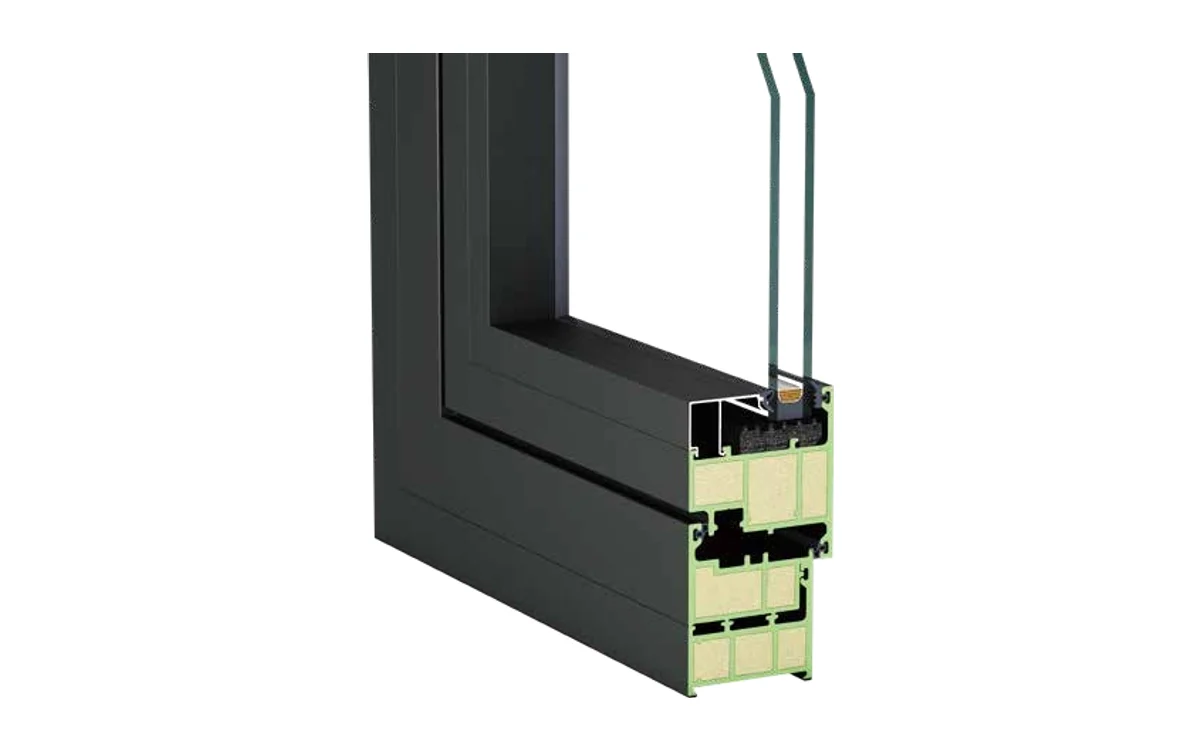
The 90 series is the PHI-certified polyurethane system; profiles and finished units are quoted separately.
Specify GFRP-PU polyurethane pultrusion windows for your project
Send the dimensions, quantity, service conditions and destination. We reply within one business day.