Ask five suppliers to quote "a fiberglass window frame profile" and you will get five numbers spread across a 40% band, and no way to tell whether the spread is quality, margin, or scope. That opacity is not in anyone's long-term interest, least of all ours: an unexplained cheap quote wins orders that end in disputes, and an unexplained expensive quote loses orders it deserved. So here is how the per-meter price of a pultruded window profile is actually built, driver by driver.
1. Resin system: the biggest single lever
The matrix resin is the largest material-cost decision in the profile. Polyester is the economic baseline and fully adequate for most residential series. Vinyl ester adds roughly 10–25% at the profile level and buys better moisture cycling, temperature resistance, and long-term stability. Polyurethane (GFRP-PU) sits at the top of the range (the resin itself is the most expensive of the three and it requires dedicated closed-injection equipment) and buys the highest cross-fiber strength, thinner walls, and deep-cold toughness (the full engineering case is here). When two quotes differ sharply, resin system is the first thing to check: they may simply not be quoting the same material.
2. Glass content and fiber architecture
More glass means more stiffness per section, and more cost, because glass loading also slows the line and demands tighter process control. Fiber architecture matters as much as quantity: a profile with multiaxial fabric layers for corner-screw retention costs more per meter than a roving-only lay-up of the same weight, and behaves differently in your fabrication line.
3. Section complexity and wall thickness
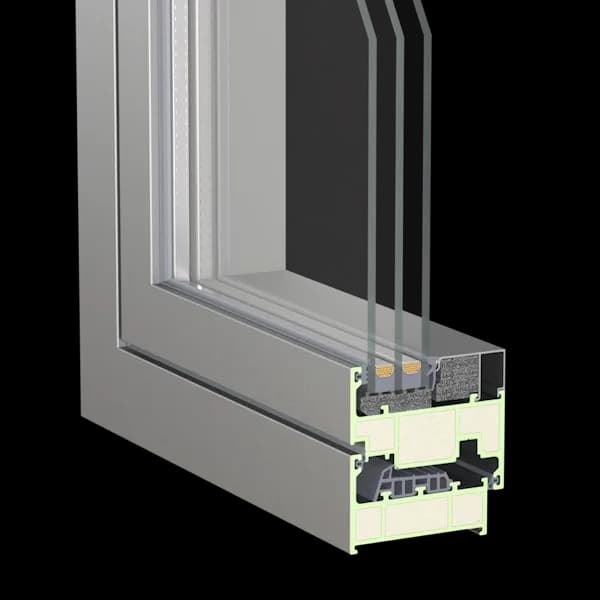
A three-chamber sash profile with co-pultruded gasket channels pulls slower and scraps higher than a plain rectangular tube: pull speed is production cost. Thinner walls (a GFRP-PU specialty) reduce material per meter but demand premium process control, so wall thickness cuts both ways in the price.
4. Die tooling and amortization: where MOQs come from
Every profile geometry needs its own pultrusion die (typically 4–8 weeks to make). On a standing-die profile from the supplier's existing library, you pay no tooling. On a custom section, the die cost has to sit somewhere: either as a one-time tooling charge or amortized into the per-meter price with a minimum order quantity. Paying off the die is why custom-section MOQs exist, and why the honest answer to "what is your MOQ?" is always "which section?"
5. Surface finish
Mill finish (resin-rich veil, unpainted) is the baseline. Architectural powder coating to AAMA 2604 or 2605 in a custom RAL color adds a real increment: coating line time, masking, and the qualification overhead of the rating itself. Dark and metallic colors cost more than standard white or gray because they require heat-buildup qualification and reduce coating-line throughput.
6. Certification and testing overhead
A profile shipped with EN ISO 10077-2 thermal simulation data, batch mill certificates, and a PHI-certified system behind it carries the cost of maintaining that evidence: accredited-lab testing, certificate renewals, per-batch QC documentation. This is genuine value, not padding: it is precisely the evidence the qualification checklist demands. A quote that undercuts the market by skipping it is cheaper for a reason you will meet later.
7. Volume and scheduling
Pultrusion economics reward continuity: a standing order that keeps a die on the line prices below sporadic small runs of the same section, because die changeovers are dead line time. If your volumes are predictable, say so in the RFQ: scheduling certainty is worth real money to a manufacturer and much of it comes back to you.
8. Logistics terms: the quiet 15–30%
An EXW-factory price and a DDP-jobsite price are different products. Between them sit sea freight, insurance, customs classification (fiberglass profiles under HS 3925.20 / 7019: our tariff guide covers this), import duty and VAT, and broker risk. A "cheaper" EXW quote routinely loses to a DDP quote once those are priced honestly, and the DDP quote tells you the supplier has done this route before.
So what does it cost?
Published catalog pricing for F1's fenestration profile range spans roughly €8–110 per linear meter: a deliberately wide band, because the eight drivers above interact. A 65-series polyester frame profile in mill finish and a 90-series GFRP-PU sash profile in dark AAMA 2605 powder coat are both "fiberglass window profiles," and they sit at opposite ends of that band on merit.
The practical takeaway for buyers: make quotes decomposable. Ask every supplier to state resin system, glass content, D3917 tolerance class, finish specification, tooling treatment, and incoterm on the quote itself. The 40% spread will collapse into an explainable comparison, and the suppliers who resist decomposing their number have answered a different question for you. Our fiberglass window and door profiles page lists what to specify for a quote of that kind: sections, cut lengths, machining and documents.