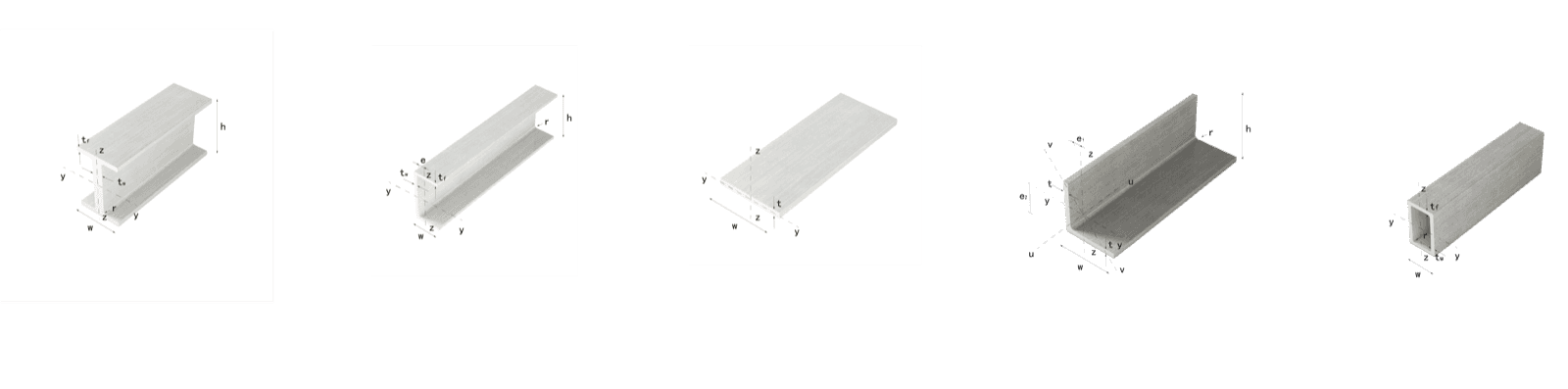
Structural steel has one density: 7.85 g/cm³, whatever mill it came from. Aluminum alloys sit at 2.70. Ask the same question about a pultruded FRP profile and the honest answer is a range, roughly 1.7 to 2.1 g/cm³, because FRP density is not a material constant. It is the output of a recipe. Every fiberglass profile is a blend of glass fiber at 2.54 g/cm³ and cured resin somewhere near 1.2, and where a given section lands between those poles is decided by how much glass the laminate carries and in what form: rovings, mats, fabrics, veils. That makes fiberglass profile density one of the most informative numbers on a datasheet, if you know how to read it.
Why FRP density is a range, not a constant
Pull two published examples. Strongwell's design manual lists the density of its EXTREN 500/525 and 600/625 structural shapes as 0.062–0.070 lb/in³ (1.72 to 1.94 g/cm³) measured to ASTM D792, the standard displacement method for plastics. F1 Composite publishes 1.9 g/cm³ for its EN 13706 grade E23 laminate, with glass content declared at 65–70% by weight. Same process, same fiber family, and still a 13% spread inside a single catalog.
The spread is not sloppiness. Two profiles pulled on the same line differ in density because one carries more continuous roving and the other more mat; because one matrix is filled and the other is not; because one laminate cured with fewer voids. Density is a fingerprint of the laminate inside the section. Metals do not work this way. Composites do, and the rest of this article is about reading the fingerprint.
The two ingredients: glass at 2.54, resin near 1.2
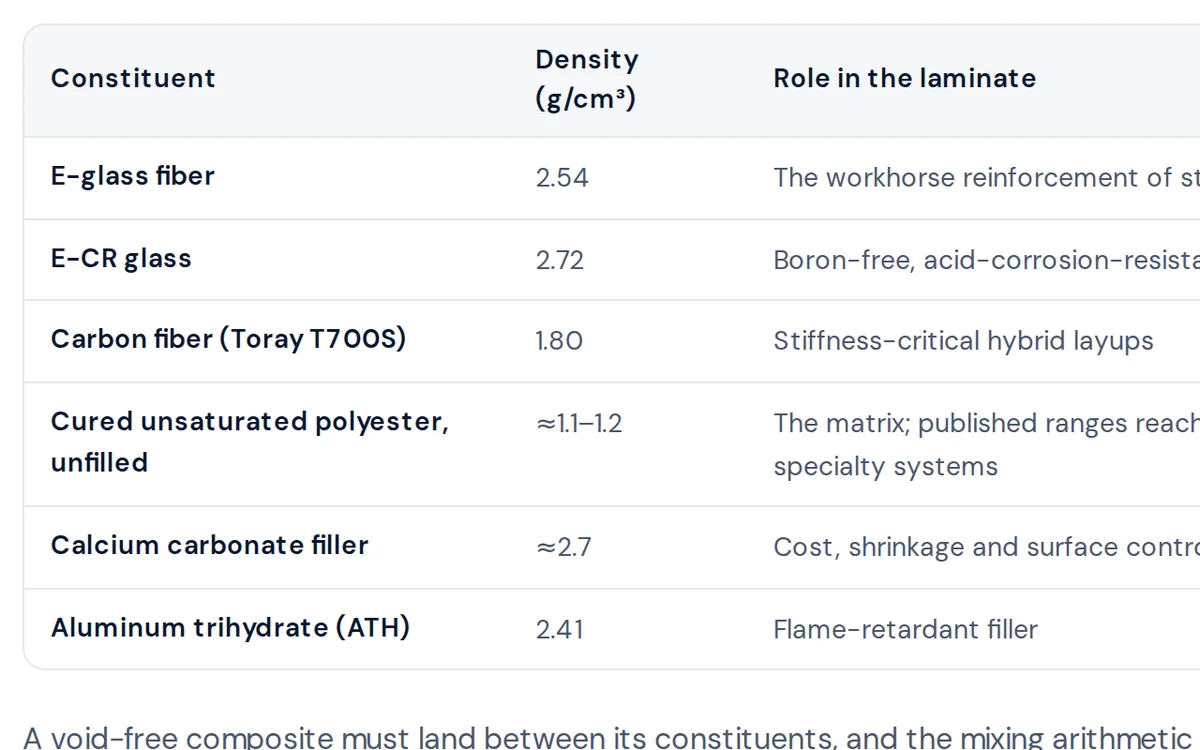
Everything in a pultruded section traces back to a short list of constituents, and each has a known density:
| Constituent | Density (g/cm³) | Role in the laminate |
|---|---|---|
| E-glass fiber | 2.54 | The workhorse reinforcement of structural pultrusion |
| E-CR glass | 2.72 | Boron-free, acid-corrosion-resistant grades |
| Carbon fiber (Toray T700S) | 1.80 | Stiffness-critical hybrid layups |
| Cured unsaturated polyester, unfilled | ≈1.1–1.2 | The matrix; published ranges reach 1.4 for filled and specialty systems |
| Calcium carbonate filler | ≈2.7 | Cost, shrinkage and surface control |
| Aluminum trihydrate (ATH) | 2.41 | Flame-retardant filler |
A void-free composite must land between its constituents, and the mixing arithmetic is fixed. With weight fractions (which is what a burn-off test hands you) density follows the inverse rule of mixtures:
1/ρc = Wf/ρf + (1 − Wf)/ρm
where Wf is the glass weight fraction, ρf the fiber density and ρm the matrix density. Plug in E-glass and an unfilled 1.20 g/cm³ polyester: a laminate at 65% glass by weight computes to 1.83 g/cm³, and at 70% it reaches 1.90. That is most of the mystery of FRP profile density solved in one line. Glass content in, density out.
Rovings, mats and fabrics: the architecture behind the number
Glass content is not a dial a pultruder turns freely. It is set by which reinforcement forms physically feed through the die, and each form packs glass differently.
Rovings are untwisted bundles of parallel continuous filaments. Straight, aligned strands nest tightly, so roving-dominant zones carry the highest local glass content in the laminate. This is where axial stiffness and tensile strength come from. Continuous filament mat and chopped strand mat are the opposite: randomly swirled filaments with loft, which trap resin between loops and hold local glass content well below what rovings achieve. Mat buys transverse strength and holds the profile together across the pull direction. Woven and stitched fabrics (0/90, ±45) sit between the two: engineered transverse properties at packing densities better than mat, short of pure roving. And the surfacing veil is barely reinforcement at all: a thin, resin-rich skin whose job is corrosion and UV protection, not load.
So the same two raw materials produce a family of densities. A solid rod pulled almost entirely from rovings sits at the top of the band. A wide, mat-rich flange sits lower. You can even run the arithmetic backwards: apply the rule of mixtures to EXTREN's published 1.72–1.94 g/cm³ with an assumed unfilled 1.20 resin and the implied glass content spans roughly 57–72% by weight, a spread that tracks with Strongwell's own description of the shapes as mat/roving composites, mat-heavier sections at one end and roving-dominant ones at the other.
This is also why density, glass content and mechanical grade move together. EN 13706 grade E23 requires a full-section longitudinal modulus of 23 GPa and 240 MPa axial tensile strength; no resin-rich laminate gets there. When a pultruded FRP profile is specified to E23, its density has effectively been specified too: somewhere near 1.9.
Fillers and voids: the matrix side of the equation
The resin in a finished profile is rarely unfilled. Mineral fillers are blended into the resin to control cost and shrinkage and to improve fire performance. Both common fillers are heavier than the polymer they displace: calcium carbonate is about 2.7 g/cm³ and aluminum trihydrate is 2.41 g/cm³, compared with 1.1–1.2 g/cm³ for cured polyester. A 2022 study in *Polymers* confirmed the expected result: adding ATH and calcium carbonate to a glass-fiber polyester laminate increased its density. Fire-rated profiles contain high ATH loadings, which is why a flame-retardant grade of the same shape often weighs measurably more than the standard grade. The added weight supports char formation and smoke suppression, not strength.
Voids push the other way. Every air pocket left by imperfect wet-out lowers density below what the recipe predicts, and unlike fillers, voids give nothing back. ASTM D2734, the void-content standard, works by comparing measured density against the theoretical rule-of-mixtures value; the gap is porosity. Higher void content means lower fatigue resistance and faster water uptake.
One honest caveat: density alone is not a quality certificate. A heavily filled, under-glassed laminate can hit 1.9 g/cm³ just like a well-made one: filler weight impersonating glass weight. Density becomes an audit tool only when paired with a glass-content measurement, which is the next section.
How density is measured and how to audit a laminate with it
Two cheap laboratory tests reconstruct most of a laminate recipe.
ASTM D792 measures density by displacement: weigh the specimen in air, weigh it in water, done. This is the method behind virtually every density line on an FRP datasheet, Strongwell's and ours included.
The burn-off measures what the density was made of. ASTM D2584 ignites a small specimen at around 565°C until the resin is gone and weighs the glass that remains; the mass loss is the resin fraction. ISO 1172:2023 is the international counterpart, calcining at 625°C, and its Method B goes one step further, separating textile glass from mineral filler, so a filled laminate cannot disguise chalk as glass.
Together the two tests take an afternoon, and they close the loop: density from D792, glass and filler fractions from the burn, and the inverse rule of mixtures to check that the three numbers agree. If a supplier declares 65–70% glass and 1.9 g/cm³ and the arithmetic does not close, ask questions before the profiles are on a ship. We publish both numbers for every product precisely so buyers can run this check: the laminate values are on the technical data page and on each datasheet.
From density to weight per meter and FRP vs steel weight
For a buyer, density matters because it converts geometry into kilograms. Weight per meter is cross-section area times density, nothing more. Take a fiberglass I-beam with a 20 cm² cross-section: at 1.9 g/cm³ it weighs 3.8 kg/m. The identical section rolled in steel is 15.7 kg/m and extruded in aluminum 5.4 kg/m: the FRP member is about 76% lighter than steel and 30% lighter than aluminum. That is the whole FRP vs steel weight argument compressed into one multiplication, and it is why two installers can place a 6-meter FRP beam that would need lifting equipment in steel.
Density is also a lever. Carbon fiber at 1.80 g/cm³ is lighter than the E-glass it replaces, so a carbon-glass hybrid pultrusion gains axial stiffness while its density falls: the only move in the recipe that improves both numbers at once. And commercially, density is how per-kilogram prices become per-meter prices: quoted price times density times section area gives cost per meter, which is why our price estimator asks for the section and does the density arithmetic for you.
The numbers F1 Composite publishes
Every F1 datasheet declares the same laminate: 1.9 g/cm³ density, 65–70% E-glass by weight, isophthalic polyester matrix, mechanical minimums to EN 13706 grade E23. Run the check yourself: 70% glass at a 1.20 resin computes to 1.90 g/cm³ on the nose. The numbers close because they describe one real laminate, not a marketing composite of best cases.
If your project needs a different point on the density map (an E-CR glass laminate for acid service, an ATH-filled fire-rated grade, or a carbon-glass hybrid optimized for stiffness per kilogram) we can develop the die and material formulation through our custom pultrusion service. Send the section drawing and service conditions to Doris Li at Doris.li@f1composite.com. The resulting quote will include the laminate specification and certified test values, not just a price.