FRP solar support design: spans, loads and connections
Plan FRP solar support structures around wind and snow loads, spans, clamp zones and connections. Link the design requirements to a specified profile schedule.
This guide covers the use of FRP profiles in PV support structures. Begin with the array layout and load path, then specify rail and post sections, clamp zones and attachments. Use the linked solar product catalog for dimensions and component supply; final structural and electrical design remains project-specific.
Best fit: coastal solar farms, floating PV, agricultural PV, corrosive industrial sites, and off-grid structures where weight reduction simplifies transport and installation.
Specify the component supply scope
Identify raw profile lengths, cut or drilled components, grating panels and any agreed assemblies. Confirm fasteners, engineering and installation responsibilities on the quotation. The application describes how the products are used; it does not by itself include complete project delivery.
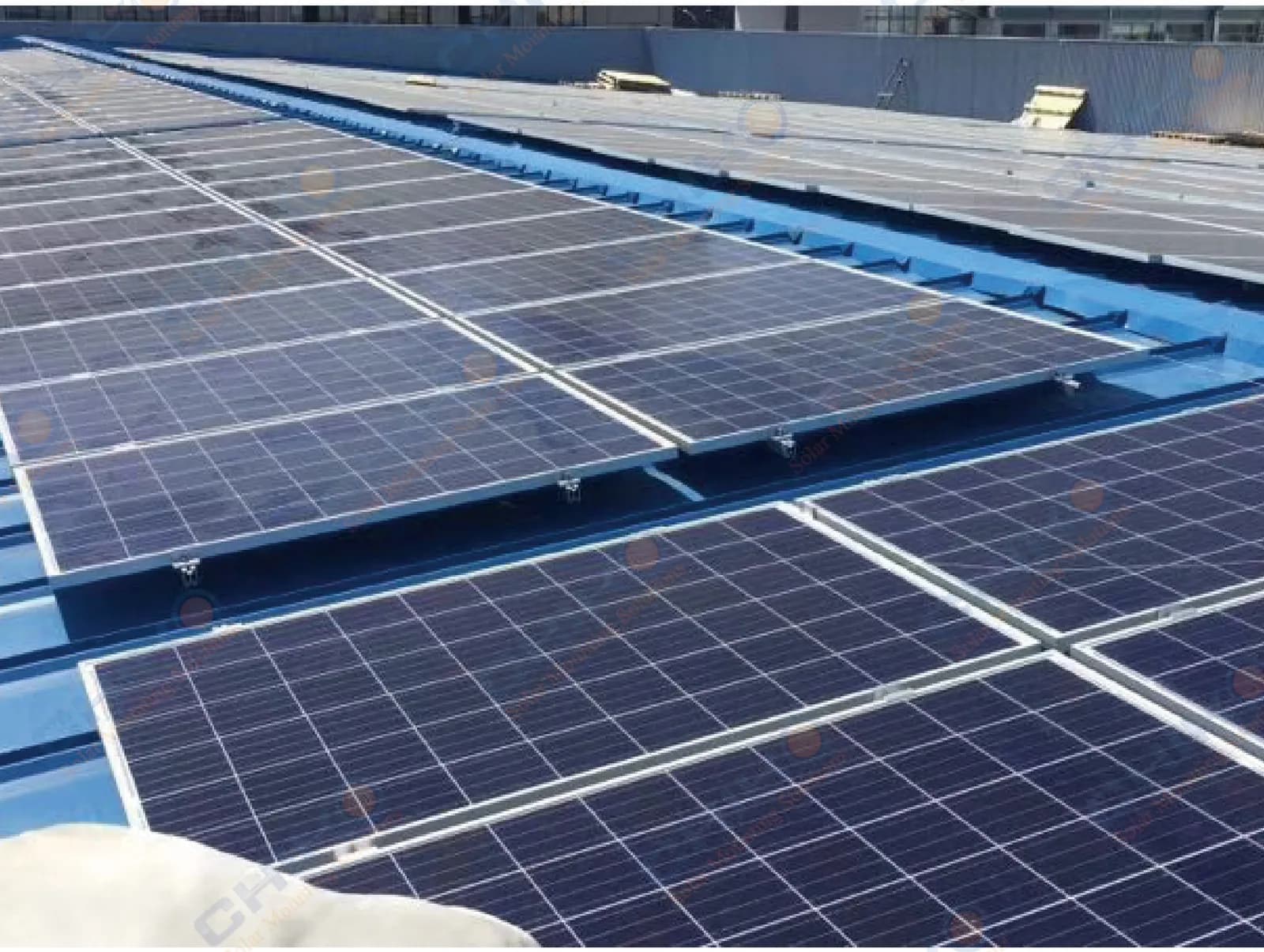
Channels and square tubes for rails and posts
Angles for panel support brackets and bracing
Flat bars and custom sections for clips, spacers, and edge members
Vinyl ester or UV-stabilized polyester laminates for harsh outdoor service
Resin recommendation
UV-stabilized isophthalic polyester is the baseline for standard outdoor PV supports. Vinyl ester is recommended for coastal, floating PV, fertilizer exposure, and aggressive industrial environments.
Common standards
FRP solar mounting profiles: design and specification checks
Wind, snow, and array geometry
Rail and post sizing starts with module dimensions, support points, tributary area, uplift and downward wind pressure, snow drift, seismic demand, and the project's serviceability limit.
Roof or foundation interface
Standing-seam clamps, roof fasteners, piles, ballast, and floating supports each create different local reactions. Pull-out and attachment capacity must be checked separately from the FRP rail span.
Electrical and environmental coordination
FRP rails do not create a conductive path, but modules, inverters, metallic clips, cabling, and lightning protection still require code-compliant bonding. Coastal, fertilizer, floating, and desert sites also need different resin and UV packages.
Specifying FRP solar mounting profiles as a PV system
FRP solar mounting profiles can serve at three levels: module perimeter frames, purlins and rails immediately below the module, or the wider post-and-brace support structure. Each level sees a different combination of bending, torsion, clamp pressure, uplift reversal, temperature cycling, and assembly tolerance. The RFQ should identify which level is in scope and include the module drawing, clamp zones, array layout, site design actions, attachment concept, and target installation sequence.
Low density is most valuable when an existing roof or floating structure has limited reserve. It reduces the rail contribution to permanent load and simplifies manual handling, but it does not eliminate structural review of the roof sheet, seam clamp, fastener pull-out, pile, or float. Likewise, electrical insulation is useful around DC cabling but does not replace module bonding, lightning protection, or the electrical engineer's grounding design.
Outdoor durability depends on the full laminate and surface package. UV-stabilized polyester with a protective veil is a common baseline; vinyl ester is preferred for saline water, fertilizer, and aggressive industrial exposure. F1 can provide standard channels and tubes or develop custom clamp and drainage geometry, then supply factory-cut rails, splice plates, and hardware schedules linked to the installation drawing.
Have a question about this product?
Our FRP Engineering Advisor answers spec, sizing, and chemical-compatibility questions instantly — and routes complex ones to the right human.
Pre-filled question: “I am evaluating FRP solar mounting profiles. Please recommend profile families, resin system, standards, and RFQ details for my project.”
Need a quote for FRP solar mounting profiles?
Send the dimensions, quantity, service environment, and destination. We acknowledge requirements within one business day.