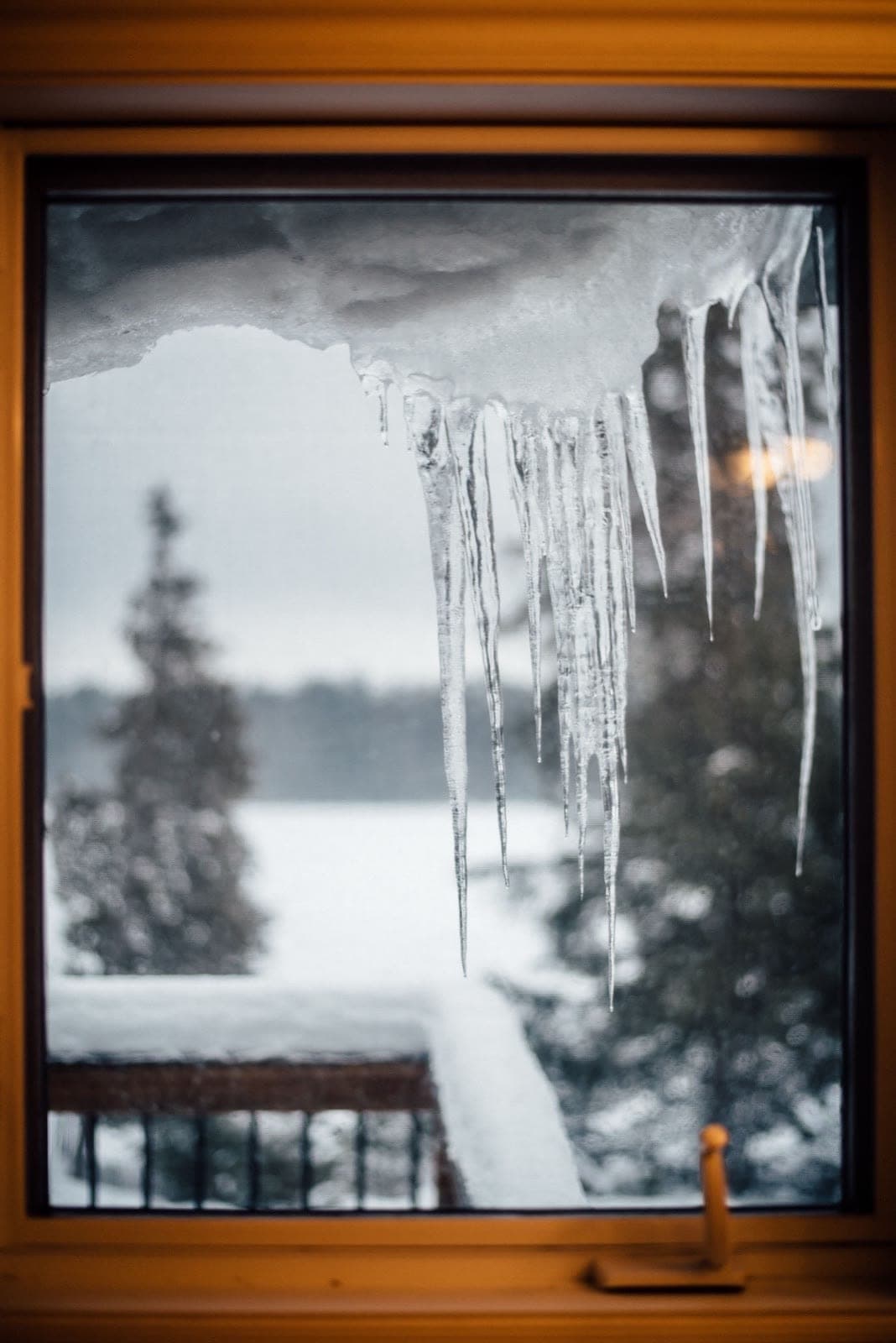
The failure arrives on a schedule. First cold snap of the year: a call about "leaking windows". Nothing is leaking; the water pooling on the sill condensed there. Deep winter: frost growing on the interior of the frame itself. Spring: a mold remediation quote for the drywall returns below the windows. Building managers in Winnipeg, Oslo, Harbin, and Ulaanbaatar know this sequence by heart, and it repeats because it is not a defect. It is the frame material obeying physics.
The mechanism: a race between surface temperature and dew point
Condensation forms on any surface colder than the local air's dew point. At 21°C interior temperature and 40% relative humidity, ordinary winter conditions in an occupied building, the dew point sits around 7°C. Any interior surface below 7°C collects water; below 0°C, it grows frost.
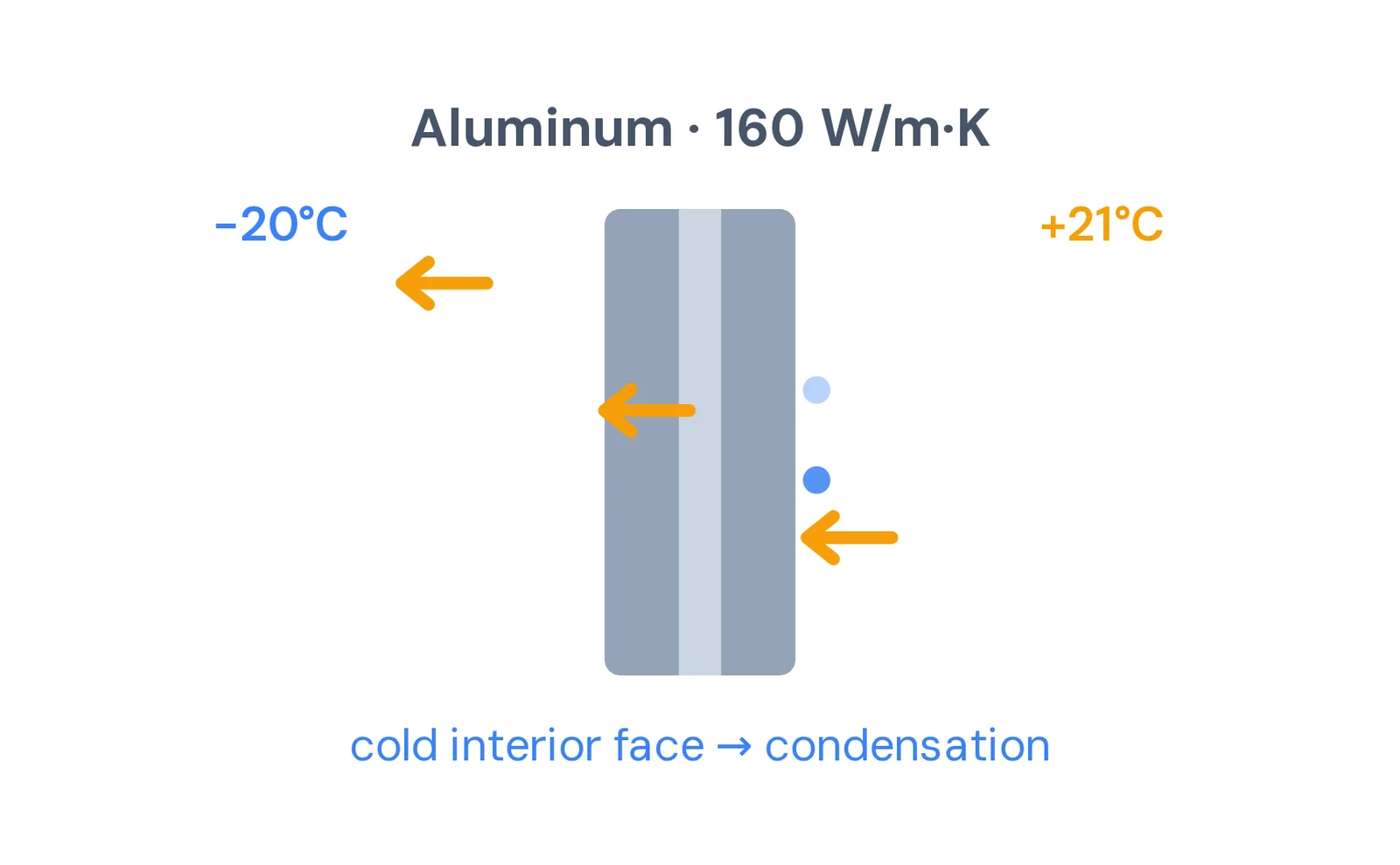
The question, then, is what temperature the interior face of a window frame runs on a cold night. That is set almost entirely by the frame material's thermal conductivity: how fast the frame pipes interior heat to the outside. Aluminum conducts at roughly 160 W/m·K. Pultruded fiberglass conducts at roughly 0.3 W/m·K: a factor of about 500. Timber and uPVC sit near fiberglass; no practical geometry overcomes a 500× material handicap. On a −20°C night, an unbroken aluminum frame's interior face can run below freezing while the wall beside it sits at 18°C. The frame is not underperforming; it is a heat exchanger doing its job in the wrong application.
Why thermal breaks help less than the datasheet implies
The industry's answer is the thermal break: a polyamide or polyurethane strip separating the exterior and interior aluminum shells. It works, partially. Three leak paths remain in real assemblies:
Hardware and fixing penetrations. Every screw port, corner key, and lock case that crosses the break line re-bridges it in metal. The break is continuous in the extrusion drawing and interrupted in the assembled window.
Edge-of-frame details. Sills, thresholds, and coupling mullions are the hardest places to keep the break continuous, which is why cold-climate condensation photographs are so often of sills.
The arithmetic ceiling. Even executed perfectly, a thermally-broken aluminum frame reaches U-frame values of roughly 2.5–4.0 W/m²·K. An intrinsically insulating pultruded frame starts below 1.6 and reaches 0.8 without any break at all, because there is no metallic path to interrupt in the first place.
CRF: the number that predicts the service calls
North American practice has a metric for exactly this: the Condensation Resistance Factor (CRF, AAMA 1503): in essence, a scaled measure of how warm the frame's interior surface stays relative to the temperature difference across it. Higher is better; cold-climate specifications typically demand CRF in the 60s or above. Thermally-broken aluminum systems commonly test in the 45–65 range; insulating-frame systems (fiberglass, uPVC, timber) test meaningfully higher, with the gap widening at the frame-to-glass edge when warm-edge spacers are added. European practice reaches the same verdict through EN ISO 13788's surface-condensation (fRsi) assessment.
If you specify windows for heating-dominated climates, CRF (or fRsi) belongs on the submittal checklist next to U-value. It is the number that predicts the January service calls, and it is available before purchase rather than after.
What actually fixes it
In order of effect:
1. Frame material. Raise the interior surface temperature at the source: a frame that conducts at 0.3 instead of 160 W/m·K keeps its interior face above dew point down to design temperatures no break assembly reaches. This is the structural fix; everything else is mitigation. The material-by-material comparison is here.
2. Warm-edge spacers and glazing. The IGU edge is the second-coldest line in the assembly. Non-metallic warm-edge spacers plus triple glazing lift the edge-of-glass temperature: necessary in any frame material, sufficient in none.
3. Humidity management. Ventilation and humidity control move the dew point down. It works, but note what it concedes: lowering winter indoor humidity below ~30% to protect the windows trades occupant comfort for frame physics.
The field evidence
Theory aside, the condensation question has field answers. F1's GFRP-PU windows run condensation-free on a −25°C chemical-industry campus in Baotou (specified precisely because the previous aluminum frames frosted) and at Qinling Station, Antarctica, against a −60°C design low (case study), where a frame-face condensation failure would not be a service call but a station-integrity problem. The same physics that streams water down an aluminum sill in Winnipeg keeps an insulating frame face dry in Antarctica; the only variable that changed is the conductivity of the material in between.
To check where a specific frame and glazing build lands before specifying, run it through our EN ISO 10077-1 U-value calculator. It computes the whole-window value and flags the pass/fail against cold-climate program targets.