Ask what U-value a passive house window needs and the answer comes back instantly: 0.80. It is the most-quoted number in high-performance fenestration, and it is genuinely in the standard, but as one row of a table, attached to one climate zone, and accompanied by three further criteria that trip up more certification attempts than the headline number does.
The PHI table, in full
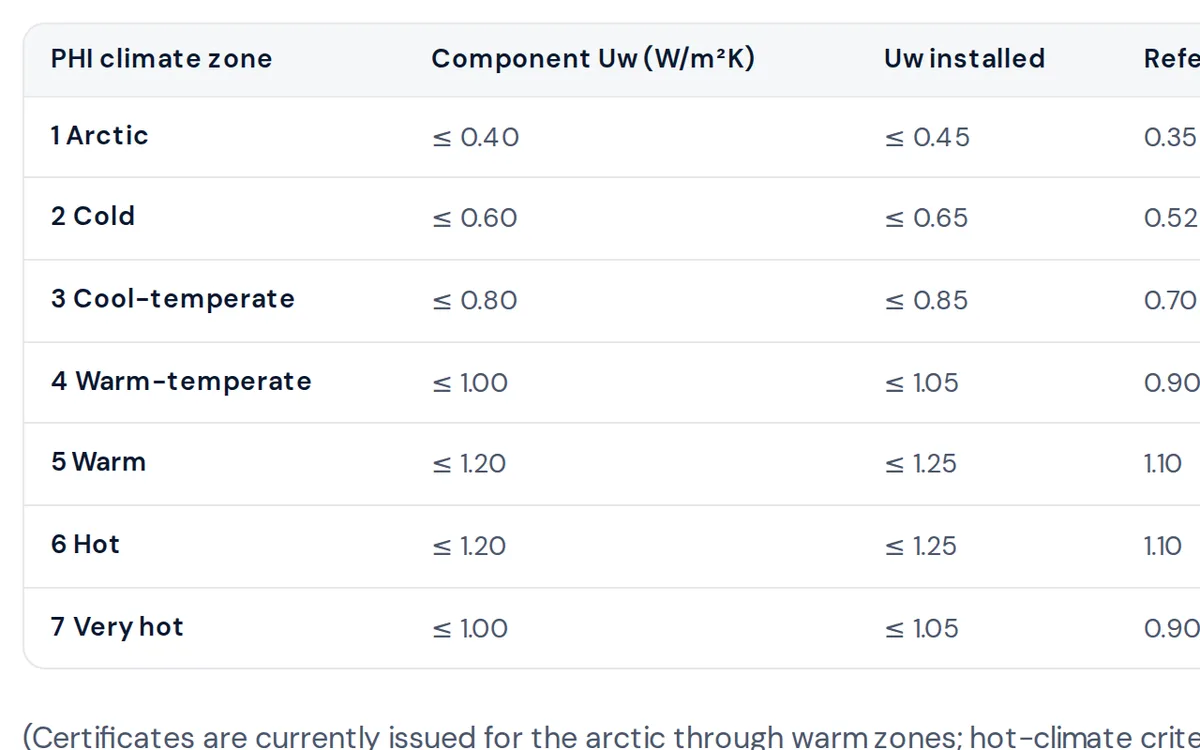
The Passive House Institute (PHI, Darmstadt) certifies windows as components against its *Criteria for Transparent Building Components* (v5.6, 2025). The world is divided into seven climate zones, and each gets its own whole-window limit, calculated per EN ISO 10077-1 on the 1.23 × 1.48 m reference window:
| PHI climate zone | Component Uw (W/m²K) | Uw installed | Reference glazing Ug |
|---|---|---|---|
| 1 Arctic | ≤ 0.40 | ≤ 0.45 | 0.35 |
| 2 Cold | ≤ 0.60 | ≤ 0.65 | 0.52 |
| 3 Cool-temperate | ≤ 0.80 | ≤ 0.85 | 0.70 |
| 4 Warm-temperate | ≤ 1.00 | ≤ 1.05 | 0.90 |
| 5 Warm | ≤ 1.20 | ≤ 1.25 | 1.10 |
| 6 Hot | ≤ 1.20 | ≤ 1.25 | 1.10 |
| 7 Very hot | ≤ 1.00 | ≤ 1.05 | 0.90 |
(Certificates are currently issued for the arctic through warm zones; hot-climate criteria are published but in trial.) Central Europe, most of the northern US, southern Canada, Japan's main islands, and much of China's heating-dominated belt fall in cool-temperate, hence 0.80's fame. Move the same project to Oslo or Harbin territory and the requirement tightens to 0.60; an arctic research posting demands 0.40. Warm-temperate Mediterranean and subtropical zones relax to 1.00–1.20.
Two columns beside the headline number matter in practice. Uw,installed re-runs the calculation with the window mounted in a reference wall, adding the installation thermal bridge. A window that scores 0.80 free-standing but 0.90 installed fails. And the reference glazing column pins the Ug each zone's calculation assumes, which stops manufacturers from buying the rating with exotic glass on an uninsulating frame.
Where the numbers come from
The limits are not energy-budget arbitrary. PHI derives them from two functional requirements:
Comfort: the interior surface temperature of the window may deviate from the room's operative temperature by at most 4.2 K at design cold. Beyond that gap, the window face drives cold-air descent and radiant asymmetry that occupants feel as draught, even in an airtight building. The zone U-values are this criterion solved for each climate's design temperature.
Hygiene: a temperature factor (fRsi ≥ 0.70 for cool-temperate, up to 0.80 arctic) keeps every point of the frame surface warm enough that water activity stays below 0.80, the mold-growth threshold. This is the same surface-condensation physics covered in our cold-climate condensation analysis, promoted from service-call nuisance to certification gate.
PHI additionally grades certified windows into efficiency classes, phA+ to phC, by the heat loss through the opaque part (frame plus glass edge, Ψopaque ≤ 0.065 W/m·K for phA+, ≤ 0.110 phA, ≤ 0.155 phB, ≤ 0.200 phC). Two windows can both pass cool-temperate; the class tells you which one passed comfortably.
Phius: same physics, different program
North American projects mostly certify under Phius, which runs its own window program. Three differences matter for specification:
- Phius publishes climate-zone-specific performance data and recommendations (keyed to US climate zones) rather than a single pass/fail Uw: the verified data sheet carries whole-window installed U-factor, center-of-glass U, and SHGC, with zone recommendation checkmarks. - Since the 2023 program update, Phius reports manufacturers' whole-window U-values without the penalty factor it previously applied. - SHGC is a first-class criterion: warm zones cap it for cooling protection, cold zones treat winter solar gain as a resource. (The U-value/SHGC interaction is its own topic.)
A window certified by PHI is not automatically Phius-verified or vice versa; cross-market products get both.
What construction actually passes
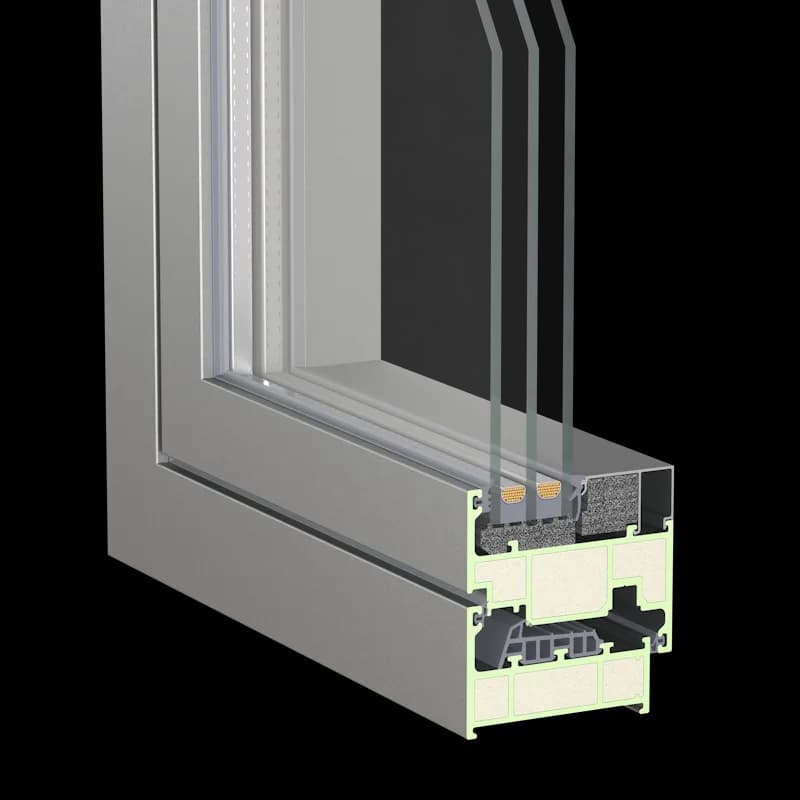
Run the EN ISO 10077-1 arithmetic against the cool-temperate row and the constraint lands on the frame. With the reference triple glazing at Ug 0.70 and a warm-edge spacer, the frame needs roughly Uf ≤ 1.0–1.3: territory no aluminum system reaches, thermally broken or not. That is why the PHI component database's window list is dominated by timber, timber-aluminum hybrid, uPVC, and pultruded fiberglass frames.
Pultruded GFRP does it with bulk conductivity around 0.3 W/m·K and adds what the other insulating frames lack: aluminum-class stiffness for large sashes and slim sightlines, no swelling or rot, and stable geometry from −60°C service (proven at Qinling Station, Antarctica) to desert heat. F1 Composite's GFRP-polyurethane window system holds PHI component certificate 2491wi03 with certified builds to Uw 0.78: the pultruded fiberglass window frames page carries the series-by-series data.
To test a specific frame + glazing + spacer combination against the PHI zone limits before committing to certification samples, run it through the free whole-window U-value calculator. It computes Uw per EN ISO 10077-1 and flags the pass/fail against the passive house targets directly. For a guided selection by climate and project type, the Passive House AI window selector walks the same logic conversationally.