Skip to content
Solar Profile Catalog

FRP solar profiles — module frames, rails and supports

Choose module-frame sections, support profiles and rooftop rails from the catalog below. F1 supplies specified pultruded components; connection hardware, fabrication and any assembly scope are confirmed on the quotation.

Quote This ProductAsk the AI Assistant

Start with your name and email. Product details and drawings can follow.

This page covers component selection and supply. For wind, span and connection considerations, read the PV support design guide →
Three component roles

Profile supply from module edge to support structure

01

Solar module frame profiles

Custom perimeter, corner-key and clamp-interface profiles for framed PV modules. Geometry is developed around the laminate, glass stack, sealant channel, drainage and module load test.

02

Composite PV support profiles

Square, C and H sections for fixed ground arrays, agrivoltaics, fishery-PV, floating arrays and coastal structures. Standard connectors remain mechanically fastened and field-serviceable.

03

Rooftop rails and hardware

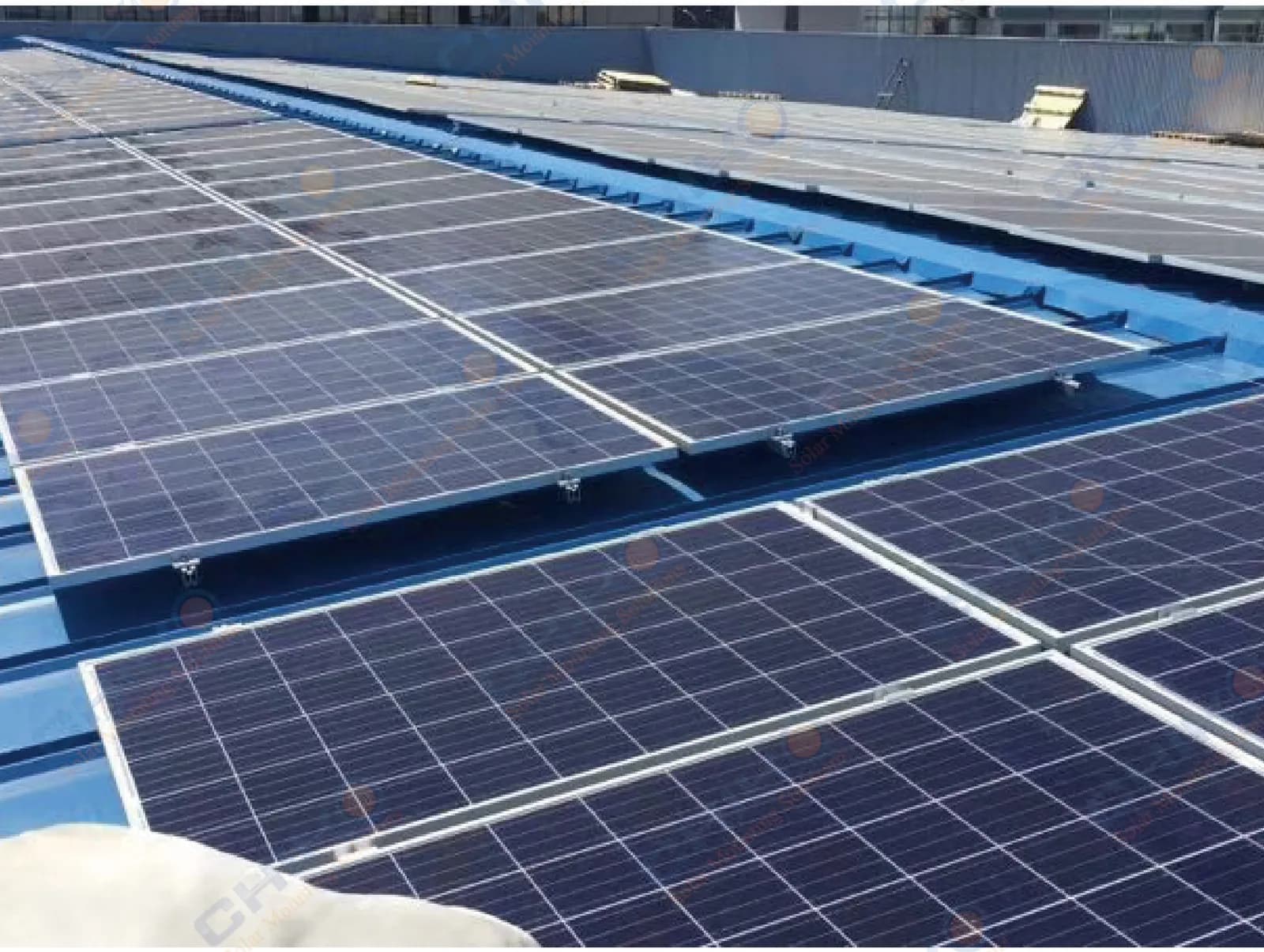
Low-line-mass roof rails for BAPV, BIPV and distributed generation, with matched mid clamps, end clamps, splice plates, sliding nuts and roof interfaces.

Pultruded FRP rooftop rails supporting photovoltaic modules on an industrial roof

Rooftop retrofit system: pultruded H-rail with module clamps and roof-sheet interface.

Catalog sections

Standard FRP solar support and rail profiles

These starting sections cover light rooftop rails through primary ground-mount support. Final section selection is governed by span, module layout, wind uplift, snow, seismic load, connection capacity and the project deflection limit.

ModelOverall sizeWallSection areaTypical role
GTP-FCFG-3030-330 × 30 mm3.0 mm324 mm²Light bracing / secondary support
GTP-FCFG-3060-330 × 60 mm3.0 mm504 mm²Module bearer / light rail
GTP-FCFG-6060-360 × 60 mm3.0 mm684 mm²Posts and support framing
GTP-FCFG-9090-590 × 90 mm5.0 mm1,713 mm²Primary posts / heavy support
GTP-FCHB-8255-555 × 82 mm5.0 mm1,080 mm²H-section mounting rail
GTP-FCCB-7550-450 × 75 mm4.0 mm782 mm²C-section purlin / rail
GTP-FCCB-1005-450 × 100 mm4.0 mm896 mm²Deep C-section purlin
GTP-FCHB-8080-580 × 80 mm5.0 mm1,374 mm²H-section primary rail

Model geometry and availability are confirmed at quotation. Custom solar-module frame and roof-interface profiles are produced from customer drawings or developed as a paid first-article program.

Material options

PU for thin-wall performance; polyester or vinyl ester for exposure-led design

Polyurethane (PU) pultrusion

Density
2.0–2.2 g/cm³
Axial tensile strength
1,000–1,200 MPa
Axial tensile modulus
40–60 GPa
Thermal conductivity
0.1–0.3 W/m·K

Unsaturated polyester (UP)

Density
2.0–2.2 g/cm³
Axial tensile strength
580–750 MPa
Axial tensile modulus
30–40 GPa
Thermal conductivity
0.2–0.4 W/m·K

Values are characteristic laminate ranges from the solar-profile program, not design allowables. Project calculations use batch-qualified properties with environmental, duration, temperature, buckling and safety factors applied.

Laboratory evidence

FRP photovoltaic module frame material test reports

Review the tested material, coating and specimen dimensions before applying a result to your module design. These reports concern the identified samples; they do not certify every F1 Composite profile or a complete PV module. Chinese reports include English notes beside each original page. Untouched originals are also available for signature verification.

PV frame mechanical, electrical and ageing properties

Wuxi / CPVT · 2025DACS20319 · issued 15 June 2026

Chongqing Xianju composite PV frame, identified as all-weather modified resin. Initial mean tensile strength: 1,310 MPa; flexural strength: 1,060 MPa; flexural modulus: 48.0 GPa; volume resistivity: 1.0 × 10¹³ Ω·m. Reported HDT: >290°C; flammability: V-1.

Includes UV, combined UV/damp-heat, UV/humidity-freeze, UV/thermal-cycle, salt-mist and ammonia exposure results. The report gives measurements without an overall pass/fail conclusion. Its salt-mist cycle count and total duration are inconsistent; consult the issuer for clarification.

PV frame performance report with English notes (PDF)

Untouched Chinese original (PDF)

Jotun Jota Solar CL coating variant

TÜV Rheinland · CN24KZ3A 002 · issued 14 March 2025

Chongqing Fengdu GFF-series polymer composite PV frames with Jota Solar CL water-based polyurethane coating. Initial mean tensile strength: 1,410.22 MPa; flexural strength: 1,570.95 MPa. Tested against 2 PfG 2923/11.22 with a reported Pass result.

Coating-change report covering clauses 5.2, 5.4, 5.5, 5.6, 5.9, 5.13, 5.16, 5.20, 5.21 and 5.22. Other tests refer to CN24KZ3A 001. Includes 2,000 h weathering, TC200, 1,000 h damp heat and TC50 plus humidity-freeze results.

Jotun coating test report in English (PDF)

B9986S polyester coating variant

TÜV Rheinland · CN24KZ3A 003 · issued 10 October 2025

Chongqing Fengdu GFF-series polymer composite PV frames with B9986S polyester coating. Initial mean tensile strength: 1,353.25 MPa; flexural strength: 1,755.71 MPa. Tested against 2 PfG 2923/11.22 with a reported Pass result.

Covers the same coating-change clauses as report 002 and refers to CN24KZ3A 001 for other tests. Tensile strength retention is reported as 92.08% after TC200, 87.54% after damp heat and 97.17% after weathering.

B9986S coating test report in English (PDF)

E-TS-AB composite material flammability

SGS · GZMR260702529004 · issued 30 July 2026

Chongqing Xianju glass-fibre-reinforced composite profile E-TS-AB, tested as longitudinal A1 sheet specimens at 10.1 mm thickness. UL 94-2023 Rev.2-2024, Section 8: V-0, Pass.

This result applies to the specified material and tested thickness. It does not establish V-0 for thin-wall PV frames or replace the V-1 result in the separate Wuxi frame report. SGS states that this report is for internal reference.

SGS material flammability report with English notes (PDF)

Untouched Chinese original (PDF)

English notes are supplied by F1 Composite and are not laboratory-certified translations. The complete reports retain their original conditions of use. TÜV Rheinland reports require prior written approval for advertising reproduction and do not authorize use of a test mark. Reported sample strengths are not structural design allowables; confirm the material, coating and production specification for your order.
Project fit

Where composite PV profiles change the project equation

Rooftop retrofit

Lower rail dead load helps preserve the structural reserve of existing industrial roofs.

Coastal & offshore

No zinc loss, anodic pitting or galvanic couple along the main composite members.

Floating & fishery-PV

Low weight and resistance to humidity, salt spray and water-side corrosion.

Ground & agrivoltaic

Mechanically fastened posts, purlins and braces for corrosive soil and fertilizer exposure.

Frequently Asked Questions

Which photovoltaic products can F1 Composite supply?

The range covers three product families: custom pultruded profiles for solar-module perimeter frames; structural FRP profiles for ground-mount, floating, fishery-PV and agrivoltaic support frames; and lightweight rooftop rails supplied with mid clamps, end clamps, splice plates and roof-clamp interfaces. Profiles can be supplied as cut lineals or as a project-specific component kit.

Can FRP solar mounting rails be used on existing industrial roofs?

Yes. Rooftop retrofit is a strong fit where the original roof has limited dead-load reserve. A typical pultruded GFRP rail weighs about 1.0–1.5 kg/m, compared with roughly 4–6 kg/m for a galvanized-steel rail. Final suitability still requires a project-specific roof survey and structural check for wind uplift, snow, seismic load and connection pull-out.

How are panels and rails connected?

The standard assembly uses sliding nuts with M8×25 fasteners for module mid and end clamps, and M6×12 fasteners for rail splice plates. Standing-seam and trapezoidal-roof interfaces are selected for the roof sheet and can be configured as non-penetrating clamps where the roof geometry permits. Hardware schedules are confirmed with the module and roof drawings.

Which resin system should be specified for PV supports?

UV-stabilized unsaturated polyester is the cost-effective baseline for normal outdoor service. Polyurethane provides the higher characteristic strength and modulus range for thin-wall, stiffness-sensitive sections. Vinyl ester is recommended for offshore, floating, high-salinity, fertilizer and aggressive industrial exposure. The laminate, veil and coating package is selected from the site's exposure class and design life.

Do electrically insulating FRP rails eliminate every grounding requirement?

The FRP members do not create a conductive path and therefore do not need bonding as metallic rails do. The PV modules, inverter, cable system, metallic fasteners and lightning-protection system must still follow the electrical engineer's design and the applicable local code. Electrical isolation of the rail is a system advantage, not a waiver of project grounding and lightning-protection review.

Have a question about this product?

Our FRP Engineering Advisor answers spec, sizing, and chemical-compatibility questions instantly — and routes complex ones to the right human.

Pre-filled question: “I need FRP photovoltaic profiles for [module frame / rooftop rail / ground-mount / floating PV]. Module size and layout: [...]. Site: [...]. Wind/snow/seismic loads: [...]. Roof or foundation interface: [...]. Recommend a profile family, resin system, hardware concept, and RFQ inputs.

Ask the AI advisor →

From selection to a project quotation

Catalog dimensions identify standard section options, not live inventory. Confirm tooling, material, quantity and production timing in the quotation.

1. Check the application

Review application requirementsReview material selection and test methods

2. Review supporting evidence

Find applicable product evidenceExplore project and engineering references

Confirm that the document and project match your proposed product.

3. Send the specification

Include the drawing, resin or environment, loads, quantity and destination.

Request a specification review

Send the module, array and load drawings — get a solar-profile proposal.

Send the dimensions, quantity, service environment, and destination. We acknowledge requirements within one business day.