Skip to content
Specialist component specification

Composite conductor core rods for qualification review

An overhead-conductor core inquiry needs a controlled architecture and a system partner. Define the intended conductor, protective interface and qualification program before discussing a nominal rod diameter or production volume.

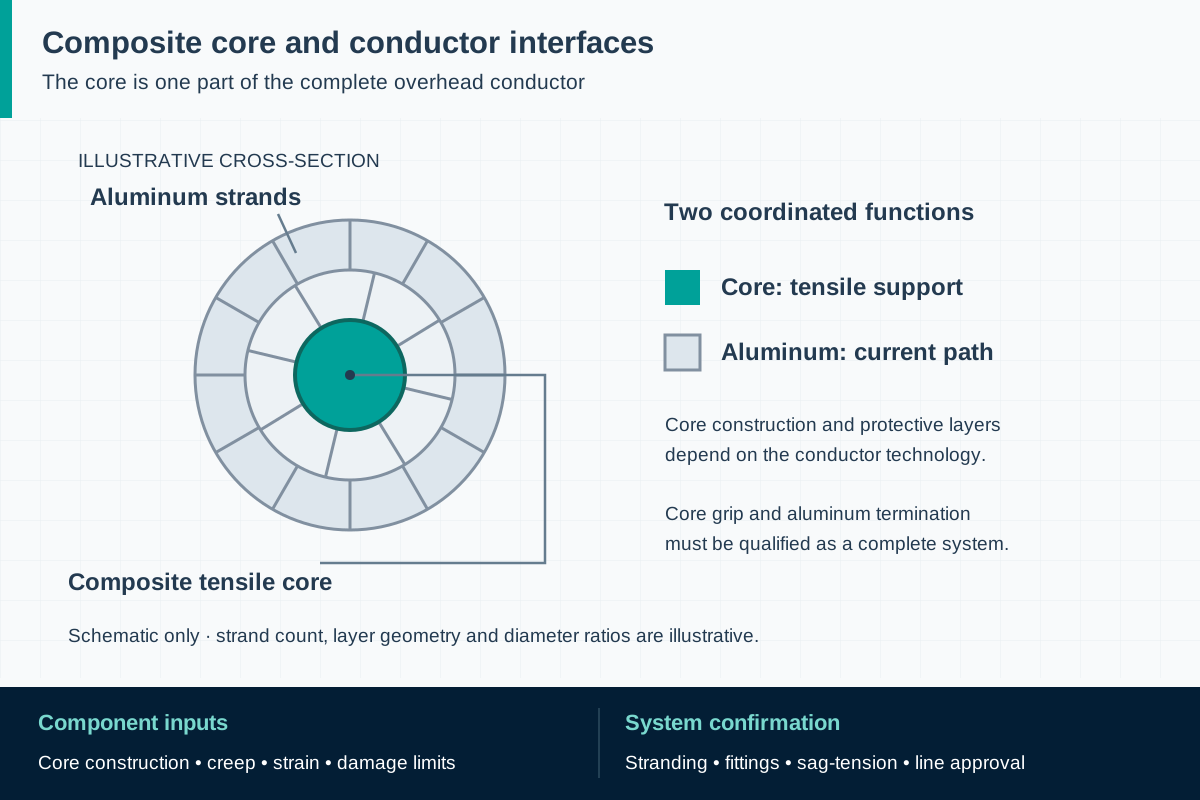
FIG. 1 Composite conductor core rodsComponent schematic · not to scale
The center carries tensile load; the surrounding aluminum provides the current path. Layer geometry and strand count are illustrative and vary with conductor technology.

Component scope and material selection

Technical feasibility and development inquiries only. No F1 utility qualification, series availability, maximum operating temperature, licensed conductor technology or stock ASTM-compliant core is represented here.

Select the complete material system

Carbon-fiber thermoset or another explicitly defined polymer-matrix core architecture, subject to manufacturing and system qualification

Components to specify

  • Candidate continuous core rods
  • Candidate individual core wires
  • Specified protective constructions requiring validated continuity and interfaces

Define what the development program is meant to produce

Identify the conductor manufacturer or technology owner that will integrate the core. Describe whether the inquiry concerns a material study, qualification-length core, trial conductor production or a proposed series supply program. Each stage needs a defined deliverable and approval gate. F1's review begins with feasibility and evidence requirements; a page about the application does not establish an approved manufacturing capability.

Attach the proposed core drawing and architecture, including the load-bearing material and outer protection. State whether the design is a single core or individual wires for a stranded construction, and resolve any licensed or proprietary interface requirements. Do not request equivalence solely by naming a branded conductor or supplying its outside diameter.

ReferencesEpsilon Composite: advanced conductorsIEC TS 62818-1:2024: polymeric matrix composite cores

Control geometry and the protection that surrounds it

Nominal diameter is only one variable. Specify dimensional variation, roundness where relevant, protective-layer construction, surface defects and the continuous length needed for the integration trial. Define how the conductor manufacturer will verify receipt and how a nonconforming length will be located and isolated. The protection system must remain compatible with adjacent metal, stranding operations and approved termination preparation.

The ASTM core specification includes a defined dimensional scope and requirements for the protective barrier and core quality. Those standard scope limits are not a catalog of sizes F1 can supply. The feasibility review must establish the manufacturing route, measurement capability and qualification plan for the requested construction before a production specification is accepted.

ReferencesASTM B987/B987M-25: carbon thermoset conductor coresIEC TS 62818-1:2024: polymeric matrix composite cores

Specify performance with its test condition and definition

For each requested property, state the specimen construction, conditioning, test temperature, loading method and reporting basis. Tensile strength, axial stiffness, strain capacity, thermal behavior and performance after exposure should be traceable to the same material definition. Values from a different fiber ratio, surface construction or matrix cannot be treated as guaranteed data for the proposed core.

Distinguish initial characterization from retained properties after the qualification exposure. Let the conductor integrator define how the evidence supports its temperature envelope and mechanical model. A high Tg result or a short-term elevated-temperature tensile test alone does not prove a long-term conductor rating. Record the exact limits the development program is testing instead of promising the outcome in advance.

ReferencesIEC TS 62818-1:2024: polymeric matrix composite coresEPRI: Advanced Conductor Specification GuideIEEE 738-2023: conductor current-temperature calculation

Agree on reel handling and stranding interfaces before delivery

Request the receiver's payoff and stranding arrangement, contact surfaces, tension controls, reel geometry and handling path. Agree on the core-specific limits and how the trial will detect damage. Protection during transport is part of the delivered condition, so identify packaging, restraint, reel marking and the inspection required after a suspected impact or handling deviation.

The qualified handling envelope must come from the actual construction and process. Do not infer a permissible field sheave size from an isolated core test or a generic diameter ratio. The completed conductor requires its own installation instructions. If production trials change a contact, bend or gripping condition, assess the change before treating earlier evidence as valid for the new process.

ReferencesCIGRE TB 916: handling fittings and conductorsASTM B987/B987M-25: carbon thermoset conductor cores

Make the evidence package usable by the conductor integrator

The proposed release package should connect core identity, reel identity, drawing and material revision, inspection results, test reports and approved deviations. Define where retained samples and records will be held. Distinguish the core tests from conductor and fitting qualification, with named responsibility for each. The order should state which standard editions and purchaser criteria apply rather than relying on a general claim of international compliance.

A trial pass supports the next agreed development step; it does not independently approve utility service. Material, protection, cure, dimension and production-process changes require the designated review. Before series release, the system integrator and utility should have accepted the necessary conductor and accessory evidence and the installation support plan. This product page is an entry point to that qualification discussion.

ReferencesIEC TS 62818-1:2024: polymeric matrix composite coresEPRI: Advanced Conductor Specification GuideCIGRE TB 426: qualifying high-temperature conductors

Standards, regulations and acceptance evidence

The project authority determines the governing jurisdiction and adopted edition. The scope of each reference matters: a material test, an equipment requirement and a workplace rule answer different questions.

Standard · Procurement programs specifying ASTM carbon thermoset composite core requirements.

ASTM B987/B987M-25

Carbon-reinforced thermoset supporting cores for overhead conductors; the 2025 scope includes core diameters 4.57–21.21 mm and individual stranded-core wires 1.52–7.07 mm.

Application boundary: Scope dimensions are not F1 available sizes. Compliance does not approve a finished conductor, fitting or line. Other matrix systems require their applicable qualification basis.

ReferencesASTM B987/B987M-25: carbon thermoset conductor cores

Guidance · Projects adopting this IEC Technical Specification for polymer-matrix supporting cores.

IEC TS 62818-1:2024

Terminology and characterization recommendations for single- or multi-wire fiber-reinforced polymer cores.

Application boundary: Its stated scope does not supply all compliance criteria that a purchaser may need. Agree on acceptance limits and system qualification separately; it is a Technical Specification, not a generic IEC product certificate.

ReferencesIEC TS 62818-1:2024: polymeric matrix composite cores

Standard · Line-rating studies and utility programs adopting this calculation method.

IEEE 738-2023

Relates bare-conductor current, temperature and weather for steady and time-varying conditions.

Application boundary: The user selects appropriate input conditions. Thermal calculation does not qualify core aging, predict all sag behavior or verify fittings and structural capacity.

ReferencesIEEE 738-2023: conductor current-temperature calculation

Guidance · Utility qualification programs choosing to incorporate this technical guidance.

CIGRE TB 426 (2010)

Recommendations for qualifying complete high-temperature conductor systems and accessories intended for maximum temperatures above 150 °C.

Application boundary: It is guidance with a defined temperature scope. A buyer must specify the required tests and criteria; citing the brochure does not certify a core or prove service life.

ReferencesCIGRE TB 426: qualifying high-temperature conductors

Guidance · Engineering studies for existing-line current uprating or new-line development, respectively.

CIGRE TB 763 (2019) and TB 983 (2026)

Supports selection and system assessment of high-temperature conductors in the relevant project context.

Application boundary: Neither replaces statutory clearance rules, utility acceptance or project structural calculations. Current uprating must not be described as automatic voltage upgrading.

ReferencesCIGRE TB 763: uprating existing overhead linesCIGRE TB 983: high-temperature conductors in new lines

Public source scopes were reviewed on . These references do not establish certification of an F1 product. Agree the offered grade, finished component, test specimen and acceptance criteria in the project specification.

Composite conductor core rods: practical questions

Is this an available utility-approved F1 core product?

No such status is asserted. The page invites a feasibility and qualification inquiry. Any supply proposal must establish manufacturing capability and the required core and system approvals separately.

Can I order by diameter and tensile strength only?

Those inputs are insufficient. The architecture, protection, thermal duty, bending and handling requirements, conductor integration and evidence program also need definition.

Does the ASTM dimensional scope confirm F1 production sizes?

No. It describes the standard's coverage. Requested dimensions and production lengths remain subject to feasibility and qualification review.

Technical sources and further reading

Industry sources establish where the application is used. Authority sources define the published scope of standards and regulations. The design and procurement checklists above are an original engineering synthesis for project review.
  1. Industry application evidence

    Epsilon Composite: advanced conductors

    Discovery evidence for pultruded composite conductor cores. Epsilon's trademarks, qualification, temperature limits and capacity claims are specific to its technology and are not F1 claims.

  2. Standard or public authority

    ASTM B987/B987M-25: carbon thermoset conductor cores

    Active edition checked October 2026; its scope includes defined core and individual-strand diameters. Older supplier pages may still cite the 2020 edition.

  3. Standard or public authority

    IEC TS 62818-1:2024: polymeric matrix composite cores

    Technical Specification for polymer-matrix single- or multi-wire supporting cores. Characterization guidance is not complete-conductor or line approval.

  4. Standard or public authority

    IEEE 738-2023: conductor current-temperature calculation

    Thermal calculation method. The official scope expressly leaves selection of suitable weather and conductor parameters to the user.

  5. Standard or public authority

    CIGRE TB 426: qualifying high-temperature conductors

    2010 guidance for complete conductor systems, including accessories, intended for maximum temperatures above 150 °C; not a universal rating for all composite cores.

  6. Standard or public authority

    CIGRE TB 763: uprating existing overhead lines

    2019 guidance covering conductor choices and sag-tension in current uprating. It explicitly distinguishes voltage upgrading.

  7. Standard or public authority

    CIGRE TB 983: high-temperature conductors in new lines

    2026 publication covering electrical, mechanical, constructability and economic considerations for new lines; scope reviewed from official public contents.

  8. Standard or public authority

    CIGRE TB 916: handling fittings and conductors

    2023 industry guidance on handling and installation. Project-specific manufacturer procedures remain necessary.

  9. Standard or public authority

    EPRI: Advanced Conductor Specification Guide

    Public guide and example specification for conductor procurement and thermal-mechanical qualification. Its examples are not universal contract requirements.

Prepare a component qualification brief

Provide the application and acceptance requirements so we can assess material, geometry, sampling and the proposed supply scope. We reply within one business day; a formal quotation follows once the specification and delivery are reviewed.

01 · Development stage, conductor integrator, utility/project context and qualification decision owner.
02 · Core architecture and drawing, size and tolerances, protection system, continuous trial length and technology rights or interfaces.
03 · Mechanical and thermal requirements with test conditions, retained-property criteria and environmental exposure.
04 · Reel, payoff, stranding and contact geometry; proposed inspection and handling controls.
05 · Core standards and editions, purchaser criteria, test laboratory responsibilities and witness requirements.
06 · Core-to-conductor traceability, change control, trial quantity, timing and evidence needed before series consideration.
Get a quoteWhatsApp