Skip to content
Pultrusion application guide

Qualifying FRP components for live-line tools

A fiberglass rod or tube becomes a candidate tool component only through a defined material, fabrication and qualification process. Establish the applicable component standard and complete-tool acceptance route before selecting a profile.

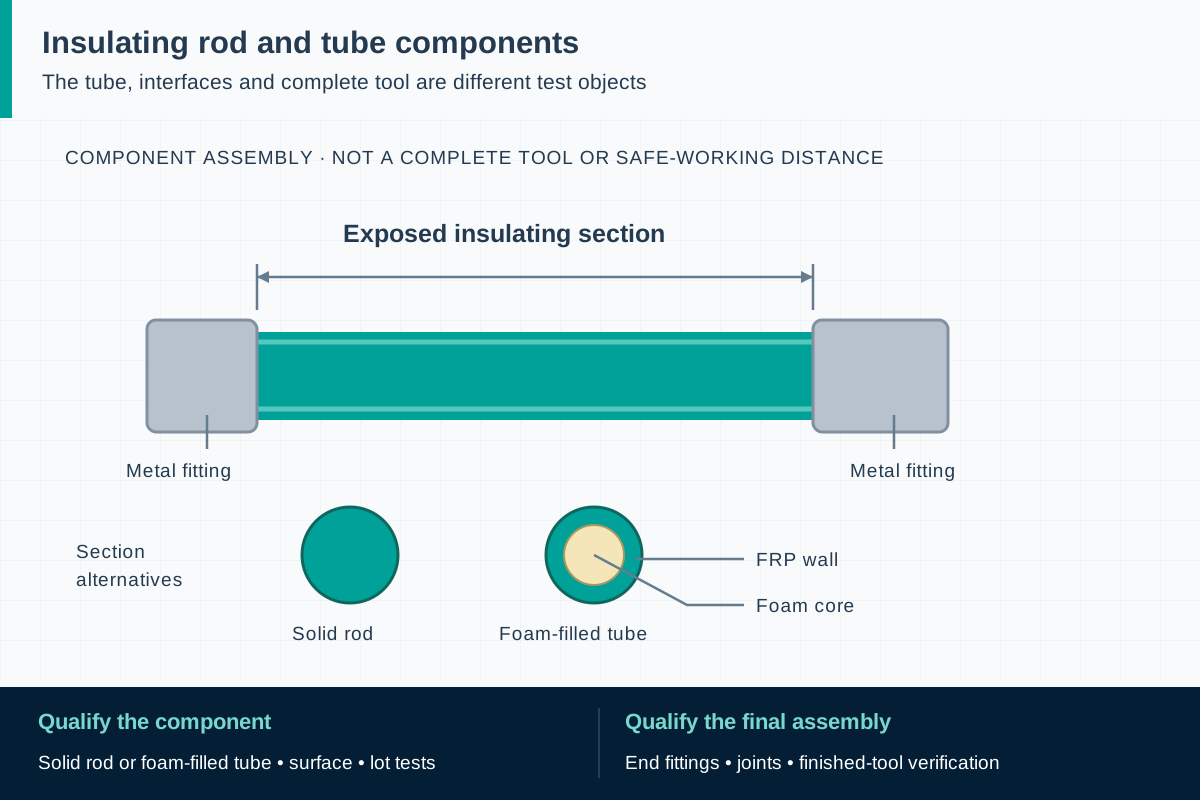
FIG. 1 Live-line tool component qualificationApplication schematic · not to scale
The dimension spans exposed insulation between fitting edges. The two sections distinguish a solid rod from an FRP wall around foam; this is not a working-distance specification.

Component scope and material selection

This is a component feasibility and qualification inquiry. F1 has not established a dedicated live-line tool qualification through this page. It is not an offer of an approved complete tool, a working-voltage rating or instructions for energized work.

Select the complete material system

Candidate fiberglass-reinforced insulating solid rod or foam-filled tube, subject to application-specific qualification

Components to specify

  • Solid insulating rods
  • Circular foam-filled insulating tubes
  • Drawing-controlled component ends subject to tool-maker qualification

Define whether you are buying a profile, component or tool

State the deliverable at the beginning of the inquiry. A pultruded blank, a cut and machined insulating component, a component fitted with a metal head and a complete tool are different products. The party integrating the tool must define the acceptance route for the final assembly and the evidence needed from its component supplier. A generic fiberglass handrail tube or structural rod is not an acceptable substitute merely because glass and resin are commonly electrical insulators.

Tencom identifies pultruded fiberglass as a tool-component application. The authoritative component boundaries come from the relevant standards: ASTM F711 covers insulating solid rods and foam-filled tubes, while its scope excludes fittings and attachments for complete tools. IEC 60855-1 addresses circular-section rods and foam-filled tubes for manufacturing live-working equipment. These scope statements guide the inquiry; they do not establish that an F1 profile or an assembled tool conforms.

ReferencesTencom: fiberglass tool handles for lineworkASTM F711-26: FRP rod and tube used in live-line toolsIEC 60855-1:2016: insulating foam-filled tubes and solid rods

Choose a complete insulating construction

Describe the required solid or foam-filled construction, dimensions, effective component length, surface finish and end treatment. For a foam-filled tube, the core, tube wall, interfaces and end closures should be reviewed as one construction. The choice of a foam by itself cannot prove resistance to moisture ingress. Establish how the selected manufacturing process will control the relevant features and how the agreed inspections can verify them without overlooking internal or interface defects.

Specify the fiberglass reinforcement and resin system with the qualification plan, then identify the properties that matter in the intended temperature, moisture and contamination conditions. Do not substitute carbon reinforcement or conductive additives into a construction intended to provide electrical insulation. Surface appearance and a low water-absorption figure alone do not establish live-line suitability. The material identity, processing controls and test evidence must describe the actual component that will enter the tool assembly.

ReferencesASTM F711-26: FRP rod and tube used in live-line toolsIEC 60855-1:2016: insulating foam-filled tubes and solid rods

Check the mechanics of the tool and its end interfaces

Obtain load cases from the tool designer, including the tool head, handling geometry and any intended axial, bending or torsional action. A long component can meet a strength target while deflecting too much for the intended tool function. Discuss stiffness, component mass, straightness and the load introduction at each end together. Use the actual reinforcement orientation and construction when establishing the assessment; a generic longitudinal tensile value does not cover every failure mode.

Holes, machined ends, threaded inserts, clamps, bonded ferrules and telescoping interfaces can change performance locally. Agree on the joint geometry, preparation and assembly controls with the tool manufacturer, then qualify the applicable final configuration. Changing a head or increasing overlap does not automatically preserve the original basis of approval. The rod-and-tube standard's scope limit is especially relevant here: evidence for the insulating length does not by itself establish the strength or electrical behavior of attachments.

ReferencesASTM F711-26: FRP rod and tube used in live-line tools

Write an electrical test plan without inventing a working rating

The procurement specification should state the adopted standard and edition, the component construction and the required design, production and acceptance evidence. Identify test conditions, required conditioning, the inspected length, acceptance criteria and who reviews the results. These details belong in a controlled plan agreed with the tool maker and test organization. A single dry dielectric test or a resin datasheet cannot stand in for the relevant qualification of the finished component.

Keep laboratory tests separate from permitted field operation. A test voltage divided by specimen length is not a rule for selecting a safe working length, approach distance or equipment voltage. The working surface and complete assembly are exposed to conditions a simple material number cannot describe. This guide therefore provides no energized-work procedure or voltage-to-length formula. Qualified employers and tool manufacturers must establish their operating limits and practices through the applicable rules and validated equipment.

ReferencesASTM F711-26: FRP rod and tube used in live-line toolsIEC 60855-1:2016: insulating foam-filled tubes and solid rodsOSHA 29 CFR 1910.269(j): live-line tools

Carry qualification controls into production and assembly

Freeze the drawing, material construction, surface system, approved machining and marking locations before the first production release. Agree on the inspection methods for dimensions, straightness and visible damage, as well as the test records required by the selected standard and purchase contract. Development samples should be clearly distinguished from released components. Identify how the component batch will remain traceable after cutting, fabrication and integration into a complete tool.

Review proposed changes before implementing them. A different reinforcement, resin, core, coating, end closure or fabrication process can affect the assumptions used during qualification. Packaging should preserve the qualified surfaces and prevent mix-ups with ordinary structural fiberglass products. The receiving tool manufacturer should verify identification and the agreed acceptance documents before assembly, then perform the further checks needed for its complete tool. Supplier documentation is an input to this process, not a substitute for it.

ReferencesASTM F711-26: FRP rod and tube used in live-line toolsIEC 60855-1:2016: insulating foam-filled tubes and solid rods

Distinguish daily condition checks from periodic examination

For work within its scope, OSHA 1910.269(j) requires live-line tools to be wiped clean and visually inspected before each day's use. A defect or contamination that could affect insulation or mechanical integrity triggers removal from service and the prescribed evaluation. The employer's procedure should make identification, condition reporting and segregation of suspect tools practical. Useful observations include cracks, surface damage, persistent deposits and loose interfaces; the manufacturer's instructions govern the actual inspection and care process.

Tools used for primary employee protection enter OSHA's two-year examination, cleaning, repair and testing regime, with detailed conditions for testing and specific exceptions in the rule. It should not be reduced to a blanket statement that every tool needs only one identical test every two years. Read the current regulation and applicable manufacturer guidance together. Test voltages for in-service evaluation are not field working ratings, and a purchase certificate does not remove the employer's responsibilities.

ReferencesOSHA 29 CFR 1910.269(j): live-line toolsOSHA: clarification of live-line tool examination and testing

Define withdrawal, repair and replacement responsibilities

Specify who can authorize repair, what processes are permitted and how the tool returns to service after the required examination and testing. Uncontrolled sanding, drilling, painting or fitting replacement hardware can alter the construction that was qualified. A contaminated surface or damaged interface should not be dismissed because the underlying material is fiberglass. Record the defect, tool identity and relevant exposure so the manufacturer can distinguish isolated damage from a manufacturing or application issue.

Use separate procurement gates for feasibility, component qualification, complete-tool validation and release to field use. If a required report, manufacturing control or competent approval is missing, keep the part within development status. A drawing-led inquiry can establish the work needed without claiming that a suitable product is already qualified. The result should be a clear allocation of design, testing, inspection and maintenance duties rather than a broad statement that a handle is electrically safe.

ReferencesOSHA 29 CFR 1910.269(j): live-line toolsASTM F711-26: FRP rod and tube used in live-line tools

Standards, regulations and acceptance evidence

The project authority determines the governing jurisdiction and adopted edition. The scope of each reference matters: a material test, an equipment requirement and a workplace rule answer different questions.

Standard · Procurement and qualification programs specifying ASTM requirements; not independently a universal legal requirement.

ASTM F711-26

Technical characteristics and tests for FRP insulating solid rods and foam-filled tubes intended for live-line tools. The official catalog identifies design, sample, routine and acceptance testing.

Application boundary: Fittings and attachments for complete tools are excluded. Ordinary hollow tube, a material datasheet or an individual electrical test cannot establish compliance of a finished tool. This page makes no F1 conformity claim.

ReferencesASTM F711-26: FRP rod and tube used in live-line tools

Standard · Countries and contracts adopting this IEC component standard or its national implementation.

IEC 60855-1:2016

Circular-section fiberglass-reinforced solid rods and insulating foam-filled tubes for manufacture of live-working tools and equipment on electrical systems above 1 kV.

Application boundary: The scope does not automatically cover every cross-section, construction or complete tool. Its intended system-voltage scope is not a working-voltage rating for an unqualified component.

ReferencesIEC 60855-1:2016: insulating foam-filled tubes and solid rods

Regulation · United States workplaces and activities within OSHA's electric-power generation, transmission and distribution rule. Construction work on such systems falls under the parallel rule at 29 CFR 1926.957 (Subpart V).

29 CFR 1910.269(j)

Live-line tool design and condition, including daily cleaning and visual inspection and the periodic examination regime for tools used for primary employee protection. The current regulatory note references ASTM F711-02 (2007).

Application boundary: ASTM's current F711-26 catalog edition does not rewrite the regulation's referenced edition. Employers must follow the actual applicable rule; a component purchase does not establish a safe work method.

ReferencesOSHA 29 CFR 1910.269(j): live-line tools

Public source scopes were reviewed on . These references do not establish certification of an F1 product. Agree the offered grade, finished component, test specimen and acceptance criteria in the project specification.

Live-line tool component qualification: practical questions

Can an ordinary hollow fiberglass tube be used as a hot-stick component?

Do not infer that from the material name. ASTM F711 and IEC 60855-1 cover solid rods and foam-filled tubes. Insulating hollow tubes have their own IEC standard, IEC 61235, and complete insulating sticks are covered by IEC 60832-1. The tool manufacturer must select and validate the appropriate construction and complete tool.

Does ASTM F711 qualification cover the tool head and attachments?

The standard's public scope excludes fittings and attachments for complete tools. Their design, fabrication and integration need the applicable further assessment. Rod or tube evidence cannot be presented as complete-tool approval.

Why are two ASTM F711 editions mentioned?

ASTM's catalog currently lists F711-26, while the current note in OSHA 1910.269(j) names F711-02 (2007). A current standards catalog does not amend the regulation. The purchaser and responsible employer must determine how their specific requirements will be met.

Technical sources and further reading

Industry sources establish where the application is used. Authority sources define the published scope of standards and regulations. The design and procurement checklists above are an original engineering synthesis for project review.
  1. Industry application evidence

    Tencom: fiberglass tool handles for linework

    Application-discovery source for pultruded fiberglass tool components. Supplier performance claims are not used as F1 qualification evidence.

  2. Standard or public authority

    ASTM F711-26: FRP rod and tube used in live-line tools

    Current edition, published March 2026. Covers solid rods and foam-filled tubes; fittings and complete-tool attachments are outside its scope.

  3. Standard or public authority

    IEC 60855-1:2016: insulating foam-filled tubes and solid rods

    Official scope for circular-section glass-reinforced components intended for live-working equipment on systems above 1 kV.

  4. Standard or public authority

    OSHA 29 CFR 1910.269(j): live-line tools

    United States workplace rule covering tool design and condition. Its current note names ASTM F711-02 (2007), distinct from ASTM's current edition.

  5. Standard or public authority

    OSHA: clarification of live-line tool examination and testing

    Explains the employer's responsibility and distinctions among rod, hollow-tube and foam-filled constructions. Read with the current regulation.

Prepare a component qualification brief

Provide the application and acceptance requirements so we can assess material, geometry, sampling and the proposed supply scope. We reply within one business day; a formal quotation follows once the specification and delivery are reviewed.

01 · Requested deliverable: blank profile, fabricated insulating component, fitted component or complete tool, with each party's qualification responsibilities.
02 · Intended tool function, destination country, applicable standards and exact editions, and the tool manufacturer's acceptance procedure.
03 · Solid or foam-filled construction, circular-section dimensions where applicable, length, straightness, mass and functional surface requirements.
04 · Tool-head and connection drawings, mechanical load cases, stiffness targets, fabrication and assembly process requirements.
05 · Temperature, moisture and contamination exposure, approved cleaning system, marking and protective packaging.
06 · Design, routine and acceptance test plan, conditioning, test responsibility, required reports and change-control procedure.
07 · First-article quantities, production forecast, traceability and explicit identification of development parts not released for field use.
Get a quoteWhatsApp