Skip to content
Pultrusion application guide

Composite overhead conductor cores: from rod to qualified line

The composite core is one element in a high-temperature low-sag (HTLS) conductor, fitting and line system. Its value depends on retained strength and dimensional behavior through manufacture, installation and operation, not only on the tensile strength of a new straight specimen.

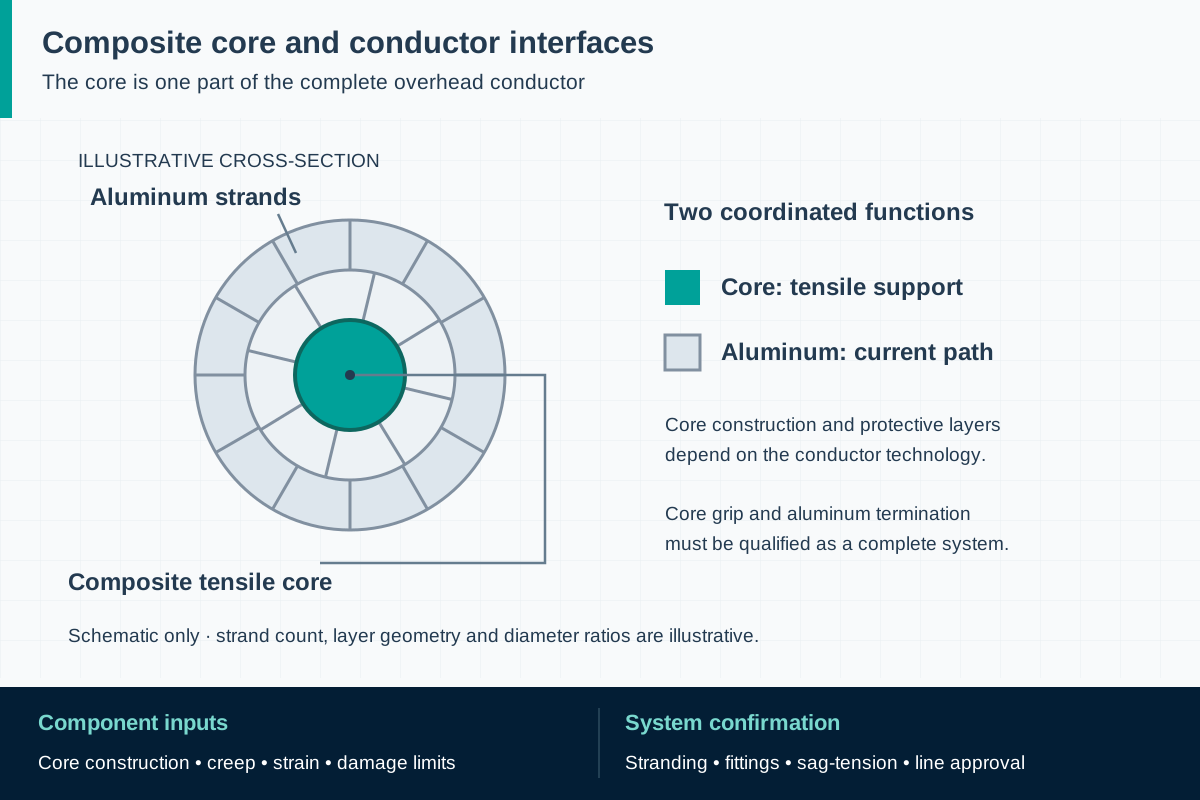
FIG. 1 Composite cores for overhead conductorsApplication schematic · not to scale
The center carries tensile load; the surrounding aluminum provides the current path. Layer geometry and strand count are illustrative and vary with conductor technology.

Component scope and material selection

This guide supports technical feasibility and qualification inquiries only. F1 does not claim a utility-approved conductor core, licensed proprietary conductor system, demonstrated ampacity increase or established maximum service temperature on the basis of this page.

Select the complete material system

Candidate carbon-fiber thermoset cores or other specifically defined polymer-matrix architectures, with qualified protection and interfaces

Components to specify

  • Monolithic composite supporting cores
  • Individual composite wires for a separately designed stranded core
  • Protected core constructions subject to system qualification

Define the project before selecting the core

Begin with the utility's purpose: increase current on an existing circuit, resolve a clearance constraint, replace aged conductors or design a new line. Document the existing geometry and the limiting equipment. The line designer should check structures, foundations, insulator strings, fittings, substation connections and required clearances as part of the option study. A conductor proposal cannot promise that existing towers will remain adequate without that review.

Epsilon identifies pultruded composite cores as a technology used in advanced conductors. That confirms the application; performance evidence must still come from the core actually offered. Separate three purchases or approvals: the core, the finished conductor with its accessories, and the project line design. A favorable result at one level does not release the next. Current uprating also does not automatically authorize raising the circuit voltage; those changes involve different electrical and regulatory assessments.

ReferencesEpsilon Composite: advanced conductorsCIGRE TB 763: uprating existing overhead linesCIGRE TB 983: high-temperature conductors in new lines

Specify the complete material architecture

Describe the load-bearing fibers, matrix, external protection, nominal size and construction. A monolithic carbon-based rod, a hybrid fiber arrangement and a multi-wire polymer-matrix core have different interfaces and handling behavior. Include the method by which the core is separated from neighboring metallic strands where galvanic interaction needs control. A coating or barrier is part of the qualified construction; it is not an optional cosmetic finish.

The specification should connect each architecture choice to a requirement and a verification method. Check the applicability of the selected core standard before requesting compliance. ASTM B987/B987M-25 concerns carbon-reinforced thermoset cores with defined dimensional scope; IEC TS 62818-1:2024 addresses polymer-matrix supporting cores more broadly. Neither permits all advanced conductor materials to be described as equivalent pultruded carbon rods. Identify any technology rights, approved-source requirements or proprietary fitting interfaces before a development program begins.

ReferencesASTM B987/B987M-25: carbon thermoset conductor coresIEC TS 62818-1:2024: polymeric matrix composite coresEpsilon Composite: advanced conductors

Establish temperature duty and retained performance

The duty specification should distinguish continuous operation, temporary emergency operation and temperature cycles, with their durations and associated tension. Ask where the temperature is evaluated: the metal surface, the core or a connector can experience different conditions. Require a justified operating envelope for the selected conductor system. A resin glass-transition measurement by itself does not demonstrate long-term strength retention, a safe emergency limit or a promised service life.

Develop an aging plan that relates exposure to the required mechanical behavior. Define what will be measured before and after conditioning, how load is applied and how changes are accepted or rejected. Consider retained tensile performance, dimensional change, environmental interaction and the stability of protective layers. EPRI's public guide provides a reference for thermal-mechanical qualification; its example procedures need an explicit project decision before becoming procurement criteria. Accelerated testing requires a defensible interpretation rather than an unsupported conversion from test hours to years outdoors.

ReferencesEPRI: Advanced Conductor Specification GuideIEC TS 62818-1:2024: polymeric matrix composite coresCIGRE TB 426: qualifying high-temperature conductors

Calculate thermal rating and mechanical clearance separately

A thermal calculation estimates conductor temperature for a current and set of environmental assumptions. IEEE 738-2023 supplies a method, but does not choose appropriate weather or conductor inputs for the utility. State the wind, ambient conditions, solar exposure and conductor properties used in the study, and distinguish a steady rating from a time-dependent operating case. Avoid quoting a percentage capacity gain without the baseline, conductor configuration and accepted temperature limit.

The mechanical study then needs the conductor's stress-strain behavior, creep assumptions, thermal expansion and load sharing between metal and core. Review initial and final conditions, span geometry, wind and ice cases, and the relevant hot-state clearance. A low thermal-expansion core is not proof that sag is negligible. Use a model and data valid for the exact conductor architecture, including any transition in load sharing, and resolve the uncertainty before claiming that a reconductoring option preserves every existing clearance.

ReferencesIEEE 738-2023: conductor current-temperature calculationCIGRE TB 763: uprating existing overhead linesCIGRE TB 983: high-temperature conductors in new lines

Review the full path from manufacturing reel to installed span

Track each place that bends, grips or redirects the core and conductor: core winding, stranding, transport reels, payout equipment, tensioners, sheaves and final hardware. Define the permitted equipment geometry and loads through the conductor manufacturer's installation process. A straight tensile specimen does not reproduce bending under tension, local contact or accumulated handling damage. The qualified core and complete conductor may also need different limits, so a core test diameter should not be copied into a field stringing instruction.

The qualification review should include the relevant fatigue mechanisms and how the conductor interacts with clamps, dampers and spacers. Consider the actual exposure to vibration and cyclic motion rather than assuming that a high static strength resolves them. Plan how potential damage will be detected, recorded and assessed after a handling incident. Visual appearance alone may not settle whether the core remains fit for use, and an unvalidated field inspection technique must not be presented as conclusive.

ReferencesASTM B987/B987M-25: carbon thermoset conductor coresCIGRE TB 916: handling fittings and conductorsCIGRE TB 983: high-temperature conductors in new lines

Qualify terminations and accessories with the conductor

Dead ends and splices must transfer load through the architecture they actually grip. Define the core termination, the metal-strand connection, heat flow, electrical contact and any protection exposed during preparation. Obtain drawings and controlled installation instructions for each approved fitting combination. A fitting used successfully on another conductor of the same outside diameter is not automatically compatible with a different composite core or strand arrangement.

Evaluate mechanical retention and thermal behavior together under the project's required conditions. Inspect for slip, local crushing, damaged protection and changes after cycling. Suspension hardware, dampers and spacers also need the proper compatibility basis. CIGRE's high-temperature qualification guidance treats the conductor and its accessories as a system; the purchase specification should make responsibility for that system explicit, including who approves deviations and who supplies trained installation support.

ReferencesCIGRE TB 426: qualifying high-temperature conductorsCIGRE TB 916: handling fittings and conductorsEPRI: Advanced Conductor Specification Guide

Preserve traceability through stranding and acceptance

Map the evidence chain from core batch to reel, conductor manufacturing lot and installed line section. Agree on which characteristics are verified on the core before stranding and which on the completed conductor. Include controlled handling between those stages. A core certificate should be attributable to the material actually consumed in a conductor reel, with changes and nonconformities resolved before delivery rather than reconstructed after an incident.

Design qualification, routine control and purchaser acceptance have different purposes. The contract should define the relevant standards, editions, tests, sample selection, acceptance limits, retest rules and witness points. Agree on material and process change control covering fibers, matrix, protection, cure, dimensions and stranding. Do not label an entire supply program approved because a single development sample passed one test. Release quantities and production stages in accordance with the utility and conductor manufacturer's qualification plan.

ReferencesASTM B987/B987M-25: carbon thermoset conductor coresIEC TS 62818-1:2024: polymeric matrix composite coresEPRI: Advanced Conductor Specification Guide

Hand over a maintainable system with recorded limits

Before construction, the utility, conductor supplier and contractor should agree on the installation plan, equipment, trained personnel, hold points and disposition of damaged material. Record reel identity, installed section, fitted hardware and any deviations. Use the supplier's approved inspection and installation methods; this guide supplies specification questions, not a stringing procedure or permission to improvise around a damaged core.

The operations handover should identify accepted ratings, temperature limits, inspection methods and the triggers for engineering review. Include the response to abnormal heat exposure, suspected connector movement, mechanical damage or a changed operating regime. A replacement fitting or repair must preserve the system qualification. Compare inspection results with the installation baseline and documented duty, and avoid promising that the composite core makes the line maintenance-free.

ReferencesCIGRE TB 916: handling fittings and conductorsCIGRE TB 983: high-temperature conductors in new linesCIGRE TB 426: qualifying high-temperature conductors

Standards, regulations and acceptance evidence

The project authority determines the governing jurisdiction and adopted edition. The scope of each reference matters: a material test, an equipment requirement and a workplace rule answer different questions.

Standard · Procurement programs specifying ASTM carbon thermoset composite core requirements.

ASTM B987/B987M-25

Carbon-reinforced thermoset supporting cores for overhead conductors; the 2025 scope includes core diameters 4.57–21.21 mm and individual stranded-core wires 1.52–7.07 mm.

Application boundary: Scope dimensions are not F1 available sizes. Compliance does not approve a finished conductor, fitting or line. Other matrix systems require their applicable qualification basis.

ReferencesASTM B987/B987M-25: carbon thermoset conductor cores

Guidance · Projects adopting this IEC Technical Specification for polymer-matrix supporting cores.

IEC TS 62818-1:2024

Terminology and characterization recommendations for single- or multi-wire fiber-reinforced polymer cores.

Application boundary: Its stated scope does not supply all compliance criteria that a purchaser may need. Agree on acceptance limits and system qualification separately; it is a Technical Specification, not a generic IEC product certificate.

ReferencesIEC TS 62818-1:2024: polymeric matrix composite cores

Standard · Line-rating studies and utility programs adopting this calculation method.

IEEE 738-2023

Relates bare-conductor current, temperature and weather for steady and time-varying conditions.

Application boundary: The user selects appropriate input conditions. Thermal calculation does not qualify core aging, predict all sag behavior or verify fittings and structural capacity.

ReferencesIEEE 738-2023: conductor current-temperature calculation

Guidance · Utility qualification programs choosing to incorporate this technical guidance.

CIGRE TB 426 (2010)

Recommendations for qualifying complete high-temperature conductor systems and accessories intended for maximum temperatures above 150 °C.

Application boundary: It is guidance with a defined temperature scope. A buyer must specify the required tests and criteria; citing the brochure does not certify a core or prove service life.

ReferencesCIGRE TB 426: qualifying high-temperature conductors

Guidance · Engineering studies for existing-line current uprating or new-line development, respectively.

CIGRE TB 763 (2019) and TB 983 (2026)

Supports selection and system assessment of high-temperature conductors in the relevant project context.

Application boundary: Neither replaces statutory clearance rules, utility acceptance or project structural calculations. Current uprating must not be described as automatic voltage upgrading.

ReferencesCIGRE TB 763: uprating existing overhead linesCIGRE TB 983: high-temperature conductors in new lines

Public source scopes were reviewed on . These references do not establish certification of an F1 product. Agree the offered grade, finished component, test specimen and acceptance criteria in the project specification.

Composite cores for overhead conductors: practical questions

Does a composite core automatically double line capacity?

No. The result depends on conductor design, accepted temperatures, weather assumptions, clearances, fittings and the rest of the circuit. A competitor's reported gain cannot be transferred to an unqualified core or a different line.

Is ASTM B987-20 the current reference?

The official ASTM catalog identifies B987/B987M-25 as active as of this review. A contract may specify a particular edition, so resolve that requirement explicitly rather than copying an older supplier reference.

Can generic pultruded carbon rod replace an approved conductor core?

No. The material, protection, manufacturing control, handling and conductor interfaces require dedicated qualification. This inquiry page does not identify an interchangeable or utility-approved F1 core.

Does a core test certificate approve the complete conductor?

No. The stranded conductor, its accessories, installation process and project design need their own evidence and acceptance. Keep the three approval levels visible in procurement.

Technical sources and further reading

Industry sources establish where the application is used. Authority sources define the published scope of standards and regulations. The design and procurement checklists above are an original engineering synthesis for project review.
  1. Industry application evidence

    Epsilon Composite: advanced conductors

    Discovery evidence for pultruded composite conductor cores. Epsilon's trademarks, qualification, temperature limits and capacity claims are specific to its technology and are not F1 claims.

  2. Standard or public authority

    ASTM B987/B987M-25: carbon thermoset conductor cores

    Active edition checked October 2026; its scope includes defined core and individual-strand diameters. Older supplier pages may still cite the 2020 edition.

  3. Standard or public authority

    IEC TS 62818-1:2024: polymeric matrix composite cores

    Technical Specification for polymer-matrix single- or multi-wire supporting cores. Characterization guidance is not complete-conductor or line approval.

  4. Standard or public authority

    IEEE 738-2023: conductor current-temperature calculation

    Thermal calculation method. The official scope expressly leaves selection of suitable weather and conductor parameters to the user.

  5. Standard or public authority

    CIGRE TB 426: qualifying high-temperature conductors

    2010 guidance for complete conductor systems, including accessories, intended for maximum temperatures above 150 °C; not a universal rating for all composite cores.

  6. Standard or public authority

    CIGRE TB 763: uprating existing overhead lines

    2019 guidance covering conductor choices and sag-tension in current uprating. It explicitly distinguishes voltage upgrading.

  7. Standard or public authority

    CIGRE TB 983: high-temperature conductors in new lines

    2026 publication covering electrical, mechanical, constructability and economic considerations for new lines; scope reviewed from official public contents.

  8. Standard or public authority

    CIGRE TB 916: handling fittings and conductors

    2023 industry guidance on handling and installation. Project-specific manufacturer procedures remain necessary.

  9. Standard or public authority

    EPRI: Advanced Conductor Specification Guide

    Public guide and example specification for conductor procurement and thermal-mechanical qualification. Its examples are not universal contract requirements.

Prepare a component qualification brief

Provide the application and acceptance requirements so we can assess material, geometry, sampling and the proposed supply scope. We reply within one business day; a formal quotation follows once the specification and delivery are reviewed.

01 · Utility, destination country, circuit purpose, existing or new-line status, and responsible conductor/system integrator.
02 · Proposed conductor architecture, core type, dimensional drawing, protective construction and technology-interface requirements.
03 · Continuous, emergency and cyclic temperature duty; required tensile behavior, creep data, environmental exposure and qualification life assumptions.
04 · Conductor geometry, metal strands, sag-tension model inputs, span and structural constraints, and rating-study conditions.
05 · Approved fittings, termination interfaces, manufacturing equipment, reel requirements and installation responsibilities.
06 · Core, conductor and system standards with editions; qualification tests, acceptance limits, witness points and change control.
07 · Development quantities, test-program responsibility, production forecast, traceability and documentation deliverables.
08 · Installation support, inspection method, abnormal-event response and conditions for field repair or replacement approval.
Get a quoteWhatsApp