Skip to content
Pultrusion application guide

Composite profiles for MRI patient-support systems

A patient support must carry and position a person while preserving the safety and performance of the imaging system. Pultruded profiles can be considered for straight structural elements, but material selection is only one part of the OEM's mechanical, MR and device qualification.

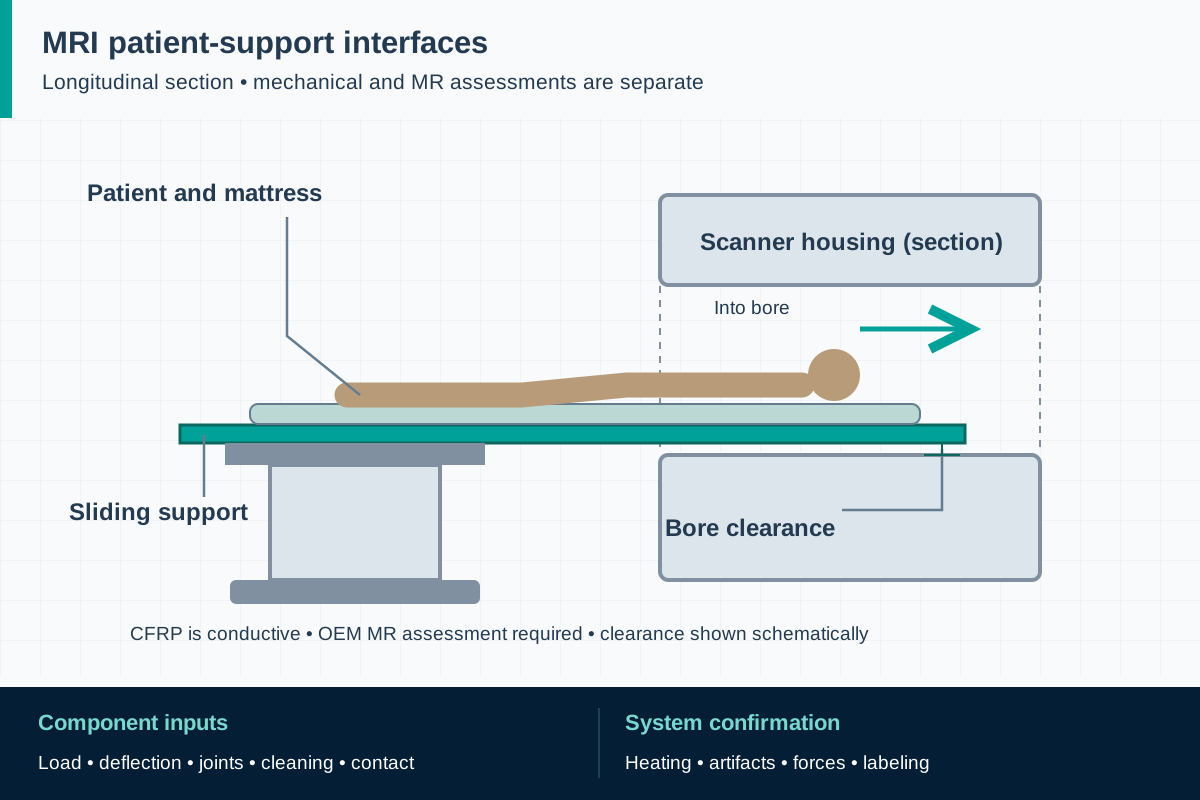
FIG. 1 Composite MRI patient supportsApplication schematic · not to scale
Longitudinal section: the patient and sliding top travel along the open bore. The clearance bracket marks the gap below the support; conductive CFRP and connected hardware require OEM MR assessment.

Component scope and material selection

F1 can review an OEM component qualification inquiry for a profile or machined structural blank. This page does not establish a medical-device supply history, MR classification, biological evaluation, regulatory clearance or medical quality-system certification for F1.

Select the complete material system

Candidate glass-fiber or carbon-fiber thermoset construction selected and evaluated for the actual scanner, component location, load and exposure; no universal MR-safe material designation is assumed.

Components to specify

  • Straight patient-table longitudinal supports
  • Profile blanks for equipment support rails
  • Drawing-specific structural members outside or adjacent to an imaging region

Locate the profile within the complete support system

Begin with a system drawing showing the table top, structural rails, slides, bearings, restraints, covers and attachment to the scanner. Identify which elements can enter the bore, their proximity to the patient and coils, and whether the component moves during imaging. A straight load-bearing rail is a different procurement item from a complete patient table or an accessory sold for clinical use.

Röchling documents an MRI patient-stretcher example using a pultruded profile, establishing a relevant application for investigation. That example does not establish the construction or suitability of another supplier's part. Decide whether the required geometry is continuously pultrudable, needs a machined blank, or needs a different process for a curved shell or a local load introduction. Keep the proposed component's interfaces and regulatory role explicit.

ReferencesRöchling Industrial: life-sciences applicationsRöchling Industrial: diagnostic-equipment componentsRöchling Industrial: pultrusion process and material selection

Assess support conditions and foreseeable handling

Request load cases from the device manufacturer: patient positioning, allowed accessories, transfer onto the table, movement, emergency handling and the most extended support position. State allowable deflection at the patient and at the mechanism interfaces. A single evenly distributed static load cannot represent every local or asymmetric loading condition relevant to the equipment.

Evaluate the complete load path through the profile, fasteners, slides and end supports. Local bearing pressure, screw retention, cut-outs, creep and repeated cycling need consideration alongside flexural strength. Protect users from sharp edges and exposed fibers, and coordinate stiffness with clearances so that deformation does not create a pinch point. The OEM must derive loads and acceptance criteria from its device requirements; this page does not assign a universal patient weight rating.

ReferencesIEC 60601-2-33:2022: diagnostic MR equipmentFDA: MRI safety information for professionalsISO 14971:2019: medical-device risk management

Compare GFRP and CFRP without an MR shortcut

Glass reinforcement may be attractive where low electrical conductivity is a design objective; carbon can be attractive where stiffness within a limited envelope is important. The final comparison must use the whole construction: reinforcement, resin, additives, pigment, surface layer, inserts, adhesive and connected hardware. A material name alone does not describe the electrical, magnetic or mechanical behavior of the assembled support.

Carbon composites are electrically conductive and their response depends on construction and frequency. ASTM F2503 reserves the MR Safe term for items made only of electrically nonconductive, nonmetallic and nonmagnetic materials, so a conductive CFRP part cannot be marked MR Safe; after assessment it can at most be marked MR Conditional. A candidate GFRP part also needs an appropriate assessment of its complete composition and configuration. A declaration that a laminate is radiolucent for an X-ray application does not establish its behavior in MRI, which uses different physical mechanisms.

ReferencesElectrical properties of carbon-fiber support systemsFDA MR guidance: full October 2023 documentRöchling Industrial: pultrusion process and material selection

Agree on the MR assessment with the device team

First determine whether the support is integral to the scanner or is a separate device or accessory. Integrated scanner-table members belong in the OEM's equipment qualification and applicable IEC 60601-2-33 assessment. FDA's October 2023 MR guidance excludes MR systems and associated components; use it here as background on hazards and terminology. Apply its recommendations directly only to a separately assessed item that falls within its stated scope.

The OEM's MR assessment should identify magnetic force and torque, RF-related heating, gradient effects, interference with equipment function and image quality as relevant to the item. Record location, orientation, connected hardware and intended scanner conditions. Conductive paths and contacts can change after installation, so a small disconnected material coupon is not automatically representative of a full rail attached to a table mechanism.

Choose tests or a justified scientific rationale for each hazard with qualified MR specialists. Do not prescribe an implant heating fixture to a patient-table rail simply because both are associated with MRI; the assessment method must fit the device. Keep safety classification separate from image-quality acceptance. ASTM F2503 governs marking, with image artifacts outside its mandatory scope, so a marking decision alone does not resolve whether the support preserves the required image quality.

ReferencesFDA MR guidance: full October 2023 documentIEC 60601-2-33:2022: diagnostic MR equipmentASTM F2503-26: marking items for the MR environmentAAPM Task Group 334: accessories in the MR environment

Specify the finished surface and cleaning exposure

Identify direct and indirect contact with patients or staff, and whether a cover or mattress reliably separates the profile from the body throughout its intended life. The biological evaluation should follow that actual contact scenario. A favorable result for a resin ingredient or an unprocessed sample cannot automatically cover a machined, bonded, coated and repeatedly cleaned finished component.

Provide the intended detergents or disinfectants, concentrations, contact conditions and cleaning frequency from the device procedure. Evaluate the relevant finished surfaces and sealed edges for the exposure, including markings and interfaces where liquid may collect. Agree on acceptable changes in surface condition and function. Sterilization resistance should be specified only when sterilization is part of intended use; it is not a generic requirement for every internal support rail.

ReferencesISO 10993-1:2025: biological-safety evaluationRegulation (EU) 2017/745: Medical Device RegulationISO 14971:2019: medical-device risk management

Build an OEM qualification file around the component

A useful development sequence starts with composition and drawing review, proceeds through representative material and interface evaluation, and reaches assembled support verification under the device manufacturer's protocol. Capture mechanical and MR configuration details together. A change in an insert, conductive coating or attachment may be relevant even if the profile's external dimensions remain unchanged.

Define the supplier records the OEM needs: controlled material identity, process revision, lot traceability, dimensional inspection, surface finish and agreed test reports. Mark unverified properties as pending and document who may release the part for use. F1's role at this stage is to assess a component inquiry; the website is not evidence of a completed medical supplier audit or of a regulatory-authorized finished device.

ReferencesFDA: Quality Management System RegulationISO 14971:2019: medical-device risk managementIEC 60601-2-33:2022: diagnostic MR equipment

Distinguish a supplied profile from a medical device

The actual intended purpose and delivered item determine the regulatory analysis. A raw or unfinished profile supplied to an OEM is not automatically equivalent to an independently marketed medical accessory. Conversely, calling a functioning accessory a component does not remove the obligations that apply to it. Identify the legal manufacturer and the intended market before attaching regulatory claims to a quotation or label.

In the United States, FDA's QMSR became effective in February 2026 and addresses applicable finished-device manufacturers. In the EU, the MDR establishes obligations for devices and accessories within its scope. These routes require more than a material certificate. Current standard editions, a regulator's recognized standards and the OEM's accepted conformity route may differ, so record each rather than presenting an ISO number as universal approval.

ReferencesFDA: Quality Management System RegulationRegulation (EU) 2017/745: Medical Device RegulationISO 10993-1:2025: biological-safety evaluation

Preserve the qualified configuration in service

Agree on inspection and replacement criteria for the finished support, including damage from transfer equipment, cracks, damaged edges, loose hardware and degraded protective surfaces. Establish whether a structural rail is repairable and under whose procedure. A field repair can change stiffness, dimensions, surface chemistry or electrical paths, which may affect more than appearance.

Keep part identity, revision and installation orientation available to the service organization. Supplier changes to resin, fiber, additives, coating, inserts or manufacturing process should follow an agreed notification and review route. The device team determines whether additional mechanical, biological, imaging or MR evidence is needed. Replacement procurement should preserve the evaluated configuration rather than specify only a visually similar composite section.

ReferencesISO 14971:2019: medical-device risk managementAAPM Task Group 334: accessories in the MR environmentFDA: Quality Management System Regulation

Standards, regulations and acceptance evidence

The project authority determines the governing jurisdiction and adopted edition. The scope of each reference matters: a material test, an equipment requirement and a workplace rule answer different questions.

Guidance · United States medical-device regulatory submissions and labeling

FDA MR testing and labeling guidance, October 2023

MR safety, compatibility and labeling recommendations for medical devices within its stated scope, including independently supplied devices or accessories where applicable.

Application boundary: Excludes the MR system and associated components. Integrated scanner-table rails follow the OEM's equipment qualification, including the applicable IEC 60601-2-33 route. For those parts this nonbinding guidance provides hazard and terminology background, not a direct component approval or labeling route.

ReferencesFDA: testing and labeling medical devices in the MR environmentFDA MR guidance: full October 2023 documentIEC 60601-2-33:2022: diagnostic MR equipment

Standard · Items entering MR environments where this marking practice is adopted

ASTM F2503-26

MR marking terminology, icons and information accompanying medical devices and other items.

Application boundary: The active publisher edition is 2026; regulatory recognition may identify a different edition. Mandatory provisions do not cover image artifacts. The label must follow a supported assessment of the item, not just its resin or reinforcement name.

ReferencesASTM F2503-26: marking items for the MR environment

Standard · Diagnostic MR equipment programs using the IEC route or an applicable national adoption

IEC 60601-2-33:2022

Particular basic-safety and essential-performance requirements for MR diagnostic equipment; the publisher's corrected copy includes interpretation sheets from 2023 and 2025.

Application boundary: Equipment-level scope. A profile certificate cannot establish compliance of the patient-support mechanism, scanner or accessory. Confirm the contractual and regulatory edition with the OEM.

ReferencesIEC 60601-2-33:2022: diagnostic MR equipment

Standard · Medical-device development and biological evaluation where applicable

ISO 14971:2019 and ISO 10993-1:2025

Device risk management and a risk-based evaluation of biological safety, informed by the nature and duration of body contact.

Application boundary: A structural support hidden behind a cover and a directly contacted surface may need different evidence. A resin ingredient report is not a blanket finished-component biological evaluation. Check the regulator's recognized edition as well as the publisher's current edition.

ReferencesISO 14971:2019: medical-device risk managementISO 10993-1:2025: biological-safety evaluation

Regulation · United States; applicable finished-device manufacturers

21 CFR Part 820: QMSR

The QMSR has applied since 2 February 2026 and incorporates ISO 13485:2016, with FDA-specific provisions.

Application boundary: A supplier of an unfinished structural profile is not automatically a finished-device manufacturer. Selling a functioning device or accessory changes the analysis; supplier controls still need agreement with the OEM. No F1 medical QMS certification is asserted here.

ReferencesFDA: Quality Management System Regulation

Regulation · European Union medical devices and accessories within scope

Regulation (EU) 2017/745

The applicable device manufacturer's obligations, risk management, technical documentation and general safety and performance requirements.

Application boundary: An OEM drawing or intended hospital use alone does not establish a component's regulatory classification or CE status. Determine the actual supplied item and intended purpose using the current consolidated regulation; a material supplier's report does not replace device conformity assessment.

ReferencesRegulation (EU) 2017/745: Medical Device Regulation

Public source scopes were reviewed on . These references do not establish certification of an F1 product. Agree the offered grade, finished component, test specimen and acceptance criteria in the project specification.

Composite MRI patient supports: practical questions

Is a nonmetallic composite automatically MR Safe?

No. The complete item and its materials must support the relevant MR assessment and labeling. Carbon reinforcement is conductive, and inserts, coatings, additives and connected hardware also matter.

Is a radiolucent carbon panel automatically suitable for MRI?

No. X-ray attenuation and MRI behavior are different questions. The OEM must assess the actual support for its MR environment, imaging requirements and mechanical role.

Does an internal structural profile always need the same biological testing as a patient-contacting surface?

No. The device team's biological evaluation follows the actual contact and exposure scenario, including indirect contact where relevant. Establish that scenario and the evidence needed before selecting a test program.

Does F1 claim medical-device or MR certification for these profiles?

No. This page describes an OEM component qualification inquiry. Any required medical quality-system, regulatory, MR, biological or mechanical evidence must be reviewed and confirmed for the proposed supply scope.

Technical sources and further reading

Industry sources establish where the application is used. Authority sources define the published scope of standards and regulations. The design and procurement checklists above are an original engineering synthesis for project review.
  1. Industry application evidence

    Röchling Industrial: life-sciences applications

    The patient-stretcher example explicitly identifies a pultruded composite profile used in an MRI scanning system. It is application evidence, not F1 medical experience or evidence that all listed material combinations have identical MR behavior.

  2. Industry application evidence

    Röchling Industrial: diagnostic-equipment components

    Identifies patient beds, coil supports and machined components. The page includes multiple materials and manufacturing processes; not every illustrated part is pultruded.

  3. Industry application evidence

    Röchling Industrial: pultrusion process and material selection

    Explains how fiber architecture, resin and section affect profile properties. It does not establish clinical, MR or biological suitability.

  4. Standard or public authority

    FDA: testing and labeling medical devices in the MR environment

    October 2023 nonbinding guidance for in-scope devices entering an MR environment. The full document excludes the MR system and its associated components; it is terminology and hazard background for integrated scanner-table parts, not their direct qualification route.

  5. Standard or public authority

    FDA MR guidance: full October 2023 document

    Page 2 excludes MR systems and associated components, giving spacing pads and coils as examples. Direct application is limited to devices within scope. Integrated scanner supports follow the OEM's equipment assessment; the document provides relevant MR terminology and hazard background.

  6. Standard or public authority

    ASTM F2503-26: marking items for the MR environment

    Active 2026 edition for MR marking and associated information. Image artifacts are outside its mandatory scope; a marking practice does not itself qualify a supplied material.

  7. Standard or public authority

    FDA: MRI safety information for professionals

    Describes RF-related burns as well as patient-table pinch, crush and fall hazards. Useful context for defining the complete support assembly's risks.

  8. Standard or public authority

    IEC 60601-2-33:2022: diagnostic MR equipment

    Edition 4; publisher's corrected November 2025 copy incorporates the 2023 and 2025 interpretation sheets. Equipment basic safety and essential performance, not certification of an isolated profile.

  9. Standard or public authority

    ISO 14971:2019: medical-device risk management

    Official scope for medical-device risk management through the life cycle. The device manufacturer determines risks and acceptance; this page makes no F1 conformity claim.

  10. Standard or public authority

    ISO 10993-1:2025: biological-safety evaluation

    Current sixth edition replaces 2018. Contact nature and exposure inform a risk-based biological evaluation. Publication and regulatory recognition are separate questions.

  11. Standard or public authority

    FDA: Quality Management System Regulation

    Effective 2 February 2026; 21 CFR Part 820 incorporates ISO 13485:2016. FDA explains applicability to finished-device manufacturers and the definition including accessories.

  12. Standard or public authority

    Regulation (EU) 2017/745: Medical Device Regulation

    Official legal entry, including Article 10 and Annex I. Follow the current consolidated text for the project; the manufacturer's obligations depend on the actual device or accessory and intended purpose.

  13. Standard or public authority

    Electrical properties of carbon-fiber support systems

    Primary experimental research showing that carbon-fiber structural systems have important electrical behavior at high frequency. Not an MR safety test or medical-device approval.

  14. Standard or public authority

    AAPM Task Group 334: accessories in the MR environment

    Professional task-group guidance for radiotherapy immobilization devices and accessories in MR environments. Used for configuration and compatibility considerations, not as a universal patient-table specification.

Prepare a component qualification brief

Provide the application and acceptance requirements so we can assess material, geometry, sampling and the proposed supply scope. We reply within one business day; a formal quotation follows once the specification and delivery are reviewed.

01 · Device or accessory description, intended market, legal manufacturer and component regulatory role.
02 · System drawing, scanner relationship, bore entry, patient proximity and all connected hardware.
03 · Load cases, support conditions, component life, stiffness limits and failure consequences.
04 · Candidate composition, reinforcement architecture, surface treatment and conductive features.
05 · MR assessment owner, intended scanner conditions and mechanical/image-quality acceptance criteria.
06 · Contact scenario, covers, cleaning or disinfection procedure and biological-evaluation responsibilities.
07 · Drawing datums, machined interfaces, surface acceptance and required lot documentation.
08 · Prototype quantity, supplier qualification, change control, release authority and service requirements.
Get a quoteWhatsApp