Fiberglass I-beam (FRP) profiles
Wide-flange pultruded fiberglass I-beams from 76×38 to 305×305 mm, 68–83% lighter than a steel section of the same depth. They do not rust, and deflection rather than strength usually decides the size.
- A
- 1,864 mm²
- Ix
- 659.8 cm⁴
- Mass
- 2.9 kg/m
Overview
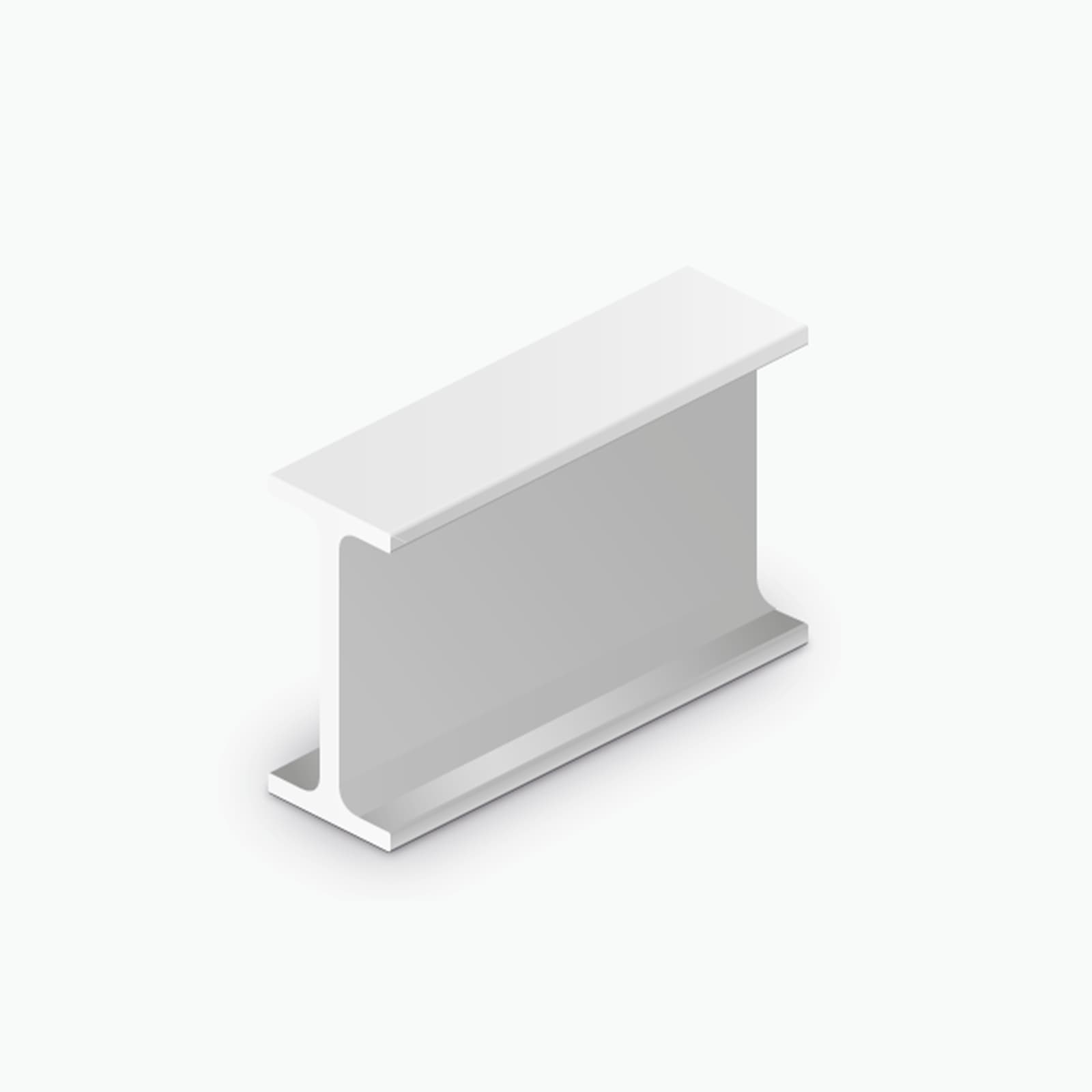
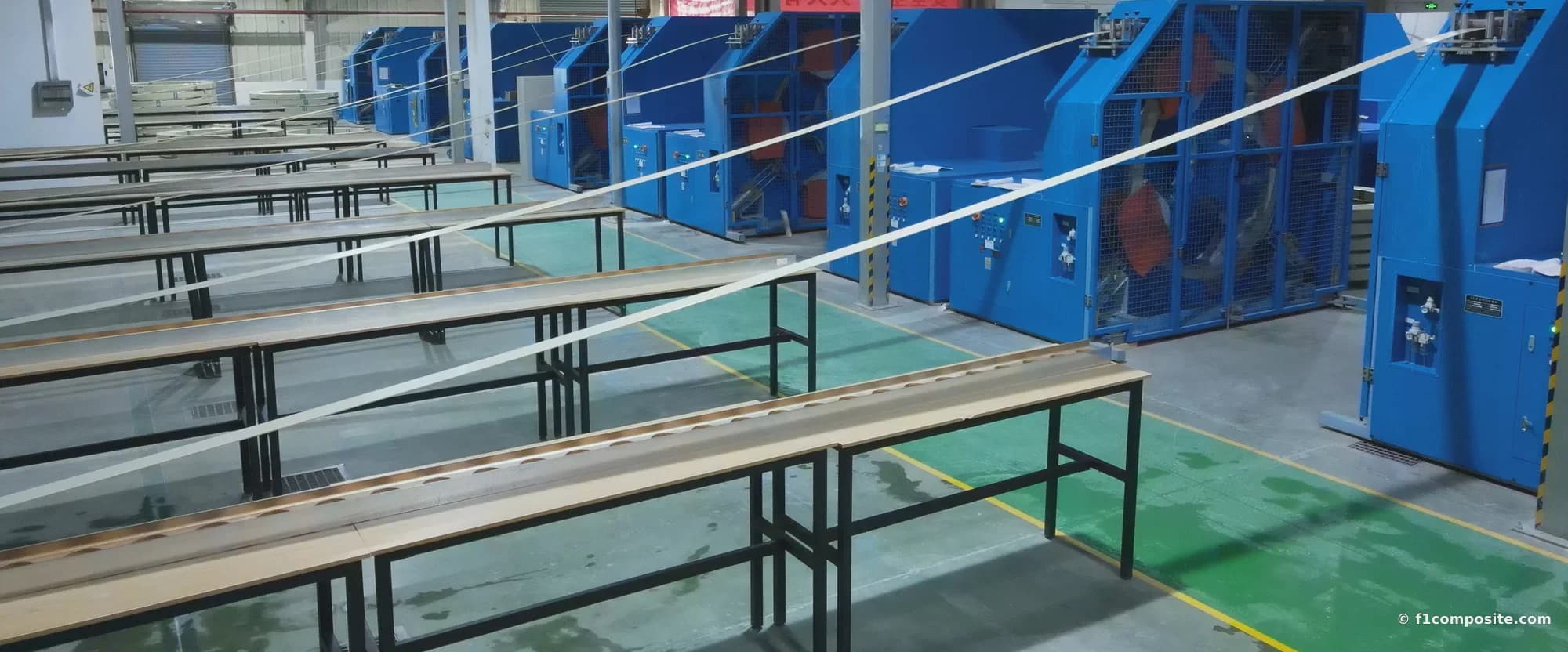
A pultruded FRP I-beam is a constant-section fiberglass wide-flange beam, pulled through resin and a heated die. Roving in the flanges gives bending stiffness, mat in the web carries shear, and a surface veil forms a resin-rich outer layer.
It carries bending like a steel I-beam at a fraction of the weight, without rust. With about a tenth of the modulus of steel, it is sized by deflection.
- EN 13706 E23
- ASTM D3917 tolerances
- 6 m lengths or cut to size
- Polyester, vinyl ester, PU, phenolic
Specify FRP when
- Corrosive service: coastal, chemical, wastewater, de-icing salt
- Electrical insulation or a non-magnetic structure is required
- Crews lift members by hand, with no crane or hot work
- Decades of service without recoating
Stay with steel when
- Dry, inland service with a horizon under 15 years
- Long spans that would need a very deep FRP section
- Continuous service above about 60 °C
- The certifying authority does not accept FRP for the element
Cost and lifecycle comparison: FRP vs steel, aluminum and timber
Sizes 9 catalog sizes
| Model | Drawing and quote | |||||||||
|---|---|---|---|---|---|---|---|---|---|---|
| I 76×38×6.4 | 76 | 38 | 6.4 | 1.2 | 72.53 | 19.09 | IPE 80 | 6.0 | 80% | DXFQuote |
| I 100×50×6 | 100 | 50 | 6 | 1.6 | 166.8 | 33.36 | IPE 100 | 8.1 | 80% | DXFQuote |
| I 120×60×6 | 120 | 60 | 6 | 2.0 | 297.1 | 49.52 | IPE 120 | 10.4 | 81% | DXFQuote |
| I 152×76×6.4 | 152 | 76 | 6.4 | 2.9 | 659.8 | 86.81 | UB 152×89 | 16.0 | 82% | DXFQuote |
| I 160×80×8 | 160 | 80 | 8 | 3.6 | 939.1 | 117.4 | IPE 160 | 15.8 | 77% | DXFQuote |
| I 200×100×10 | 200 | 100 | 10 | 5.8 | 2,293 | 229.3 | IPE 200 | 22.4 | 74% | DXFQuote |
| I 240×120×12 | 240 | 120 | 12 | 8.4 | 4,754 | 396.2 | IPE 240 | 30.7 | 73% | DXFQuote |
| I 300×150×15 | 300 | 150 | 15 | 13.5 | 11,610 | 773.8 | IPE 300 | 42.2 | 68% | DXFQuote |
| I 305×305×12.7 | 305 | 305 | 12.7 | 16.0 | 18,870 | 1,237 | UC 305×305 | 96.9 | 83% | DXFQuote |
A deflection-equal FRP section is usually one or two depths larger than the steel it replaces, and still about 70% lighter installed. Catalog dimensions identify standard section options, not live inventory. Confirm tooling, material, quantity and production timing in the quotation.
Properties and design
Standard laminate · EN 13706 E23
| Property | Value | Test method |
|---|---|---|
| Tensile modulus (longitudinal)EN ISO 527-4 | 23 GPa | EN ISO 527-4 |
| Tensile modulus (transverse)EN ISO 527-4 | 7 GPa | EN ISO 527-4 |
| Tensile strength (longitudinal)EN ISO 527-4 | 240 MPa | EN ISO 527-4 |
| Flexural strength (longitudinal)EN ISO 14125 | 240 MPa | EN ISO 14125 |
| Interlaminar shear strength (ILSS)EN ISO 14130 | 30 MPa | EN ISO 14130 |
| Pin-bearing strength (longitudinal)EN 13706-2 Annex E | 150 MPa | EN 13706-2 Annex E |
| DensityEN ISO 1183 | 1.9 g/cm³ | EN ISO 1183 |
| Glass contentEN ISO 1172 | 65–70% by weight | EN ISO 1172 |
Values of the isophthalic polyester laminate every datasheet lists. Moduli and strengths are the EN 13706-3 E23 minimums; ILSS is published above the 25 MPa minimum. Transverse strength is much lower than longitudinal, so connections need their own check. Full property table and test methods
Resin options
- Isophthalic polyesterStandard laminate for general structural use. Not fire-retardant.
- Fire-retardant polyesterFor an ASTM E84 Class 1 requirement in mild chemistry; the test report is issued per profile.
- Vinyl esterChemicals, seawater and wastewater; fire-retardant with low smoke.
- PolyurethaneTough matrix for thin walls and impact.
- PhenolicFire-critical enclosed spaces: low flame spread, smoke and toxicity.
All are declared to grade E23. Resin decides chemical and fire performance, not stiffness. Compare resin systems
Sizing an FRP I-beam
- Check 1
Deflection first
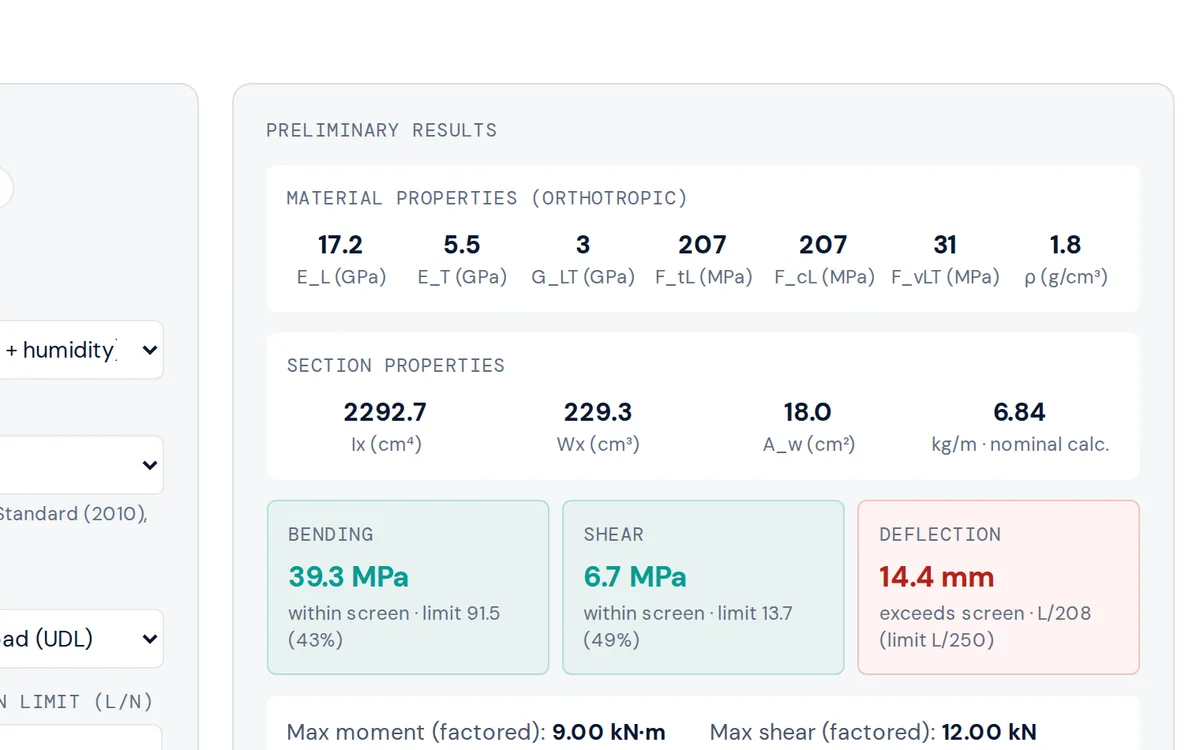
FRP modulus is 17–28 GPa, about a tenth of steel. A section that meets L/240 or L/360 usually has a large margin in bending and shear.
- Check 2
Add shear deflection
With a shear modulus of about 3 GPa, shear adds 15–25% to bending deflection on short spans. 5wL⁴/384EI alone under-predicts; the calculator includes shear.
- Check 3
Check flange buckling
Thin flanges can buckle before the bending capacity is reached. Keep the outstanding flange b/t at or below about 18; check to ASCE/SEI 74-23 Ch. 3 or CEN/TS 19101 §6.
- Check 4
Detail the connections
Transverse strength is about a quarter of longitudinal: edge distance and spacing of at least 4 bolt diameters, oversized washers, snug-tight A4-316 bolts.
Standards by region: EU, US, China
| Topic | Europe | North America | China |
|---|---|---|---|
| Structural design code | CEN/TS 19101 | ASCE/SEI 74-23 (LRFD) | GB 50608 / CECS 692 |
| Profile grade / tolerance | EN 13706 E17 / E23 | ASTM D3917 | GB/T 31539 |
| Tensile test | EN ISO 527-4 | ASTM D638 | GB/T 1447 |
| Flexural test | EN ISO 14125 | ASTM D790 | GB/T 1449 |
| Fire — surface flame spread | EN 13501-1 | ASTM E84 | GB 8624 |
Applications
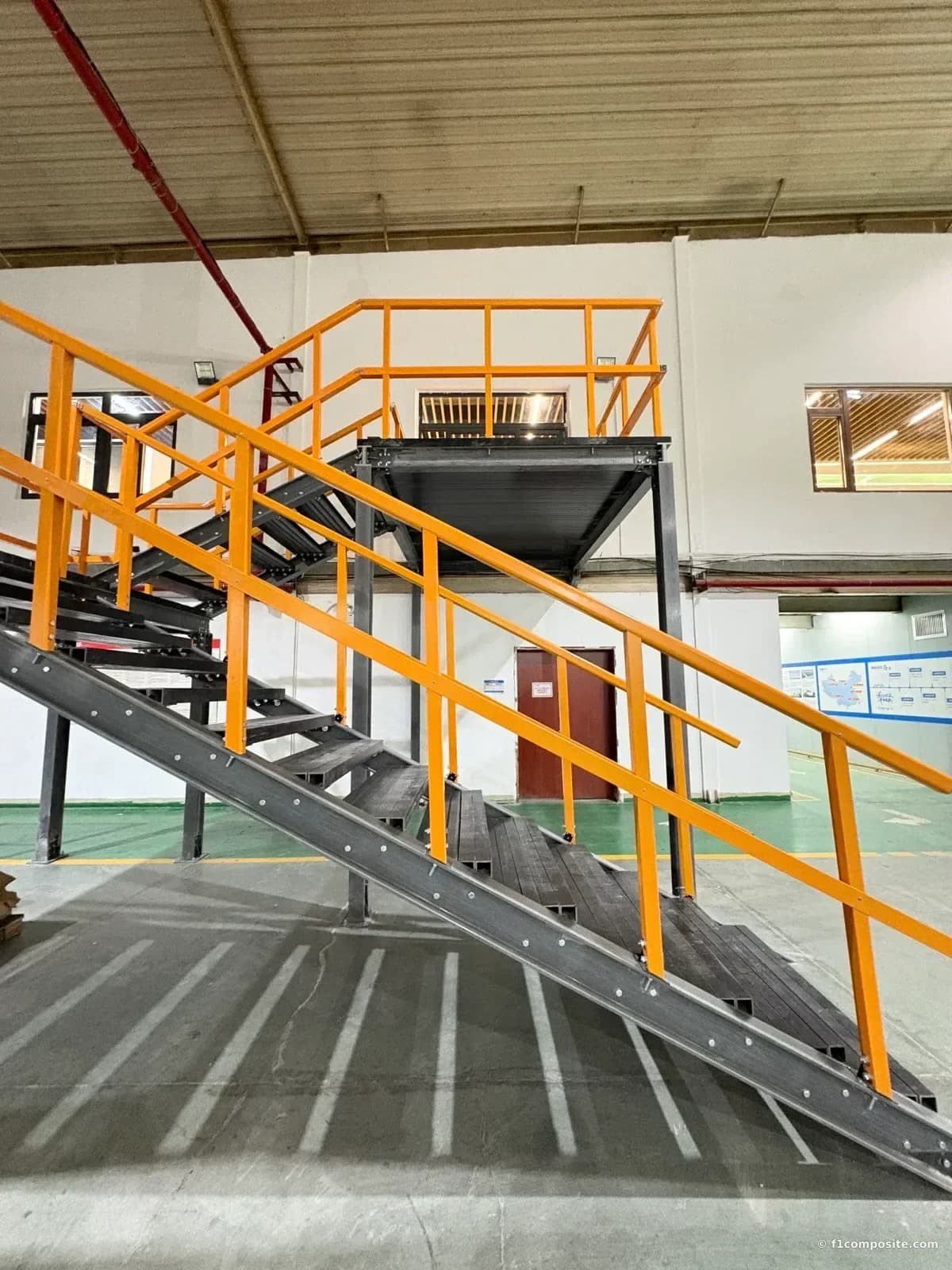 Case studyFactory access staircaseA bolted FRP stair in our Chongqing plant, assembled by four people with hand tools: no welding, hot work or crane.Profiles used I-beam stringers and landing beams with square tubes, in vinyl ester
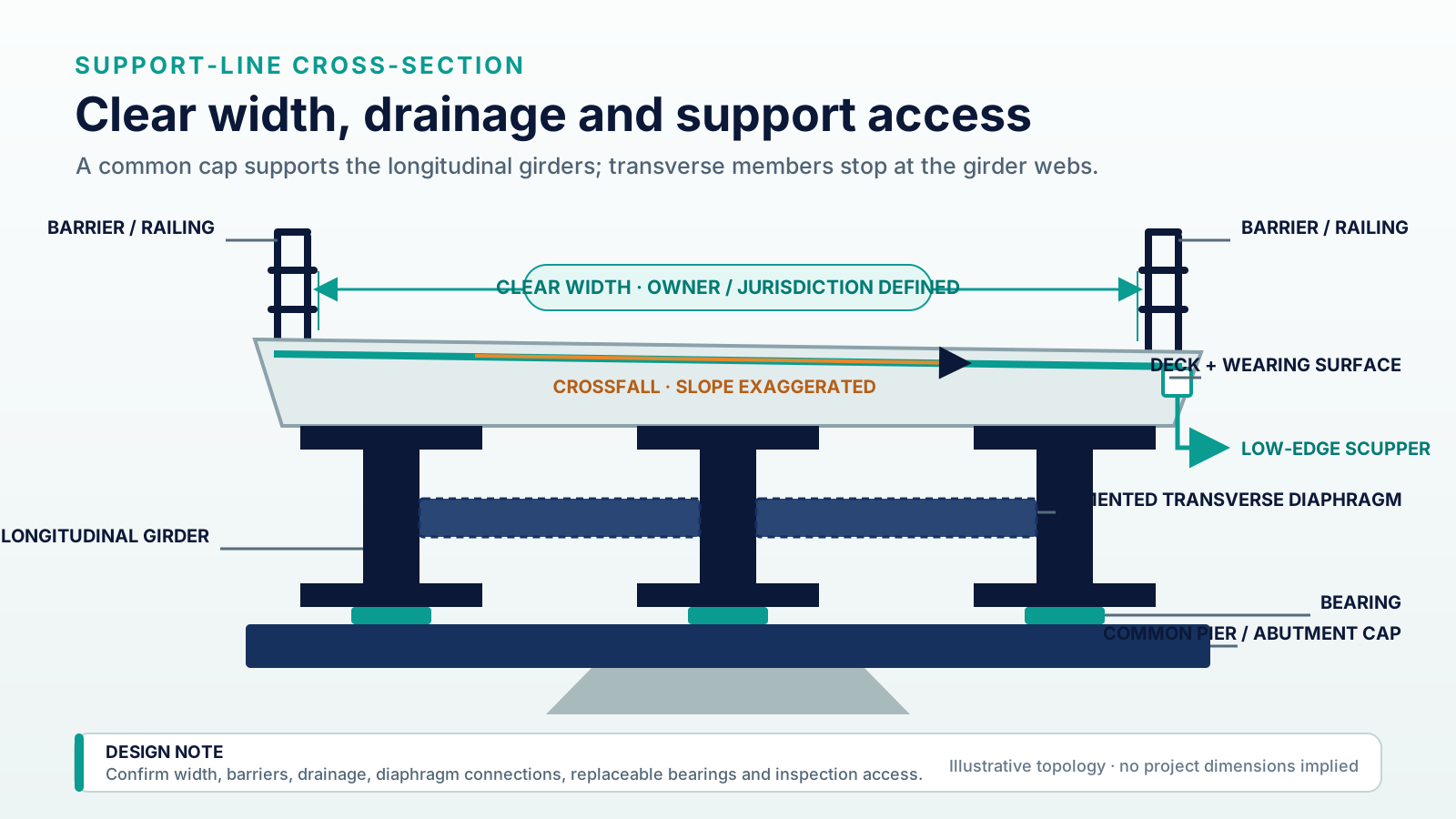 Design guideBeam bridge designLongitudinal I-beams, cross-members and a deck: the usual starting point for a pedestrian or cycle bridge cost study.
 ApplicationChemical plant platformsI-beams and channels carry the floor; grating, stair treads and handrails complete an access system for acid splash and washdown.
Infrastructure and bridgesBridge deck panelsIndustrial and chemical plants
Documents
- Data sheet9 sizes · web page
I-beam datasheets
- Issued by
- F1 Composite
One page per size: dimensions, calculated section properties, E23 laminate data and, where published, allowable load by span.
- CADDXF · 9 sizes
I-beam section drawings
- Issued by
- F1 Composite
Dimensioned cross-sections that open in AutoCAD, DraftSight or LibreCAD. Download one from its row in the size table; no login or email.
- Data sheetPDF · 3 MB
FRP Profile Design Manual — DOC-PF-2026-EN Rev. B
- Issued by
- F1 Composite
- For
- Structural shapes
Revision B (October 2026), generated from the website's catalog, laminate and design-basis data: EN 13706 E23 laminate values beside the grade minimums, section properties of all 114 catalog sizes, allowable uniform loads to the published LRFD screening basis, application guides, durability stated by resin formulation, fabrication and inspection. A preliminary-sizing reference, not a project approval or batch certificate; it supersedes the withdrawn Rev. A.
- CertificatePDF · 142 KB
EPD & Carbon Footprint — Pultruded GFRP Composite Profiles
- Issued by
- CABR
- For
- Standard profiles
Environmental Product Declaration and product carbon footprint analysis for F1 Composite pultruded GFRP composite profile products, with 1 m² functional unit. Calculation reference CABR-CFC-01(02)-2025(20030)1, cradle-to-gate 33,934.34 g CO₂e/m², distribution 254.59 g, cradle-to-grave 36,099.32 g. Standards: GB/T 24025-2009 (ISO 14025-aligned Type III EPD), GB/T 32161-2015, ISO 14067, PAS 2050. Issued by China Academy of Building Research Co., Ltd. (CABR) Certification Center on April 30, 2025.
- CatalogOn request
Product Catalog 2024
- Issued by
- F1 Composite
- For
- All products
Complete catalog of standard pultruded FRP profiles with dimensions, properties, and ordering information.
- CertificateOn request
ISO 9001:2015 Certificate
- For
- All products
Request the current quality-management certificate holder, validity and scope for your proposed supply.
- CertificateOn request
CE Declaration of Performance
- For
- All products
Request product-specific performance and applicable conformity documentation; confirm the intended use and assessment route.
Questions buyers ask
How much lighter are FRP I-beams compared to steel?
At the same nominal depth, a pultruded FRP I-beam weighs about 68–83% less than the steel section. An FRP I 200×100×10 is 5.8 kg/m against 22.4 kg/m for a steel IPE 200, a 74% cut in lifting weight and dead load. Because FRP modulus is about a tenth of steel, a deflection-equal FRP member is usually one or two depths larger than the steel it replaces; the installed weight still drops by roughly 70%.
Where do I get the section properties (Ix, Sx) for design?
The size table lists A, Ix and Wx (the elastic section modulus, also written Sx) for every size, calculated from the nominal, sharp-cornered section. Each size's datasheet adds Iy, the radii of gyration and the torsion constant. Use them for preliminary sizing, and confirm the section properties on the production datasheet of the profile you order: corner radii and wall tolerances change them slightly.
Can FRP I-beams be used as primary structural members?
Yes: for walkways, pedestrian bridges, platforms, cooling towers and building frames. Because the elastic modulus is about a tenth of steel, deflection usually governs the design rather than strength. F1 Composite supplies the E23 laminate data, span and load calculation support, and connection detailing.
What resin systems are available for I-beams?
Isophthalic polyester for general structural use, vinyl ester for aggressive chemical, chlorine or marine service, polyurethane for toughness, and phenolic for fire-critical or rail (EN 45545-2) applications. Resin choice drives chemical resistance and fire performance, not stiffness.
Which standards do F1 Composite I-beams meet?
Profiles are produced to EN 13706 grade E23 (a longitudinal modulus of at least 23 GPa) with dimensional tolerances to ASTM D3917. Fire-retardant grades are available, with ASTM E84 flame-spread reports on request, as is the ISO 9001 certificate. Design references: ASCE/SEI 74-23 (US LRFD), CEN/TS 19101 (EU), GB 50608 / CECS 692 (China).
What is the lead time and minimum order for FRP I-beams?
Catalog sections ship in 2–4 weeks; a variant on an existing die takes 4–6 weeks and a new die 6–10 weeks. A first custom run starts at 500 m and repeats at 200 m; catalog quantities are confirmed per order. Beams come in 6 m lengths or cut to your length.
What is FRP?Design guides (ASCE, EN 13706)FRP and pultrusion glossary
Quote FRP I-beams
Send the size, length and quantity, the service environment and the destination. We reply within one business day; a formal quotation follows once the specification and delivery are reviewed.
- Lengths & tolerances
- Catalog sections come in 6 m lengths or cut to your length. Give the piece length and count, say whether ASTM D3917 or EN 13706 tolerances apply, and mark any tighter tolerances, holes or end cuts on the drawing.
- Resin & surface
- Polyester suits general structural use; vinyl ester is the usual choice for chemicals, seawater and wastewater. Tell us the chemicals, concentration, temperature, outdoor exposure, color and any fire requirement, and we will confirm the resin and surface veil.
- Quantity & samples
- Catalog sections ship in 2–4 weeks. Give the trial quantity and the expected repeat demand; minimum quantities and samples are confirmed for the section and resin you choose.
- Documents & delivery
- Each production batch ships with a mill test certificate. Include the destination and target date, and we will quote FOB or DDP with the packing method and shipping schedule.