Skip to content
Specialist component specification

Fiberglass rods and tubes for tool qualification inquiries

Prepare a component specification for a tool manufacturer's qualification program: construction, dimensions, interfaces, required tests and controlled production release. A structural fiberglass profile is not automatically a live-line tool component.

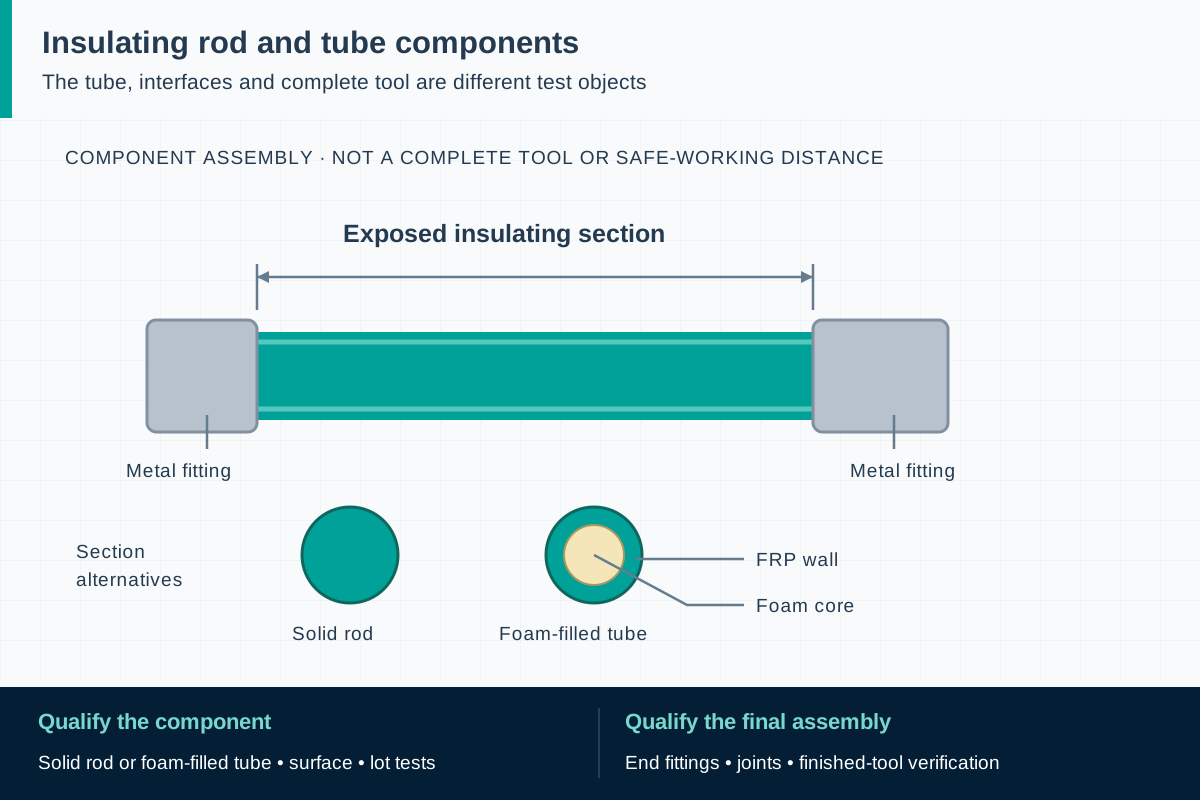
FIG. 1 Fiberglass insulating rod and tube componentsComponent schematic · not to scale
The dimension spans exposed insulation between fitting edges. The two sections distinguish a solid rod from an FRP wall around foam; this is not a working-distance specification.

Component scope and material selection

Feasibility and qualification inquiry for insulating components. No dedicated F1 live-line tool conformity, complete-tool approval or working-voltage rating is established here. Components must remain in development status until the responsible parties complete the required release process.

Select the complete material system

Candidate fiberglass-reinforced solid rod or foam-filled insulating tube, subject to an agreed qualification program

Components to specify

  • Solid insulating rods
  • Circular foam-filled insulating tubes
  • Drawing-controlled cut and finished components

Choose the construction covered by the qualification route

The inquiry should identify solid rod or foam-filled tube, the applicable standard and exact edition, and the intended component function. ASTM F711-26 covers these FRP insulating constructions for live-line tools. IEC 60855-1:2016 specifies circular-section fiberglass-reinforced rods and foam-filled tubes within its stated scope. An ordinary hollow structural tube cannot be relabeled as a component meeting either specification simply because it uses a similar resin and reinforcement.

For a tube, include the wall, core and end-closure arrangement in the proposed construction. For either form, describe the intended surface and the subsequent fabrication operations. Agree on which party is responsible for design qualification, manufacturing controls and complete-tool integration. This page supports that inquiry; it does not present a qualified F1 material grade, an approved tooling range or a ready-to-use energized-work product.

ReferencesASTM F711-26: FRP rod and tube used in live-line toolsIEC 60855-1:2016: insulating foam-filled tubes and solid rods

Dimension the profile around its function and interfaces

Provide diameter, tube wall where applicable, cut length, straightness and any required roundness or mass limits. Mark the functional datums and inspection condition. Show the surfaces involved in gripping, sliding or locating inside another component, together with the tolerances needed for those functions. Supply the tool-head or ferrule drawing so that local fit is considered before deciding the component dimensions and secondary operations.

Holes, end machining, bonded fittings, clamps and telescoping interfaces need review by the tool designer. Identify their loads, approved preparation and assembly process. The public scope of ASTM F711 excludes complete-tool fittings and attachments, so evidence for a rod or tube is only part of the final acceptance case. Any change to the end design or machining must be assessed against that case rather than assumed to be covered by an earlier test.

ReferencesASTM F711-26: FRP rod and tube used in live-line tools

Specify the qualification evidence before ordering samples

List the tests, conditioning, acceptance criteria and reporting responsibilities required by the adopted standard and tool maker. ASTM's official scope distinguishes design, sample, routine and acceptance tests; these serve different purposes. A small set of development samples, an isolated dielectric result or a general pultrusion property sheet does not establish that the production component meets the required program. Agree on the sample identity and construction so results remain connected to the intended series product.

Confirm the edition explicitly. The ASTM catalog currently lists F711-26, while the current note in OSHA 1910.269(j) references F711-02 (2007). The customer and responsible employer must determine the applicable contractual and regulatory basis; a later catalog edition does not silently amend the rule. Neither a material test voltage nor the voltage scope of an IEC standard establishes a working rating for the unqualified component offered for review.

ReferencesASTM F711-26: FRP rod and tube used in live-line toolsIEC 60855-1:2016: insulating foam-filled tubes and solid rodsOSHA 29 CFR 1910.269(j): live-line tools

Accept the finished component and preserve its identity

Agree on dimensional inspection, surface condition criteria, approved fabrication and the required production test records. Record the material construction, drawing revision and batch identity in the acceptance package. Marking location and method should be part of the approved specification so identification does not damage a critical surface. Keep unreleased development pieces distinguishable from accepted components and from ordinary structural rods or tubes in both documentation and packaging.

A receiving check should confirm identity, transport condition and the agreed records before tool assembly. Establish how scratches, impact damage, exposed reinforcement, suspect closures or fabrication defects will be assessed. Packaging should protect the surface and ends and prevent mix-ups among constructions. A visually clean component still requires its qualification evidence, while a compliant document does not override physical damage observed on delivery.

ReferencesASTM F711-26: FRP rod and tube used in live-line toolsIEC 60855-1:2016: insulating foam-filled tubes and solid rods

Control release to the tool manufacturer and later changes

Separate feasibility review, first-article testing, component production approval and complete-tool release in the supply agreement. Identify the evidence and approving party for each stage. Where suitable tests or production controls have yet to be established, describe the supply as development work. No part should be represented as ready for energized service on the strength of this product description or the general insulating behavior of fiberglass.

For repeat production, review changes to resin, reinforcement, core, surface, end closure and machining before implementation. Retain the records needed to investigate a returned component and connect it to the tool manufacturer's assembly records. Field inspection, maintenance and return-to-service decisions remain within the applicable employer and tool-manufacturer procedures. They cannot be replaced by the original component purchase or a supplier's broad claim of durability.

ReferencesASTM F711-26: FRP rod and tube used in live-line toolsOSHA 29 CFR 1910.269(j): live-line tools

Standards, regulations and acceptance evidence

The project authority determines the governing jurisdiction and adopted edition. The scope of each reference matters: a material test, an equipment requirement and a workplace rule answer different questions.

Standard · Procurement and qualification programs specifying ASTM requirements; not independently a universal legal requirement.

ASTM F711-26

Technical characteristics and tests for FRP insulating solid rods and foam-filled tubes intended for live-line tools. The official catalog identifies design, sample, routine and acceptance testing.

Application boundary: Fittings and attachments for complete tools are excluded. Ordinary hollow tube, a material datasheet or an individual electrical test cannot establish compliance of a finished tool. This page makes no F1 conformity claim.

ReferencesASTM F711-26: FRP rod and tube used in live-line tools

Standard · Countries and contracts adopting this IEC component standard or its national implementation.

IEC 60855-1:2016

Circular-section fiberglass-reinforced solid rods and insulating foam-filled tubes for manufacture of live-working tools and equipment on electrical systems above 1 kV.

Application boundary: The scope does not automatically cover every cross-section, construction or complete tool. Its intended system-voltage scope is not a working-voltage rating for an unqualified component.

ReferencesIEC 60855-1:2016: insulating foam-filled tubes and solid rods

Regulation · United States workplaces and activities within OSHA's electric-power generation, transmission and distribution rule. Construction work on such systems falls under the parallel rule at 29 CFR 1926.957 (Subpart V).

29 CFR 1910.269(j)

Live-line tool design and condition, including daily cleaning and visual inspection and the periodic examination regime for tools used for primary employee protection. The current regulatory note references ASTM F711-02 (2007).

Application boundary: ASTM's current F711-26 catalog edition does not rewrite the regulation's referenced edition. Employers must follow the actual applicable rule; a component purchase does not establish a safe work method.

ReferencesOSHA 29 CFR 1910.269(j): live-line tools

Public source scopes were reviewed on . These references do not establish certification of an F1 product. Agree the offered grade, finished component, test specimen and acceptance criteria in the project specification.

Fiberglass insulating rod and tube components: practical questions

Are these components already qualified for live-line use?

This page does not establish a dedicated F1 qualification. It defines a feasibility and evidence review for a tool manufacturer's development program. Release depends on the required component and complete-tool assessments.

Can a hollow catalog tube be supplied instead of a foam-filled tube?

A construction change must be assessed against the selected standard and tool design. The cited component standards identify solid rods and foam-filled tubes; ordinary structural tube is not an equivalent solely because its dimensions match.

Can the component report serve as the finished tool's certificate?

No. Fittings, attachments, fabrication and the final configuration can introduce requirements outside the component report. The responsible tool manufacturer must establish the complete-tool acceptance evidence.

Technical sources and further reading

Industry sources establish where the application is used. Authority sources define the published scope of standards and regulations. The design and procurement checklists above are an original engineering synthesis for project review.
  1. Industry application evidence

    Tencom: fiberglass tool handles for linework

    Application-discovery source for pultruded fiberglass tool components. Supplier performance claims are not used as F1 qualification evidence.

  2. Standard or public authority

    ASTM F711-26: FRP rod and tube used in live-line tools

    Current edition, published March 2026. Covers solid rods and foam-filled tubes; fittings and complete-tool attachments are outside its scope.

  3. Standard or public authority

    IEC 60855-1:2016: insulating foam-filled tubes and solid rods

    Official scope for circular-section glass-reinforced components intended for live-working equipment on systems above 1 kV.

  4. Standard or public authority

    OSHA 29 CFR 1910.269(j): live-line tools

    United States workplace rule covering tool design and condition. Its current note names ASTM F711-02 (2007), distinct from ASTM's current edition.

  5. Standard or public authority

    OSHA: clarification of live-line tool examination and testing

    Explains the employer's responsibility and distinctions among rod, hollow-tube and foam-filled constructions. Read with the current regulation.

Prepare a component qualification brief

Provide the application and acceptance requirements so we can assess material, geometry, sampling and the proposed supply scope. We reply within one business day; a formal quotation follows once the specification and delivery are reviewed.

01 · Component or complete-tool supply boundary, intended tool function, destination country and responsible tool manufacturer.
02 · Applicable standards and exact editions, qualification stages, approving parties and required test reports.
03 · Solid or foam-filled construction, section geometry, diameter, wall, length, straightness and interface tolerances.
04 · Mechanical loads, stiffness requirements, end drawings, permitted machining and assembly operations.
05 · Temperature and moisture exposure, surface finish, core and end-closure details where applicable, and marking requirements.
06 · Design and production acceptance plan, change control, traceability, packaging and development-status identification.
07 · First-article quantity, subsequent demand and explicit conditions for component and complete-tool release.
Get a quoteWhatsApp