Linkages and push rods
For axial members where low mass and stiffness matter. Include unsupported length, compression loads and the bonded or mechanical end connection.
Solid pultruded carbon fiber rods for lightweight linkages, stiffeners and fabricated components. Specify a CFRP round bar by diameter, cut length, fiber and resin requirements, then send your drawing to F1 Composite for a project quotation.
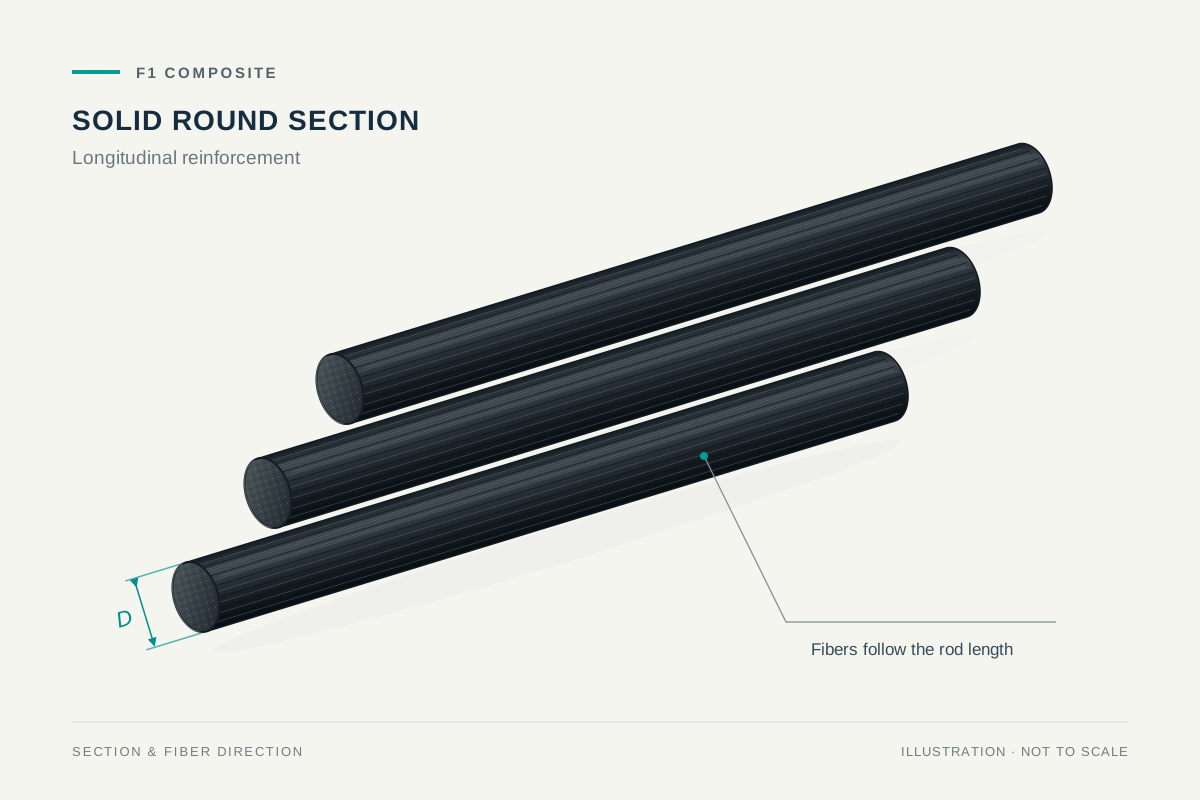
A carbon fiber rod combines continuous carbon reinforcement with a cured resin matrix. In pultrusion, the main fibers follow the length of the bar. This construction suits straight members where axial stiffness and low mass guide the material choice.
Specify the entire part, including its unsupported length and end fittings. A material tensile value alone does not establish the bending, buckling or connection capacity of a finished rod.
For glass-fiber sizes and fabricated blanks, use the existing fiberglass rod catalog. For a solid section with flat locating faces, compare square rods.
A 3/8 inch solid carbon fiber rod is a specific imperial size. Keep 9.525 mm on the drawing when fit matters; 9.5 mm and 10 mm are different nominal diameters. Include cut length, diameter tolerance and quantity in your inquiry.
Request a 3/8 inch rod quotation →| Selection point | Carbon fiber rod (CFRP) | Fiberglass rod (GFRP) |
|---|---|---|
| Reinforcement | Carbon fibers in a resin matrix | Glass fibers in a resin matrix |
| Selection driver | Often considered for higher axial stiffness at low mass | Often considered for electrical isolation and cost-sensitive components |
| Electrical behavior | Conductive; do not specify as an electrical insulator | Insulation duty still requires a qualified material and finished component |
| Dimensions and properties | Confirm the offered CFRP grade, diameter and test direction | Use the fiberglass catalog for GFRP dimensions; confirm the applicable material data |
Request CFRP-specific strength, modulus and temperature data for your design. Values and certificates published for F1 fiberglass profiles or other carbon composite products do not transfer to this rod.
For axial members where low mass and stiffness matter. Include unsupported length, compression loads and the bonded or mechanical end connection.
For straight stiffeners in RC models, equipment and lightweight assemblies. Define bending, impact and attachment requirements for the finished part.
For moving supports and locating components. Check deflection, joint loads, surface wear and electrical isolation where the rod meets the equipment.
It is a solid composite round bar made by drawing continuous carbon fibers and resin through a forming and curing die. The main reinforcement runs along the rod, making load direction and end-connection design important when specifying the component.
Yes. Send an inquiry for a nominal 3/8 inch (9.525 mm) solid rod with your diameter tolerance, cut lengths and quantity. F1 Composite confirms the proposed material, tooling, samples, minimum order and delivery in the quotation; this size reference is not a stock listing.
No. A 3/8 inch diameter is 9.525 mm. A nominal 10 mm rod is 0.475 mm larger, which can change fit and section properties. Specify the intended units and tolerance on the drawing.
A rod has a solid cross-section; a tube has an internal bore. A tube places more material away from its center and can suit bending-stiffness targets at lower mass. Compare the actual outside diameter, bore, loads and end fittings before choosing a section.
No. Carbon fibers conduct electricity. For an insulating component, start with an appropriate glass-fiber system and specify the required electrical, environmental and finished-assembly qualification.
No. Glass and carbon reinforcement are different material systems. Request properties and test evidence for the offered carbon fiber grade, resin, section and loading direction. The existing fiberglass catalog does not establish CFRP strength, stiffness or temperature limits.
Specify the finished drawing and agree the fabrication route. Cutting and cross-drilling can expose or interrupt longitudinal fibers; threads and end fittings need a connection review. Include hole locations, edge distances, bonding surfaces and acceptance requirements with the inquiry.
Send your rod drawing, diameter, cut lengths and quantity, with the application and destination. We reply within one business day; a formal quotation follows once the specification and delivery are reviewed.