Skip to content
Specialist component specification

FRP support profiles for demister and scrubber internals

Specify the members that carry and locate a mist-eliminator assembly: support beams, frames, spacers and retaining rails designed around the equipment interfaces.

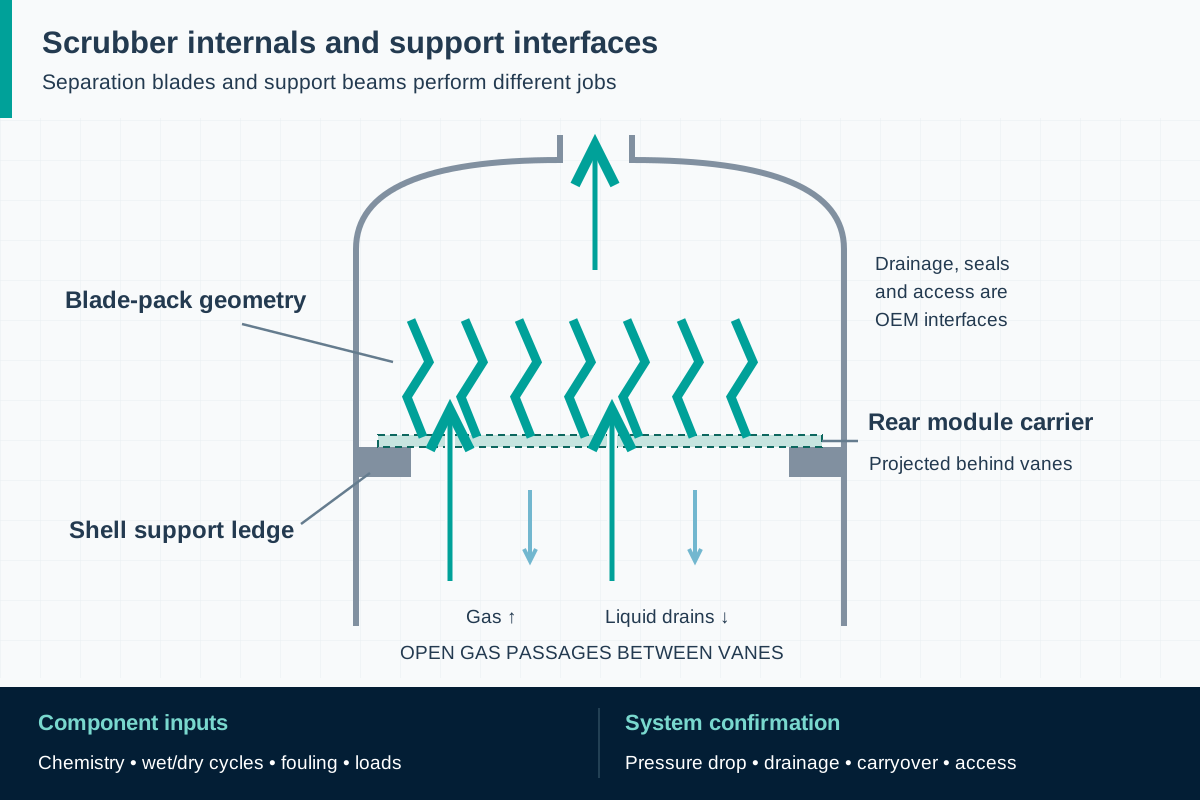
FIG. 1 FRP demister support profilesComponent schematic · not to scale
Gas passes through the vane pack while collected liquid drains downward; the carrier transfers pack loads to the shell ledges.

Component scope and material selection

Drawing-led review of pultruded FRP support and locating members, with agreed cutting, drilling and surface treatment. Custom lamella geometry can be assessed as a separate qualification item. This inquiry does not include an independently guaranteed separator or pressure vessel.

Select the complete material system

A specified glass-fiber thermoset laminate with exposure-qualified resin and surface protection. Directional mechanical properties, service temperature and any required electrostatic behavior must be established for the proposed construction.

Components to specify

  • Support channels and beams
  • Angles and edge frames
  • Spacer and locating rails
  • Hold-down or retaining sections to OEM drawings

Identify what the member carries and locates

Start the purchase description with a function and a drawing revision. A beam carrying several vane modules, a rail maintaining vane pitch and a hold-down restraining a mesh pad have different critical dimensions. Identify contact faces, fastening points and areas that must remain clear for gas flow or drainage.

For a packing support, provide the packing system and its support design instead of substituting a generic open grating. The opening pattern must retain the selected packing while meeting process requirements. The vessel ledge and any intermediate supports belong in the interface drawing, even if they are supplied by another contractor.

ReferencesSulzer: vane geometry, drainage and gas-flow directionKoch-Glitsch: plastic packing and column internals

Control assembled fit as well as the nominal section

Specify section dimensions, cut length, straightness, twist and hole datums. Use agreed tolerances for locating features that accumulate across a bank. Mark slotted holes and adjustment allowances explicitly; unplanned field drilling can weaken a connection or interfere with a required seal.

Pultrusion suits the continuous member. Curved perimeter pieces, three-dimensional transitions and complex end fittings may need separate fabrication. Define where machining removes the original surface protection and state the approved edge treatment. Include a first-article assembly check when a new section mates with existing modules or brackets.

ReferencesRöchling: pultrusion process and reinforcement choicesASTM D3917-23: dimensional tolerances of pultruded shapesINEOS Composites: Derakane resin selection guide

Purchase against an exposure and load schedule

Provide normal and upset conditions for gas, condensate, wash liquid and cleaning. Ask the material reviewer to address the exact surface construction rather than approving a resin family by name. Where laboratory qualification is needed, document specimen construction and the retained properties required after exposure.

The structural schedule should include the supported assembly, retained liquid, deposits and relevant pressure or cleaning loads. Supply span, restraint, allowable movement and design temperature so the responsible engineer can assess strength, connection behavior and sustained deflection. Resolve the vessel-side reactions before fabrication release; the beam's capacity does not verify its supporting ledge.

ReferencesASTM C581-26: chemical resistance in liquid serviceASTM D543-21: evaluating the resistance of plastics to chemical reagentsKoch-Glitsch: plastic packing and column internalsEN 13121-3:2016: above-ground GRP tanks and vessels

Agree on evidence that can be tied to the supplied construction

A useful qualification package identifies the resin and reinforcement system, profile revision, relevant test specimens, manufacturing route and acceptance criteria. Keep material evidence, component calculations and routine production inspection as distinct records. Changes to the surface veil, conductive additive, coating or thickness should trigger review of the evidence affected by that change.

Where the plant requires fire or electrostatic properties, specify the exact method and configuration to test. An ordinary glass-fiber profile must not be relabeled as antistatic because the assembly has a grounding lug. The system integrator determines the required charge-control arrangement and legal conformity responsibilities for the intended hazardous-area use.

ReferencesINEOS Composites: Derakane resin selection guideASTM C581-26: chemical resistance in liquid serviceIEC TS 60079-32-1:2013+A1:2017: electrostatic hazardsDirective 2014/34/EU: equipment for explosive atmospheres

Set measurable incoming and assembly checks

Agree on a lot inspection plan before production. Identify which dimensions require a report, which surfaces require visual inspection and how material batches are linked to component labels. Record acceptable appearance and repair criteria so exposed reinforcement, splitting or a damaged connection feature is not accepted by informal comparison with an old part.

For a representative assembly, verify hole alignment, support contact, module clearances, hold-down engagement and unobstructed drains. Identify any gauges or fixtures used and record the drawing revision. The plant performance test remains a separate acceptance activity after installation; dimensional conformity is necessary evidence of fit, not a removal-efficiency certificate.

ReferencesASTM D3917-23: dimensional tolerances of pultruded shapesSulzer: vane geometry, drainage and gas-flow directionVDI 3679 Part 3:2019-08: wet separators and mist eliminatorsUS EPA: air-emissions monitoring for permits

Design the spare so it can be installed and inspected

Confirm the packed length, manway opening and lifting route. Use a module and part identification scheme that survives transport and the agreed operating environment. Keep the approved drawing and material revision with the spare inventory; a visually similar section can have a different laminate or critical interface.

Request the OEM's cleaning and inspection procedure and keep attachment checks accessible. The replacement work plan must address vessel entry and isolation of process equipment. After fitting the part, verify seals and drainage, then record the operating baseline under the system commissioning procedure. Investigate recurring deformation, cracking or fouling before repeating the same specification.

ReferencesMunters: DV210+ mist elimination and integrated washingOSHA 29 CFR 1910.146: permit-required confined spacesOSHA 29 CFR 1910.147: control of hazardous energyUS EPA: wet scrubbers for particulate matter

Standards, regulations and acceptance evidence

The project authority determines the governing jurisdiction and adopted edition. The scope of each reference matters: a material test, an equipment requirement and a workplace rule answer different questions.

Guidance · Germany; other projects when specified

VDI 3679 Part 3:2019-08

A technical basis for selecting mist-elimination arrangements and agreeing droplet measurement, washing, operating and maintenance provisions.

Application boundary: An OEM performance agreement must still name the actual duty and measurement method. Referencing this guidance is not certification of a profile or an emissions guarantee.

ReferencesVDI 3679 Part 3:2019-08: wet separators and mist eliminators

Standard · Material qualification when contractually specified

ASTM C581-26 and ASTM D543-21

Chemical-exposure test planning: identify the resin, laminate, reagent, temperature, time and properties to evaluate. C581 addresses unstressed reinforced thermoset specimens for liquid service. European vessels designed to EN 13121-3 normally take laminate chemical-resistance evidence from EN 13121-2; confirm which route the vessel designer requires.

Application boundary: Different methods answer different questions. These tests alone do not qualify wet gas, hot dry excursions, sustained structural loading or a finished demister assembly.

ReferencesASTM C581-26: chemical resistance in liquid serviceASTM D543-21: evaluating the resistance of plastics to chemical reagents

Standard · Pultruded component purchasing when specified

ASTM D3917-23

Provides a dimensional-tolerance framework for thermosetting glass-reinforced pultruded shapes.

Application boundary: State agreed vane spacing, contact faces, module squareness and mounting-hole tolerances on the project drawing; dimensional conformity does not establish separation performance.

ReferencesASTM D3917-23: dimensional tolerances of pultruded shapes

Standard · European GRP vessel projects and contracts specifying it

EN 13121-3:2016

Applies within its defined scope to design and workmanship of above-ground GRP tanks and vessels, including specified shell attachments. The vessel designer reviews the load transfer from internals.

Application boundary: Do not label a pultruded beam or vane as an EN 13121-certified scrubber. Check the prescribed laminate, fabrication and verification provisions for the proposed construction; the public scope excludes vessels subject to explosion risk.

ReferencesEN 13121-3:2016: above-ground GRP tanks and vessels

Regulation · Facility jurisdiction; U.S. Title V/CAM where applicable

Facility air permits (U.S.: 40 CFR Parts 70/71 Title V; Part 64 CAM)

The operator identifies the applicable emissions limit, monitoring, reporting and replacement-change requirements for the source and its control device.

Application boundary: A material certificate or internal-component inspection does not demonstrate stack-emissions compliance. A site's permit and approved test procedures establish its acceptance obligations.

ReferencesUS EPA: air-emissions monitoring for permitsUS EPA: wet scrubbers for particulate matter

Regulation · European Union; products within the directive's scope

Directive 2014/34/EU (ATEX)

First establish the intended explosive atmosphere, use and legal product status. Identify applicable conformity responsibilities for equipment, protective systems or components.

Application boundary: A raw FRP profile has no automatic ATEX approval. Determine applicability from the actual product and installation rather than assigning a certification label from material properties.

ReferencesDirective 2014/34/EU: equipment for explosive atmospheres

Guidance · Electrostatic risk assessments and projects specifying this guidance

IEC TS 60079-32-1:2013+A1:2017

Informs the assessment of charging and discharge hazards and measures involving conductors, insulating surfaces and operating conditions.

Application boundary: Insulating FRP, flame retardancy or an earthed metal bracket alone does not establish explosion safety. Verify the specified charge-control properties in the assembled configuration.

ReferencesIEC TS 60079-32-1:2013+A1:2017: electrostatic hazards
Public source scopes were reviewed on . These references do not establish certification of an F1 product. Agree the offered grade, finished component, test specimen and acceptance criteria in the project specification.

FRP demister support profiles: practical questions

Are standard FRP channels suitable as demister supports?

They are candidates only after the profile, chemistry, load, connection and movement requirements are checked. A nominal section match does not establish equal reinforcement, corrosion protection or service-temperature behavior.

Can F1 reproduce a used support sample?

A sample helps identify geometry, but pair it with a survey and approved replacement drawing. Worn holes, creep or damaged edges should not become the new manufacturing dimensions. Confirm why the original part failed before finalizing the replacement.

Does this product include the mist-eliminator vanes?

The primary scope is support and locating profiles. A constant-section vane can be reviewed separately against an authorized OEM drawing and qualification plan. Separator geometry, operating envelope and performance responsibility must be agreed explicitly.

Technical sources and further reading

Industry sources establish where the application is used. Authority sources define the published scope of standards and regulations. The design and procurement checklists above are an original engineering synthesis for project review.
  1. Industry application evidence

    Röchling: composite profile applications in chemical plants

    The chemical plant section identifies lamella walls in a flue gas washer. It establishes the application, not an F1 resin specification or separation guarantee.

  2. Industry application evidence

    Röchling: pultrusion process and reinforcement choices

    Manufacturing background for continuous profile geometry and the selection of reinforcement and resin; competitor capabilities are not attributed to F1.

  3. Industry application evidence

    Sulzer: vane geometry, drainage and gas-flow direction

    OEM explanation of simple and complex vane separators. Proprietary capacities and geometry are not used as F1 product ratings.

  4. Industry application evidence

    Sulzer: gas–liquid separation technology

    OEM discussion of mesh, vane and other separation methods, including efficiency, pressure loss, materials and fouling tradeoffs.

  5. Industry application evidence

    Sulzer: diagnosing liquid carryover and flow distribution

    System-level diagnostic example involving CFD, maldistribution and bypass; the high-pressure case study does not establish performance in an atmospheric FRP scrubber.

  6. Industry application evidence

    Munters: DV210+ mist elimination and integrated washing

    OEM evidence for salt, dust and gypsum deposition, wash coverage and cleaning-cycle integration. Its system guarantees belong to that supplier.

  7. Industry application evidence

    Munters: DV 880 vertical-flow mist eliminator

    Explains capture, coalescence and gravity drainage in a vertical-flow vane system; specific operating envelopes remain OEM dependent.

  8. Industry application evidence

    Koch-Glitsch: plastic packing and column internals

    Distinguishes packing, support plates and bed limiters; vessel ledge adequacy and internals depend on the actual installation.

  9. Standard or public authority

    US EPA: wet scrubbers for particulate matter

    Public guidance on entrainment separators, operating problems and monitoring indicators. Its discussion of particulate control is not a universal acid-gas performance model.

  10. Standard or public authority

    US EPA: air-emissions monitoring for permits

    Explains source-level permit and monitoring responsibilities. Title V and Compliance Assurance Monitoring applicability must be established for the facility.

  11. Industry application evidence

    INEOS Composites: Derakane resin selection guide

    Resin-specific exposure guidance with concentration, temperature and laminate qualifications. A listed resin temperature is not a finished pultrusion rating.

  12. Standard or public authority

    ASTM C581-26: chemical resistance in liquid service

    Current public scope checked: unstressed reinforced thermoset specimens provide chemical-resistance evidence, not the sole basis for a loaded component's serviceability.

  13. Standard or public authority

    ASTM D543-21: evaluating the resistance of plastics to chemical reagents

    Exposure conditions, stress and retained properties must match the question being tested. Laboratory results have stated limits.

  14. Standard or public authority

    ASTM D3917-23: dimensional tolerances of pultruded shapes

    ASTM lists the active dimensional-tolerance specification. A demister fit drawing must separately identify its critical interface tolerances.

  15. Standard or public authority

    VDI 3679 Part 3:2019-08: wet separators and mist eliminators

    Public scope covers droplet separation, measurement, washing, performance agreements and maintenance. No unpublished numerical criteria are reproduced.

  16. Standard or public authority

    EN 13121-3:2016: above-ground GRP tanks and vessels

    Scope includes specified tanks, vessels and attachments bonded directly to their shells. It is not a freestanding demister-efficiency or generic pultrusion product standard.

  17. Standard or public authority

    Directive 2014/34/EU: equipment for explosive atmospheres

    Use the applicable consolidated text and national implementation. Scope depends on equipment, protective-system or component status and intended use; a raw FRP profile has no automatic ATEX approval.

  18. Standard or public authority

    IEC TS 60079-32-1:2013+A1:2017: electrostatic hazards

    Guidance for assessing charging and ignition risks, including conductors and insulators. It does not assign every scrubber the same electrical material specification.

  19. Standard or public authority

    OSHA 29 CFR 1910.146: permit-required confined spaces

    For work within its U.S. general-industry scope, the employer evaluates the vessel and entry hazards and establishes the required controls.

  20. Standard or public authority

    OSHA 29 CFR 1910.147: control of hazardous energy

    Relevant to servicing within the rule's scope; isolation planning must consider fans, pumps, automatic wash cycles and connected process equipment.

Prepare a component qualification brief

Provide the application and acceptance requirements so we can assess material, geometry, sampling and the proposed supply scope. We reply within one business day; a formal quotation follows once the specification and delivery are reviewed.

01 · Controlled member and assembly drawings, quantities, required lengths and spare quantities.
02 · Function: beam, locator, spacer, edge frame, retaining rail or approved packing support.
03 · Span, restraints, load schedule, allowable deflection and support reactions.
04 · Gas/liquid/cleaning exposure schedule, including concentrations and dry or hot upset conditions.
05 · Resin and laminate qualification basis, surface protection and machining/edge-sealing requirements.
06 · Critical tolerances, first-article fit check, traceability and production inspection plan.
07 · Any fire or electrostatic test requirement with its actual method, configuration and acceptance criteria.
08 · Packaging, access constraints, installation responsibilities and required delivery documentation.
Get a quoteWhatsApp