Skip to content
Specialist component specification

Pultruded FRP third-rail coverboards

Specify a coverboard as a drawing-controlled component with agreed material, interface and acceptance requirements. Establish the operator's qualification route before releasing a profile for railway service.

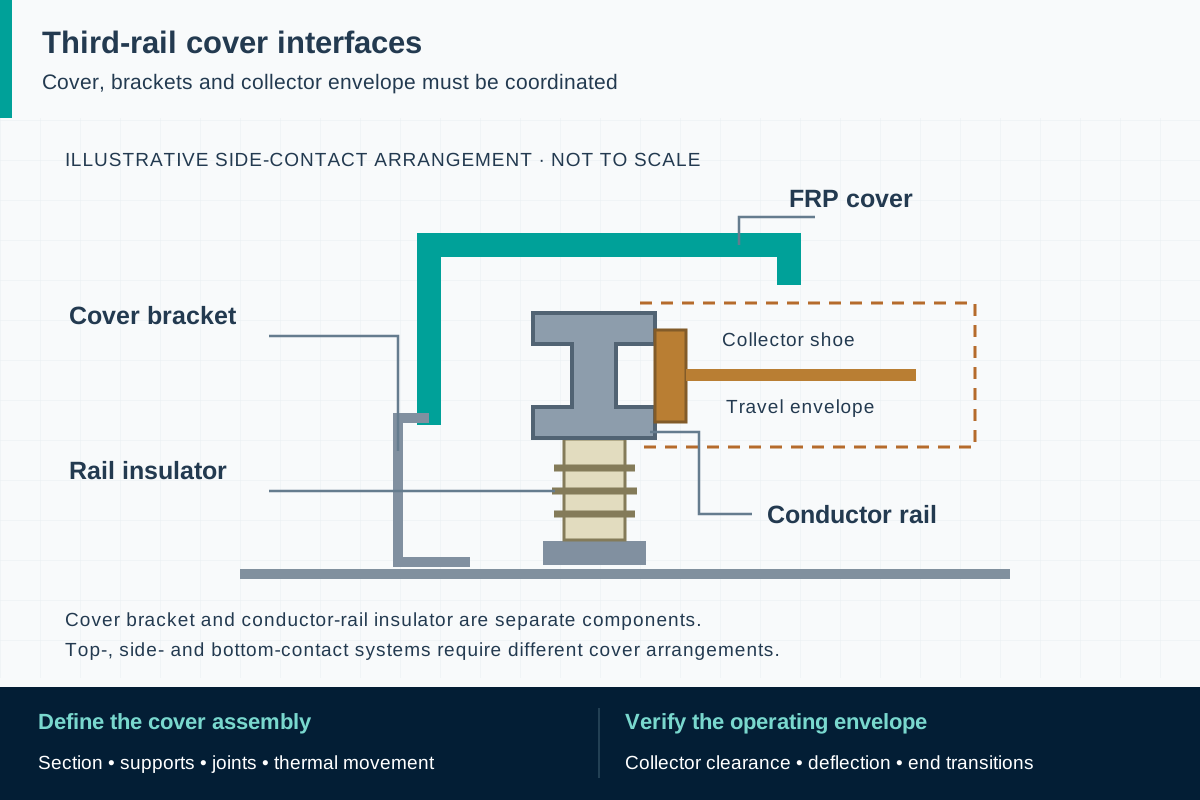
FIG. 1 Pultruded third-rail coverboardsComponent schematic · not to scale
Side-contact example: the shoe meets the rail beside its insulating support. The cover bracket is a separate component, and the dashed outline marks collector travel.

Component scope and material selection

Component feasibility and qualification inquiry only. An approved railway product, standard available section, certified material package or installed system is not established by this page.

Select the complete material system

Application-qualified glass-reinforced thermoset profile; resin, reinforcement and surface package agreed during review

Components to specify

  • Custom open coverboard sections
  • Profiles with returned edges and defined mounting zones
  • Cut and machined cover lengths to approved drawings

Define the component before selecting the section

Provide a section drawing showing the conductor rail and collector clearance alongside the proposed coverboard. Mark the profile surfaces that locate on brackets, the regions that carry fixing loads and the boundaries that must remain clear after tolerances and deflection are included. Specify whether the order covers raw lengths or cut, drilled and identified parts. A quotation based only on overall width and wall thickness leaves important functional requirements unresolved.

Pultrusion is a candidate route for repeatable constant-section covers. Complex transitions, curved end pieces and supports may need a different manufacturing process or a separately qualified assembly. Röchling's application examples distinguish profile-based covers from compression-molded supports. Keep those parts separate in the bill of materials so that a profile supplier's scope does not imply responsibility for an entire conductor-rail protection system.

ReferencesRöchling: rail technology and vehiclesRöchling: composite and pultruded profiles

Specify functional datums, fit and tolerances

Dimension mounting width, internal clearances, wall thickness, returns, radii and the features controlling engagement with the bracket. Define the measurement datums and agreed inspection condition. Include cut length, end squareness, straightness, twist and hole or slot position where relevant. These requirements should be derived from the assembly tolerance budget; a generic pultrusion tolerance does not prove that a long cover will fit a particular track installation.

Review thin lips, local thickness changes and tightly constrained fastening regions during die feasibility. Ask how first-article fit will be checked with representative mating parts, and how changes to bracket spacing or joint geometry will be controlled. Supplied length is a logistics and fabrication parameter. Permissible span and fastening capacity must come from the project assessment, including local wall behavior and connection retention.

ReferencesRöchling: composite and pultruded profilesL.B. Foster: coverboards and brackets

Freeze the tested material and surface package

List the required mechanical, electrical, environmental and fire evidence without assuming one property substitutes for another. The accepted material description should identify resin and reinforcement, relevant additives, surface layers, color, wall thickness and any coating or edge treatment. Request reports that can be related to that description and to the specified conditioning. A report for an unrelated sheet or differently coated sample is not automatically evidence for the supplied profile.

The operator's location and approval framework determine the applicable fire and electrical requirements. NFPA 130 and EN 50122-1 address different aspects of the transit installation, while EN 45545-2 has a railway-vehicle scope. Resolve the project's test matrix and adopted editions before production. This product inquiry does not assert a flame classification, insulation rating or railway approval for an untested F1 section.

ReferencesNFPA 130: fixed guideway transit and passenger rail systemsBSI: current BS EN 50122-1 releaseBSI: current BS EN 45545-2 release

Agree on fabrication and acceptance at the finished-part level

The fabrication drawing should control cut ends, drilled features, any specified edge finish and identification. Agree on how cracks, separation of layers, local damage and exposed fibers will be evaluated, especially in mounting or electrically functional regions. Where a repair is allowed, its approval and inspection route should be documented before the batch is accepted. A conforming overall dimension does not override a defect that affects the intended function.

An acceptance package can include the approved drawing revision, material identity, batch record, dimensional inspection, agreed test reports and a first-article fit record. Define sampling, witness points and responsibility in the purchase order. Development samples should remain clearly identified until the operator or designated approver releases the component. Packaging and handling instructions should protect long edges and prevent distortion or impact damage during transport and unloading.

ReferencesRöchling: composite and pultruded profilesBSI: current BS EN 50122-1 release

Separate feasibility, first article and approved series supply

Begin with a feasibility review of geometry, material requirements and the tests needed. Then agree on a first-article scope, representative brackets and the review needed before any series order. Tooling approval is a manufacturing milestone, not railway approval. If the qualification route requires testing or acceptance that has not been completed, the commercial documents should say so and identify the remaining responsibilities and release conditions.

For repeat orders, reference the accepted configuration and control changes to the profile, surface, machining or attachment interface. Retain batch identification through installation where the operator requires it. Spare parts should restore the approved geometry and material system. A visually similar replacement is not enough when the existing qualification depends on a particular wall, fixing detail or tested fire package.

ReferencesBSI: current BS EN 50122-1 releaseNFPA 130: fixed guideway transit and passenger rail systems

Standards, regulations and acceptance evidence

The project authority determines the governing jurisdiction and adopted edition. The scope of each reference matters: a material test, an equipment requirement and a workplace rule answer different questions.

Standard · Projects adopting the European fixed-railway electrical-safety framework; national adoption and contract govern.

EN 50122-1:2022+A1:2025

Protective provisions against electric shock in railway fixed installations, coordinated with earthing and the return circuit. The project engineer determines the cover's role in the complete protection arrangement.

Application boundary: An insulating profile alone does not demonstrate compliance of the track installation. Material dielectric data do not establish safe access, clearances or bonding arrangements.

ReferencesBSI: current BS EN 50122-1 release

Standard · North American and other projects where the authority having jurisdiction or contract adopts NFPA 130; the adopted edition can differ.

NFPA 130, 2026 edition

Fire and life safety for fixed guideway transit and passenger rail systems, including stations, trainways and other system elements.

Application boundary: A generic flame-retardant resin declaration does not approve a coverboard installation. The project must identify the material tests, assembly conditions and acceptance criteria applicable to its location.

ReferencesNFPA 130: fixed guideway transit and passenger rail systems

Standard · Railway-vehicle projects adopting EN requirements; a fixed-installation contract may separately specify selected tests.

EN 45545-2:2020+A1:2023

Fire behavior of materials and components on railway vehicles. Its use for a fixed third-rail cover needs an explicit project requirement.

Application boundary: A vehicle material classification is not a universal third-rail approval and does not replace fixed-installation electrical-safety or operator acceptance requirements.

ReferencesBSI: current BS EN 45545-2 release

Public source scopes were reviewed on . These references do not establish certification of an F1 product. Agree the offered grade, finished component, test specimen and acceptance criteria in the project specification.

Pultruded third-rail coverboards: practical questions

Is there a universal third-rail coverboard section?

No section can be assumed to fit every conductor rail, collector envelope and support system. Send the operator's drawings and acceptance requirements for a component feasibility review.

Can I order this as a certified stock item?

This page establishes a qualification inquiry, not certified stock availability. Material evidence, section feasibility, testing and operator acceptance need to be agreed for the requested component.

Does the supplied profile length determine its allowable span?

No. Length describes the delivered part. Span depends on material properties, section geometry, support and fixing behavior, load cases and the permitted deflection in the track assembly.

Technical sources and further reading

Industry sources establish where the application is used. Authority sources define the published scope of standards and regulations. The design and procurement checklists above are an original engineering synthesis for project review.
  1. Industry application evidence

    Röchling: rail technology and vehicles

    Identifies profile-based third-rail covers separately from compression-molded conductor-rail supports. Supplier approvals and service history are not F1 evidence.

  2. Industry application evidence

    Röchling: composite and pultruded profiles

    Manufacturing-route reference for pultruded profiles; no competitor material rating is adopted here.

  3. Industry application evidence

    L.B. Foster: coverboards and brackets

    Confirms that coverboard assemblies are adapted to transit-agency criteria and local wind, snow and ice exposure.

  4. Standard or public authority

    BSI: current BS EN 50122-1 release

    Lists BS EN 50122-1:2022+A1:2025 for fixed-installation electrical safety, earthing and the return circuit.

  5. Standard or public authority

    NFPA 130: fixed guideway transit and passenger rail systems

    Official 2026 edition and system scope. The authority having jurisdiction and contract determine the applicable edition and requirements.

  6. Standard or public authority

    BSI: current BS EN 45545-2 release

    Lists 2020+A1:2023 and identifies the railway-vehicle fire scope. It is not automatically the acceptance standard for a fixed third-rail cover.

Prepare a component qualification brief

Provide the application and acceptance requirements so we can assess material, geometry, sampling and the proposed supply scope. We reply within one business day; a formal quotation follows once the specification and delivery are reviewed.

01 · Operator and installation location, adopted standards and editions, and component approval responsibility.
02 · Section and fabrication drawings with conductor/collector envelope, bracket interfaces and functional tolerances.
03 · Required profile and cut lengths, support spacing, fastening arrangement and defined component loads.
04 · Material, conditioning, electrical and fire test matrix, surface finish, color and permitted fabrication processes.
05 · First-article fit checks, inspection sampling, witness requirements, documents and release criteria.
06 · Quantities, packaging, delivery sequence, spare-part strategy and batch identification requirements.
Get a quoteWhatsApp