Skip to content
Specialist component specification

Pultruded FRP profiles for switchgear component development

Specify the profile around its mounting faces, insulation paths and load-transfer interfaces. The useful deliverable is a controlled component definition and qualification plan that the switchgear manufacturer can evaluate.

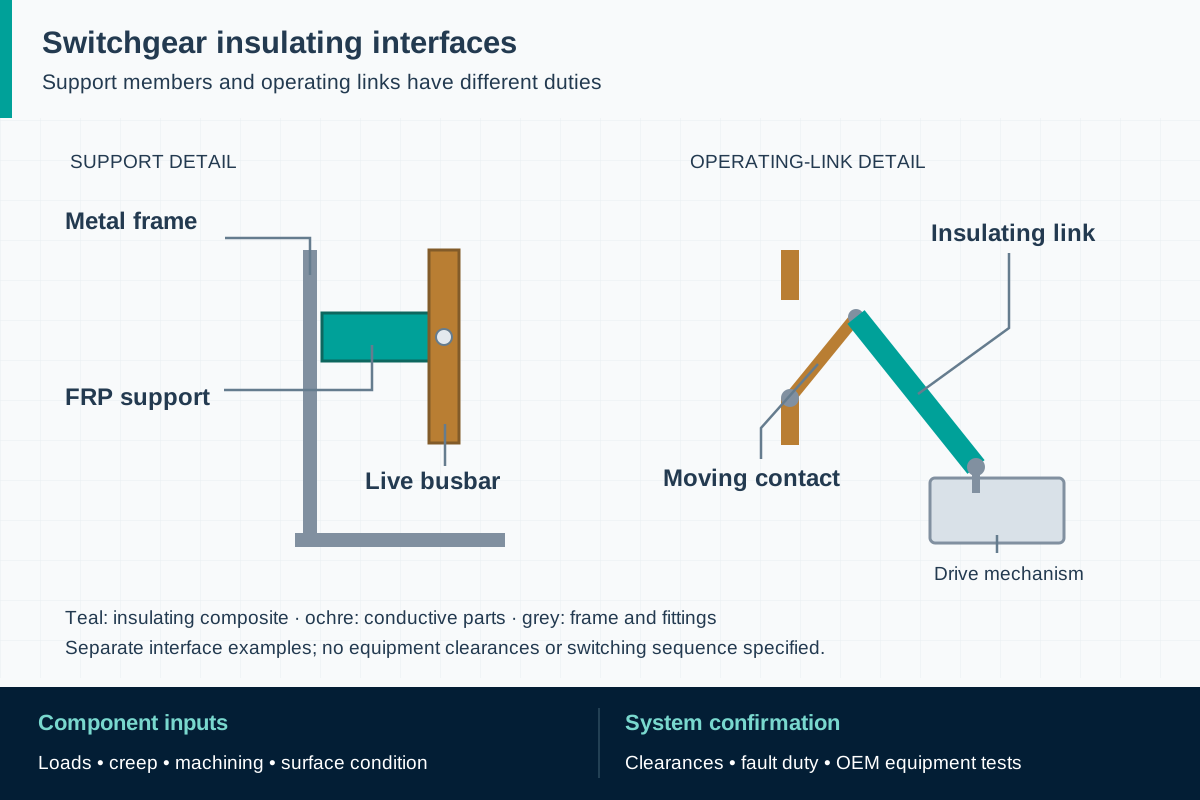
FIG. 1 Switchgear insulating profilesComponent schematic · not to scale
Separate support and operating-link details: teal identifies composite insulation, ochre identifies conductive parts, and grey identifies the frame and fittings.

Component scope and material selection

Qualification inquiries for angles, channels, custom sections and suitable rod or tube blanks. Availability, manufacturing route and required validation are reviewed against the drawing; no stock electrical grade or approved equipment rating is asserted.

Select the complete material system

Application-qualified glass-reinforced thermoset with controlled surface and machining condition

Components to specify

  • Support angles and channels
  • Frame, guide and insulating spacer sections
  • Rod and tube blanks for separately qualified mechanisms

Choose a blank, a machined component or a development sample

State the delivery boundary first. A cut profile blank leaves hole-making and finishing to the OEM; a fabricated component requires an approved machining drawing; a development sample is supplied for evaluation under an agreed plan. List what the delivered part includes, especially inserts, end treatments and identification. A supplied rod should not be called a complete switch operating mechanism when the joints and assembly are outside the order.

Match the candidate route to the geometry. Constant sections are suitable for pultrusion review, while deep three-dimensional features or pressure-tight insulating barriers can require a different process. The application examples establish a use for composite profiles, not universal interchangeability with molded or machined-sheet electrical components.

ReferencesRöchling: composite materials for switchgear

Put functional dimensions ahead of a generic tolerance table

Identify the datums used during assembly and inspection. Provide contact-face flatness, hole-to-hole spacing, hole-axis orientation, straightness, twist and cut length where they control fit or insulation geometry. For a sliding guide, include the mating clearance and permitted wear; for a link, include pin fit, end geometry and travel. A universal dimensional tolerance cannot answer these different interface requirements.

Review whether the specified features can be measured reliably on the intended part. Agree on gauges or inspection fixtures for critical positions and reserve representative first articles for fit assessment. The drawing should show which deviations are acceptable, which require engineering disposition and which reject the component.

ReferencesIEC 61439-1:2020: low-voltage assembliesIEC 62271-1:2017+AMD1:2021: AC switchgear

Request evidence for the selected material and surface

Specify the loads, temperature and environment before choosing a resin system. Request relevant directional mechanical data and the proposed electrical and thermal characterization. Record the reinforcement, curing, surface layer and any coating in the material identity. A change of pigment or surface treatment should be reviewed when the acceptance evidence depends on that surface.

Keep tests in their proper roles. Tracking-index data characterize a material or part under a defined test; dielectric properties depend on specimen geometry and condition; thermal classification distinguishes material from insulation system. None of these documents independently certifies the completed switchgear. Ask the OEM to identify the evidence needed for its exact equipment program.

ReferencesIEC 60112:2025: proof and comparative tracking indicesIEC 60085:2007: thermal evaluation and designationIEC 60664-1:2020+AMD1:2025: insulation coordination

Qualify end features and assembly methods

Specify drilling, edge finishing, insert installation and cleaning as controlled operations. Review holes near ends and thin webs for the actual connection loads. Where an adhesive or clamped insert transfers force, include its cure, surface preparation or tightening method in the joint validation; a strong parent laminate does not demonstrate a durable joint.

Inspect the first fabricated parts with the intended hardware. Check fit, movement, retained separation and the ability to identify the approved orientation. Document any contact marks, fiber damage or local crushing found during trial assembly. Resolve those observations through the drawing or process before series manufacture instead of relying on operator adjustment.

ReferencesIEC 62271-1:2017+AMD1:2021: AC switchgearRöchling: composite materials for switchgear

Agree on qualification, batch acceptance and traceable delivery

Separate one-time design qualification from production acceptance. The plan should name the approved configuration, sampling basis, conditioning, methods, acceptance limits and record owner. Include dimensional inspection and whatever material or part checks the OEM requires. Equipment-level verification remains with the switchgear manufacturer, including the applicable assembly standard and product part.

Package components to preserve surfaces and prevent mixing of drawing revisions. Mark the batch and part identity in an approved location outside critical electrical or fitting areas. The delivery file should connect material identity, fabrication revision, inspection results and any approved deviations. A future replacement order should be reproducible from that record rather than from a photograph and nominal dimensions.

ReferencesIEC 61439-1:2020: low-voltage assembliesIEC 62271-1:2017+AMD1:2021: AC switchgearIEC 62271-200:2021+AMD1:2024: metal-enclosed assemblies

Standards, regulations and acceptance evidence

The project authority determines the governing jurisdiction and adopted edition. The scope of each reference matters: a material test, an equipment requirement and a workplace rule answer different questions.

Standard · Low-voltage assembly contracts adopting IEC requirements or their national implementation.

IEC 61439-1:2020 with the relevant product part

General requirements and verification of low-voltage switchgear and controlgear assemblies. Part 1 is used with the relevant Part 2 or later product part.

Application boundary: Part 1 alone is not an assembly conformity route. Approval of a support material does not establish temperature rise, short-circuit withstand or dielectric performance of the assembly.

ReferencesIEC 61439-1:2020: low-voltage assemblies

Standard · AC high-voltage equipment programs adopting IEC requirements; equipment-specific parts and national adoption govern.

IEC 62271-1:2017+AMD1:2021

Common specifications for AC switchgear above 1 kV, with service frequencies through 60 Hz, unless the particular equipment standard specifies otherwise.

Application boundary: This is not a material standard or a qualification of an individual insulating operating rod. DC equipment requires its appropriate separate framework.

ReferencesIEC 62271-1:2017+AMD1:2021: AC switchgear

Standard · Projects specifying prefabricated AC metal-enclosed switchgear within the standard's scope.

IEC 62271-200:2021+AMD1:2024

Assemblies rated above 1 kV and through 52 kV, indoors or outdoors, with frequencies through 60 Hz.

Application boundary: Internal-arc classification and other equipment results depend on the tested arrangement. Neither a flame-retardant resin nor a profile coupon proves the classification of a modified enclosure.

ReferencesIEC 62271-200:2021+AMD1:2024: metal-enclosed assemblies

Standard · Low-voltage equipment insulation-coordination programs using this IEC basic safety publication through the relevant product standard.

IEC 60664-1:2020+AMD1:2025

Equipment up to AC 1,000 V or DC 1,500 V, through 30 kHz; addresses creepage, clearance and solid-insulation criteria.

Application boundary: Do not apply its air-gap rules to liquid insulation, other gases or compressed air. It is not a universal clearance table for medium-voltage switchgear or ionized arc environments.

ReferencesIEC 60664-1:2020+AMD1:2025: insulation coordination

Standard · Material and part qualification programs specifying proof or comparative tracking indices.

IEC 60112:2025

AC-voltage testing of solid insulating material specimens for tracking characterization or acceptance.

Application boundary: CTI/PTI does not establish impulse withstand, arc containment, equipment voltage or a maintenance interval. Use the exact surface and conditioning relevant to the part.

ReferencesIEC 60112:2025: proof and comparative tracking indices

Regulation · European Union equipment and activities within the F-gas Regulation's scope.

Regulation (EU) 2024/573: switchgear provisions

Staged restrictions on putting certain F-gas switchgear into operation, subject to the regulation's conditions and derogations; review the equipment category and project date.

Application boundary: A composite support is not an F-gas compliance certificate. A change of insulating medium still requires equipment and material compatibility assessment. Commission FAQ guidance does not replace the legal text.

ReferencesEuropean Commission: F-gas stakeholder obligationsEuropean Commission: electrical switchgear F-gas FAQ

Public source scopes were reviewed on . These references do not establish certification of an F1 product. Agree the offered grade, finished component, test specimen and acceptance criteria in the project specification.

Switchgear insulating profiles: practical questions

Are published standard profile dimensions an approved electrical catalog?

No. Geometry availability and electrical application qualification are separate. Submit the equipment requirements and drawing for a component-specific feasibility review.

Can F1 reproduce a competitor's approved grade from its name?

A trade name or appearance is insufficient. Provide the functional requirements and required evidence; any proposed material needs its own qualification and the OEM's approval.

Can the OEM perform final machining?

The supplied state can be agreed, but machining, surface condition and cleanliness still need controlled instructions and acceptance. Qualification should represent the final component that enters the equipment.

Technical sources and further reading

Industry sources establish where the application is used. Authority sources define the published scope of standards and regulations. The design and procurement checklists above are an original engineering synthesis for project review.
  1. Industry application evidence

    Röchling: composite materials for switchgear

    Application discovery: pultruded frames and housings in switchgear. Supplier grades, ratings and service history do not establish F1 capabilities.

  2. Standard or public authority

    IEC 61439-1:2020: low-voltage assemblies

    Assembly-level general rules, used with the relevant product part. The official copy incorporates the 2021 and 2023 corrigenda.

  3. Standard or public authority

    IEC 62271-1:2017+AMD1:2021: AC switchgear

    Common specifications for AC switchgear above 1 kV, subject to the relevant equipment-specific part.

  4. Standard or public authority

    IEC 62271-200:2021+AMD1:2024: metal-enclosed assemblies

    AC metal-enclosed equipment above 1 kV through 52 kV. Includes equipment tests; does not assign an arc rating to a bare FRP profile.

  5. Standard or public authority

    IEC 60664-1:2020+AMD1:2025: insulation coordination

    Low-voltage insulation-coordination scope, including its limits for gases and liquid insulation.

  6. Standard or public authority

    IEC 60112:2025: proof and comparative tracking indices

    Official catalog lists the corrected 2026-02 version. Material tracking characterization must not be presented as equipment working voltage.

  7. Standard or public authority

    IEC 60085:2007: thermal evaluation and designation

    Distinguishes an electrical insulating material from an electrical insulation system for thermal classification.

  8. Standard or public authority

    European Commission: F-gas stakeholder obligations

    Official implementation guidance for Regulation (EU) 2024/573. The regulation, not this summary guidance, has legal force.

  9. Standard or public authority

    European Commission: electrical switchgear F-gas FAQ

    Version 3, November 2025, explains staged putting-into-operation prohibitions and derogations; check the project date and applicable legal text.

Prepare a component qualification brief

Provide the application and acceptance requirements so we can assess material, geometry, sampling and the proposed supply scope. We reply within one business day; a formal quotation follows once the specification and delivery are reviewed.

01 · Part drawing, supplied-state definition, revision, functional datums, mating components and first-article quantity.
02 · Switchgear application, AC/DC and voltage information, destination, adopted standards and OEM approval contact.
03 · Load cases, cycles, stiffness/deflection limits, local temperature, medium and environmental exposure.
04 · Electrical, tracking, thermal and fire evidence required for the exact material and final surface condition.
05 · Holes, slots, inserts, end preparation, finishing, cleanliness and assembly method to be qualified.
06 · Inspection and acceptance criteria, batch traceability, packaging, change notification and production forecast.
Get a quoteWhatsApp