A grating specification has one job: make every offer comparable and every installed panel checkable. For FRP grating that means stating the loads for the real span, the resin for the real exposure, the surface, the clips and the fabrication rules, and asking for the documents that prove them. This guide walks through the three-part format and links an editable FRP grating guide specification you can drop into a project manual.
Where the section sits
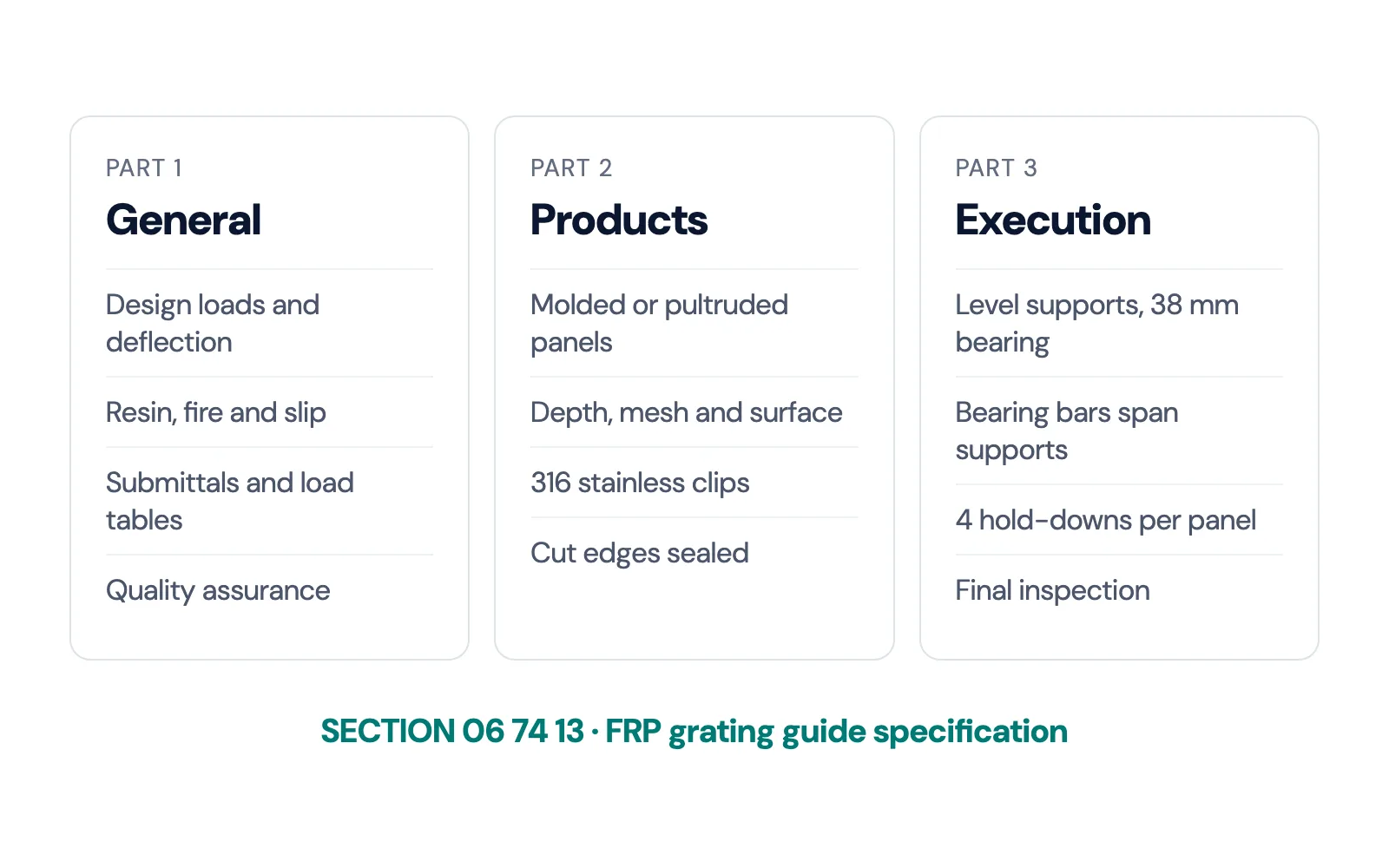
Manufacturer guide specifications commonly file FRP grating under MasterFormat 06 74 13, Fiberglass Reinforced Gratings. US Department of Defense projects use the Unified Facilities Guide Specification UFGS 06 73 01, Fiberglass Reinforced Plastic (FRP) Grating, published in August 2023. Both follow the three-part format: general requirements, products and execution. Use whichever number your project manual or owner standard requires, and cross-reference the framing, handrail and ladder sections that the grating sits on or next to.
Part 1: loads, performance and submittals
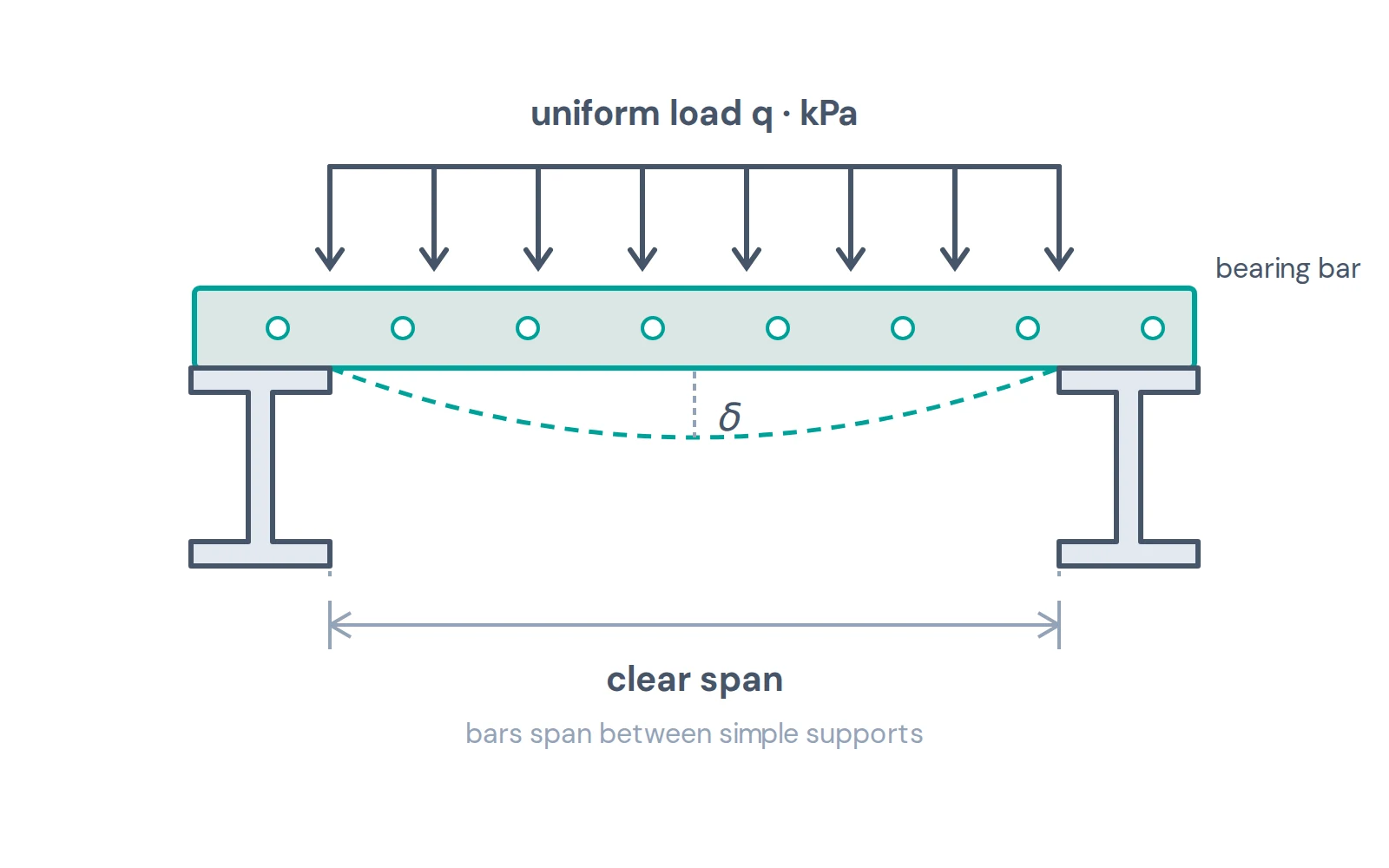
Design requirements. State the uniform live load at the clear span, any concentrated load with its footprint, and the deflection limit, using the values the governing code and the engineer of record set. Require the load tables to name the offered panel series and bar depth and to show the same span and load type. Our guide on how to read an FRP grating load table explains what to check.
Performance requirements.
- Resin: name the resin system for the exposure: isophthalic polyester for general service, vinyl ester for more aggressive chemicals, phenolic where low smoke is required, or as the chemical review decides.
- Fire: where the code or owner requires it, state the flame spread index to ASTM E84 and require a report for the offered resin system.
- Walking surface: grit, meniscus or a covered top, with slip evidence for the expected wet or contaminated condition.
- Electrical: if the area needs a non-conductive floor, say so, and remember that metal clips and fasteners are part of the assembly.
Submittals. Ask for product data, load tables, shop drawings with panel layout, bearing-bar direction, cut-outs, clip types and locations, test reports that name the tested product, a sample panel and the installation instructions. A submittal list is the easiest way to make offers comparable, because it forces each bidder to document the same things.
Part 2: the products
Molded grating is a one-piece panel with glass reinforcement in both directions. Specify depth, mesh (square, mini-mesh or rectangular), top surface and color. Pultruded grating uses pultruded bearing bars joined by cross rods or cross bars and spans one way, so specify bearing-bar shape and depth, open area, surface and the span direction shown on the shop drawings. Our grating product guide compares the two.
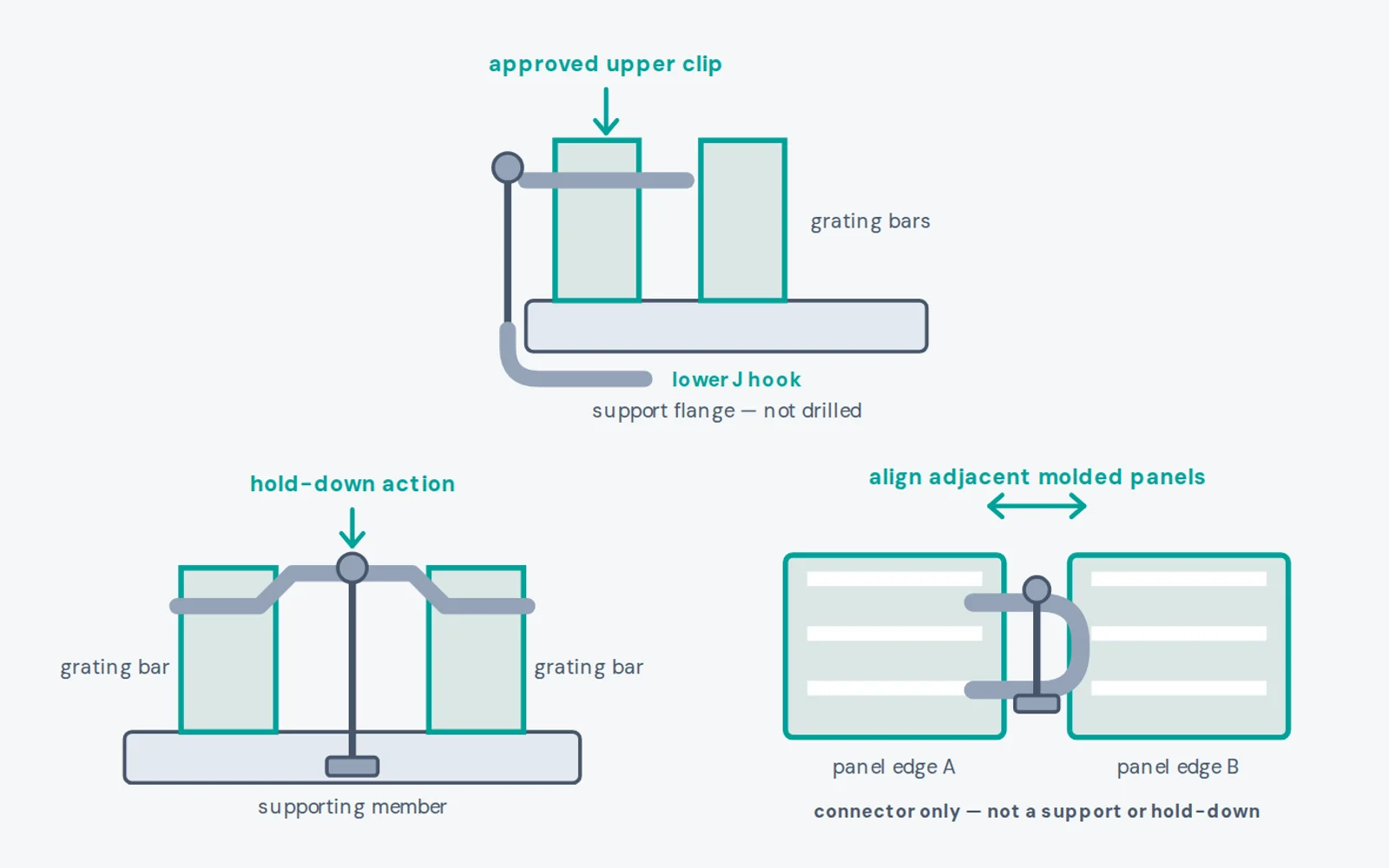
For accessories, name the clip material, commonly 316 stainless steel, and require clip types selected for the panel series, bar geometry and support detail. The pultruded grating clips and molded grating clips sections show the M, C, J and T types F1 supplies. For fabrication, require every cut surface to be sealed with a resin compatible with the panel, state how openings and edges are banded, and give tolerances for panel size, squareness and flatness.
Part 3: installation and inspection
Write the installation rules into the specification so the installer works to the same basis as the designer:
- Supports level and coplanar, with at least 38 mm (1.5 in) of bearing or the bearing on the shop drawings.
- Pultruded panels with bearing bars spanning between supports.
- At least four hold-downs per panel, two on each support line, at no more than 1,200 mm (4 ft) spacing, or the layout on the shop drawings.
- Field cuts made with carbide or diamond tools under dust extraction, cut ends supported, every cut surface sealed, and the clip layout rechecked.
- A final inspection of orientation, bearing, clip count and spacing, sealed edges and trip edges before handover.
These rules match our step-by-step guide on how to install FRP grating.
Using the template
The F1 FRP grating guide specification is a plain-text file in the three-part format. Values in square brackets are project inputs or options: fill them in or delete them, and remove the molded or pultruded paragraphs you do not need. The template sets no loads, deflection limits or fire ratings of its own; those come from the project. When the specification is ready, send it with the drawings and F1 will return load tables, product data and test reports for the fiberglass grating offered against it.
FRP grating specification questions
What CSI section is FRP grating?
Manufacturer guide specifications commonly use MasterFormat 06 74 13, Fiberglass Reinforced Gratings. US Department of Defense projects use UFGS 06 73 01, Fiberglass Reinforced Plastic (FRP) Grating. Use the number and format your project manual or owner standard requires.
What load and deflection should an FRP grating specification state?
The values the governing code, the owner's standard and the engineer of record set for the area: a uniform live load at the clear span, any concentrated load and its footprint, and a deflection limit. The specification should require load tables for the offered panel series that show the same span, load type and deflection.
Should the specification require ASTM E84 Class A?
Only where the code or owner requires it. When it does, specify the flame spread index and require a test report for the offered resin system, because fire performance belongs to the formulation. A report for a different resin or product does not qualify the panel being supplied.
Is there a free FRP grating guide specification?
Yes. The F1 guide specification is a plain-text template in the three-part format with bracketed project values. It is a starting point for the specifier, not a product approval, and every value in brackets must be filled in or deleted for the project.