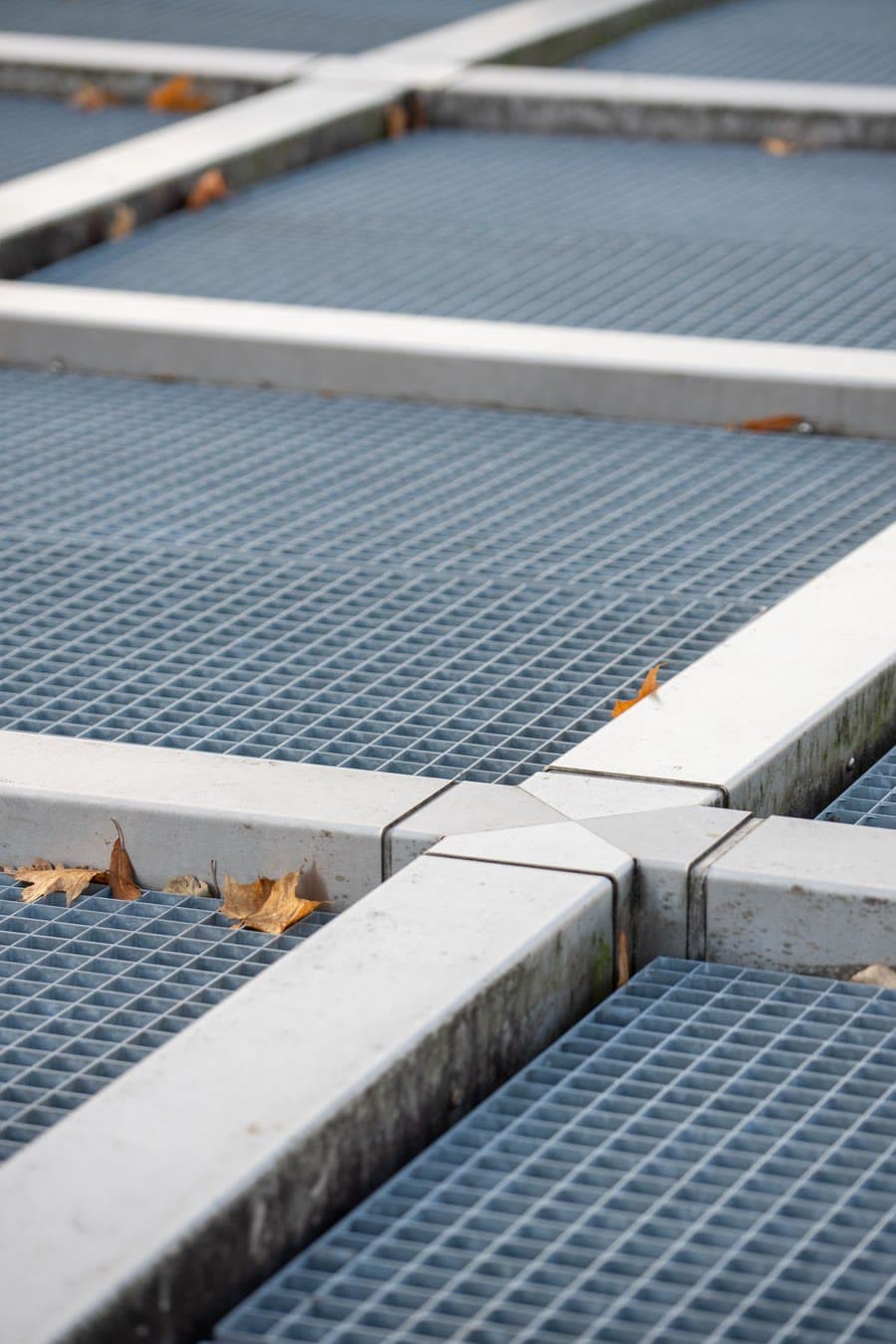
A lifecycle comparison is useful only when both grating options satisfy the same project requirements. Start with the load, clear span, support arrangement, deflection limit, walking surface, fire requirements and exposure. Then price the offered FRP and steel systems, including their supports, clips and installation work.
Compare the installed weight
The density of a laminate or a metal is not the weight of a grating panel. Bar depth, thickness, spacing, mesh and required supports affect the result. Use the offered panel's mass per square metre and the actual area, then add clips, framing and other accessories. A material-density ratio does not establish a 75% reduction for two load-equivalent systems.
Handling costs also depend on panel size, lifting access, cutting requirements and the site's work plan. Request the packing and lifting information for the proposed panels before assigning an installation saving.
Match protection to the environment
FRP does not rely on a zinc coating for corrosion protection, but the selected resin, reinforcement protection and exposed edges still need review against chemicals, concentration, temperature and duration of exposure. For steel, specify the coating or alloy and assess the same conditions. Neither option has a universal maintenance or replacement interval.
Inspection remains part of the plan for both systems. Include walking-surface condition, damaged panels, supports, clips and cut edges. Use the manufacturer's instructions and the owner's site experience to define the work and frequency; do not assume that FRP needs no upkeep or that steel must be replaced after a fixed number of years.
Price the installation method
Identify which parts arrive cut and drilled, the permitted field operations, required equipment, dust control, access and fixing method. A mechanically fixed FRP layout may reduce some on-site fabrication tasks. Any permit, fire-watch or shutdown requirement follows the actual site method and rules, so deleting these costs automatically would overstate a saving.
For prepared components, include the machining and edge-treatment scope in the quotation. The FRP profile machining guide explains how to define finished features and inspection requirements; use the grating supplier's own instructions for panel fabrication.
Keep safety requirements in the comparison
Specify the walking-surface finish and slip evidence for the expected wet or contaminated condition. Do not infer slip performance from the word molded, or electrical suitability from the word FRP. Confirm the actual system's fire, electrical and structural evidence where the application requires it.
Build a transparent cost model
Use the same evaluation period and cost basis for both options. Record:
- Quoted panels, supports, fasteners, freight and installation. - Inspection, cleaning, repairs and coating work, with their timing and quantities. - Access, shutdown and replacement costs only where supported by the owner's plan or a stated scenario. - The discount rate and treatment of inflation, if future costs are discounted. - End-of-period removal or residual value, if included for either option.
For an undiscounted comparison, add the initial installed cost and the scheduled costs over the chosen period. For a discounted comparison, apply the same present-value method to both options. Run a sensitivity case with less severe exposure or lower steel maintenance, as well as the planned case. A result that changes with those assumptions should be presented as conditional.
The lifecycle cost calculator can help organize a scenario. Check its assumptions and replace planning inputs with project quotations; its output is not a prediction of either material's service life.
Make the decision from the project
Where both systems meet the performance requirement, the result may favor either material. The useful deliverable is a bill of materials, a documented service and inspection plan, and a comparison whose assumptions the owner can review. For product selection, continue to the FRP versus steel grating comparison or grating product guide.