01 / CFRP
Automation & robotics
Moving links, lightweight supports and end-effector members where lower moving mass matters.
Send acceleration, reach, payload and joint details.
Longitudinal stiffness. Less moving mass. Develop CFRP tubing around your component’s dimensions, loads and connections, with F1 review of the laminate, tooling and finished-part requirements.
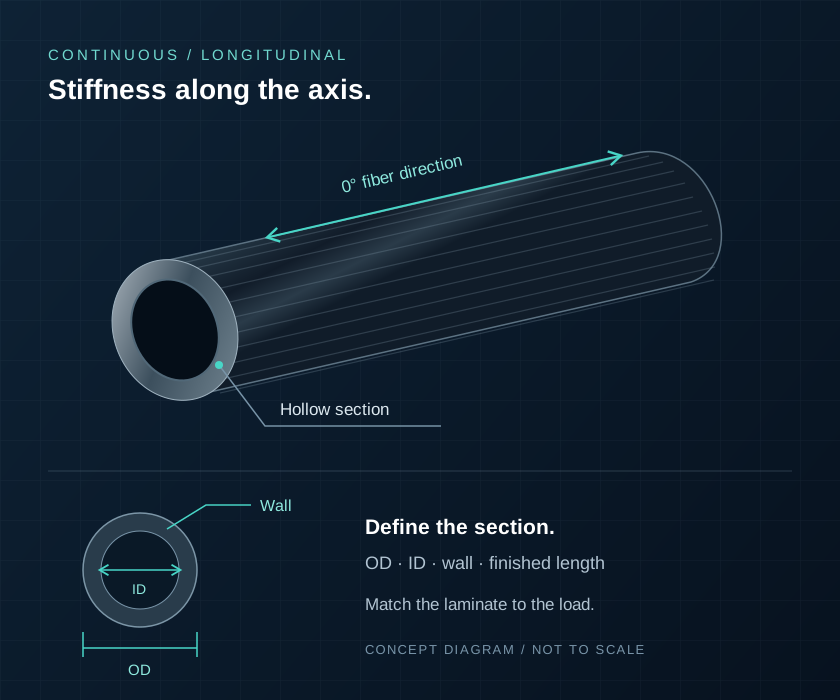
Carbon reinforcement can make a compact, lightweight member attractive when movement, reach or alignment drives the design. The finished tube’s bending stiffness depends on both its longitudinal modulus and section geometry; fiber grade alone cannot establish component performance.
During pultrusion, continuous reinforcement is impregnated with resin, formed and cured through a heated die, then pulled and cut. The fiber arrangement, cure and dimensional controls must be defined together. Explore the pultrusion process.
For general structural tubing, compare our fiberglass round tubes and fiberglass square and rectangular tubes alongside the carbon option.
For a uniform round section, ID = OD − 2 × wall. A nominal calculation does not establish bore fit; include the mating part and required clearance.
Request data for the proposed tube laminate, test direction and conditioning. Numerical strength, modulus, temperature and tolerance guarantees belong in the agreed specification.
| Decision | Carbon fiber tubes · CFRP | Fiberglass tubes · GFRP |
|---|---|---|
| Selection priority | Low moving mass and high longitudinal stiffness. | A balance of structural performance and material cost. |
| Electrical behavior | Carbon reinforcement conducts electricity; do not specify as electrical insulation. | Glass reinforcement suits insulating designs; qualify the resin, part and assembly for the duty. |
| Load direction | Predominantly axial reinforcement; assess torque, local crushing and joints separately. | Roving, mat and fabric content also govern directional properties and connection behavior. |
| Environment & interfaces | Review resin exposure and isolate carbon from susceptible metals where moisture is present. | Review resin, weathering and connection materials for the exposure. |
| Commercial decision | Justify the material premium through mass, deflection or equipment performance. | Often the starting point for cost-led frames, rails and general structural members. |
01 / CFRP
Moving links, lightweight supports and end-effector members where lower moving mass matters.
Send acceleration, reach, payload and joint details.
02 / CFRP
Sensor supports and positioning structures where deflection and dimensional stability guide material selection.
Define alignment tolerance and the temperature cycle.
03 / CFRP
Straight members in portable equipment and small UAV structures, subject to the complete assembly design.
Identify bending, vibration, torsion and impact cases.
Review bonded fittings, sleeves or supported inserts to transfer load without concentrating pressure on a thin wall. Holes and cutouts interrupt fibers and need their own assessment.
Define adhesive, bond preparation, fit, cure and inspection. Where carbon meets aluminum or other susceptible metals in wet service, use suitable electrical isolation and sealing.
Agree static, fatigue or environmental testing for the actual fitting and tube. Include service temperature, chemicals, UV exposure and impact in the requirements.
It is a hollow, constant-section composite made by pulling resin-impregnated carbon reinforcement through a heated die. The main fibers typically run along the tube. This architecture supports longitudinal stiffness, while the resin and any off-axis reinforcement govern other aspects of performance.
Pultrusion pulls reinforcement continuously through a die. Roll wrapping places prepreg plies around a mandrel, allowing selected fiber angles. A mainly unidirectional pultrusion can suit axial and bending duties; significant torque or circumferential loads may need an architecture with off-axis plies. Compare the actual laminate and test data, not just the process name.
Send the required outside and inside dimensions, wall, finished length, fit and quantity. F1 reviews the section, tooling and inspection requirements before confirming dimensions and tolerances. This page does not represent a fixed stock-size list; sample timing, MOQ and production lead time are quoted for the proposed configuration.
No. Carbon fibers are electrically conductive. If electrical isolation is required, start with a suitable fiberglass tube specification and qualify the complete part under the required electrical and environmental conditions. A surface coating alone should not be assumed to provide dependable insulation.
These details require joint design. Drilling interrupts fibers, and concentrated clamp pressure can split or crush a thin wall. Define load transfer, bond preparation, supported inserts or sleeves, adhesive and environmental exposure; validate the finished connection. Do not apply a universal clamp torque or bond length.
A structural carbon tube has no implied pressure rating. Pressure service requires a purpose-designed hoop reinforcement system, end connections and qualification. Include pressure, temperature and medium in the brief so the manufacturing route can be reviewed.
Start with your section, finished length, quantity and the job the tube needs to do. We reply within one business day; a formal quotation follows once the specification and delivery are reviewed.