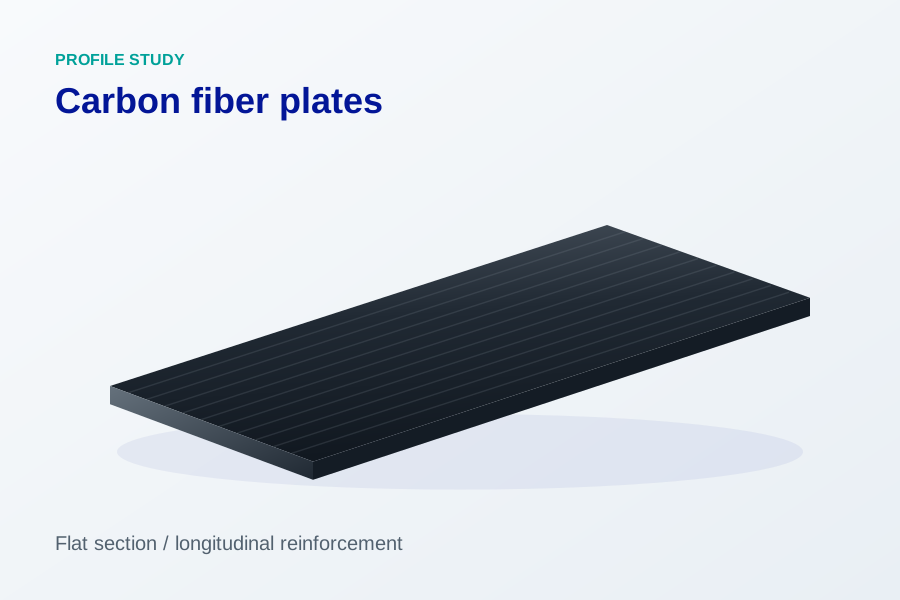
 Profile illustrationCarbon fiber plates & stripsFlat, constant-section laminates for bonded reinforcement, spar caps and lightweight stiffeners.Width × thickness × cut lengthExplore plates & strips
Carbon fiber pultrusion
Pultrusion carbon fiber: plates, tubes & rods
Continuous carbon fibers. A constant cross-section. A profile built around your load path. Explore pultruded CFRP plates, strips, tubes and solid rods for lightweight, stiffness-driven components.
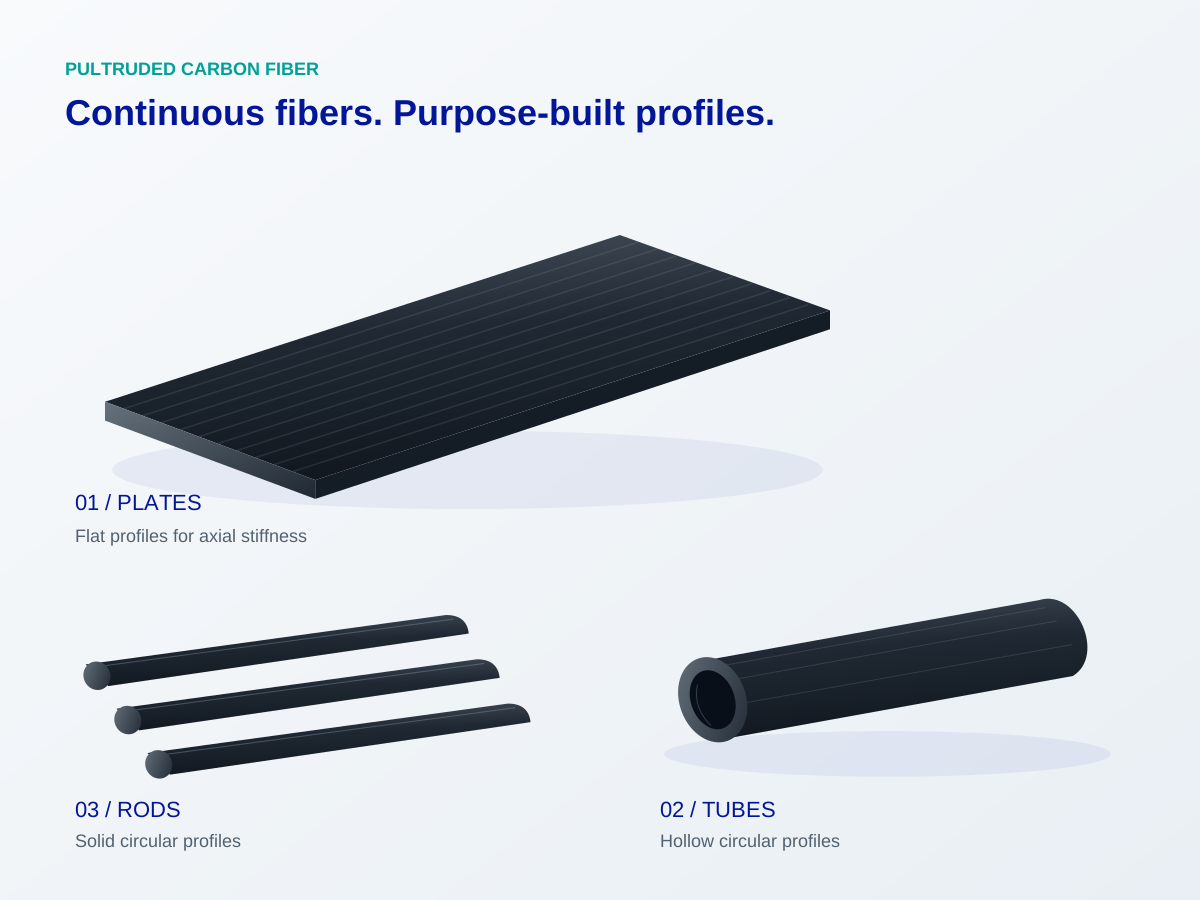
FIG. 1 One process, different profilesProfile illustration
Choose your pultruded carbon fiber profile
Carbon fiber pultrusion combines continuous reinforcement with a resin matrix in a heated die. The process suits long, straight profiles with a consistent cross-section; the main reinforcement typically runs along their length.
Profile illustrationCarbon fiber plates & stripsFlat, constant-section laminates for bonded reinforcement, spar caps and lightweight stiffeners.Width × thickness × cut lengthExplore plates & strips 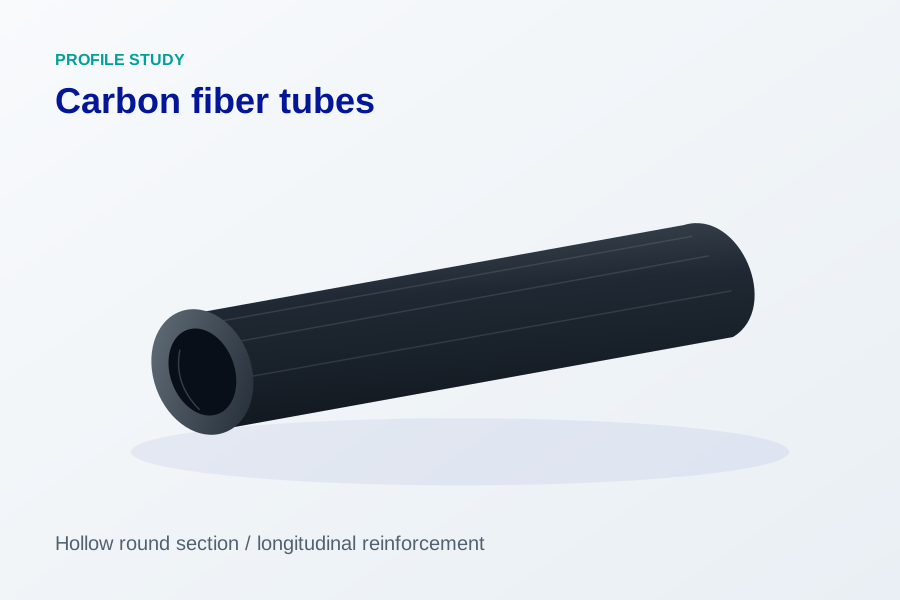 Profile illustrationPultruded carbon fiber tubesHollow profiles for lightweight supports, booms and components where section stiffness matters.Outside size × inside size or wall × lengthExplore tubes
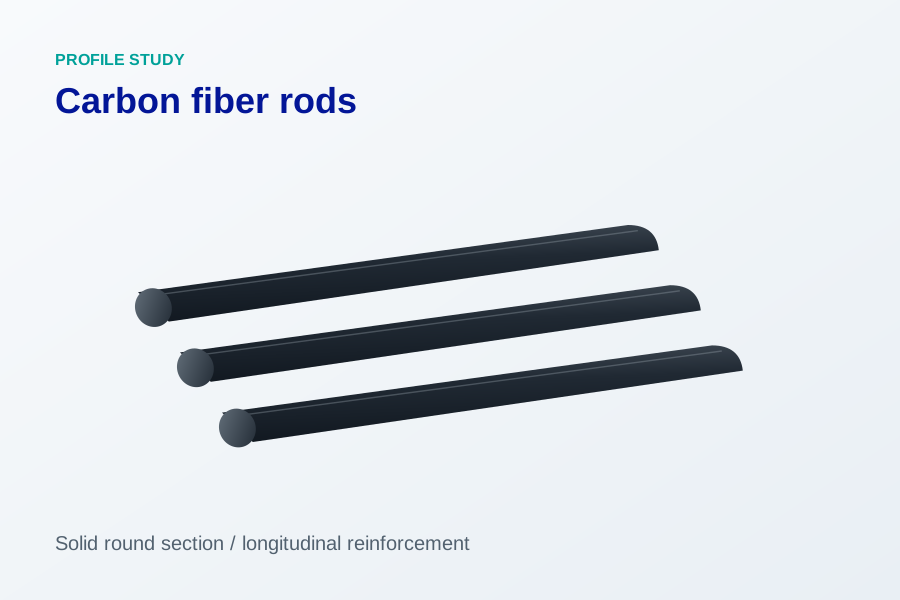 Profile illustrationPultruded carbon fiber rodsSolid sections for alignment members, model spars, pushrods and drawing-led reinforcement.Diameter or section × cut lengthExplore solid rods
Need a different section? Discuss a custom carbon fiber profile with the drawing, material requirements and annual volume.
Carbon fiber plates & strips
FIG. 2 Plates & stripsProfile illustration
A pultruded carbon fiber plate carries continuous reinforcement along its length. Specify the bonding face, edge condition and thickness tolerance as well as the section. For a broad sheet with loads in several directions, review a laminated sheet construction instead.
What to specify
Confirm longitudinal and transverse properties, bond preparation, end load transfer and the qualification of the complete assembly.
Pultruded carbon fiber tubes
FIG. 3 TubesProfile illustration
Carbon tubing puts material away from the center of the section. Round, square or rectangular geometry can be reviewed against the drawing and tooling. A mainly axial pultrusion needs particular care at clamps, holes, inserts and bonded end fittings.
What to specify
State torque, transverse loading and clamp pressure. Pull-winding or another off-axis laminate may be needed; a structural tube has no implied pressure rating.
- Pultruded carbon fiber tube product details
- Carbon fiber roller tube components
- Compare fiberglass round tubes
Pultruded carbon fiber rods
FIG. 4 Solid rodsProfile illustration
A carbon fiber rod is solid through its cross-section. It can suit compact axial members and small reinforcement parts, but its diameter alone does not define load capacity. Long compression members also need a buckling check against their unsupported length and end restraints.
What to specify
For a 3 mm rod inquiry, send the diameter tolerance, length, quantity, end finish and load case. This is a specification example; stock availability, minimum order and lead time are confirmed in the quote.
How carbon fiber pultrusion works
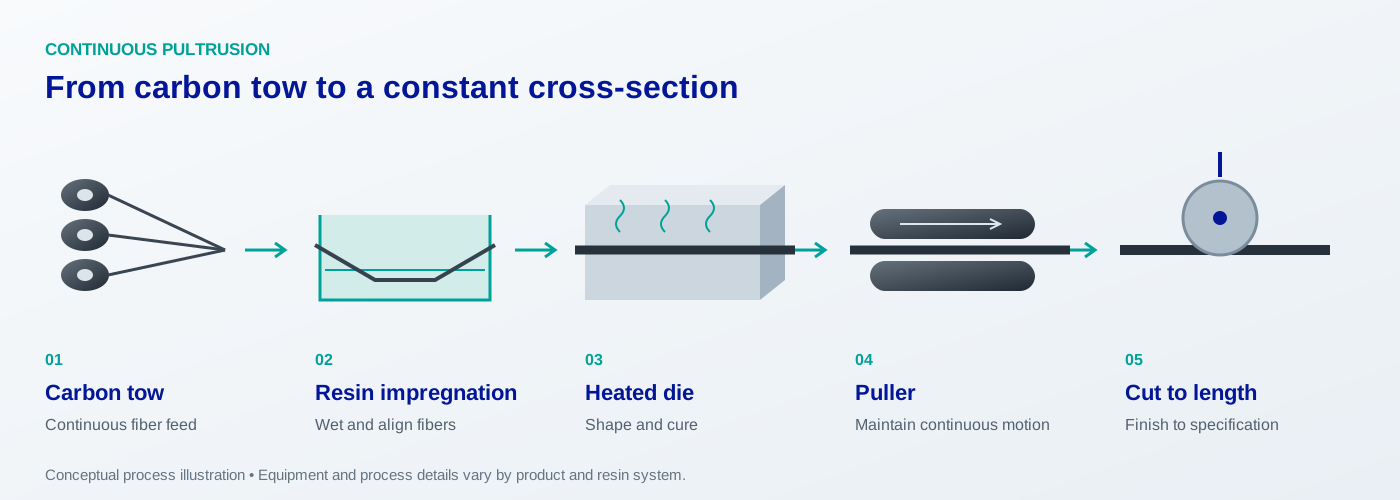
The profile is pulled through the line continuously. Fiber alignment, resin wet-out and cure control work together to establish the finished laminate.
FIG. 5 From carbon tow to finished profileProcess schematic
- 01
Align the carbon tow
Continuous fibers are guided into the required section. Their orientation establishes the main reinforcement direction.
- 02
Impregnate with resin
The selected resin wets the reinforcement through an appropriate bath or injection arrangement.
- 03
Shape and cure
A heated die controls the profile geometry while the resin cures around the fibers.
- 04
Pull continuously
A puller advances the cured section at a controlled speed matched to the material and die.
- 05
Cut and inspect
The profile is cut to the agreed length and checked against the order's dimensional and material requirements.
Explore the pultrusion process · Compare manufacturing methods
Choose the fiber architecture for the job
Longitudinal stiffness is only part of the specification. Review the direction of every load and how it enters the component.
Axial and bending loads
Mainly longitudinal carbon fibers can support stiffness-driven designs with low moving mass. Finished-part properties still depend on the fiber grade, resin, fiber content and section geometry.
Torque and transverse loads
A mainly unidirectional profile needs separate checks for shear, hoop loading and local bearing. Off-axis reinforcement, pull-winding or a wrapped laminate may better suit these loads.
Connections and exposure
Specify bonded joints, inserts and clamps early. Carbon is electrically conductive; review electrical isolation and metal interfaces in wet service, together with resin, temperature and UV requirements.
Comparing carbon with glass fiber? Review pultruded fiberglass profiles when cost or electrical insulation drives the design. Compare actual laminate data and the complete assembly against the same service requirements.
From flat reinforcement to moving components
Follow the application to its section, interfaces and qualification requirements.
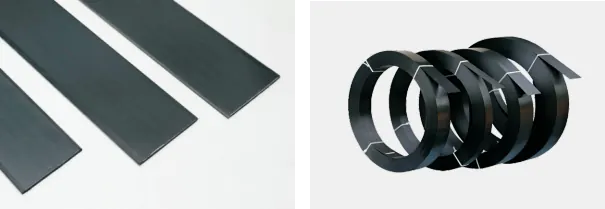
FIG. 6 Carbon fiber wind-blade laminatesRepresentative supplier image
Wind-blade spar caps
Specify the laminate, bonding surface and fatigue qualification as a single material program.
Bonded strengthening strips
Review the strip together with the adhesive, substrate and load transfer at its ends.
Robotic beams and struts
Balance moving mass and stiffness with joint loads and the working cycle.
Industrial roller tubes
Define runout, end fittings and operating speed; the laminate and manufacturing route follow the duty.
Carbon fiber pultrusion: common questions
What is pultrusion carbon fiber?
Carbon fiber pultrusion is a continuous process that pulls resin-impregnated carbon reinforcement through a heated shaping die. It produces constant-section CFRP profiles such as plates, strips, tubes and rods, with the main fibers typically aligned along the profile.
Are pultruded carbon fiber plates the same as woven carbon sheets?
No. A pultruded plate is generally designed around continuous longitudinal fibers. A laminated sheet may contain woven or angled plies to address loading in several directions. Choose the reinforcement architecture for the loads, joints and geometry rather than the black surface appearance.
Should I choose a solid carbon rod or a hollow tube?
Start with the space available, load direction, span and connection. Tubes can distribute material efficiently for bending stiffness, while rods offer a solid section for compact members. Neither form has a universal load rating; compare the actual section, laminate, stability and joints.
Can I request a 3 mm pultruded carbon fiber rod?
Yes. Use the rod inquiry link and state 3 mm as the requested diameter, along with tolerance, cut length, quantity and application. F1 will review feasibility and supply terms. The example is not a stock listing or a promise of a particular weight, strength or delivery time.
Is carbon fiber electrically insulating like fiberglass?
No. Carbon fibers conduct electricity. Specify electrical isolation where needed and review contacts with metals in wet service. If insulation is central to the application, consider an appropriate fiberglass system and qualify the finished assembly.
Can I specify custom sizes, resin and cut lengths?
Send a drawing and the service requirements. F1 reviews the section, fiber architecture, resin, tooling, finish and inspection plan before confirming the supply scope. Material properties, minimum order, tooling cost and lead time are quotation-specific.
Start with the section. Build the specification together.
Send your plate, tube, rod or custom profile drawing. F1 Composite will review the material, tooling, inspection and delivery requirements for a project quotation. We reply within one business day; a formal quotation follows once the specification and delivery are reviewed.
- Section, length & quantity
- Plate width and thickness; tube outside and inside dimensions; or rod diameter. Include units, tolerances and batch quantities.
- Loads & interfaces
- Span, supports, tension, compression, bending, torque, deflection limits, joints, holes and bonded or clamped fittings.
- Material & service
- Carbon grade if specified, reinforcement direction, resin requirements, temperature, moisture, UV exposure and electrical isolation.
- Inspection & delivery
- Required test evidence, first-article acceptance, traceability, packing, destination and target delivery date.