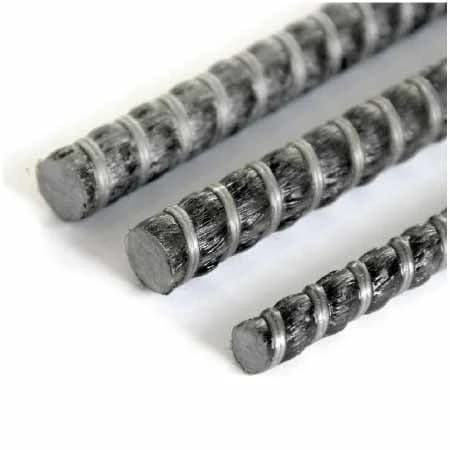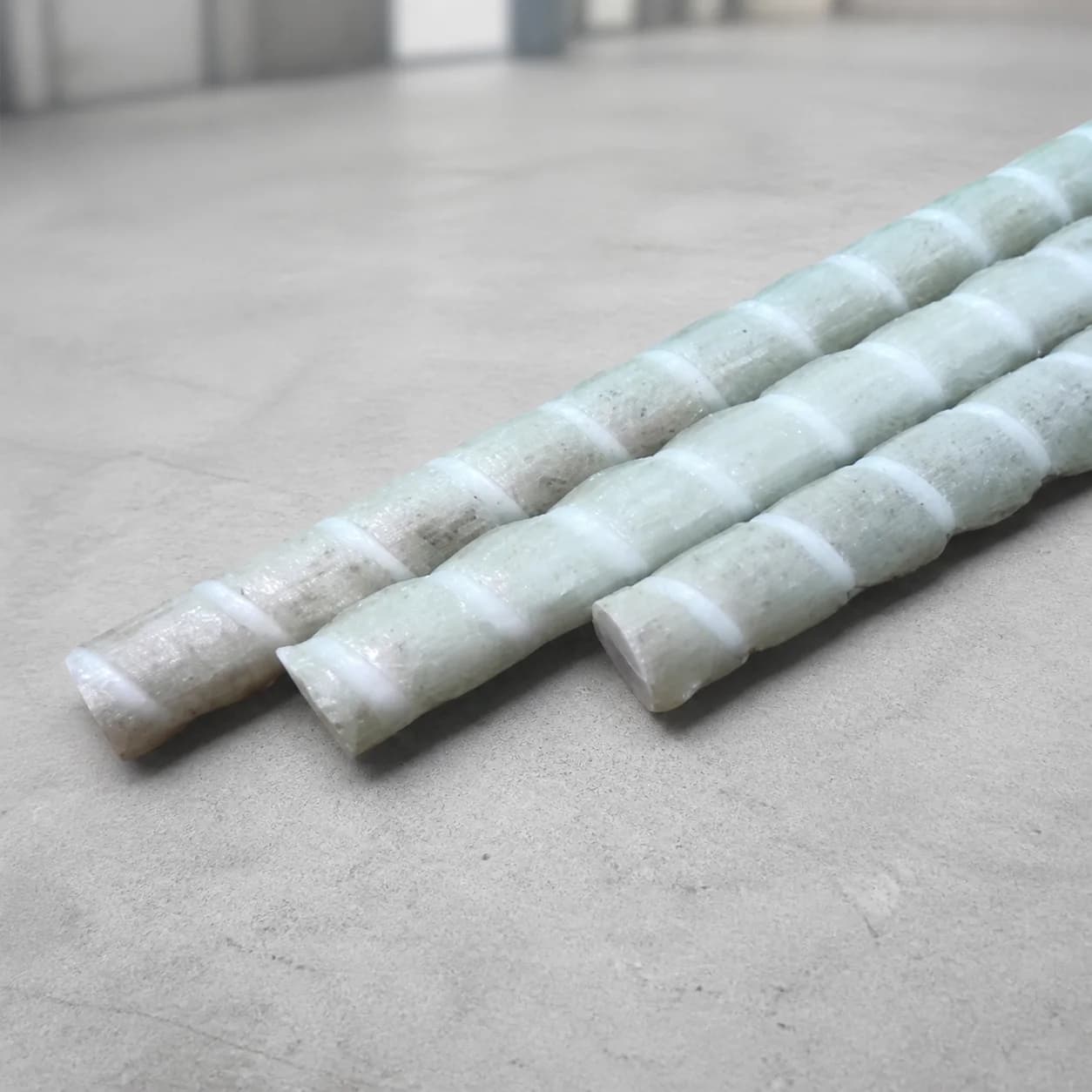
Basalt fiber reinforced polymer (BFRP) and glass fiber reinforced polymer (GFRP) bars are built the same way: continuous fibers locked in a thermoset resin, pultruded into a round bar with a bonded surface. Both resist the corrosion that limits steel in chlorides and both are non-magnetic. The choice between them is decided less by fiber chemistry than by which standard governs the project and what the offered bars can prove.
Standards decide most projects
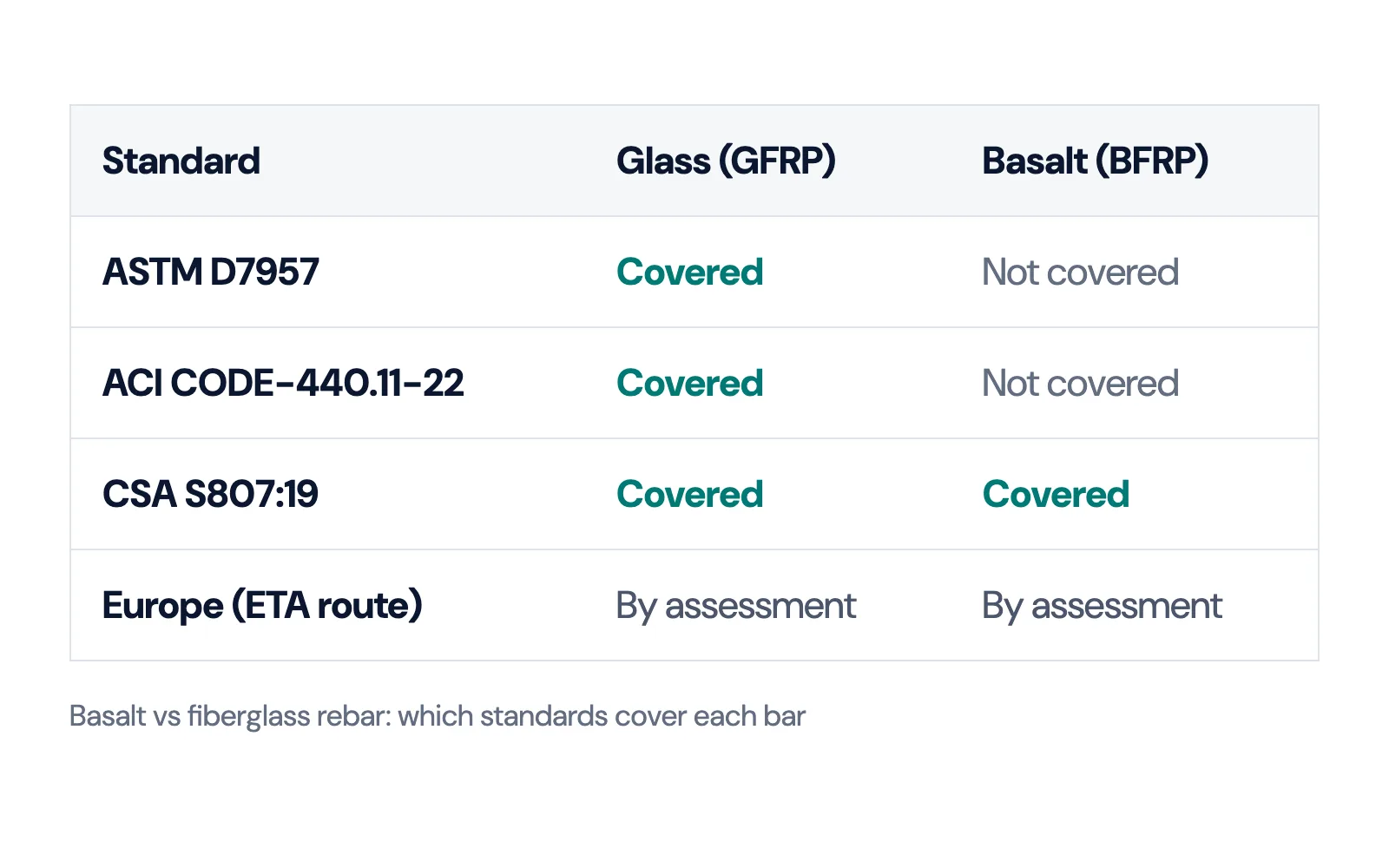
| Market | Glass fiber (GFRP) bars | Basalt fiber (BFRP) bars |
|---|---|---|
| United States, buildings | ASTM D7957 bars, designed to ACI CODE-440.11-22 | Outside the D7957 and ACI 440.11 scope; needs engineer and authority acceptance |
| Canada | CSA S807:19, designed to CSA S806 or CSA S6 | CSA S807:19, designed to CSA S806 or CSA S6 |
| Europe | ETA route; EN 1992-1-1:2023 Annex R where adopted | ETA route; EN 1992-1-1:2023 Annex R where adopted |
ASTM D7957 is the specification for solid round glass fiber reinforced polymer bars, and ACI CODE-440.11-22 is the building code for concrete reinforced with GFRP bars. A basalt bar can be well made and still fall outside that US code path. In Canada, CSA S807:19 covers bars made with E-CR glass, carbon, aramid or basalt fibers, so either material can be specified by grade. Our GFRP rebar calculator lists the GFRP standards for each market.
Bar properties: compare certificates, not fibers
Published fiber data generally show basalt fibers as stiffer and stronger than E-glass fibers. That difference does not carry straight into the bar: fiber volume, resin, diameter, surface and process set the bar's guaranteed tensile load and modulus. Two practical rules follow:
- Compare the guaranteed tensile force, tensile modulus, bond and transverse shear on the certificates of the offered bars, measured to the methods your standard names.
- Design with the certified values. A basalt bar with a higher modulus can reduce deflection and crack width, but only the certified value of the bar actually supplied can be used.
Durability evidence
Both materials are used because they do not rust. For concrete, the questions are alkaline exposure, moisture and sustained load, and the answers depend on the fiber, its sizing, the resin and the bar's manufacture. Ask for durability data to the test methods in the governing standard: the alkali resistance and creep rupture tests referenced by ASTM D7957 for GFRP, or the durability grading in CSA S807 for either fiber. A SINTEF study comparing basalt FRP bars with steel is useful background on strength and embodied emissions, but it did not test glass fiber bars, so it does not settle basalt against GFRP.
Cost and availability
Basalt fiber costs more than E-glass fiber, and glass fiber bars have the larger production base and the longer supply record in codified projects. For most buyers this makes GFRP the lower-cost and easier-to-approve option. A basalt bar earns its premium where the governing standard accepts it and its certified properties reduce the reinforcement needed. Compare delivered quotations for the full bar schedule, not price per foot of different sizes; our fiberglass rebar cost guide explains how to put offers on the same basis.
Which one to choose
Choose GFRP when the project is designed to ACI CODE-440.11-22 or AASHTO GFRP guidance, when the specification names ASTM D7957, or when cost and approval time drive the decision.
Consider BFRP when the governing standard covers it (for example CSA S807 in Canada), the owner wants it, and the certified bar data show a benefit for the design.
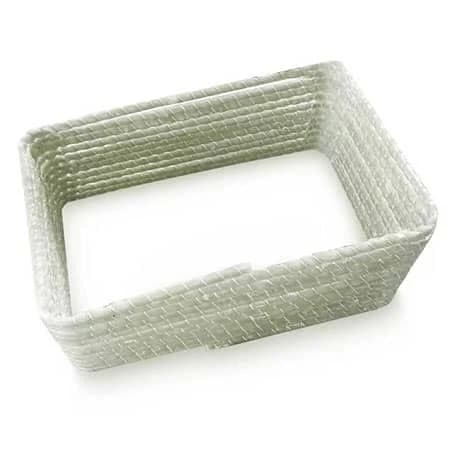
In both cases, keep bends to factory-formed shapes, specify the standard and edition, and request lot certificates. The GFRP rebar specification guide lists the submittal documents, and the fiberglass rebar vs steel review covers the comparison with steel. F1 supplies GFRP straight bars, stirrups and mesh against a project schedule.
Basalt and fiberglass rebar
Is basalt rebar stronger than fiberglass rebar?
Basalt fibers are generally reported to be stiffer and stronger than E-glass fibers, but a bar's properties depend on fiber content, resin, diameter and manufacture. Compare the guaranteed tensile load and modulus on the certificates of the bars you are offered, tested to the method your standard names.
Can basalt rebar be used under ACI 440.11?
ACI CODE-440.11-22 is written for structural concrete reinforced with glass fiber reinforced polymer bars, and it relies on ASTM D7957, which covers glass fiber bars. Using basalt bars on a project governed by ACI 440.11 needs the engineer of record and the authority having jurisdiction to accept them outside that scope.
Which standard covers basalt rebar in Canada?
CSA S807:19 covers fiber reinforced polymer bars made with E-CR glass, carbon, aramid or basalt fibers, with isophthalic polyester, vinyl ester or epoxy resins. It excludes hybrid bars made with more than one type of fiber. Design is to CSA S806 for buildings or CSA S6 for bridges.
Is basalt rebar cheaper than fiberglass rebar?
Usually not. Basalt fiber costs more than E-glass fiber, and glass fiber bars have the larger production base. Compare delivered quotations for certified bars of equivalent design capacity, since the bar schedule can differ between the two materials.