On a steel-reinforced job, a bar bender shapes stirrups on site from straight stock. With glass-fiber reinforced polymer (GFRP) the shape is fixed when the resin cures in the factory, and after that it cannot change. That single fact moves bends from the site to the drawing office: every hook, stirrup and bend has to be scheduled, approved and made before the bars ship.
Why GFRP cannot be bent on site
A GFRP bar is glass fibers locked in a cured thermoset resin, typically vinyl ester for concrete reinforcement. Bending a cured bar breaks fibers and cracks the matrix; heating it degrades the resin. Construction specifications and product instructions therefore prohibit field bending, heating and welding, and owner rules such as UFC 3-301-01 state the same prohibition for Department of Defense work. The only way to get a bent GFRP bar is to form it before the resin cures, which is what the manufacturer's bending line does.
What a bend schedule must contain
| Field | Why it matters |
|---|---|
| Bar mark | Ties each bundle to the drawing and the inspection record |
| Shape code or sketch | Defines the geometry the factory forms |
| Nominal diameter | Sets the forming tool and the bent-bar data that apply |
| Leg dimensions | Measured the way the drawing states: outside, inside or centerline |
| Inside bend radius | Checked against the minimum for the diameter and product |
| Quantity | Pieces per mark, including spares agreed with the contractor |
| Tolerances | Leg length and angle tolerances agreed before production |
Straight bars need only diameter, cut length and quantity. Keep the two lists separate so nobody reads a straight length as a bent shape. Our bar schedule template has columns for both.
Bent-portion capacity and radius
The bent portion of a GFRP bar carries less tensile force than the straight bar, and the design codes account for that reduction. ASTM D7957/D7957M addresses the minimum bend diameter for bent shapes as well as cut lengths, and ACI CODE-440.11-22 governs how bends and hooks are used in design. For the submittal, ask for the tested capacity of the bent portion for each diameter and radius ordered, measured to a stated method and edition. Bent-bar data from one diameter or one radius does not transfer to another.
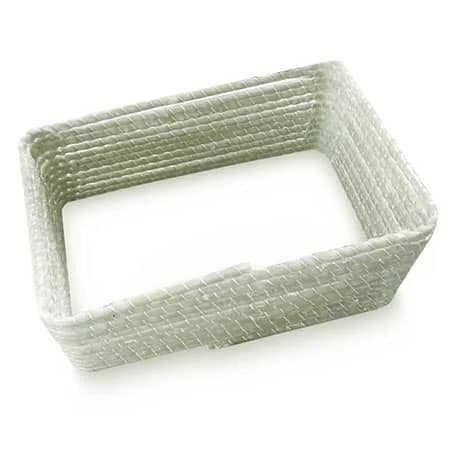
Closed stirrups need a stated closure: the overlap length or the hook arrangement shown on the drawing. Check it against the design, because the closure is where a stirrup's capacity is decided.
Mesh and intersections
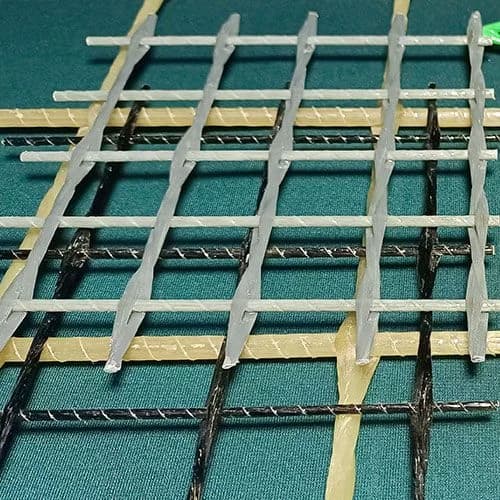
Pre-manufactured GFRP mesh is outside the scope of ASTM D7957. A mesh order therefore needs its own specification: rod diameter and center-to-center spacing in both directions, overall sheet dimensions, the intersection type, edge distances, quantity and the approved drawing. The mesh from F1's manufacturing source uses glass fiber with an epoxy resin and custom spacing and sheet sizes, and its properties are confirmed for the configuration offered rather than borrowed from straight-bar data. ISO 10406-1:2025 provides test methods for FRP bars and grids when the project needs its own test scope.
Timing and logistics
Bends and mesh need drawings, forming and curing before they ship, so they usually take longer than straight bars. Release the bend schedule as early as the design allows, and keep a small agreed allowance of spare shapes for site damage, because a replacement cannot be bent on site. Ask for packing by bar mark with labels that match the certificates, and follow the storage instructions supplied with the bars: support them evenly, protect them from impact, and keep them out of prolonged sunlight where the instructions say so.
Checklist before release
Before the schedule goes to production, confirm that every shape has a mark, a sketch, dimensions, an inside radius and a quantity; that the bent-bar data cover every diameter and radius on the list; that closures on stirrups match the design; that mesh has a drawing and its own test scope; and that the edition of each standard is written down. The GFRP rebar specification guide covers the rest of the submittal list, and the FRP rebar page takes a BOQ, a drawing or a completed schedule.
GFRP bends and mesh questions
Can GFRP stirrups be made in any shape?
Common shapes such as closed rectangular stirrups, L-bars and U-bars are routine. Other shapes depend on the forming tools available for the diameter and radius. Send the drawing with dimensions, inside radii and tolerances, and the shape is confirmed before production.
Can GFRP bars be cut on site?
Straight bars can be cut to length on site with the method in the product instructions, typically a diamond or abrasive blade, with dust protection. Shearing, heating and welding are not permitted, and a cut bar cannot be reshaped into a bend.
Is GFRP mesh covered by ASTM D7957?
No. Pre-manufactured mesh is outside the scope of ASTM D7957/D7957M. Specify the rod diameter and spacing in both directions, the sheet size and the intersection detail, and agree the test scope; ISO 10406-1 includes test methods for grids.
How early should bends and mesh be ordered?
As soon as the bar schedule is approved. Bends and mesh need drawings, forming and curing before shipment, so they usually take longer than straight bars. The production timing for your quantities is confirmed in the quotation.