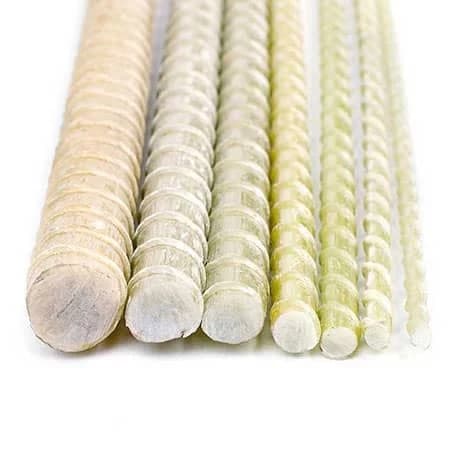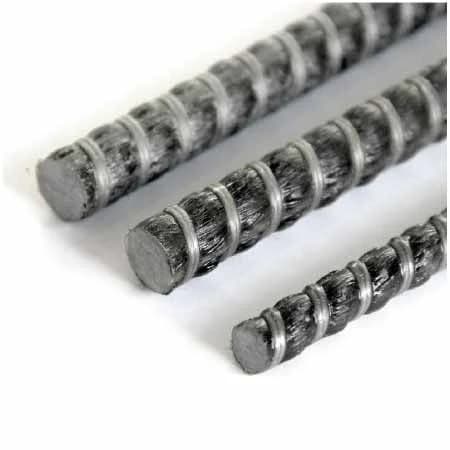
GFRP rebar goes into concrete the same way steel does: on supports, tied into mats and cages, then cast. What changes is how the bar is treated before and during the pour. The glass fibers and resin do not forgive the handling that steel tolerates, a cured bar cannot be bent, and the bar is lighter than the concrete it sits in. This guide follows the bars from delivery to the pour. It draws on ACI SPEC-440.5-22, the construction specification for GFRP reinforcing bars, and on the construction notes in Appendix G of UFC 3-301-01, the US Department of Defense structural criteria. The project specification and the supplier's instructions govern.
Receiving the bars
Check each delivery against the bar schedule and the certificates: bar marks, diameters, lengths, bent shapes and the lot identification that ties the bars to their test reports. Look over the surface. UFC 3-301-01 notes that a bar with a damaged surface has to be replaced, and that the project specification defines which visible damage counts, so agree the acceptance criteria with the inspector before the first delivery rather than during the pour.
Lifting and storage
GFRP bars are far more flexible than steel bars of the same size, and long bundles sag between pick-up points. Lift them with a spreader bar and several slings rather than a single choker, set them down without dropping, and never drag bars over the ground or across other bars.
Store them on level dunnage, off the ground, with supports close enough to stop the bundles sagging. Keep them away from chemicals and out of the sun. UFC 3-301-01 records that ACI 440.5 recommends covering bars stored outdoors for more than four months with opaque plastic, and that the DoD construction specification sets that limit at two months. It also says bars should not be exposed to temperatures above 120 °F (49 °C), so shade matters in hot climates, where bars left in direct sun can get much hotter than the air.
Cutting, and why bending stays in the factory
Straight bars can be cut on site. Use a fine-toothed saw or a diamond or abrasive blade, support the bar on both sides of the cut, and give the crew dust extraction or respiratory protection, eye protection and gloves. Do not shear or flame-cut GFRP bars: shearing crushes and splits the fibers at the cut.
Cured bars are never bent, heated or welded on site. UFC 3-301-01 permits field cutting but not field bending, because a bend can only be formed in the factory before the resin cures. Order every hook, stirrup and bent bar from the approved schedule, with a small agreed allowance of spare shapes for site damage. Our GFRP bent bars and stirrups guide covers the schedule.
Supports and ties
UFC 3-301-01 calls for reinforcement supports of dielectric material or of steel coated with a dielectric material. Check whether the project specification accepts coated steel or asks for fully nonmetallic supports; plastic or composite chairs and bolsters meet both. Because GFRP bars are more flexible than steel, place supports close enough that the bars stay at their drawn cover under the weight of the mat and the crew, as the project specification sets out.
Tie the bars with plastic- or polymer-coated tie wire, or with nylon or plastic ties where the reinforcement must stay fully nonmetallic, for example in concrete near MRI equipment. Keep the tails of coated wire away from the formwork face.
Stopping the mat from floating
A GFRP bar is lighter than the concrete around it. The GFRP bars tested in a University of Kentucky study for FHWA had a specific gravity of 1.92, below that of fresh normal-weight concrete, so an untied mat can rise during placement and vibration and lose its cover. Tie every intersection the specification asks for, tie the mat to its supports, and where there is a risk of uplift, hold the supports down to the formwork or to anchors below. Check cover again during the pour where concrete is placed in deep lifts or vibrated heavily.
Cover, laps and tolerances
Concrete cover, bar spacing and lap lengths come from the GFRP design, and they differ from the values for a steel design: UFC 3-301-01 notes that cover requirements for GFRP differ from those for steel reinforcement. Do not transfer steel laps or cover to a GFRP drawing. ACI SPEC-440.5 refers to the placing tolerances of ACI 117.
Temperature in service
ASTM D7957/D7957M requires a mean glass transition temperature of at least 100 °C (212 °F) for the bars, and UFC 3-301-01 cites the ACI CODE-440.11-22 suggestion that GFRP bars should not be used where the service temperature exceeds 85 °C (185 °F). If a slab will carry hot process equipment or sit near a heat source, raise it with the designer before the bars are ordered.
The pre-pour check
Before the pour, walk the mats and cages. Check bar marks and diameters against the schedule, bar spacing, cover, lap positions and lengths, bent shapes and their orientation, ties at the required intersections, supports and their hold-downs, and any damaged bars that need replacing. Record the lot numbers placed in each element, so the certificates follow the concrete.
For the specification side, see our GFRP rebar specification guide. F1 supplies GFRP straight bars, factory-formed stirrups and mesh against a project schedule; handling and storage instructions are confirmed with the bars offered.
GFRP rebar installation questions
Can GFRP rebar be bent on site?
No. Cured GFRP bars cannot be field bent, heated or welded. Every bend, hook and stirrup is formed in the factory before the resin cures, so order bent shapes from the approved schedule. Straight bars can be cut to length on site with a saw.
What tie wire is used with GFRP rebar?
Plastic- or polymer-coated tie wire, or nylon or plastic ties where the reinforcement must stay fully nonmetallic, for example near MRI equipment. Follow the project specification, which may rule out bare steel wire and set the support material.
Why does GFRP rebar float in concrete?
Because it is lighter than the concrete around it. A GFRP bar with a specific gravity of about 1.9 is less dense than fresh normal-weight concrete, so a mat that is not tied down can rise during placement and vibration. Tie it to its supports, and anchor the supports to the formwork where needed.
How long can GFRP bars be stored outdoors?
Keep outdoor storage short and shaded. The UFC 3-301-01 commentary notes that ACI 440.5 recommends opaque covers for bars stored outside for more than four months, while the DoD construction specification sets the limit at two months, and that bars should not be exposed to more than 120 °F (49 °C).