Glass-fiber reinforced polymer (GFRP) bars earn their place where steel reinforcement is the weak point: chloride-exposed seawalls and bridge decks, concrete near MRI rooms and other magnetically sensitive equipment, electrical isolation zones and tunnel soft-eyes that a boring machine has to cut through. Getting them onto a project takes a specification that says more than "GFRP rebar, 16 mm". It has three layers, and each one needs its edition written down.
The three layers of a GFRP specification
| Layer | Documents | What it controls |
|---|---|---|
| Design code | ACI CODE-440.11-22 for buildings; AASHTO GFRP-2 (2nd edition, 2018) for bridges; owner rules such as UFC 3-301-01 Appendix G | Strength, serviceability, durability, development, splices and fire provisions |
| Product standard | ASTM D7957/D7957M; CSA S807:19 (R2024) in Canada | Qualification, production-lot control, physical and mechanical properties, bends |
| Test methods | ASTM D7205/D7205M for tension; ISO 10406-1:2025 for bars and grids | How the reported values were measured |
| Construction | ACI SPEC-440.5-22 | Submittals, storage, handling, placement, tolerances and inspection |
ACI CODE-440.11-22 is the consensus building-code route for concrete reinforced with qualifying solid, round, vinyl-ester GFRP bars. CSA S807 classifies FRP bars by fiber, strength, modulus and durability, and covers E-CR glass, carbon, aramid and basalt fibers with isophthalic polyester, vinyl ester or epoxy resins. The AASHTO guide specification, first issued in 2009 for decks and railings, now also covers girders, bent caps, substructure and foundation elements.
Edition control
The newest ASTM edition does not silently update an older code reference or an older test report. ASTM D7957/D7957M-26 is current, but ACI CODE-440.11-22 was written around the 2022 edition. The specification should say which edition the qualification reports were run against and whether the project accepts results to a later edition. The same applies to ASTM D7205, which measures short-term static tensile properties and, by its own scope, does not account for sustained or fatigue loading.
Design differences to expect
Stiffness. Research lots tested in U.S. programs measured moduli of about 40.0 GPa (University of Kentucky for FHWA, 2000) and 54.3 GPa (Iowa State for MnDOT, 2023). The epoxy-coated steel bars in the Kentucky program measured about 196 GPa. With a quarter of the stiffness, crack widths and deflections often control the reinforcement area, not ultimate strength.
No yield plateau. GFRP bars stay linear to failure. The Iowa State tests recorded stress rising linearly to a sudden rupture, which is why the codes use different strength reduction and sustained-stress limits from steel design. UFC 3-301-01, for example, caps sustained stress at 0.3 of the ultimate tensile stress for Department of Defense work.
Compression and temperature. UFC 3-301-01 ignores GFRP compression strength in covered design, and fire and elevated-temperature behavior depend on the resin. Fire-rated and seismic-force-resisting members need an explicit decision from the engineer of record.
Thermal movement. An FHWA study measured a longitudinal coefficient of thermal expansion of about 9.2 microstrain per degree Celsius for a tested GFRP bar against 11.9 for Grade 60 steel. The difference is small, but it belongs in the design record for long pavements and decks.
The consequence is simple to state: GFRP does not replace steel bar for bar. The detailed trade-offs, with the field evidence and a lifecycle cost study, are in our fiberglass rebar vs steel review.
What to put in the submittal list
Qualification report. Laboratory, standard and edition, specimen sizes, and results for tensile force, modulus and strain, transverse shear, bond and the other properties the product standard requires.
Production-lot certificates. Lot identification tied to the delivered bars, with the lot tests the standard requires.
Bent-bar data. Shapes, inside radii and the tested capacity of the bent portion for the diameters ordered. Bends are covered in our GFRP stirrups and bent bars guide.
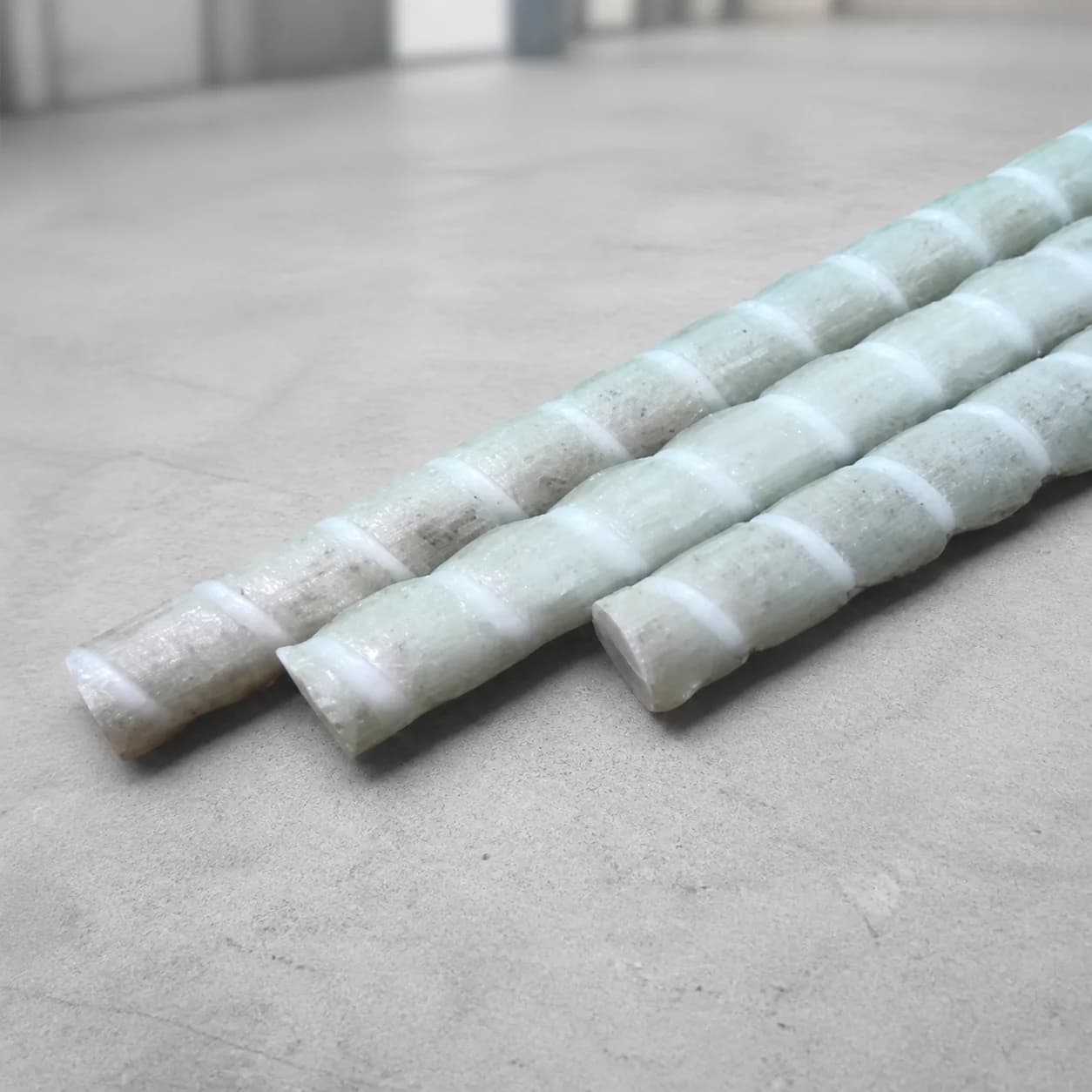
Dimensions and marking. Nominal diameter, measured area, unit mass, surface type and the labeling that lets an inspector match bundles to certificates.
Handling and storage instructions. Support spacing for storage, protection from impact and prolonged sunlight where the product instructions require it, and the approved cutting method.
Accessories. Chairs, spacers and ties chosen to suit the design intent; non-metallic accessories where the reinforcement must stay magnetically or electrically inert.
Site rules that do not change
Cured GFRP bars are never field-bent, heated or welded: every bend is ordered from the factory. Bars are cut with the method in the product instructions, typically a diamond or abrasive blade, rather than sheared, with dust protection for the crew. Cover, spacing and laps are inspected against the approved drawings before the pour, with the bars tied so they stay in place while concrete is placed. The GFRP rebar installation guide covers handling, storage, supports, ties and flotation on site.
How F1 handles GFRP rebar enquiries
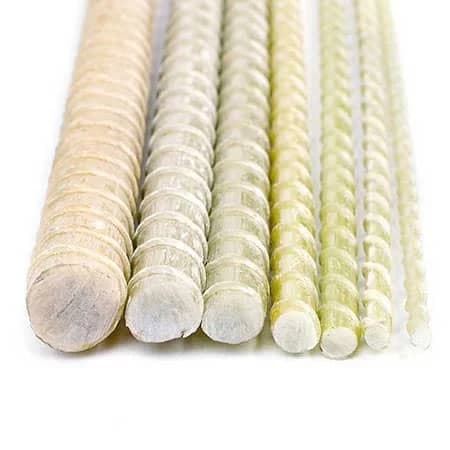
F1 supplies GFRP straight bars, factory-formed stirrups and reinforcement mesh from its manufacturing source, against a project schedule. The inquiry list covers nominal diameters from 6 to 36 mm. Grade, resin, dimensions and the evidence available are confirmed for the bar actually offered, and the standard and edition your project requires are part of that confirmation. Send a BOQ or drawing, or fill in the bar schedule template, through the FRP rebar page.
GFRP rebar specification questions
Which ASTM standard covers GFRP rebar?
ASTM D7957/D7957M covers solid round glass-fiber reinforced polymer bars for concrete reinforcement. The current edition is D7957/D7957M-26, while ACI CODE-440.11-22 references the 2022 edition, so state which edition the project accepts. Pre-manufactured mesh is outside the standard's scope.
Can GFRP rebar replace steel bar for bar?
No. The lower modulus changes crack widths and deflections, development and splice lengths differ, and bends have their own capacity. Reinforcement is redesigned to ACI CODE-440.11 or the governing code by the engineer of record.
Can GFRP rebar be used in fire-rated or seismic elements?
That depends on the code and the owner. ACI CODE-440.11-22 has its own provisions for elevated temperature, and UFC 3-301-01 restricts GFRP in fire-rated and seismic-force-resisting systems under specified Department of Defense conditions. The engineer of record decides for each element.
What modulus should I design with?
The certified value of the grade actually supplied. For orientation, U.S. research lots measured about 40.0 GPa (University of Kentucky, 2000) and 54.3 GPa (Iowa State for MnDOT, 2023); the steel bars in the Kentucky program measured about 196 GPa.