Glass fiber reinforced polymer (GFRP) rebar weighs about a quarter of steel for the same size. That one fact changes how an import is planned: the price per tonne means little, a container is filled by space as often as by weight, and the documents matter more than the freight because the bars are being bought against a standard, not by the kilogram. This guide gives the planning figures and the checklist.
Metres per tonne: why GFRP is bought per container
A GFRP bar's unit mass is its nominal area times a density of about 1.9 to 2.1 g/cm³, against 7.85 for steel. The table uses 2.0 g/cm³ and nominal areas; the supplier's declared unit mass governs the packing list.
| Nominal Ø | Closest ASTM | Area mm² | kg per metre (calc.) | Metres per tonne (approx.) |
|---|---|---|---|---|
| 6 mm | No. 2 | 28 | 0.06 | 17,700 |
| 8 mm | — | 50 | 0.10 | 9,900 |
| 10 mm | No. 3 | 79 | 0.16 | 6,400 |
| 12 mm | No. 4 | 113 | 0.23 | 4,400 |
| 16 mm | No. 5 | 201 | 0.40 | 2,500 |
| 20 mm | No. 6 | 314 | 0.63 | 1,600 |
| 25 mm | No. 8 | 491 | 0.98 | 1,000 |
| 32 mm | No. 10 | 804 | 1.61 | 620 |
A tonne of Ø12 mm GFRP is about 4,400 m of bar; a tonne of Ø12 mm steel is about 1,100 m. A quotation in dollars per tonne therefore looks four times higher than it is per metre, and a quotation per kilogram cannot be compared with a steel price per kilogram at all. Ask for the price per metre by diameter, or per bar at the agreed length, and compare it per certified area as the cost-per-foot guide explains. Imperial weights for every ASTM size are in the GFRP rebar size chart.
What fits in a 20 ft and a 40 ft container
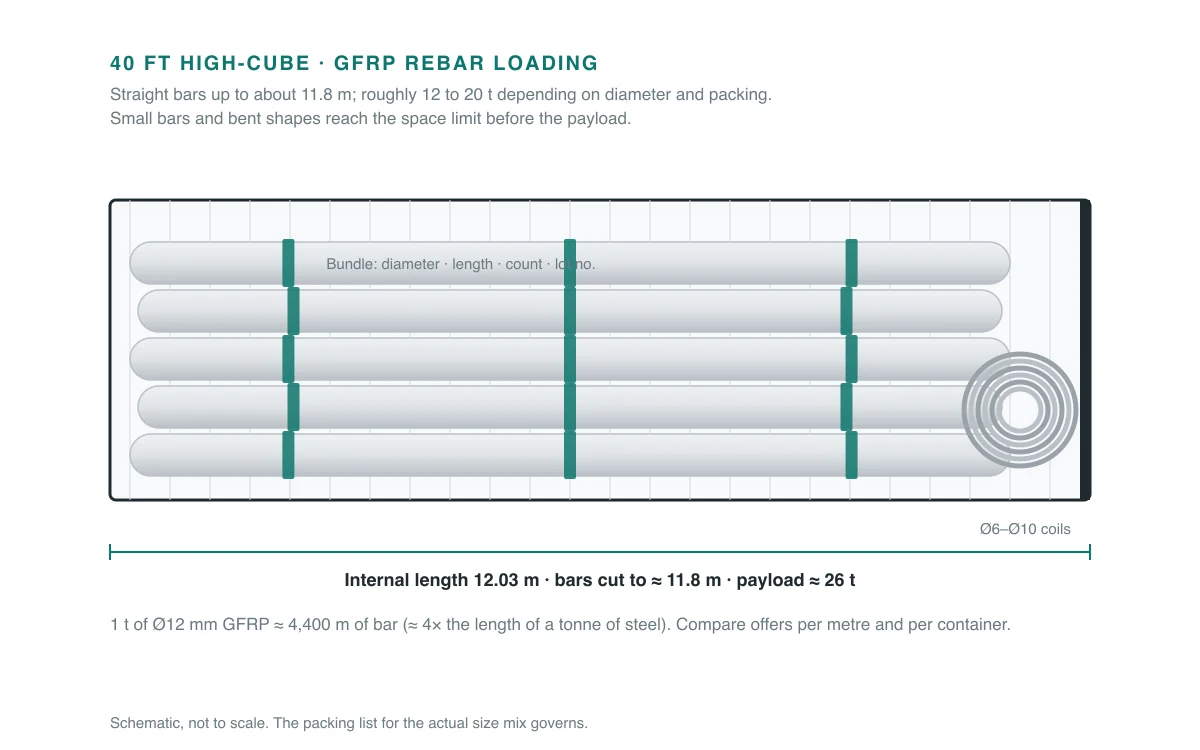
Length decides the equipment. A 40 ft high-cube container has an internal length of 12.03 m, so straight bars are produced at about 11.8 m for container shipment; a 20 ft box takes bars up to about 5.8 m. North American schedules in 20 ft (6.1 m) lengths need a 40 ft unit. True 12 m bars, or longer, travel on an open-top or flat-rack unit at a higher freight rate, or are cut to an agreed length.
Diameter and packing decide the tonnage. Round bars in strapped bundles leave air between bars and between bundles. Large diameters in dense bundles can approach a container's road payload of about 26 tonnes; small diameters, mixed lengths and bent shapes fill the space long before the weight. Planning figures for a 40 ft high-cube run from roughly 12 to 20 tonnes of straight bars, which for Ø12 mm bar is 50,000 to 90,000 m. A 20 ft box with 5.8 m bars carries proportionally less. These are planning ranges; the packing list for the actual size mix is the number to use.
Coils for small diameters. Ø6 to Ø10 mm bars can be coiled, which cuts the freight volume of mesh rods and slab bars considerably. Coiled bar needs straightening and careful handling on site, so agree the coil diameter and the straightening method before choosing it.
Bundles and labels. Bundles are strapped, protected from abrasion and labeled by bar mark, diameter, length and quantity so the inspector can match each bundle to its lot certificate. Bent bars and mesh sheets are palletized or crated to the drawing reference. One US producer's data sheet lists master bundles of 500 bars and a full truckload of 20,000 No. 3 or 12,000 No. 4 bars of 20 ft; export bundles are agreed per order, but the same logic applies: the count, not the weight, is what the site checks.
Documents to request before the goods move
- Qualification report for each size. Guaranteed tensile force, modulus, strain, transverse shear, bond, moisture absorption, alkali resistance and glass transition temperature, tested to ASTM D7205, D7617, D7913 and D7705 or the ISO 10406-1 methods, with the laboratory and the standard edition stated. This is the document the engineer of record reads.
- Production-lot certificates. ASTM D7957 calls for five specimens from each production lot; the certificate must carry the lot number that appears on the bundle labels.
- Bent-bar data for every scheduled shape, to ASTM D7914, plus the shape drawings as approved.
- Handling, storage and cutting instructions for the offered grade, which also serve as the contractor's method statement under ACI SPEC-440.5.
- Certificate of origin on the form your destination requires (a preferential form where a trade agreement applies, otherwise a chamber certificate), with the commercial invoice, packing list and bill of lading.
A supplier who cannot produce items 1 and 2 before shipment has not qualified the bar to the standard, whatever the datasheet says. The GFRP rebar standards page lists what to ask for against each standard in each market.
Customs classification and duties
GFRP rebar is not steel and is not classified with it. US Customs and Border Protection classifies FRP reinforcing bars under heading 3916, monofilament and rods of plastics, at subheading 3916.90.50, with a general duty rate of 5.8%; most other customs territories also use heading 3916 for composite bars. Additional measures sit on top of the general rate: in the United States, Section 301 duties on Chinese goods have changed several times in 2025 and 2026, and Buy America rules exclude imported bars from federally funded transportation work regardless of duty. No anti-dumping or countervailing case on GFRP rebar existed in the United States, the European Union, Canada or Australia as of October 2026. Confirm the classification and the duty stack with your broker for the shipment date, and keep the technical description on the invoice consistent with the test reports.
How MOQ and lead time are set
A GFRP rebar line is set up per diameter, so the minimum order follows the size mix: a few thousand metres of one diameter is a normal lower bound, and a 20 ft container of a stable size mix is the usual first commercial order. Lead time has three parts: production, which depends on the number of diameters and shapes; testing, which adds time when a project requires lot tests at an accredited laboratory before release; and transit. A sample lot of the sizes the engineer wants tested, with the test scope agreed in advance, is the normal way to start and shortens every later order.
Shipping terms
Compare offers on the same term. FOB leaves freight, insurance, duty and clearance with the buyer; CIF adds freight and insurance to the port; DAP and DDP move delivery and, under DDP, duty to the seller. For GFRP the freight term matters more than for steel because the container count, not the tonnage, drives the cost. The FOB and DDP export guide explains the responsibilities under each term.
Starting an inquiry
Send the bar schedule or the size mix, the lengths and shapes, the standard and edition the project names, the documents your engineer requires and the destination port. F1 Composite confirms the offered grade, the test scope, the packing plan and the price per metre, per bar or per container through the GFRP rebar page; the bar schedule template has the columns a quotation needs.
GFRP rebar import questions
How many tonnes of GFRP rebar fit in a 40 ft container?
Roughly 12 to 20 tonnes of straight bars, depending on diameter and how tightly the bundles stack. Large diameters in dense bundles approach the 26-tonne road payload; small diameters and bent shapes run out of space first. In linear metres that is about 50,000 to 90,000 m of Ø12 mm bar. The packing list for your order gives the exact figure.
What is the longest GFRP bar that ships in a standard container?
About 11.8 m in a 40 ft high-cube, whose internal length is 12.03 m, and about 5.8 m in a 20 ft box. Bars of 12 m nominal length are usually produced at 11.8 m for container shipment, or booked on an open-top or flat-rack unit at a higher freight cost.
Which HS code applies to GFRP rebar?
US Customs classifies FRP reinforcing bars under heading 3916, monofilament and rods of plastics, at subheading 3916.90.50 with a 5.8% general rate, and most other customs territories use heading 3916 as well. Additional duties, including US Section 301 measures on Chinese goods, change over time, so your broker confirms the stack for the shipment date.
What documents should come with an imported GFRP rebar order?
Beyond the commercial invoice, packing list and bill of lading: a qualification report for each size stating the standard and edition, production-lot certificates traceable to the bundle labels, handling and storage instructions for the offered grade, a certificate of origin and, where required, bent-bar test data and a material safety data sheet.