Chongqing Rooftop PV Retrofit: Pultruded FRP H-Rail on Colour Steel-Tile Roofs
Chongqing, China · 2024
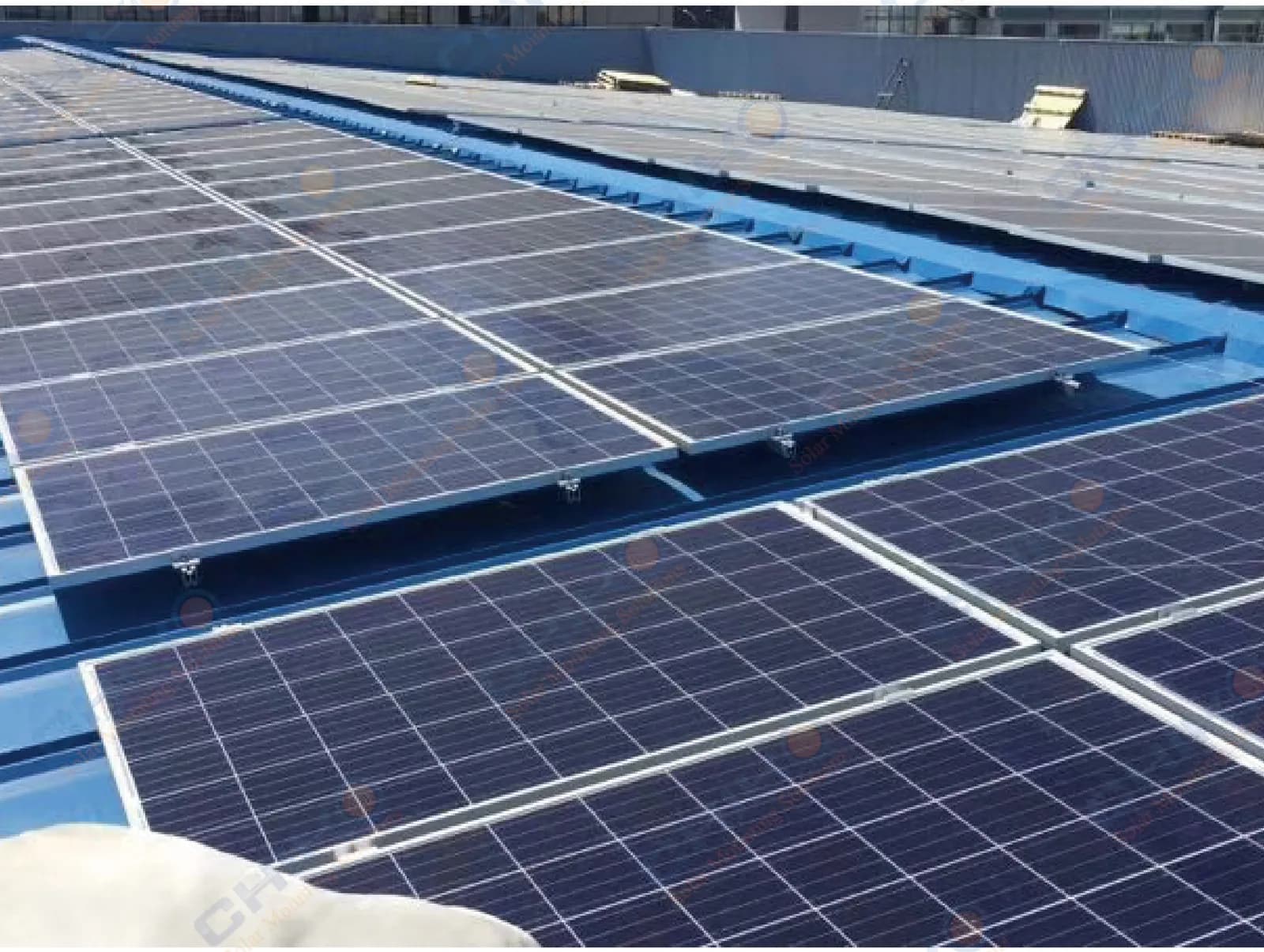
FRP rooftop solar mounting: project overview
Energy project in Chongqing, China, 2024. Products supplied: Custom Pultrusions, Standard Profiles.
The challenge
In 2024 the owner of an industrial park in Chongqing decided to add rooftop PV to a group of existing factory buildings, to cut the campus's carbon emissions and earn revenue from unused roof area. Two things ruled out the usual galvanized-steel and aluminum rails. First, the roofs had little spare capacity. They were designed for a generic industrial live load of about 0.5 kN/m², the common reserve for Chinese industrial roofs built before 2012, with no allowance for a permanent PV array. A monocrystalline array on galvanized-steel rail adds roughly 15–20 kg/m² once panels, rail, clamps and ballast are counted, a large share of that reserve, and the structural reviewer named it as the limit on the retrofit. The owner needed a rail clearly lighter than steel, and ideally lighter than aluminum, so the roofs could take the array without strengthening work that would have wiped out the payback. Second, the rooftop environment is harsh. Chongqing's humidity is above 80 % for much of the year, dew is frequent (the city is known locally as the Fog City), and rain in the Yangtze industrial corridor is acidic. On a colour steel-tile roof the surface passes 70 °C in summer and falls close to freezing in winter, with a heating and cooling cycle every day. Galvanized rail there loses zinc quickly and would need recoating every 5–8 years, which means lifting the panels off each time, over an asset designed for 25 years. Aluminum rail avoids rust, but its anodized surface pits in acidic, humid air and it forms a galvanic couple with stainless-steel clamps and the copper earthing wire.
What F1 supplied
F1 supplied pultruded glass-fiber-reinforced polymer (GFRP) H-section rail from FengDu's Yancheng plant, with a matched accessory kit: mid-clamps, end-clamps, splice plates and Jiaochi-type roof clamps that grip the standing seams of the existing colour steel-tile roof without drilling through it. The rail answers both problems. On weight, GFRP has a density of about 1.9 g/cm³, against 7.85 g/cm³ for carbon steel and 2.70 g/cm³ for 6063 aluminum. A typical rooftop layout needs 4–6 kg per metre of galvanized C-section or 1.5–2.5 kg/m of aluminum extrusion; the GFRP H-rail weighs about 1.0–1.5 kg/m, roughly three-quarters less rail dead load than steel. A 1 MW rooftop array uses around 2,000 m of rail, so the saving runs to several tonnes and the roofs stayed within their original live-load reserve without strengthening. On durability, the GFRP rail has no zinc to renew and no anodized surface to pit, and it does not form a galvanic couple with the stainless clamps or the copper earthing wire. The accessory kit was produced in two batches to match the installation sequence, with a published bolt schedule (M6 × 12 for rail splices, M8 × 25 for mid- and end-clamps and T-bolts, M8 × 30 for the Jiaochi roof clamps) that matched the installer's standard rooftop kit. Rails were cut to length in the factory and palletised in installation order for hoisting from ground level.
Results
The PV arrays were commissioned within the roofs' original live-load reserve, with no structural strengthening and without taking the factory roofs out of use. Compared with galvanized steel rail at 4–6 kg/m, the GFRP rail at about 1.0–1.5 kg/m removed roughly 75 % of the rail's share of the permanent dead load. It also removes the 5–8-year zinc recoating that steel rail would have needed, and the pitting and galvanic-corrosion upkeep that aluminum rail would have brought in this humid, acidic climate. For F1, this project is the reference for rooftop PV retrofits where roof capacity and weathering both limit the design.
Have a similar project to Chongqing Rooftop PV Retrofit: Pultruded FRP H-Rail on Colour Steel-Tile Roofs?
The advisor opens with a question about this project. Add your own site conditions to see which profiles and resin would carry over, and what a quotation needs.
Pre-filled question: “I'm looking at the F1 Composite case study "Chongqing Rooftop PV Retrofit: Pultruded FRP H-Rail on Colour Steel-Tile Roofs" in Chongqing, China (/case-studies/chongqing-rooftop-pv-frp-rail). Which materials, profiles, resin and standards did it use, and what would I need to send for a similar quotation?”
Interested in a similar solution?
Send the dimensions, quantity, service conditions and destination. We reply within one business day.