Wanhua Yantai Zero-Carbon Community: GFRP-PU Passive Windows
Yantai, Shandong, China · 2022
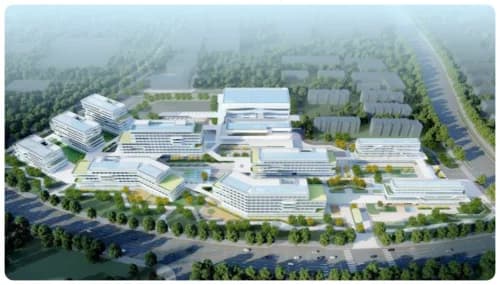
GFRP-PU passive house windows: project overview
Construction project in Yantai, Shandong, China, 2022. Products supplied: Fenestration Systems.
The challenge
Wanhua Chemical, the world's largest producer of MDI and a supplier of polyurethane raw materials, decided in 2021 to build a zero-carbon employee community on its campus in the Yantai Economic and Technological Development Zone, Shandong. The complex has 112,815 m² of above-ground floor area in mid- and high-rise dormitories and supporting buildings. It had to meet two energy standards at once: China's national near-zero energy building standard and Shandong's passive ultra-low energy residential standard. That meant a cap of 50 kWh per square metre per year for heating, cooling and lighting, an envelope well inside the national code, and blower-door testing of airtightness. The windows were the hardest part. The specification asked for whole-window U-values below 1.0 W/m²·K, which thermally broken aluminum rarely reaches without special glazing, and PVC frames could not span the tall openings on the stair towers. Wanhua also wanted the frames to be made with its own polyurethane resin.
What F1 supplied
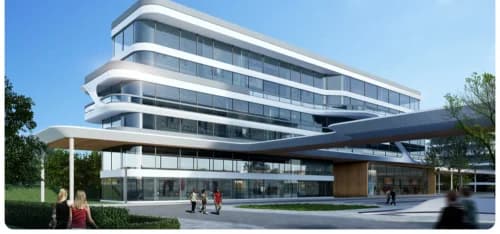
F1 supplied pultruded GFRP-PU window profiles from FengDu's Yancheng plant for the 13,657 m² dormitory part of the project. The smaller dormitory windows used 65-series inward-opening casement and tilt-and-turn profiles, the balconies used 90-series sliding profiles, and matching facade-frame sections were used at the stair-tower curtain wall. With a triple-glazed unit (5 mm single-silver Low-E + 16 mm argon + 5 mm single-silver Low-E + 16 mm argon + 5 mm Low-E), the whole-window U-value was 0.99 W/m²·K against the 1.0 W/m²·K requirement. The frame has no metal thermal break: the GFRP-PU section conducts heat at about 0.3 W/m·K, around 500 times less than aluminum. The profiles were pultruded with Wanhua polyurethane resin, from the same supplier as the building's polyurethane sandwich wall insulation. They were finished in a dark frame colour with co-extruded EPDM gasket channels and reinforced corners, and delivered on pallets in installation order during eight months of overlapping site work.
Results
The dormitory envelope was completed with F1's GFRP-PU windows as the main opening component. Figures from the building-envelope verification at handover: a comprehensive building energy-saving rate of 61.11 % against the national baseline (the near-zero energy threshold in the standard is 60 %), an envelope-only energy-saving rate of 47.56 %, a renewable-energy share of 51.81 %, and airtightness of N50 = 1.0 air changes per hour at 50 Pa. With the wall insulation, ground-source heat pumps, rooftop PV and solar hot water, the development is projected to cut CO₂ emissions by more than 2,000 tonnes a year across its 112,815 m². Wanhua Chemical's 2022 sustainability reporting lists it as the company's first zero-carbon community. For F1 it is the main reference for near-zero energy and passive residential projects: 13,657 m² of GFRP-PU windows at a whole-window U-value of 0.99 W/m²·K.
Have a similar project to Wanhua Yantai Zero-Carbon Community: GFRP-PU Passive Windows?
The advisor opens with a question about this project. Add your own site conditions to see which profiles and resin would carry over, and what a quotation needs.
Pre-filled question: “I'm looking at the F1 Composite case study "Wanhua Yantai Zero-Carbon Community: GFRP-PU Passive Windows" in Yantai, Shandong, China (/case-studies/wanhua-yantai-zero-carbon-windows). Which materials, profiles, resin and standards did it use, and what would I need to send for a similar quotation?”
Interested in a similar solution?
Send the dimensions, quantity, service conditions and destination. We reply within one business day.