Fiberglass baffles for clarifiers and contact tanks
FRP density current baffles, scum baffles, inlet baffles and baffle walls for water and wastewater treatment. Cut from vinyl ester sheet or built from pultruded sections, fixed with 316 stainless or FRP hardware.
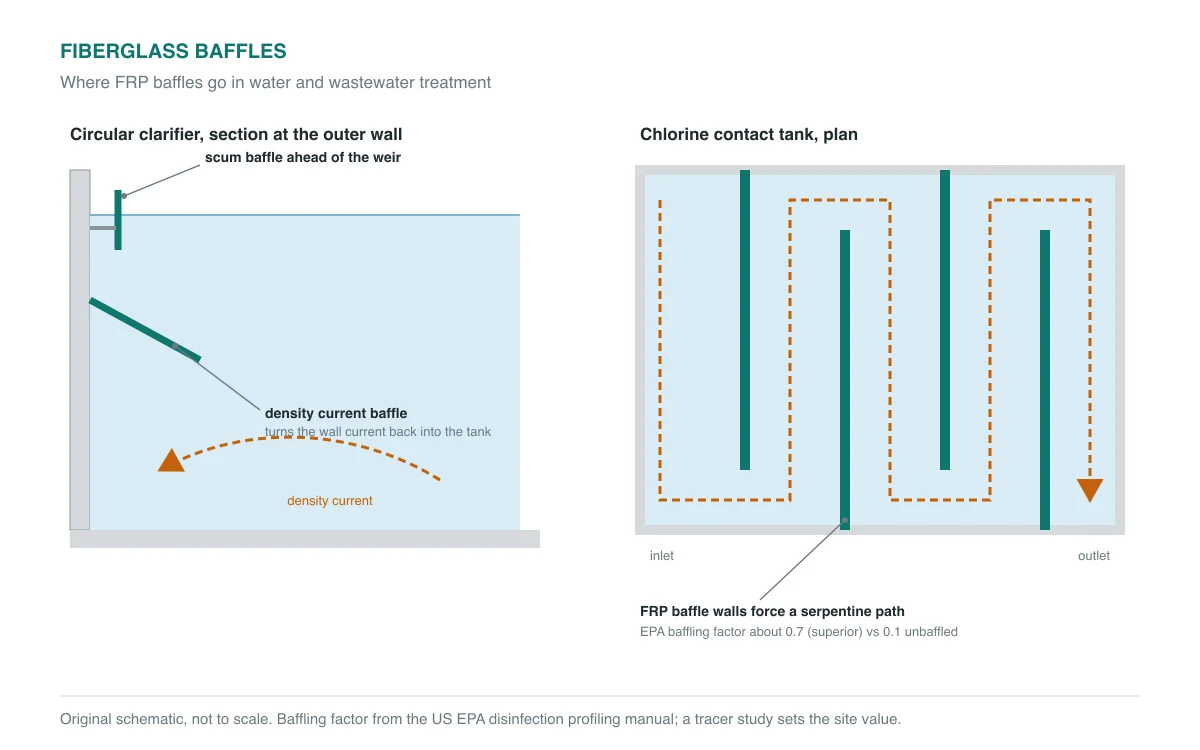
Fiberglass baffles: key facts
Fiberglass baffles are fiber-reinforced polymer plates and walls that redirect flow in clarifiers, settling tanks and chlorine contact basins. F1 Composite supplies them as vinyl ester sheet cut to size and as pultruded sections, with stainless steel or FRP fixings.
- Not acoustic
- These are water-treatment baffles; acoustic ceiling baffles are glass-wool sound absorbers, a different product.
- Why FRP
- FRP does not corrode in chlorinated or septic water, weighs far less than concrete or steel plate and is cut and drilled on site.
- Contact time
- EPA rates serpentine or perforated baffle walls at a baffling factor of about 0.7, against 0.1 for an unbaffled basin.
- Design load
- The water-level difference across the baffle: about 5.2 psf per inch of head.
- Drinking water
- Use products certified to NSF/ANSI/CAN 61 where the baffle touches potable water.
Four kinds of fiberglass baffle
| Baffle | Where | What it does |
|---|---|---|
| Density current baffles | Outer wall of circular clarifiers, below the water line | Turn the solids-laden current along the wall back into the tank so it does not short-circuit to the effluent weir. |
| Scum baffles | Ahead of the effluent weirs in primary and final settling tanks | Hold floating scum and grease back from the weirs so it can be skimmed. |
| Inlet and energy-dissipating baffles | Tank inlets and feed wells | Slow the incoming flow and spread it across the tank to prevent short-circuiting. |
| Baffle walls | Chlorine contact tanks, clearwells and treatment basins | Force a serpentine or perforated flow path so water stays longer and the disinfection contact time rises. |
Clarifier flights, weirs and the rest of the tank internals: FRP clarifier components. Plant-wide FRP: water and wastewater.
Baffle walls and disinfection contact time
| Baffling condition | Baffling factor T10/T |
|---|---|
| Unbaffled (mixed flow) | 0.1 |
| Poor | 0.3 |
| Average | 0.5 |
| Superior (serpentine or perforated intra-basin baffles) | 0.7 |
| Perfect (plug flow) | 1.0 |
Source: US EPA, Disinfection Profiling and Benchmarking Technical Guidance Manual. The manual notes that the extreme values are seldom reached in practice.
Designing an FRP baffle
- Step 1
Head and span
Take the largest water-level difference across the baffle, including surge and draining, and set panel spans and supports for it.
- Step 2
Material form
Flat vinyl ester sheet for plates and density current baffles; pultruded sections or planks for walls that span between supports.
- Step 3
Fixings
316 stainless steel or FRP bolts and brackets into the tank wall or support frame; seal cut edges with compatible resin.
- Step 4
Water contact
State drinking-water contact, chemicals and temperature so the resin and any NSF/ANSI/CAN 61 certification can be matched.
Plate stock: fiberglass sheets cut to size. Supports and framing: FRP structural shapes. Hardware: FRP fasteners.
Fiberglass baffle questions
What are fiberglass baffles used for in water treatment?
They redirect flow inside clarifiers, settling tanks and contact basins: density current baffles stop solids short-circuiting, scum baffles hold back floating material, inlet baffles calm incoming flow and baffle walls lengthen the flow path to raise disinfection contact time.
Are these the same as acoustic fiberglass baffles?
No. Acoustic baffles are glass-wool panels hung from ceilings to absorb sound. The baffles on this page are rigid fiber-reinforced polymer plates and walls that control water flow.
What baffling factor does a baffle wall give?
EPA guidance rates serpentine or perforated intra-basin baffles as superior, with a baffling factor (T10/T) of about 0.7, against 0.1 for an unbaffled basin. A tracer study gives the site value, which the state regulator accepts.
What load does a baffle wall carry?
Mainly the difference in water level across it: about 5.2 psf for every inch of head (62.4 psf per foot). The panel span, supports and connections are checked for that head plus any surge or cleaning load.
Can FRP baffles be used in drinking water?
Yes, where the product is certified to NSF/ANSI/CAN 61 for drinking-water contact. Ask for the certificate of the specific resin and product; a resin family alone is not certification.
What are fiberglass baffles fixed with?
Type 316 stainless steel or FRP fasteners and brackets, fixed to the tank wall, launder or support beams. Carbon steel is avoided because it corrodes in the same water the FRP is chosen to resist.
Quote fiberglass baffles
Send the tank drawing or dimensions, baffle type and location, water levels on each side, support points, water quality and whether the water is for drinking. We reply within one business day; a formal quotation follows once the specification and delivery are reviewed.
- Tank and baffle
- Clarifier or basin size, baffle type, height and length.
- Head and supports
- Water levels on both sides, spans and support points.
- Water
- Chlorine, chemicals, temperature and potable contact.
- Fixings
- Wall type, bracket preference and installation access.