Utilities do not publish what they pay for poles, so the cost of a composite utility pole has to be read from government reviews, utility statements and rate filings. This article collects the published figures, with the source and year for each, and separates the price of the pole from the cost of installing it.
Purchase price against wood
| Source | Year | What it says |
|---|---|---|
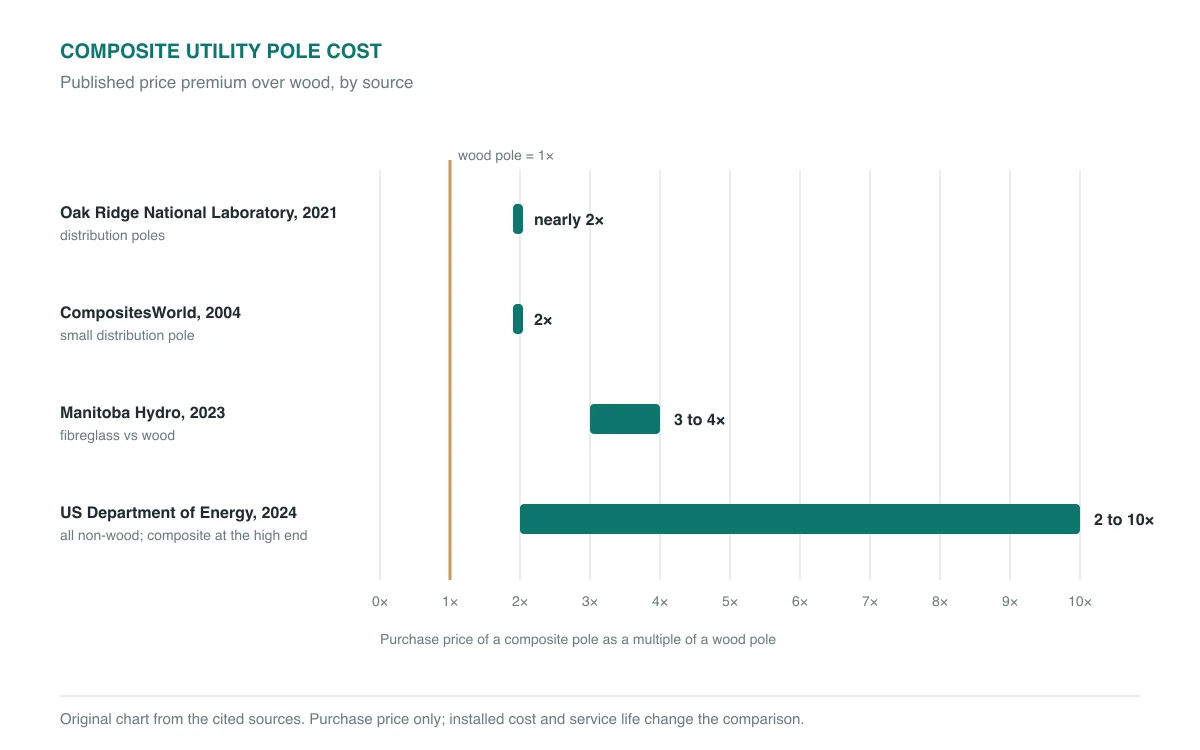
| Oak Ridge National Laboratory | 2021 | Composite poles are nearly twice the cost of wood for distribution; the difference diminishes significantly at transmission sizes |
| US Department of Energy | 2024 | Non-wood poles can be 2 to 10 times more expensive than wood, with composite at the higher end |
| Manitoba Hydro | 2023 | Fibreglass is 3 to 4 times the price of wood; poles of 75 ft and larger are closer in price |
| CompositesWorld (pole maker quoted) | 2004 | A small composite distribution pole is still two times the unit cost of wood |
The wood baseline in the first two sources is the same: a standard 40 ft wood distribution pole is typically under $1,000, and each step up in class adds roughly $100.
The sources disagree, and they are not measuring the same thing. The Department of Energy range covers steel, concrete and composite together, and the Manitoba figure is one utility's experience in one market. Read them as a range of about two to four times wood for distribution poles, with higher multiples possible.
Installed cost
The pole is a small part of what a utility spends to put it in the ground. Published program costs:
| Program or study | Cost | Notes |
|---|---|---|
| Study cited by Oak Ridge National Laboratory | About $7,500 per pole | Condemning and replacing a pole; the same study puts a wind failure at about $60,000 |
| Duke Energy Florida, lateral hardening, 2023 to 2025 | $10,800 per pole | Includes treatment, reinforcement or replacement as needed |
| Southern California Edison, 2025 rate case | Varies by up to $12,000 per pole | Depends on program type and location |
| Duke and FPL, wood to steel transmission | $26,000 per structure | 2020 dollars |
| Hawaiian Electric, critical pole hardening, 2022 | $93,700 per pole | Includes guying and intermediate poles |
Dividing a wood pole of under $1,000 by a replacement cost of $7,500 to $10,800 puts the pole at roughly a tenth of the job. Crew, traffic control, equipment, framing and conductor transfer make up the rest and are similar for any pole material. That is why a pole that costs two or three times as much does not double the installed cost.
Service life
| Source | Composite | Wood |
|---|---|---|
| Oak Ridge National Laboratory, 2021 | 70 to 100 years in its comparison table; over 80 projected | 45 years treated; 25 to 50 depending on climate |
| US Department of Energy, 2024 | 80 years | 30 to 50 years |
| Manitoba Hydro, 2023 | Over 100 years with minimal maintenance | Not stated |
| ACMA, 2018 | 60 to 80 years | 20 to 40 years |
These are projections. The longest field record is the first fiberglass poles in Hawaii, which were replaced after about 45 to 50 years because ultraviolet light had degraded the surface. Current poles use UV-stable resins and coatings, and one comparison chart notes that the coating has to be maintained.
Fewer inspections are part of the case. Southern California Edison told its regulator that fewer inspections will be required as wood poles are replaced with composite or steel. Oak Ridge cites a mean inspection cost of about $23 to $104 per pole in Australia.
Weight
| Pole | Composite | Wood |
|---|---|---|
| 40 ft, Class 4 (MacLean Gridcore brochure) | 707 lb | 1,160 lb, southern yellow pine |
| 45 ft, Class 3 (MacLean Gridcore brochure) | 795 lb | 1,630 lb |
| 45 ft (Oak Ridge National Laboratory table) | Not listed | 1,315 lb; steel 631 lb; concrete 3,793 lb |
Lower weight cuts freight per pole and allows smaller trucks, hand carrying or smaller helicopters where access is difficult. On those sites the installation saving can outweigh the price premium.
What drives the price of a composite pole
- Height and class. Longer and stronger poles use more glass and resin. For wood the step is about $100 per class.
- Process. Modular poles are filament wound, a batch process; single-piece poles and crossarms are pultruded continuously.
- Resin and UV protection. Polyurethane resins and UV-stable coatings are used on poles sold for long outdoor life.
- Fire protection. Composite fire shields are added in wildfire areas. Oak Ridge lists poor fire resistance as a disadvantage of unprotected composite poles.
- Freight. Light poles load in greater numbers on a truck or railcar.
Comparing poles over their life
A life-cycle comparison needs five inputs for each material: the pole price, the installed cost, the expected life at the site, the inspection and treatment cost per cycle, and the cost and likelihood of a failure. The pole price alone favors wood. Long life, hard access, woodpeckers, decay and wildfire exposure move the result toward composite.
Related FRP products
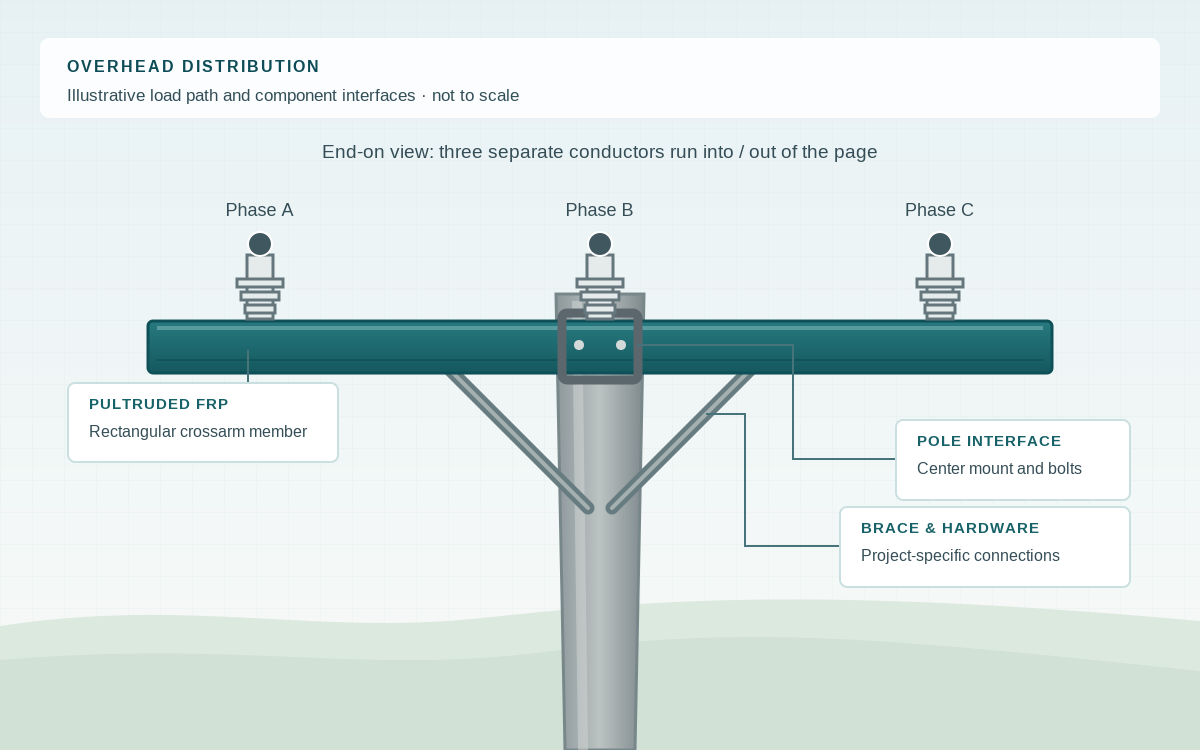
F1 Composite does not manufacture utility poles and does not quote them. For overhead lines it supplies FRP utility crossarms. For standards, classes and field rules, see the guide to fiberglass utility poles.
Composite utility pole cost questions
How much does a composite utility pole cost?
Utilities rarely publish contract prices. Published comparisons put a composite distribution pole at nearly twice the price of wood (Oak Ridge National Laboratory, 2021) to three or four times (Manitoba Hydro, 2023), against a 40 ft wood pole that is typically under $1,000.
Why do utilities pay more for composite poles?
For longer published service life, lower weight where access is hard, no rot or woodpecker damage, and wildfire hardening. San Diego Gas & Electric, for example, requires steel or fiberglass poles in its high fire threat districts.
How much does it cost to replace a utility pole?
Published figures include about $7,500 for condemning and replacing a pole in a study cited by Oak Ridge National Laboratory, and $10,800 per pole for a Duke Energy Florida hardening program that includes reinforcement or replacement as needed. Location and program type move the number widely.
How long do composite utility poles last?
Published estimates range from 60 to 80 years (ACMA) through 80 years (US Department of Energy) to 70 to 100 years (Oak Ridge National Laboratory). The earliest fiberglass poles in Hawaii were replaced after about 45 to 50 years because of ultraviolet damage.
Does the premium shrink for larger poles?
Yes, according to two sources. Oak Ridge National Laboratory says the difference diminishes significantly at transmission sizes, and Manitoba Hydro says fibreglass poles of 75 ft and larger are closer in price to wood.