Fiberglass utility poles are still a small share of the world's poles, about 1% by one estimate, but utilities use them where wood rots, woodpeckers drill, wildfire and storms recur, or access is hard. This guide explains how they are made, specified and installed.
How fiberglass poles are made
- Filament winding: glass fiber wound around a tapered or cylindrical mandrel, giving tapered single-piece or modular poles. This is the most common route for distribution poles.
- Pultrusion: continuous constant-section tubes, which suit poles of uniform diameter, sections joined into modular poles, and arms.
Both use glass fiber in a thermoset resin, with a UV-resistant surface coating; polyurethane coatings are common.
The standards
| Standard | What it covers |
|---|---|
| ANSI/ACMA/UCSC-FRP Composite Utility Poles-1-2018 | Design, materials, manufacturing, quality control, installation and inspection of direct-embedded FRP poles; revision opened in 2025 |
| ANSI O5.1 | Wood pole classes; FRP poles are commonly specified as wood-equivalent classes |
| NESC (Rule 261) | Strength and overload factors for structures, including the wood strength factor used for equivalence |
| ASTM D8019 | Test method for FRP crossarms, not poles |
| USDA RUS (2008) | Case-by-case acceptance of FRP distribution poles for RUS borrowers |
Wood-equivalent classes
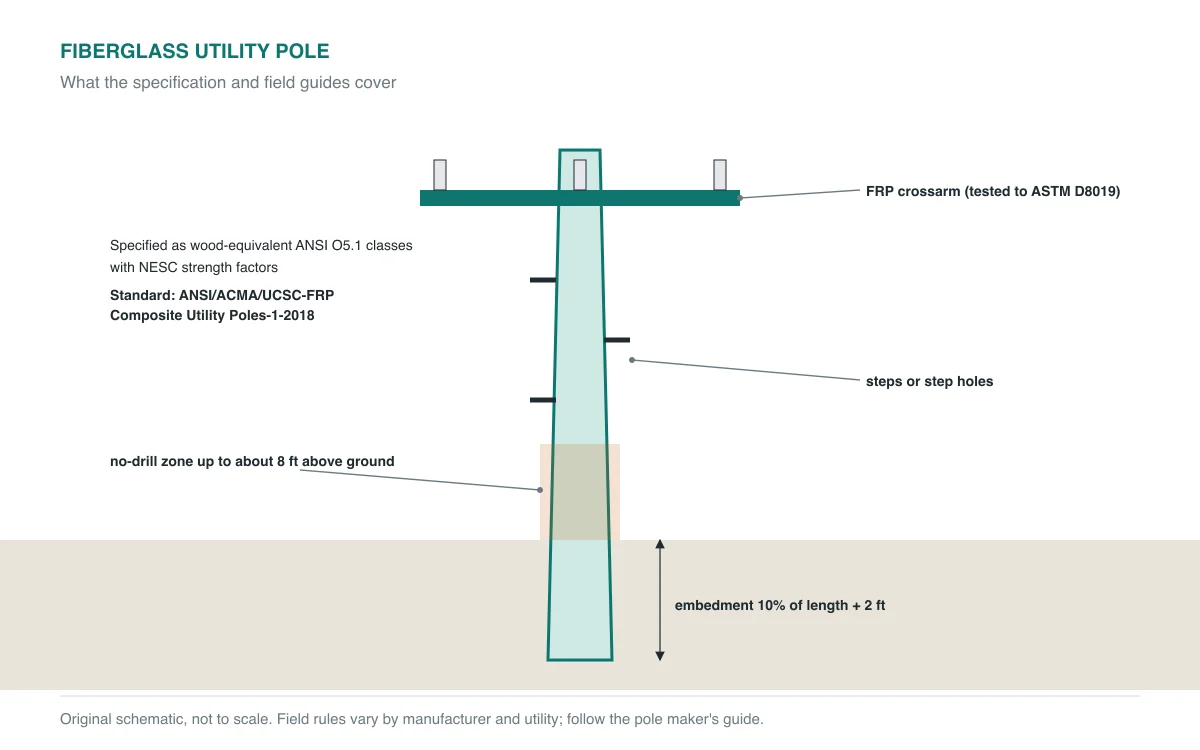
Utilities usually buy FRP poles as equivalents of wood classes, so the same framing and design tables can be reused. One utility specification sets the FRP pole strength equal to the ANSI O5.1 wood class strength multiplied by the NESC wood strength factor of 0.65 for Grade B construction. Its example design loads are 2,925 lb for Class 1 and 2,405 lb for Class 2.
The equivalence holds for the load case it was derived from. NESC strength factors differ between wood (0.65 for Grade B, 0.85 for Grade C) and steel or concrete (1.0), so a pole that matches wood in one case may not in another. RUS guidance asks engineers to calculate loads rather than substitute the same class for wood in Grade C construction, and to use Grade B overload factors at angle and deadend poles.
Why utilities choose fiberglass
- No rot, insects or woodpeckers, and no wood preservatives in the ground.
- Low weight. One pultruded transmission pole was cited at about 30% of the weight of wood; one utility caps a 35 ft Class 2 FRP pole at 400 lb.
- Low conductivity and good resistance to corrosion near the coast or in contaminated soils.
- Fire resistance, though not fireproof; fire-retardant coatings are available.
Limits to plan for
- First cost: close to twice that of wood for distribution poles in the ORNL review.
- Deflection: FRP is more flexible than steel; poles are rarely used above 230 kV.
- UV: coatings protect the fibers; scratched coatings need repair.
- Field data: long-term inspection guidance is less mature than for wood.
Installing and working on FRP poles
Field guides for FRP poles commonly call for:
- Direct embedment at 10% of length plus 2 ft, as for wood.
- No drilling in the zone from the base to about 8 ft above the ground line.
- Fiberglass-rated drill bits, holes at least six diameters apart, and plugs in unused holes.
- Through-bolts with curved washers and hardware without cleats; ground clips in galvanized or stainless steel.
- Steps or step holes for climbing, each step rated for the specified load.
Related FRP products
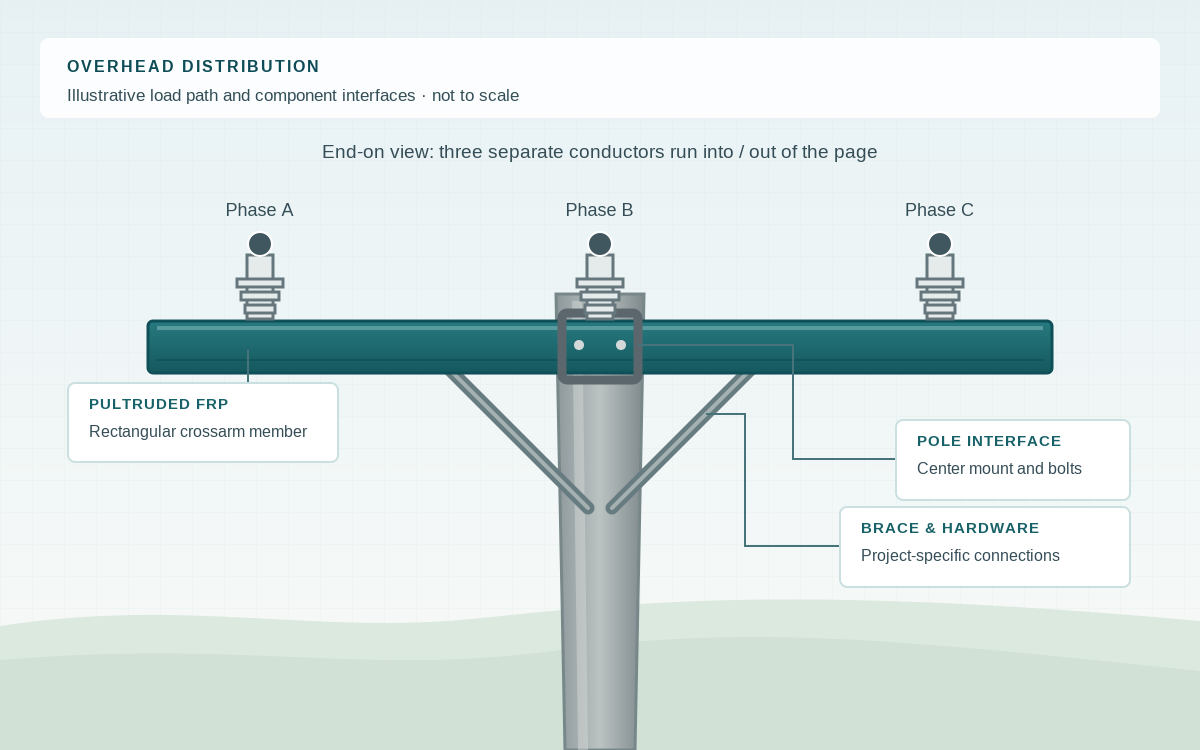
F1 Composite does not manufacture utility poles. For overhead lines it supplies FRP utility crossarms and pultruded profiles for energy and substation structures; crossarms are tested to ASTM D8019 and selected for the pole's framing and loads.
Fiberglass utility pole questions
What standard covers fiberglass utility poles?
ANSI/ACMA/UCSC-FRP Composite Utility Poles-1-2018 covers the design, materials, manufacture, quality control, installation and inspection of direct-embedded FRP poles. ASTM D8019 is a test method for FRP crossarms, not poles.
Are fiberglass poles rated like wood poles?
Usually yes. Utilities specify them as wood-equivalent ANSI O5.1 classes, applying the NESC strength factor for wood. Equivalence holds for the stated load case, so engineers check each case.
How long do fiberglass utility poles last?
Manufacturers and an Oak Ridge National Laboratory review project around 80 years with modern UV protection. Early 1960s poles in Hawaii were replaced after about 45 to 50 years because UV frayed the surface.
Can linemen drill and climb fiberglass poles?
Yes, with fiberglass-rated bits, through-bolts and hardware without cleats, outside the no-drill zone near the ground line. Steps or step holes are provided for climbing.
Are fiberglass poles more expensive than wood?
Up front, yes: distribution poles cost close to twice as much as wood in the ORNL review, with the gap narrowing at transmission sizes. Lower weight, long life and no treatment chemicals offset part of the difference over the life.