A cable route can be strong enough to carry its cables and still be wrongly specified. Small cables may need closer support. A lid can change the thermal conditions. A corrosion-resistant rail can sit on a bracket that corrodes first. Choosing an FRP cable tray, GRP trunking or fiberglass cable ladder therefore starts with the cable installation, followed by the material.
This guide separates those decisions, compares FRP vs steel and aluminum, and draws on published information from international cable-management manufacturers. Here, FRP means glass-fiber reinforced polymer, also called fiberglass or GRP. Carbon-fiber composites have different electrical behavior and are outside this comparison.
Cable tray vs trunking vs ladder: what actually changes?
The terminology is not completely uniform between markets. In North American usage, cable tray is an umbrella that includes ladder, ventilated, solid-bottom and channel constructions. In everyday project discussions, “tray” often means a continuous or perforated base, contrasted with a ladder. Specify the construction on the drawing instead of relying on the name alone. The Cable Tray Institute's standards overview identifies these system families.
| System | How it supports or encloses cables | Main selection question |
|---|---|---|
| Perforated or ventilated tray | Side rails with a base containing openings | Does the base support the smallest cable while providing the required ventilation? |
| Solid-bottom tray | Continuous base; a cover may be added | Is continuous support or protection from below needed, and how will water and heat be managed? |
| Cable ladder | Two longitudinal rails joined by spaced rungs | Are rung spacing, cable restraint and the tested support span suitable? |
| Cable trunking | Enclosing body with an access cover and compatible fittings | What protection and separation does the complete installed enclosure actually provide? |
Open rungs give access for securing cables and leave an unobstructed path for drainage between them. A continuous base distributes support under smaller cables. Neither description establishes a load rating: rail depth, reinforcement, rung joints, connections and support arrangement still control performance.
The distinction between a covered tray and trunking matters. IEC 61537:2023 covers cable tray and cable ladder systems and explicitly excludes cable trunking and ducting. IEC 61084-1, including its 2024 amendment, covers trunking and ducting and must be used with the relevant other parts of that series. Adding a cover does not establish compliance with a different system standard.
An enclosure also needs compatible joints, ends, entries and cover retention. Ask for evidence of the required ingress protection for that assembly. “Enclosed,” “weatherproof” and “dust-tight” are not interchangeable descriptions. The same applies to a product sold as a wireway: confirm its intended use and applicable approval rather than translating the name directly into trunking.
What international FRP manufacturers show
The following is a technical reference set, not a market-share ranking or an endorsement. It includes established system brands and regional suppliers with public product documentation. Coverage spans North America, Europe, India and the Middle East. A general structural pultruder is not automatically a qualified supplier of a complete electrical cable-support system.
| Manufacturer or system brand | Publicly documented FRP offering | Useful lesson for a specification |
|---|---|---|
| Eaton B-Line, North America and international markets | Fiberglass ladders and channel trays; polyester, vinyl-ester and zero-halogen material options | Request the exact resin designation and matching accessories. Product range |
| Enduro / Creative Composites Group, United States | Fiberglass tray, ladder-type tray, wireway and strut | Treat the route as a coordinated system, including supports. Electrical products |
| Øglænd System, Norway and international markets | FOE composite ladders and compatible FRP support and tray systems | Load figures have installation conditions; read the table notes. FOE system |
| Niedax Ebo Systems, Europe | Pressed and pultruded GRP ducts, trays and support systems | Manufacturing methods differ across components. Group product portfolio |
| Mita / Wibe Group, UK and European markets | GRP solid trays, troughs, lids and support components | Identify the actual product series and closure details. Mita range |
| Ercon Composites, India | GRP/FRP cable trays, ladders and pultruded sections | Match the supplier's offered system to the project environment. Manufacturer portfolio |
| Unitech / IKK Group, Middle East | Documented FRP ladder, tray and support-system range | Include bends, support positions and expansion details in procurement. FRP catalogue |
Two additional structural-material references help explain the engineering. Strongwell publishes directional mechanical properties for EXTREN profiles, while Fiberline publishes chemical-resistance guidance for its own resin grades. These documents are useful for understanding FRP behavior; neither substitutes for a tray-system test report or establishes F1 product ratings. See Strongwell's metric material comparison and Fiberline's technical data.
FRP vs galvanized steel, stainless steel and aluminum
Material comparisons must use systems that meet the same cable load, support layout, environment and acceptance criteria. Comparing equal lengths or equal kilograms can conceal different capacities and accessory requirements.
| Material | Reasons to shortlist it | Questions that can change the decision |
|---|---|---|
| Glass FRP / GRP | Electrical insulation; corrosion resistance with a suitable resin; easier handling than many steel assemblies | Chemical compatibility, stiffness, temperature derating, fire requirements and joint details |
| Galvanized steel | Stiffness; established fittings; suitable for many conventional indoor routes | Coating specification, exposure severity and maintenance access |
| Stainless steel | Corrosion resistance with an appropriate grade; high-temperature capability relative to many polymers | Actual chemical exposure, grade, joints and installed cost |
| Aluminum | Low mass; good performance in many atmospheric environments; convenient fabrication | Chemical compatibility, mixed-material connections and electrical design |
Eaton's material-selection catalogue documents legitimate advantages for all three metal options. FRP is therefore a candidate for a defined problem, not a universal replacement. In a benign indoor space, a familiar metal system may be the most practical choice. Where access is difficult and repeated corrosion-related replacement would interrupt production, evaluating FRP becomes more compelling. Those are selection judgments, not claims of a fixed cost saving.
Strength and stiffness answer different questions. Strength concerns failure; stiffness concerns movement under load. Strongwell's comparison gives longitudinal tensile modulus values of 17.2 GPa for EXTREN 500/525 and 207 GPa for its carbon-steel reference. These are product-specific material data, not tray capacities. They illustrate why high strength relative to weight does not mean steel-like deflection. Section geometry and the complete assembly must be checked. Strongwell, Section 2, page 2-5.
For a fiberglass vs steel cost comparison, price the complete installed route: straights, bends, covers, joints, supports, anchors, labor, lifting and required electrical provisions. Then evaluate inspection, repair access, replacement and downtime over the owner's chosen evaluation period. Use project quotations and stated assumptions. Do not apply a catalogue's weight reduction directly as a percentage reduction in installed cost.
Corrosion resistance belongs to the resin and exposure
The chemical resistance of FRP profiles depends on the resin formulation and the service environment. The question is resistance to which chemical, at what concentration and temperature, and under which exposure conditions. A splash zone, vapor space and continuous immersion can require different evidence.
Fiberline's published table makes the point with a concrete example: for sodium hydroxide at 10% concentration, its two listed isopolyester grades are marked not recommended, while its vinylester grade is listed at 45°C. That is guidance for those Fiberline materials under the table's conditions, not permission to use any vinylester tray at that temperature. Fiberline chemical and water resistance table.
Ask the system manufacturer to confirm the specified resin against the process chemicals, cleaning chemicals and expected exposure. Include the surface veil, cut-edge treatment, fasteners and supports in that review. FRP avoids steel rusting, but “corrosion immune” removes the very qualification that makes material selection useful.
Read the load table before choosing the span
Delivery length, support spacing and rung spacing describe different dimensions. A long straight section may cross several supports. Rung spacing governs local cable support; support spacing governs the structural span of the tray or ladder. Neither can be inferred from the other.
Øglænd's FOE table provides a useful example:
| Published product | Support spacing | Published safe working load |
|---|---|---|
| FOE70 | 2 m | 263 kg/m |
| FOE70 | 3 m | 103 kg/m |
| FOE100 | 3 m | 230 kg/m |
These are selected entries from the manufacturer's table, not F1 ratings or generic FRP limits. The source ties its load test to IEC 61537 and requires the end span to be three-quarters of the support spacing, without splices on that end span. Obtain the full report and configuration before using the values. FOE data and conditions.
For each quotation, request the allowable distributed load, concentrated-load conditions, deflection criterion and temperature basis. Ask whether self-weight and covers are included. Separately identify cable-pulling loads and support requirements at fittings. Unitech's installation guidance specifically discusses pulling stresses, expansion arrangements and fitting supports; straight-run capacity alone does not resolve those locations. Unitech FRP catalogue, installation section.
Ventilation, cable temperature and covers
The cables and their installation determine current-carrying capacity. An open ladder allows air movement around the cable arrangement, but that does not establish a universal ampacity uplift. Cable grouping, ambient conditions and the presence of covers must be evaluated under the applicable electrical design rules. Eaton's cable tray manual explains how cable arrangement and installation conditions enter selection; its 2014 code commentary should not be treated as the current local code.
Treat a later request for covers as a design change. Revisit cable thermal calculations, drainage, access, cover mass and retention. On exposed routes, ask how covers and their fixings were selected for wind actions. A lid that provides shade or catches debris can also change how the route behaves.
FRP structural temperature is another check. Eaton's elevated-temperature discussion demonstrates that retained properties depend on the product and test basis. It also contains historical NEMA language. Use the manufacturer's applicable current derating data, rather than transferring its example to another resin. A glass-transition temperature is not an allowable continuous operating temperature for a loaded tray.
Electrical insulation does not provide EMC shielding
Ordinary glass FRP is electrically insulating and does not provide the conductive shielding of a suitably designed metallic enclosure. It can be useful where a conductive support is undesirable, but it does not stop electromagnetic coupling between adjacent circuits. Cable selection, separation, shield termination and the overall EMC design remain necessary. Eaton discusses nonmetallic applications in its tray manual, while its material comparison identifies shielding among steel's attributes.
Do not use an FRP rail as a protective conductor. The installation still needs the protective conductors and bonding required for its equipment and exposed conductive parts. Metal brackets and accessories need their own assessment. Likewise, an insulating surface does not by itself establish suitability for a hazardous area: charge accumulation and any antistatic formulation need project-specific evaluation.
For power circuits, also ask the electrical designer to specify cable restraint under fault conditions. A tray's gravity-load rating is not evidence that any chosen cable cleat or tie can withstand short-circuit forces. Verify the restraint assembly, its fixing and the supporting structure together. IEC 61914:2021 addresses cable cleats and intermediate restraints, including resistance to electromechanical forces where declared.
Fire performance: ask which property was tested
Fire retardancy, smoke production, halogen content and circuit survival are different requirements. A resin can be formulated to improve one behavior without proving all the others. Øglænd explicitly offers different FRP resin options for chemical, fire, smoke and toxicity requirements; the formulation matters. Manufacturer's resin-selection discussion.
ASTM E84 concerns surface-burning characteristics. Its scope does not establish load-bearing survival in a fire, and the test alone is not a complete real-fire risk assessment. An E84 result must not be presented as proof that the tray will keep a circuit operational for a specified fire duration. Also request the edition, specimen description, thickness, mounting arrangement and reported result.
In a tunnel or another life-safety application, work backward from the required system behavior. Ask what combination of cables, supports, fixings and substrate was evaluated, and which smoke or toxicity requirements apply. A manufacturer's certificate logo on a general brochure is not enough to qualify every resin and assembly it sells.
Which standards belong in the specification?
| Reference | Relevant scope or status | What to request |
|---|---|---|
| IEC 61537:2023 | Cable tray and ladder systems; excludes trunking and ducting | Test evidence for the offered system and installation conditions. IEC |
| IEC 61084-1:2017 + AMD1:2024 | General requirements for trunking and ducting; used with relevant other parts | Correct system classification and applicable parts. IEC |
| UL 568 | Nonmetallic cable tray systems | Verify any claimed certification for the exact product. UL Solutions |
| NEMA VE 1 | Metal cable tray systems | Do not present it as the generic FRP product standard. Cable Tray Institute |
| NEMA FG 1 | Legacy fiberglass tray standard, rescinded in November 2017 | Clarify the contractual basis when a legacy class appears. Cable Tray Institute |
| ASTM E84 | Surface-burning test | Product-specific result; separate evidence for other fire objectives. ASTM |
Standards listed in a catalogue are not interchangeable certifications. Identify the edition adopted by the project, jurisdictional requirements and the particular product covered by each report. Historical references can explain a supplier's load-class terminology without being the current acceptance basis.
Installation details that preserve the design
Enduro's installation guide calls for controlled cutting and drilling, appropriate protection from machining dust, and sealing exposed cut surfaces. It also distinguishes ordinary splice arrangements from heavy-duty splice options and warns that its cable trays are not personnel walkways. These are product instructions, not details to improvise from a steel installation habit. Enduro installation guide.
An installation review should include the actual support drawing, fastener torque instructions, joint locations, expansion allowance and cut-edge treatment. Check that the supplied brackets, covers and fittings match the reviewed bill of materials. Document approved changes so that replacement parts can be selected later without guessing the original resin or load class.
A practical selection and RFQ workflow
Use these as starting questions, not ready-made designs:
| Project situation | Options worth comparing | Question to resolve first |
|---|---|---|
| Exposed industrial power route | FRP or metal ladder | Cable arrangement, restraint, environment and tested span |
| Smaller control or instrumentation cables | Perforated or solid-bottom tray | Local cable support, segregation and access |
| Route needing enclosure | Purpose-designed trunking or an approved wireway | Ingress protection, entries and thermal conditions |
| Chemical processing or coastal facility | Qualified FRP, suitable stainless steel or compatible aluminum | Exact exposure and whole-system durability |
| Tunnel or critical circuit | Systems with the required documented performance | Fire, smoke, toxicity and circuit-support requirements |
A useful RFQ contains a route drawing, cable schedule and cable mass; intended support spacing; exposure description; operating temperatures; material and fire requirements; and the acceptance documents needed. Include cover requirements, bends, vertical runs and spare capacity. Request deviations explicitly, so a supplier can explain an alternative without silently changing the design basis.
F1 Composite can discuss FRP cable tray supports, pultruded FRP profiles and custom fiberglass pultrusion services against that brief. Send the project requirements through our contact page. Confirm the offered scope and supporting evidence before specifying a complete cable-management system; competitor test data in this guide are not F1 certifications.
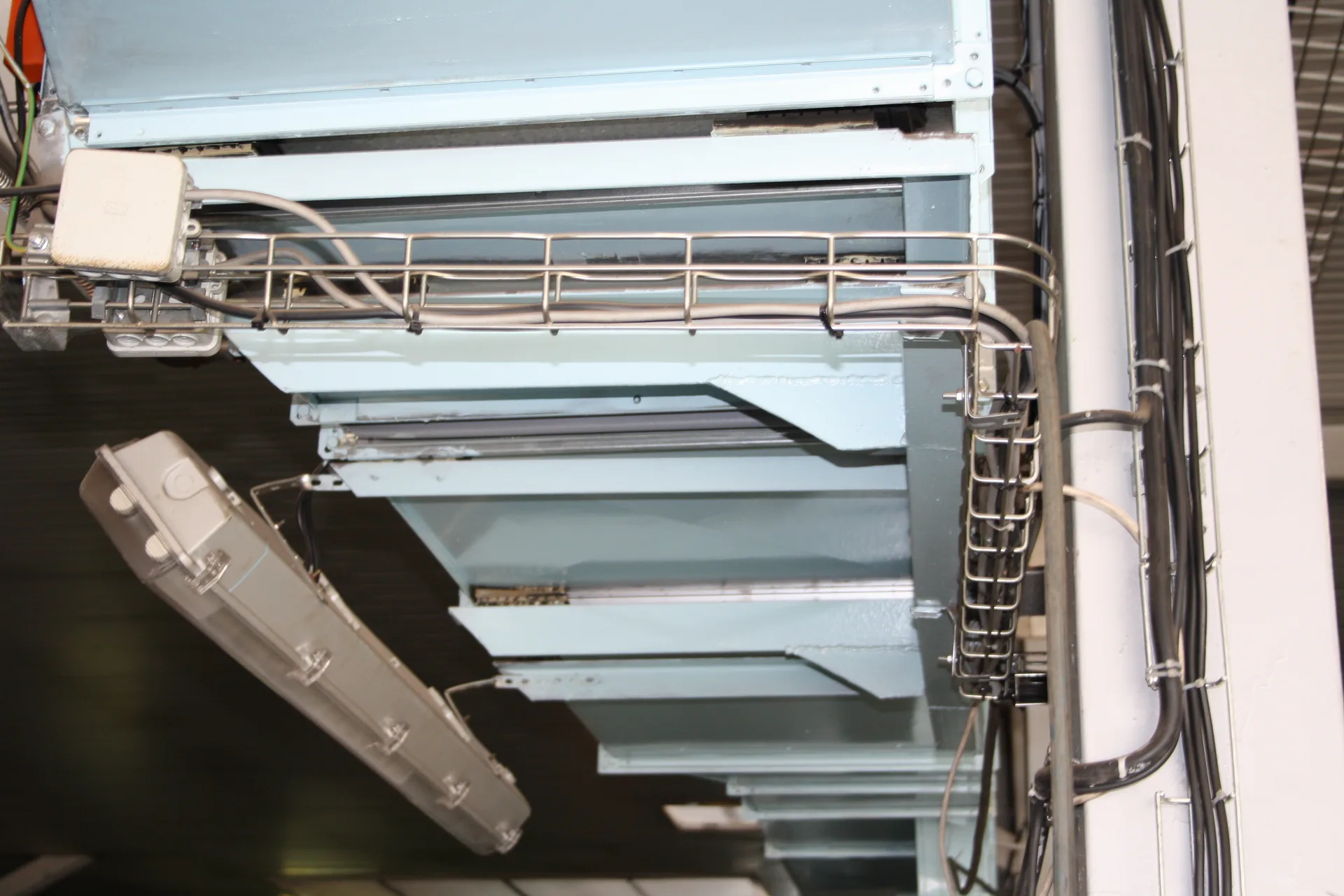
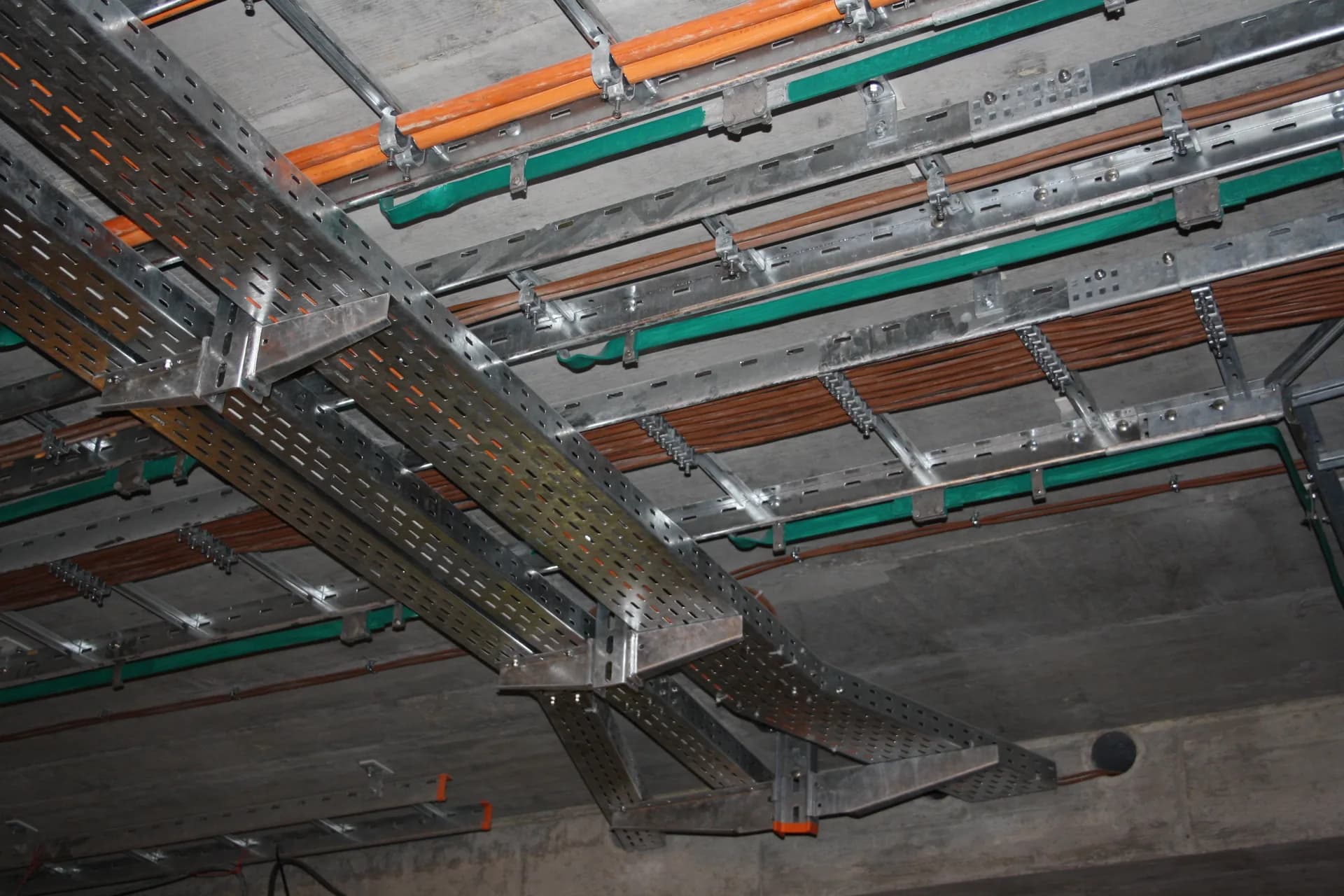
Photography shows metal cable ladders, perforated trays and wire-mesh tray construction for comparison. These are independent public-domain photographs, not FRP product photographs or F1 project references.
Cable support selection questions
Is a cable ladder different from a cable tray?
A ladder is one construction within the cable-tray family. In project shorthand, tray often refers to a perforated or continuous base. Specify the construction, rung spacing and tested load rather than relying on the name.
Does a lid turn an FRP tray into waterproof trunking?
No. A cover alone does not establish an enclosure classification or ingress protection. The complete system, including entries, joints and ends, needs evidence for the specified duty.
Is FRP always better than stainless steel or aluminum?
No. FRP can suit corrosion exposure and electrical insulation needs, but resin compatibility, stiffness, temperature and fire requirements can favor a metal alternative.
Does insulating FRP remove the need for earthing?
No. The FRP rail is not a protective conductor. Equipment, protective conductors and exposed metal parts still need the electrical protection and bonding required by the installation design.
Can any FRP ladder use a 6 m support span?
No. Product length is not an allowable support span. Use the offered system’s load and deflection evidence, with its temperature, splice and end-span conditions.