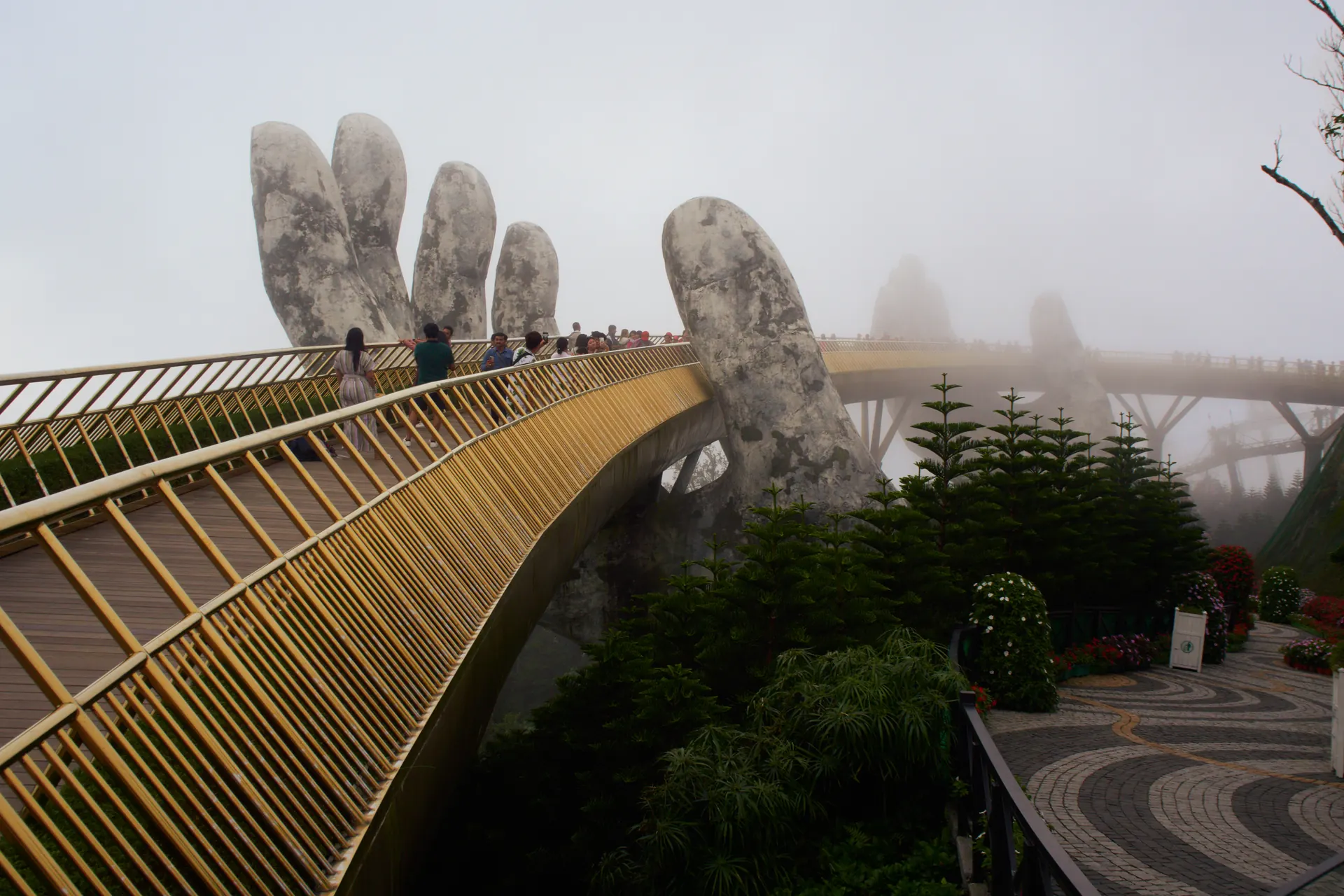
The Golden Hand Bridge, Cầu Vàng in Vietnamese, is a pedestrian walkway on Ba Na Hills west of Da Nang. A gold-railed deck loops along the mountainside, and two enormous weathered hands seem to lift it out of the forest. The bridge opened in June 2018 and quickly became one of the most photographed structures in Southeast Asia.
Editorial note: F1 Composite had no role in this project. This article explains the materials publicly reported for the bridge and credits the original teams.
The bridge in numbers
| Item | Reported value |
|---|---|
| Location | Ba Na Hills, Da Nang, Vietnam |
| Opened | June 2018 |
| Length | 150 m, in eight spans |
| Width | 5 m: a 3 m walkway between two 1 m planting beds |
| Elevation | About 1,400 m above sea level (1,414 m per the city portal; some reports say over 1,000 m) |
| Designer | TA Landscape Architecture, Ho Chi Minh City |
| Owner and operator | Sun Group, Sun World Ba Na Hills |
The deck sits on seven pillars and two abutments: steel pipe piers on reinforced concrete foundations, according to the city's tourism portal. The walkway has a timber deck and gold stainless steel handrails.
What the hands are made of
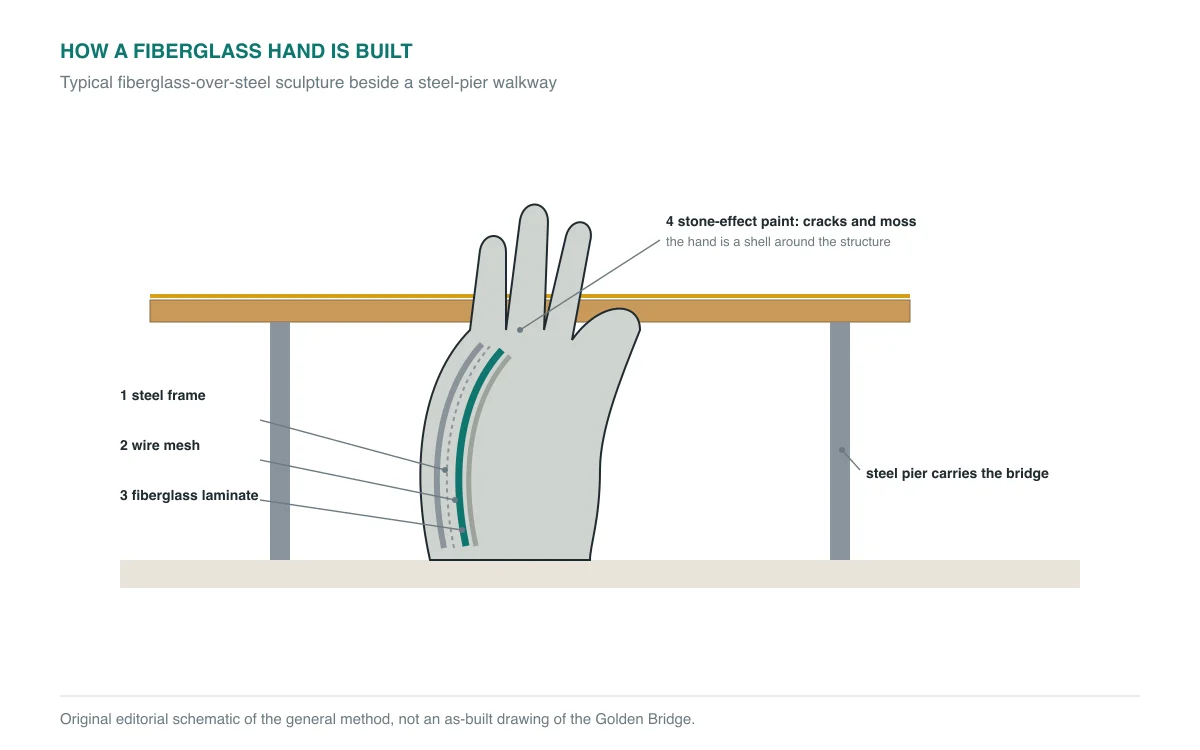
The hands look like carved stone, but they are a sculptural shell. The designers and the city portal describe a frame of steel with wire mesh shaped over it, finished with fiberglass and then painted with cracks and moss to look aged. Dezeen and Wikipedia report the same construction. One Reuters report, reprinted by The Irish Times, called the hands concrete; we found no technical source that confirms a concrete shell.
The important point for anyone studying the structure is that the hands do not carry the bridge. The steel piers do. The hands wrap around the structure as decoration, which is why a lightweight shell over a steel frame makes sense: it gives a large, durable sculptural surface without adding much weight to the mountainside.
How fiberglass-over-steel sculpture is usually built
Large outdoor sculptures and theme-park rockwork are often built in the same general way. The steps below describe the typical method, not a record of this project.
- A welded steel frame is designed to carry the sculpture's own weight, wind and anchorage loads.
- Wire mesh, and sometimes foam, is shaped over the frame to form the surface.
- Glass fiber is laid up with resin over the form, or into molds taken from a model, and cured.
- Large pieces are made in sections; joints are ground, filled and sanded.
- A paint system gives the stone, moss or patina finish; outdoor work needs UV-stable coatings.
This is hand lay-up, a different composite process from the pultrusion F1 Composite uses for straight structural profiles. Both use glass fiber in a thermoset resin, but hand lay-up suits one-off three-dimensional shapes, while pultrusion makes constant-section members such as beams, tubes and grating bars. What is FRP explains the material family.
Why the bridge works as a design
The bridge is short and structurally simple, but the hands turn it into a landmark. The combination is typical of how fiberglass is used in architecture: the structure is designed conventionally, and the composite shell provides a shape that would be heavy, slow or expensive in stone or concrete. The same logic of a light composite skin over a proven structure appears in many FRP pedestrian bridges, where the deck or parapets are composite and the load path is designed by bridge engineers.
Visiting
Ba Na Hills is reached by cable car from the foot of the mountain. The resort reported nearly 4 million visitors in 2018 and about 5 million in 2019, according to VnExpress. Check the operator's site for current tickets and opening hours.
Golden Hand Bridge questions
Are the hands of the Golden Bridge real stone?
No. Most published accounts, including the designers' and the city tourism portal, describe a steel frame and wire mesh finished with fiberglass, then painted with cracks and moss to look like old stone. One news report described them as concrete.
Do the hands hold the bridge up?
No. The deck is carried by steel piers on concrete foundations. The hands are decorative and wrap around the structure.
How long and how high is the Golden Bridge?
It is 150 m long and 5 m wide. Sources give its elevation as about 1,400 m above sea level (the city portal says 1,414 m), while some outlets say over 1,000 m.
Who designed the Golden Bridge?
TA Landscape Architecture of Ho Chi Minh City, for Sun Group's Sun World Ba Na Hills resort. It opened in June 2018.